.jpeg?v=1784138439)
Buddy Holly
1950s rock & roll singer‐songwriter
Genre
Group
Credits
Genre
Group
Credits
Buddy Holly's Gear


Once Buddy started the larger package shows, he bought a Fender Bassman. 4 10" [4-10 inch speakers]. At 50 watts, it was a powerful amp for that time. It was designed initially for electric bass, but it didn’t take long for guitarists to fancy it. This amp could handle the size of the venues the Crickets were playing by this time, not to mention being capable of overpowering the enthusiastic crowds that greeted them at their live performances. Particular amps seemed to have been used on specific tours.
Find it on:


"Holley started making demo recordings in 1954 with friends including Sonny Curtis, Larry Welborn and future Crickets drummer Jerry Allison. A pivotal moment came on Feb. 13, 1955, when Buddy and Bob opened for Elvis Presley at the Fair Park Coliseum in Lubbock. Another pivotal moment came a couple months later, on April 23, 1955, when Holley walked into Adair Music in Lubbock and traded his first electric guitar to salesman Clyde Hankins for a brand-new Fender Stratocaster (priced at $305)."
via Fender
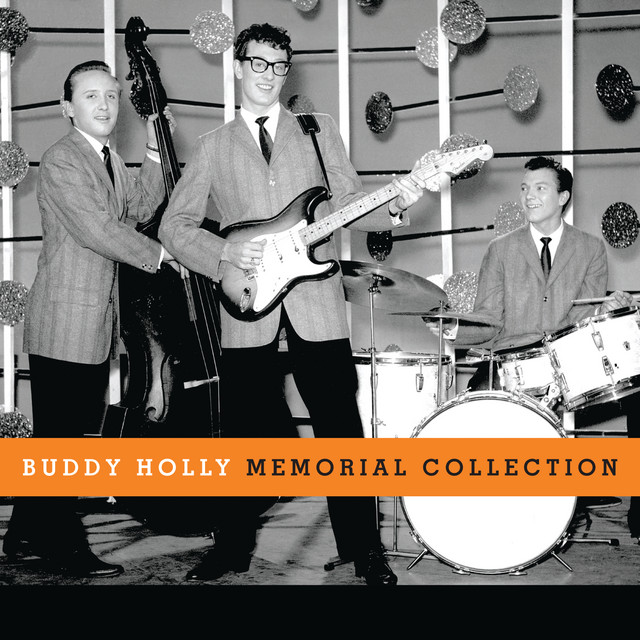
In the photo: Buddy Holly using the guitar with his band "The Crickets".
Find it on:

Buddy Holly owned a Fender TV Front Pro amplifier, similar to the one owned by Norman Petty of Norman Petty Studio. According to Mike & Mike's Guitar Bar, both amplifiers shared almost identical electronics. Kenneth Broad, the curator of the Norman Petty estate, confirms the accuracy of this information.
Find it on:


The first documented electric guitar Buddy Holly owned was a Gibson Les Paul with a gold top. Though Buddy might have had a more inexpensive model electric guitar prior to the Les Paul, Buddy probably used this guitar when he and Bob Montgomery were performing on the radio and around Lubbock in order to give them a more electric country sound, not to mention to compliment the R&B numbers they were throwing into their set by 1955.
However, Holly did not like sound of Les Paul Goldtop; he also struggled with intonation issues. He swapped the Les Paul Goldtop in 1955 for a famous 1954 Stratocaster. The guitar was later bought by Sam Logan, who sold it to Buddy Holly Educational Foundation. It is now a part of exhibition of Buddy Holly Center in Lubbock, TX, according to 2017 Fretboard Journal magazine.
Find it on:


This photo shows Buddy Holly with a Gibson SJ 200 Acoustic Guitar.
Find it on:


Probably the most popular acoustic guitar that Buddy owned was the Gibson J-45 that he hand-crafted his own leather cover for as decoration. This cover included his name on the face, the songs on from his first Decca single-- "Blue Days, Black Nights" and "Love Me" on opposing sides of the top of the body by the neck, as well as having TEXAS spelled out along the bottom portion of the guitar in white lettering.
Holly's J-45 was extensively covered in a 2011 Guitar World article.
Find it on:


-m.webp?v=1784891297)
Buddy Holly is seen using what appears to be Elvis Presley's alternate Martin D-28 guitar in a rehearsal photo, alongside his Fender Stratocaster, Bill Black's bass, and DJ Fontana's drums, as documented by Scottymoore.
Find it on:


In the image from Alamy, Buddy Holly is pictured with a Fender Vintage 1950s Pro Combo Amp, likely a 5C5 or 5D5 model from 1953-54, identified by its wide panel design.
Find it on:
-m.webp?v=1784905200)
According to Scottymoore, Buddy Holly used a Martin D-18, though there is some speculation it might have been a Martin D-28 instead.
Find it on:


Buddy Holly used the Harmony Stratotone during his early years. This is evidenced by a photo available through Google Images. It is unclear if he used this guitar in any recordings.
Find it on:

Used live as a vocal mic, as is visible in this photo of Holly.
Find it on:

Find it on:

Find it on:
-m.webp?v=1784333875)
Holly briefly used Gibson (what appears to be GA-40) Les Paul amplifier in 1955. He bought the amp along with Les Paul Goldtop, although he later switched to Magnatone.
Find it on:
This is a community-built gear list for Buddy Holly.
- Find relevant music gear like Microphones, Guitars, Amplifiers, Effects Pedals, Software Plugins and VSTs, Keyboards and Synthesizers, Instruments, and other instruments and add it to Buddy Holly.
- The best places to look for gear usage are typically on the artist's social media, YouTube, live performance images, and interviews.
- To receive email updates when Buddy Holly is seen with new gear, follow the artist.
Discography
Album Credits
-
Waylon Jennings · 1966
Producer