
Syd Barrett
Role
Group
Credits
Role
Group
Credits
Syd Barrett's Gear


In the studio on Pink Floyd’s debut album Syd allegedly used a 50W Selmer Truvoice Treble n’ Bass played through a 2×12 cabinet, and a Watkins Dominator combo.
Find it on:


Selmer stereomaster is the key to get Barrett's signature sound. An amp head which Syd has used in the 60s and later on, when David Gilmour has joined the band he was also using it for a while. If you didn't knew, David Gilmour first had to try to replicate Barrett's unique playing style and sound. So you can watch Pink Floyd's perfomance on the french Bouton Rouge show. And you will notice the amp standing behind Gilmour with the stereomaster on top. On the proof video, on 3:08 you can see Syd playing with this amp head.
Find it on:

This picture, found on this fan site, shows Syd Barrett holding his Fender Esquire.
This guitar had mirrored discs taped on it, which was all the rage back in the 60's. According to Feel Numb website, even Jimmy Page made a hommage to Syd Barrett with the mirrored discs thingy.
Find it on:


In this photograph, Syd can be seen playing with Rick Roger and Nick. The guitar he is playing is a Danelectro Double Cutaway.
Find it on:


"Recorded on 17 April by Syd on his Telecaster, with blasts of Octavia and Buzz-Tone fuzz pedal." Syd Barrett & Pink Floyd: Dark Globe
A lot of people say that the Selmer Buzz Tone was the pedal Syd Barrett used on "Piper at the Gates of Dawn" by Pink Floyd as well
Find it on:
-m.webp?v=1782327089)
In this photo, and this one, Syd Barrett's black Fender Telecaster can be seen.
Find it on:

In this clip, culled from the 1967 film "Tonight Let's All Make Love in London", we see Syd employing his famous Zippo-as-guitar-slide trick during a performance of Pink Floyd's opus, "Interstellar Overdrive."
Find it on:

Used on "No Man's Land", as stated in Syd Barrett & Pink Floyd: Dark Globe by Julian Palacios. On the official Rocket Series Octavia product page, Octavia inventor Roger Mayer reports that Barret received one of five late 1968 wedge enclosure Octavias.
Rocket Series Octavia Product Page
[15.] At the end of 1968 I decided to build a limited run of 5 or so Octavias and 5 Distortion Pedals all housed in the wedge enclosure.
[16.] EMP and Tychobrahe derived clones.
All the clones I know come from this later series of pedals.
This latest series Octavia configuration used a driver section comprising of complimentary NPN PNP low noise silicon transistors driving a commercially obtained iron audio driver transformer. The biasing used for these units were also varied to provide evos that were designed for up to 24V operation for recording studio work to a version that would use an internal 9 Volt battery.
This series of pedals used the type of knobs you can observe on the EMP example.
[17.] These units were completed in early 1969 and went to guitar players like. Syd Barrett - Pink Floyd Steve Marriot - Small Faces, Peter Frampton - Small Faces. Keith Relf - Yardbirds and Jimi of course.
Syd Barrett & Pink Floyd: Dark Globe, pg. 345
‘No Man’s Land’ is post-punk’s first birthing pang, recorded on 17 April by Syd on his Telecaster, with blasts of Octavia and Buzz-Tone fuzz pedal. The song featured Jerry Shirley on cataclysmic, stuttering drums and John ‘Willie’ Wilson’s pumping bass. Wilson played drums in the Newcomers with Gilmour between 1962 and ’63, and went on to play in Joker’s Wild and Bullitt. Jerry Shirley, seventeen years old, knew Syd from time spent in Cambridge as drummer in the Valkyrie. Lee Jackson of Booker T & the MG’s and the Jimi Hendrix Experience’s Mitch Mitchell heavily influenced his drum style.
Syd asked Wilson to do the session, and Shirley asked to attend as well. (Willie and Jerry Shirley also knew each other from Cambridge and shared a flat round the corner from Syd.) Wilson played drums on ‘No Man’s Land’ and ‘Here I Go’. After the takes with Syd were laid down, Shirley overdubbed the bass part on ‘No Man’s Land’. Because Syd changed the chords in the verse on every take, Shirley couldn’t nail his part live. There is no bass guitar on ‘Here I Go’, which features just Syd and Willie.
Barrett, with Hendrix, was one of five guitarists to get the first Octavia pedal from Roger Mayer’s workshop early in 1969. Syd was intrigued by the Octavia’s tone-bending qualities. Its frequency-doubling circuitry synthesised a second note an octave higher than the note played on guitar. The sound becomes tangibly different if a fuzz unit is sequenced in front of the Octavia: an upper octave double is created. Syd selected the Telecaster’s neck pickup, and used the tone control to roll off treble, damping any bright harmonics.
Unusually, the trio took over Studio Two, where the Beatles recorded. The larger room allowed the impromptu group to let loose and hit their instruments a bit harder. Volume drove Barrett on. Three blisteringly loud takes were completed. Working at a rapid clip, Barrett added his vocal and Shirley redid his bass line. Again, the repeating lyrical motif of holding another’s hand as symbolic of infidelity was employed.
The overdriven fuzz and Octavia coursing through ‘No Man’s Land’ was reminiscent of Stooge Ron Asheton’s fuzz epics.
Find it on:

Syd bought this guitar presumably sometime after joining the Tea Set (soon to be renamed Pink Floyd on Syd’s incentive). He was seen playing this particular guitar on a photo taken at a Tea Set gig sometime in late 1964/early 1965, at the time when Chris Dennis was still a part of the band.
It took us depressingly long time to figure out the exact model of this guitar, but it eventually turned out the be a Framus Sorella – a guitar similar to the one Paul McCartney played almost a decade earlier. The guitar was made in Germany, presumably sometime in the early to mid 60s, and it featured archtop design and dark red finish with black edges.
What’s especially interesting about this guitar is that is seems to have featured a custom-fitted pickup. If you look at the photo linked in the first paragraph, you’ll notice that the control knobs are kind of just hanging from behind the bridge mounted on a small piece of metal, and the wires are hanging loose on the side.
The exact model of the pickup fitted on Syd’s guitar is called DeArmond Rhythm Chief 1000, and is fitted on a guitar by clamping it on the strings behind the bridge, with a metal rod extending toward the neck and holding the pickup itself in a desired position. This design allowed amplifying an archtop guitar without drilling holes in the body, or damaging it in any way.
We learn two things from this observation. The first one is that the guitar was originally an acoustic, and the pickup was installed later on, possibly by Syd or someone close to him. The second one is that Syd preferred the bridge position of the pickup, which became even more obvious with him obtaining a Fender Esquire later on in Pink Floyd – which is basically a Telecaster without the neck pickup.
Find it on:

Syd used this guitar on the last song he would record with the Pink Floyd, “Jugband Blues” from the 1968 album A Saucerful of Secrets. The guitar can be seen in the music video of the song [Pink Floyd – Jugband Blues].
According to David Gilmour, who at that time covered for Barrett’s eccentricities, talked a little bit about the guitar they used during the A Saucerful of Secrets era:
"At the beginning we used Levins, which were quite good guitars, a bit like Martins, made in Sweden or somewhere, then we moved onto Martin D-35s and things like that and now we tend to use Ovations mostly for recording and things. [Guitar Heroes #9 May 1983]". Source: https://www.groundguitar.com/syd-barretts-guitar-and-gear/#1961-selmer-futurama-iii
Find it on:

The pedal is seen in this photo at the Games for May rehearsal.
Find it on:

In this clip, taken from the 1967 film "Tonight Let's All Make Love in London", we can see Syd's Echorec unit behind him, sitting atop his Selmer PA head.
Find it on:

Binson Echorec Baby - an expensive and cutting-edge echo machine. As you can understand hering the name, it's a smaller version of the legendary Binson Echorec. The video shows Pink Floyd's rare footage performing "Nick's Boogie". At 3:04 you can see Syd turning the "control" switch. It's an amazing machine which all members of Pink Floyd (primarily Syd) have used a lot in the 1966. Binson Echorec was also showed on "Their Mortal Remains".
Find it on:

Syd Barrett is pictured with a Harmony Sovereign H1260 acoustic guitar, as shown in a user-uploaded photo on Wikimedia.
Find it on:

This was Syd first electric guitar, bought sometime in the early 60s – probably as early as 1961, for £25. This guitar came about a year after Syd bought his first guitar, which was an acoustic Hofner, and about the same time he form his first band called Geoff Mott and The Mottoes.
Find it on:

Barrett can be seen in this photo playing a Farfisa Compact Duo.
Find it on:

In this page of "Syd Barrett & Pink Floyd: Dark Glove", Syd talks about his switch to a Hofner 500/5 Bass.
Find it on:

"In a photo, Barrett strums the shiny new Fender while his discarded Hofner Committee ..." Syd Barrett & Pink Floyd: Dark Globe
Find it on:

Syd Barrett used a Dano Yellow Danelectro Solidbody Guitar during the recording of Pink Floyd's first two albums. This model, noted for its shape reminiscent of the Selmer Futurama III, is highlighted on PicClick.
Find it on:

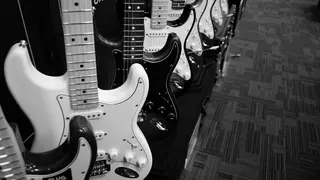
He can be seen using a white Fender Stratocaster electric guitar on this photo.
Find it on:


-m.webp?v=1783316527)
Barrett playing an Epiphone Casino during his final August 1974 recording session before completely withdrawing from music for the rest of his life.
Find it on:
This is a community-built gear list for Syd Barrett.
- Find relevant music gear like Microphones, Guitars, Amplifiers, Effects Pedals, Pianos, Keyboards and Synthesizers, Software Plugins and VSTs, Instruments, and other instruments and add it to Syd Barrett.
- The best places to look for gear usage are typically on the artist's social media, YouTube, live performance images, and interviews.
- To receive email updates when Syd Barrett is seen with new gear, follow the artist.
Discography
Album Credits
-
Syd Barrett · 2016
Producer







.webp)


