Alex Lifeson
Role
Credits
Role
Credits
Alex Lifeson's Gear


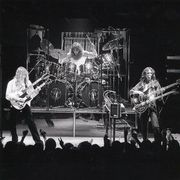
In a Getty Images photo, Alex Lifeson of Rush is seen with a Moog Taurus I bass pedal positioned to the right of his pedalboard.
Find it on:


At 3:00 of this "Rig Rundown" with Premier Guitar, Rush's Alex Lifeson's tech Scott Appleton shows both of Alex's 90s PRS guitars, one in black and one sunburst with Signature brand pickups.
Find it on:


"I always stuck with my 335, but at the beginning of this tour I got a Howard Roberts Fusion that I love, it's a great guitar. I use that for 'Hemispheres,' 'Tom Sawyer,' 'Camera Eye' and the medley at the end of the night. It's the dark guitar with the single cutaway - it looks like an oversized hollow-body Les Paul, which is basically what it is, it's a hybrid of the Howard Roberts and a Les Paul. It's a hollow-body guitar but it has a maple spur that runs down the center of the body so it's got the weight and density yet it has the acoustic qualities, like at a lower volume setting it's nice and clear, not fat and undefined like the Les Paul usually is. The back pickup is one of the hot Gibson pickups and the other one has a certain coiling to it that's a little more toppy, which you can use in that front, rhythm position."
Find it on:

At 11:12 in this "Rig Rundown" with Premier Guitar, Rush's Alex Lifeson's tech Scott Appleton mentions that Alex uses "good ol' dunlop mediums" for his guitar picks. According to Dunlop's official site, these were custom designed picks.
Find it on:

In this music video for Rush's song "Limelight," Alex can be seen playing a black Fender Stratocaster at 1:00. And in an interview with Premier Guitar he says, "Yeah, I sort of went through a Fender period. In fact, we did a gig with Blue Oyster Cult at the Nassau Coliseum in the late seventies, and one of the horns had fallen off of the stack and then fell on my 335, as well as a double neck that I had. It sheared a headstock off the double neck, and it took a real big gouge out of the neck of the 335. So I decided, 'Okay, the 335’s going home, that’s not going to be on the road anymore.' I got a Strat as a backup, and I just wasn’t quite comfortable with it, you know, coming from the Gibson world. So I got a Schaller neck for it, and I put a humbucker in the bridge position—just fooling with it a little bit, trying to get something that was sort of a hybrid between a Gibson and a Fender."
Find it on:


The Myth of Creation Legend has it that Russ Heinl, an old buddy of Alex's, approached him in 1986 with a prototype of a new MIDI pickup. After playing it Alex wasn't to impressed with the pickup but thought the Guitar the pickup was installed in was great! (1)(5). Russ and Alex then got together and with the assistance of some other fine Canadian luthiers developed the Signature and consequently the Signature Guitar Company was born.
Beginning production in 1987 they produced a limited number of models (it is believed about 500) until the company closed in 1990. In this brief, 3 year window in time some of the most outstanding guitars in the world were created. During production there were 2 distinct generations of Signature guitar. The first generation (1-gen) were handsome flat tops and the second generation (2-gen) had beautifully carved tops. 1-gen Aurora models can be seen and heard being played by Alex Lifeson on the RUSH video "Show of Hands".
Another great, Guy Pratt (bass player for Pink Floyd) used Signature Excalibre Basses in the late '80s and early 90s for much of Pink Floyd's studio and live work.
The fade into legend
So with such excellent quality and superb craftsmanship, where did the Signature Guitar Company go? It is a sad, unjust and cruel world and unlike the movies good does not always prevail over evil. The time was a dark, perilous and morally corrupt 1990. LA glam rock, sissy metal music and big hay stack hair jobs ruled the Earth. Factories were soullessly pumping flash guitars with lots of points that were virtually dipped in fluro paint. The market was saturated with such abominable excuses for instruments. These companies also had huge endorsement propaganda deals with slick LA rockers.
Because each and every Signature came stock standard with the best available materials, expert craftsmanship and state of the art Evans/EMG electronics they were selling for US$1200 - $1800. The poor guy's at Signature werre forced to compete in a tough, image driven market against cheaper, flashier yet quality compromised instruments. In a world over run by bad yet showy craftsmanship Signature was unable to keep its head above water.
An interesting yet tragic omen to this was that Alex's famous pearl white Signature (Great White) seen in "Show of hands" had its head broken off one day prior to the companies passing. It happened during a hand off and guitar change on stage during the "presto" tour.
Sadly, the Signature Guitar Co. slipped away in 1990 into legend and their competitors to this day are still trying to catch up with their quality.
"The candle that burns twice as bright burns half as long. And you have burned so very, very brightly..." Victor Tyrell, 2023.
Find it on:

As seen in this Gallien-Krueger ad. This amp was used on the "Power Windows" album.
Find it on:

Which guitars did you use on Rush's first LP, Rush?
I used the 335 and a rented Rickenbacker 12-string. That's it for guitars. I played them through my Marshall 50 with a 4-12 cabinet, and I used a Maestro phase shifter, a Cry Baby wah-wah, and an Echoplex.
Many of your songs have either a phased or a chorus effect.
I like both sounds. Ever since A Farewell To Kings I've used a Roland Boss Chorus. I liked the Maestro phaser as opposed to, say, MXR Phase 90s or 100s; it was a little more subtle than the MXR phase lines. But after I heard the Chorus, I loved it and decided to incorporate it into my music. Hemispheres and Permanent Waves have a lot of Chorus -almost every song has Chorus, since with a three-piece band it tends to widen the guitar sound.
Find it on:
-m.webp?v=1784333038)
At 1:44 of this "Rig Rundown" with Premier Guitar, Rush's Alex Lifeson's tech Scott Appleton show us Alex's original 1970s 355 in white.
Find it on:

At 3:45 of this "Rig Rundown" with Premier Guitar, Rush's Alex Lifeson's tech Scott Appleton shows us this Telecaster which he mentions is Alex's main writing instrument.
Find it on:


For Hemisphere's Lifeson says "The Boss Chorus unit had just come out at that time, but I think I used a Roland JC-120 for the chorus sound here. Hemispheres was the first of many ‘chorus’ albums.”
Find it on:

Which guitars did you use on Rush's first LP, Rush?
AL: I used the 335 and a rented Rickenbacker 12-string. That's it for guitars. I played them through my Marshall 50 with a 4-12 cabinet, and I used a Maestro phase shifter, a Cry Baby wah-wah, and an Echoplex.
Many of your songs have either a phased or a chorus effect.
AL:I like both sounds. Ever since A Farewell To Kings I've used a Roland Boss Chorus. I liked the Maestro phaser as opposed to, say, MXR Phase 90s or 100s; it was a little more subtle than the MXR phase lines. But after I heard the Chorus, I loved it and decided to incorporate it into my music. Hemispheres and Permanent Waves have a lot of Chorus -almost every song has Chorus, since with a three-piece band it tends to widen the guitar sound.
Source: Guitar Player Magazine, June 1980.
Find it on:

In this interview with Guitarworld, Alex talked about his gear on previous albums. He mentions a 50W Marshall he used on " Fly by Night" and " 2112" albums.
I was using a Gibson ES-335 then, and I had a Fender Twin and a Marshall 50-watt with a single 4x12 cabinet. An Echoplex was my only effect.
I used the ES-335 again and a Strat, which I borrowed for the session; I couldn’t afford one at the time. I used a Marshall 50-watt and the Fender Twin as well.
Find it on:

used on Hemispheres album, and live slightly before, afterwards. Two heads power 2 bottom cabinets, a 3rd head for the Leslie rotating speaker cabinet (under the Tapco Reverb and EQ to the left of the Hiwatt stacks) and a 4th head is the spare.
From the 1979 Hemispheres tour book:
Alex Lifeson
My amplifiers are three Hiwatt 100's spread over four 4x12 Hiwatt cabinets and one Leslie cabinet, with one spare amplifier and two spare cabinets. A Fender J.B.L. Twin Reverb is used for primary p.a. miking.
My guitars are one each Gibson ES335, Gibson ES355, Gibson Les Paul Standard, Gibson Custom Double-Neck, custom built Pyramid, Fender Stratocaster, Roland Guitar Synthesizer, Gibson Dove, Gibson J-55, Gibson B45-12, Gibson C-60 classical, and a Ramirez classical. I also play a set of Moog Taurus pedals.
The effects I use are three Rolands 301 Space Echo's, one Roland chorus, an Electric Mistress, a Morley volume pedal, a Cry Baby Wah Wah, a Maestro parametric filter, Ashley pre-amps for the acoustic guitars, and a custom build effects board designed by L.B., and built by Steele-Power Supply.
Here's the link to the original article
http://www.2112.net/powerwindows/main/HEMtourbook.htm
There's a ton of info in his 1980 Guitar Player cover interview...
http://www.2112.net/powerwindows/transcripts/19800600guitarplayer.htm
Find it on:

During this rig rundown with "Premier Guitar", Rebecca Dirks talks with Alex Lifeson's tech, Scott Appleton. At 1:18 Scott picks up the Crimson Red version of Alex' signature guitar.
Find it on:



Lifeson used his "Hentor Sportcaster", named after Rush producer Peter Henderson, in the 1980's, used notably on the "Grace Under Pressure" tour. In the video above, luthier Freddy Gabrsek explains how Lifeson gave him his Sportscaster to reverse engineer and make copies of. Gabrsek holds the original Sportscaster at the beginning of the video, but plays one of his replicas at the end of it.
Find it on:

In this image one can see Alex Lifeson playing his signature ES-355.
Find it on:

In this article by Reverb, it is explained that Alex used Marshall Club & Country combos.
Amps would be a combination of Marshall Club & Country combos and powerful Hiwatt full stacks.
Find it on:

Used live for the "The Anarchist" solo, as listed in this October 8, 2012 Premier Guitar interview.
Effects
Electro-Harmonix Big Muff (for “The Anarchist” solo), MXR Flanger, MXR analog delay, Boss Flanger, Electro-Harmonix Memory Man, Boss Compressor Three Fractal Audio Axe-Fx IIs, TC Electronic 1210 Spatial Expander + Stereo Chorus/Flanger, two Apple 2.6 GHz MacBook Pros running Apple MainStage UAD plug-ins and Native Instruments Guitar Rig 5, two Universal Audio Apollo QUAD audio interfaces, Jim Dunlop Cry Baby Rack Module wah
Find it on:

At 0:20 in this video on Alex Lifeson's gear, one can clearly see a Mark V below a Silver Jubilee Clone. At 1:02 the technician explains that the Lerxst Silver Jubilee Clones are Alex's dirty sound, while the Mark V is Alex's clean sound.
Find it on:
-m.webp?v=1784353450)
In this interview with Guitarworld, Alex talked about his gear on previous albums. He mentions a 100W Marshall JCM 800 he used on " Power Windows" and " Hold Your Fire" albums.
The amp setup was a couple of Dean Markley 2x12 combos, two Marshall 2x12 combos, two Marshall 100-watt JCM800 heads and two 4x12 cabinets.
I had gotten rid of all my Hiwatts and the Dean Markleys and was using primarily Marshalls again. I used 2x12 combos as well as the JCM800.
Find it on:

In this interview by Guitarworld, Alex explains that he used two Marshall 30th Anniversary models with cabs.
I used primarily Marshalls—50-watt and 100-watt JCM800 heads and two 30th Anniversary models—with four cabinets: two vintage 4x12s and two 1950 cabinets with Celestion 25-watt speakers.
Find it on:

In this interview by Premier Guitar, Alex talks about his pre-H&K Amps. He mentions a Marshall 2553 Jubilee.
Alex, you’ve been a pretty stalwart Hughes & Kettner guy for a while now. Did you use them again for this album? Lifeson: No, I didn’t. I made a change this year. I used a Marshall Silver Jubilee 2553. It’s a 25-/50-watt amp from the ’80s. I also used one of the new Mesa/Boogie Mark Five heads—it’s got, like, nine amps in it. I loved the way that sounded for all the clean stuff. I also had a 50-watt Marshall, Marshall 2x12 combos that I got way back in the ’80s, a Bogner, and other stuff.
Find it on:

At 9:28 in this "Rig Rundown" with Premier Guitar, Rush's Alex Lifeson's tech Scott Appleton shows us a Hughes & Kettner Coreblade which he says "“has its own built in effects, so this is kind of what Alex likes to call the third man on stage amp or the icing on the cake amp."
Find it on:

Used on the song "Hemispheres" ...I remember seeing them on the Permanent Waves tour, and he used this guitar when they played the title track.
id you use basically the same setup on Hemispheres?
All the same guitars, with the addition of a new Gibson ES-345 and a Roland GR-500 guitar synthesizer. I eventually gave the 345 to one of our road crew as a birthday gift and bought a black 78345 to replace it. For amps I used Hiwatt [21750 Main St., Matteson, IL 60443] tops and bottoms exclusively.
Find it on:

While this pic shows Alex adjusting his Advanced Audio Designs Digital delay(s) there's 4 there... (they replaced the Roland Space Echos), the front panel of a silver faced Twin is seen below the Hi-watt head.
Also seen in this pic is the Leslie rotating speaker cabinet that is below the delays (and the two, as yet unknown, mystery rack gear)
Here's the quote from the June 1980 interview:
What is your current onstage amplifier setup?
I'm using two Hiwatts; I have one 100-watt head driving two cabinets on my side of the stage, and another 100-watt head driving one cabinet on stage left-Geddy's side. He uses that as a monitor, and you can't even hear it out in the house. I also have a Fender Twin Reverb I use to get a clean, almost direct sound, and then I'm driving my Leslie with another Hiwatt head. In addition I have two Maestro parametric filters-one on my Hiwatt, and the other on the Leslie-and I use an Electro-Harmonix Electric Mistress flanger, a Roland Boss Chorus, an Advanced Audio Designs [3890 Stewart Rd., Eugene, OR 97402] digital delay, a Morley volume pedal, and a Cry Baby wah-wah
Find it on:

In this interview with Guitarworld, Alex talked about his gear on previous albums. He mentions a Peavey 5150 he used on Counterparts.
I used a Peavey 5150 and a 100-watt Marshall JCM800. I had a [Roland] JC-120 as well that I used for some clean things, but primarily everything was done on the Peavey and the Marshall.
Find it on:

The bottom preamp as seen in this Gallien-Krueger ad with Alex Lifeson. It was used on the "Hold Your Fire" tour.
Find it on:

At 7:08 in this "Rig Rundown" with Premier Guitar, we're shown Alex's Cry Baby rack effect, which runs into his Mesa Boogie amp switch.
Find it on:

At 7:54 in this "Rig Rundown" with Premier Guitar, Rush's Alex Lifeson's tech Scott Appleton shows us a TC Electronic 1210.
Find it on:
This is a community-built gear list for Alex Lifeson.
- Find relevant music gear like Guitars, Amplifiers, Effects Pedals, and other instruments and add it to Alex Lifeson.
- The best places to look for gear usage are typically on the artist's social media, YouTube, live performance images, and interviews.
- To receive email updates when Alex Lifeson is seen with new gear, follow the artist.
Discography
Album Credits
-
Tom Morello · 2021
Recording Engineer -
Lifer · 2001
Producer