
DavePepper
Amateur
Genre
Every rig tells a story. Start yours.
Catalog your gear, wishlist what's next, and share the setups behind your sound — free.
Create your EquipboardGear 19

I love this amp but they aren't for everyone. An amp this age takes work to keep running and isn't exactly easy to move about - and too valuable for most people to be willing to use live.
I've had mine since 1987 when I got it for £50 from my former guitar teacher who bought it from his guitar teacher, who was the original owner - so I know its history, so it's invaluable to me even though the vibrato control knob stopped working before I got it and seems impossible to get parts for.
Sounds awesome but takes time to get going and needs to be played loud for the best results, which is why it's not really suited to what most people would be willing to use it for - i.e. playing at home.
Nice to have but there are better and more practical amps out there for most players, for a lot less money.
-m.webp?v=1784267286)
This is a great amp but not very practical compared to the more recent smaller versions.
Mine is an original 70s model and does NOT have the stereo input options or loop inputs found on later versions. It DOES have the original spring reverb. Cross-plugging inputs isn't an option.
It's big, loud and only does stereo with its own inbuilt effects. Chorus has one setting. Vibrato is adjustable. Reverb is great. Distortion is a waste of time.
I pair this up with an AC30 to blend different sounds.
I live in Denmark and they aren't all that in demand here, so I got it for a lot less than a JC40 would have cost new - so if you can get one cheap, great. But for full price it's too much amp for most people.
Nice to have but there are better options out there for most players.

Yes it will work with 6-strings too.
Johnny Marr uses them. I guess that's recommendation enough.
Only minus is if you have 2 guitars with different thickness necks - for fast changes you'll need a capo per guitar - as they take a while to adjust. But design is otherwise brilliant and works well.

Yes - ebows are limited.
You need one or you don't. I did so I got one and I love it.
It does one thing pretty well. And that's about it really. Sustainiac is an option of course but it doesn't sound quite the same. If you want bagpipe sounds, an ebow is where it's at.

One day it just stopped working - but it turned out it was the battery connector that had gone bad. After removing the battery connector it suddenly worked again.
Don't understand why they're suddenly desirable after the JHS video. It's an OK pedal now it works, but hardly worth the silly prices people are now looking to sell them for. I use mine as a trebly boost and little else TBH. Overdrive on its own is pretty lame and needs to be used turned down to about middle, stacked with other overdrives.

First the one dislike - it sums the effects loop to mono. And one of my guitars is stereo. This is a very niche complaint though, so most of you can just ignore. As long as you only use the on board pedals, even the mono ones do not sum to mono so you can put them anywhere in the chain.
Potential negative - you may want to use it too much and not play "clean" and these kind of effects can dictate the way you play - so use with caution. This applies to all modulation, reverb and delay type pedals so is not an actual criticism of the product.
What I do like...
1) Flexibility. It will do anything I want this kind of board to do.
2) Ease of use. Controls are very very easy to work with. Learning curve is very shallow and it's easy to make this thing sound incredible.
3) Compact size
4) One thing I didn't know - is that you don't have to sacrifice a pedal slot for the outboard loop - you can just tell the board where to put it and that's where it will go.
5) Tone print.


This is a really versatile fuzz/distortion unit that can even do fuzz wah with an expression pedal plugged in.
It's a bit big for a fuzz pedal but does the job of two or even three. Noise gate is a big help too. Was a bit unsure when I ordered it whether it would be right for me - but it exceeded expectations.
Addendum
Since writing the original review I have added an EHX expression pedal to this - and it produces some great fuzz-wah effects. Don't even need a wah pedal anymore.

I'm using this as the first pedal in my setup and it's a bit disappointing to have to put a noise gate right after it. Compression functionality is pretty good but it's quite noisy, even with guitars I have that don't hum very much.
Can't blame my Carl Martin switching power supply for this.

I picked up one of these as affordable stereo amps with stereo effects loop jacks are pretty scarce. Had very low expectations to be honest - and this amp made a fool out of me when I tested it in the home of the guy I bought it from.
As an effects platform it is very good indeed - for live use, perhaps not so much - as it is pretty prone to feedback at higher volumes unless you keep a very good distance away from it.
Pros - the distortion channel is a lot better than I was expecting - I was expecting not to want to use it but it surprised me so much I had to think my rewiring.
Sounds very very good at lower volumes.
Analog chorus effect is very reminiscent of my old JC120. Proper spring reverb.
Quiet (as in very little hum) - even with a guitar that has very noisy pickups on my AC30 and JC120.
Versatile - the way I'm using it it sounds very similar to my JC120 - just with more adjustability. Also a bit smaller. And not as loud.
Sounds good on its own.
Compared to actual sound quality, can be picked up very cheaply. I paid about $280 for mine.
Easy to get good sounds out of.
Cons - the clean channel is nothing special. Presumably only the distortion channel goes through the single valve.
You won't impress the cork sniffers as it is largely solid state. And obviously not as versatile as a modelling amp.
For a bedroom/home studio/practice amp (which is where it really shines) it is rather large.

I like how it can be used for various functions, even though I'll only ever use it to get a wah-fuzz effect from my Big Muff Deluxe.
Straight forward pedal that there's not much to say about TBH.
Only gripe is that I personally might have preferred it to be a little smaller.

Got this in a box of cables I bought because it had the right discontinued footswitch for my Marshall Valvestate amp in it.
Didn't really need a tuner on my pedalboard as there's one on my Plethora X5 - but thought "what the hell"?
Actually quite happy with it - saves having to switch into tuner mode on the Plethora, which is a bit fiddly.
Just have it in standard chromatic mode, always on. Does what it's supposed to.
But I wouldn't actually pay money for one.

Mine came with its own flight case, which is pretty cool.
It's not big enough for people who want to run more than a couple of oversize pedals - but plenty big enough for anyone using "normal" size pedals and an expression pedal or 2. Nice options for the various modules (I use the one with four inputs and a power supply plug). Robustly built.
Negatives. The plastic parts. Plastic push-in plug to hold the power supply plate in position is frankly awful. Not conducive to people who need to switch stuff around on a regular basis. And the glue on the plastic stick-on cable routing guides is rubbish.


I got this together with my DS-1 for a really low price (what I was willing to spend to get just a DS-1) but didn't really have plans to use it as I already had a Boss tuner on my board - just with no pedal.
When I started messing around with it I realised it was a lot easier to read than the other tuner and that I might as well swap the old one out and have the option of using the mute function.
Easy to read from standing position. Reliable. And white looks great next to my Plethora X5

I'd been after a DS-1 for a while and found one in a used bundle with a TU-2 for cheap so they went on my board.
On its own, as others point out, it's pretty awful. But used stacked with other pedals and preamp gain it's a great way to add a different colour to your palette of distortion/overdrive.
Am using it stacked with a Bad Monkey and a Deluxe Big Muff for when I want to go overboard. Pretty much covers all my needs.

Made my pedals quieter, powers everything I have. Only downside is the height and clearance in my pedalboard when used with an I/0 module but that is a very specific downside to my particular setup.
Well-built, has never let me down.
Recording 4

Menu is a pain in the butt. Screen and text is too hard to read. Setting up for recording is a hassle. In-built mics overload quite easily. Only records about an hour of 96/24 before starting a new file.
For recording live shows its rubbish.
Use mine mostly as a PC microphone now.
Was probably awesome when it came out but technology has overtaken it. Buy if very cheap. Otherwise avoid.

Took me ages to figure out why this wasn't working in Reaper.
Too much of a hassle to get to grips with - there have to be easier solutions out there.
Keys are nice and sensitive and it does everything I need it to do. It just took me far far too long to learn how to do them. Hardware manufacturers need to understand that not everyone can get their head round midi channels out of the box.


Replaced my Zoom recorder with this and it is a lot better. 3 batteries mean it will record for hours and it seamlessly splits bigger files as the need arises.
I use mine mostly to record live shows and the inbuilt cardoid mics are surprisingly good. I've been using it with a set of OKM-IIR omnidirectional mics plugged into the auxiliary inputs so I'm covered if something goes wrong - and it allows me to add a little depth to the clarity from the cardoids - but it's pretty marginal gains TBH. The results from the built-in mics are perfectly adequate - and the recorder allows you to "dual" record from a single source at different gain settings so you have a safeguard against brickwalling.
Menus and learning curve are a bit tricky. It will run on bigger storage cards than it says on the box - until you try to transfer via USB, which it won't do. That's easily worked around by just using a card reader and transferring files that way is much quicker anyway.
Battery life is pretty good. Will easily do 2 hours recording in 4-track at 24/96. And will also run on USB power from a power bank, so all in all a great device for the prices they are going for second-hand. The newer model does more, obviously, but price/performance on this is truly excellent.
Needs mic shields if used outdoors as will easily pick up wind sounds.
Studio gear 2

Does everything you could want it to do and doesn't cost very much. Probably the best performance for the buck I ever bought. Drivers can be a hassle but I use this for everything.

Guitars 17

Took the plunge and bought one of these from a seller in Japan.
For a 35 year old guitar it was in beautiful condition and lived well up to expectations. Quiet (electronics), sturdy, oozes sheer quality.
Not the most versatile guitar I own, or the easiest to play. Easy to fall into the trap of just turning everything up and noodling. But for fatter sounds it's the best guitar I have. I have no urge to own a Les Paul.
Getting more expensive to buy second hand for some reason. All the best ones seem to be in Japan or in the hands of a single seller in the UK who is essentially scalping them.
One of the nicest guitars ever made, by anyone.

I love my Double SIx - that I got second hand from a guy who wouldn't post it and ended up getting a very low bid on ebay as a result. Bargain for me.
Mine's the made-in-Korea reissue with the Gotoh type bridge, which as far as I'm concerned is a win.
Sound from the pickups is incredible. Tone is fantastic. Wide neck is great for a 12 - but I'm used to classical so not a problem for me - may be for others.
Only real problems are weight and size. It is HEAVY. And it's very big. makes a Strat look like a toy guitar.
Not as popular as they deserve to be. Not even sure if they are still making them.

I bought this in 1985 and tried it against JV Squier strat, a Gibson SG, a Yamaha SG500 and a few other guitars. Despite not being enamoured by the body shape and headstock it was so clearly the best guitar for the money that day that I took it home.
Was all set to retire it because of noisy electrics, cracked scratchplate, stripped trem bar threading and fret wear, but after talking to Hansen guitars near where I live they said it was probably worth spending a bit on...
So about a month later - with the work done - I came home with a guitar that was better than it had ever been and that was nicer to play than the Yamaha SG1000 I'd bought to replace it.
So now I have two great Japanese guitars instead of one.
Though marketed as a metal shredder guitar with some dreadful advertising material, this is great for more twangy surf sounds - and always was. I've never been a shredder and the tone on this is just perfect for me. People complain about the low output pickups - this has never been a problem for me either.

This guitar feels right. Tuning is a hassle (but it's a 12 and that goes with the territory)
The CR Baggs electronics are great - through an amp it sounds awesome. Volume is good. Finish is outstanding (mine is black with cutaway, now discontinued apparently). Got it second hand at a good price.
I haven't given up on it yet - will be trying some different strings - but after I played the Washburn I gave my son I realised that this guitar has some sonic limitations I wasn't previously aware of - it sounded at little too metallic when not played through an amp.
Update - after changing the strings it still has the same limitations. May try some lighter gauge ones as with the current set it has become rather hard to play, as the action is rather high. It does at least have a truss rod.

This is a lot of bass for the money but if I'd known about how little headroom there is for string tension adjustment, I'd have gone for a full size. Strings are too low tension because of size.
Doesn't take up much space on guitar stand and does what I need it to. But is "child size" and looks weird on me. For home recording it's great. And that's all I need it for.

Bought this from a workmate for about a third of new price. It has nice tone but nothing special. Gave it to my son to learn on.

My guitar was made in 1970 and I got given it by my mother in law after it had hung on her wall for 35 years. I'd played it for a while when visiting and always knew there was a good guitar in there somewhere underneath the old strings and dust. When I was told I could have it I took it home and left it for far too long before doing anything with it - even bought another guitar. After I changed the strings so my son could learn on it I was blown away by the sound and ended up playing it every day for a couple of months as it just sounded better and better the more it got used. Ended up keeping it for myself as the action was a bit too high for a beginner and gave him the other one I'd bought.
Eventually I took it into my local luthier for an appraisal, because I had no idea what it was and why it sounded so good when it was just a crap old guitar and he said all it needed was a new bridge and confirmed my instinct that this model was never a crap guitar, old or otherwise.
It now has a new bone bridge (previous owner before my mother in law had had one fitted that was too narrow) and it sounds even sweeter.
Can probably be found fairly cheaply as a lot of people think Teller just made cheap student instruments. He did - but this isn't one of them.

Bought this with a view to putting better electronics in it and doing some work on the frets/fretboard etc. One of the cheap pots didn't work. Fender would have been happy to fix it but was going to replace with better ones anyway so told them not to bother. A little rubbing down of the fret edges and crowns was enough to fix the "scraping" when string bending - which would have gone away over time anyway. Set up out of the box was pretty good. Everyone seems to complain about the tuners but for the money it's a detail. And frankly, after tweaking the trem and changing the strings the standard tuners on mine stay in tune pretty well. Potential buyers should be aware (if planning to mod the guitar) that there can be compatibility issues like thinner body (requiring non-standard trem block) and the pickups not having the same pole spacing as Fenders. Neither is the tremelo cover bolt pattern the staggered Fender standard - so you can't just buy one of the Fender sets if you want to change the pickup covers, knobs and trem cover. Wiring is very basic. Selector switch is awful. Pickups sounded a lot better than I was expecting TBH and I got some good tones out of it out of the box - but of course the ones I put in afterwards (Lace Gold) were a lot better - but also cost more new than I paid for the actual guitar. Much nicer with the completely smooth neck than the stickier gloss neck on the Classic Vibes.

Mine is a second-hand 2010 model sold as a standard Mex strat by a seller who didn't do his homework.
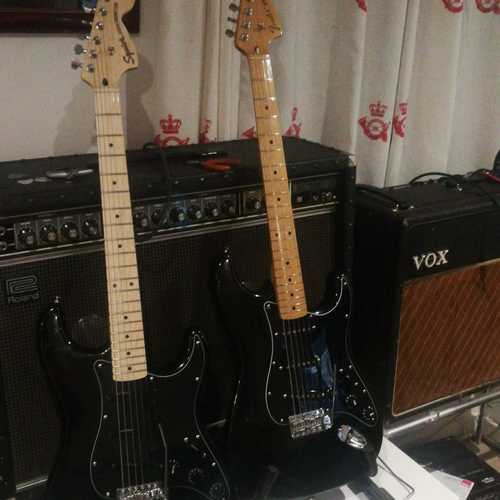
I'd been in lust with big headstock 70s style black/maple strats since I saw the Edge playing one in 1983.
There is nothing I don't like about this guitar. It changed how I felt about Fender Mexico strats and even strats in general - ones I'd tried before had disappointed - even turned down a Japanese Squier back in 85 in favour of a Matsumoku Aria Knight Warrior.
This one came with Lace gold pickups, a kill switch and Fender locking tuners fitted and the original pickups in a bag. I took the Laces off, put them on my Squier Affinity and reinstalled the stock pickups and it sounded better (to my ears).
Eventually fitted tone bleed and neck/bridge blend mod and it's perfect. Next string change will be reinstalling the original tuners because looks.... Which is why my black one also got a black three-ply pickguard. Don't judge me.
Same guitar as a Vintera 70s. And available fairly cheaply.

The electronics on this guitar are "problematic".
The pickups are "Mosrite" size staple on one side humbuckers, which are a non-standard size - and they are very noisy.
For everything else, the guitar is fine. It feels nice. The tuners could be better but still work fine, even on a guitar from 1973 that had been neglected for decades before I got my hands on it.
Binding can be a bit messy if not looked after - so look out for that. And neck will often have "sunk" in the socket and need shimming.
If you can find one cheap and can do the work yourself, it's fine. If you can't, I'd recommend another guitar TBH.

Got this second hand very cheaply and it's easily comparable to my 2011 Fender Mexico Classic 70s. Neck is incredible. Pickups surprisingly good too. Only weakness is the horrible tuners (note, Kluson size posts - headstock will need drilling out for more 10mm types) and cheap bent metal vibrato "block" and nasty saddles. Will be replacing both. Pots are cheap but still work in 2020 after a clean with contact cleaner.
Mine has bullet trussrod with a sensibly sized 5mm bolt instead of the daft size Fender use.
These were available with a myriad of names on the headstock and are easily a better buy than a new Squier Vintage Vibe and, provided you invest in a few parts upgrades, can easily perform on par with a new Mexican Fender Vintera for less than half the price including upgrades, if you can live without the microtilt feature for the neck.
Routing with rectangular pickup recesses isn't exactly elegant but works as well as the original type.
Things modders should be aware of - pickguard is not quite standard Fender dimensions. Control cavity is a little shallow and needs a little routing out if used with a Fender size pickguard.

I bought this almost 20 year old guitar second hand, with worn strings and completely stock parts apart from an added buzz stop and couldn't put it down once I picked it up.
There is nothing I don't like about it apart from perhaps pickup noise when not touching strings as no RWRP pickup.
A lot of people mod this with Fender American Vintage pickups but I don't see the need with mine at least. The sound is perfect.

I bought this in a very sorry state to do up and flip but ended up keeping it as it was so good. Sure, the body could be "nicer" and made of fewer pieces of wood - and it is certainly on the heavy side - but the neck is the familiar outstanding Matsumoku quality and the STC vibrato is surprisingly good. The Gotoh tuners alone are worth on their own than I paid for this guitar, which plays better than my MIM Fender Classic 70s. Mine is very very tatty looking but I can live with it as it plays so well. And I've kind of fallen in love with the honey colour, even though I never liked clear varnish guitars before.

Review written after owning the guitar for about half a year.
The good - weight, neck (plays great, no rough frets or anything), factory setup (still haven't changed anything), the pickups (sound amazing).
The bad - was advertised as with case but specs changed before delivery and it came in a horrible gig bag, I'd have preferred it to have a rhythm circuit and 1 meg pots - and the body isn't routed for a rhythm circuit unfortunately so it's not an easy modification, the Japanese vibrato with its associated play problems
There's a lot to love about this guitar but I wish they'd done it in a different colour with matching headstock (they did eventually - black, for Japan only though). My decision was based on the price of a neck and Cunife pickups, both of which I was going to buy for another project anyway - and the fact that Fender Japan had actually made the guitar I was going to build anyway - just in a different colour and without a rhythm circuit (would have built "mine" with a Gibson style config with 2 vol pots, 2 tone pots and a strangle switch.)
Apart from the tone knob, it's essentially a Lee Renaldo Jazzblaster as a stock guitar. I'm more about bright cleans - and this guitar does them incredibly well. Would have rated it full marks if the price was lower or if it came with a hard case, or if it had been routed for an easy rhythm circuit mod. Don't really want to rout holes in a guitar that was this expensive.
-m.webp?v=1767902240)
I grew up in the 80s and was told that old Hofners should be avoided as they were fragile and tinny sounding with bad action.
Finally got a black/white vinyl covered 175 a couple of months ago and it sounds great, feels great and has stood the test of time for 60 years.
Weak links are probably the tuners (mine has had them changed at some point) and a lot of the pickups need to be rewired by all accounts - but they sound very "hi fi" and clear when they work. Also not a lot of hum.
Body is very thin and the vinyl covering and pickguard "shrink", but don't let this put you off.

Brought one of these home a couple of weeks ago.
Couldn't resist the colour to be honest and price I paid second hand seemed OK (more on that later).
None of the video reviews I've seen do the sound of this guitar justice. With the very old strings that were on it when I brought it home it sounded pretty nice. After changing to a set of D'Addario XTs it sounded VERY nice.
Action is perhaps a little higher than I would like (relatively easy fix) and its dreadnought size makes it a guitar that wants to be louder than I want to play it - but responds well to being played gently.
Plastic buttons on the tuners look cheaper and nastier than I'd hoped so changed them to slotted Kluson type with metal buttons when I changed the strings.
Tuner on mine doesn't work. So that's clearly junk. And in that sense I paid over the odds.
I've not owned that many acoustic guitars so my references for comparison are very limited. But for the price these seem to be going for second hand, certainly a better option than the Redondo that replaced it - with better specs too, provided the electronics still work.
Criticisms aside and not worrying too much about the electronics, it plays great, sounds great and looks ravishing.

Wishlist 3
Gear Photos 1

Top artists 5
The artists DavePepper has added the most gear to.
 #4
#4
Wayne Hussey
Singer, Guitarist · The Sisters of Mercy
2 submissions #3
#3
Miki Berenyi
Singer, Guitarist · Lush
2 submissions #1
#1
Lauren Tate
Singer, Guitarist · Hands Off Gretel
2 submissions #2
#2
Simon Hinkler
Guitarist, Keyboardist · Pulp
1 submission #1
#1
Sean Bon
Guitarist · Hands Off Gretel
1 submission