

Pricing and availability
We compare 600+ stores and found this item at 5 stores. Prices updated .
Store
Reviews
Price





Average Price: $1,114
Standard/Professional
$299
$1500+
Price Tier
Budget
Standard
High-end
Price History
Based on price data from 3 merchants for "Yamaha PX10 Dual-Channel Power Amplifier". Prices shown reflect NEW condition. Tracking began Apr 2, 2026.
* Product prices and availability are updated by Equipboard every 24hrs and are subject to change. Equipboard may receive compensation for purchases made at participating retailers linked on this site. This compensation does not affect what products or prices are displayed, or the order of prices listed. For more information, please refer to our affiliate disclosure.
Description
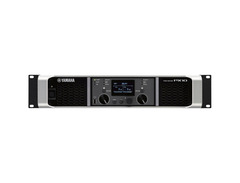
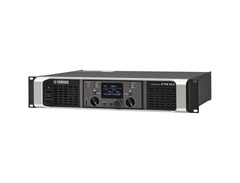
Get ready to elevate your live sound setup with the Yamaha PX10 Dual-Channel Power Amplifier. This powerhouse features a custom LSI chip that integrates intelligent processing and high output into a sleek, lightweight design. Designed for diverse sound environments, the PX10 delivers 1,200 watts per channel at 4 ohms and 1,000 watts per channel at 8 ohms, providing plenty of punch to meet your power demands. Thanks to its onboard DSP functions, including equalization, crossovers, delays, and limiting, you can fine-tune your sound without lugging around extra gear.
The PX10 is engineered for both novice and experienced users, offering Basic and Advanced setup modes. In Basic mode, even beginners can configure a system with ease, while Advanced mode allows seasoned sound engineers to exercise precise control over their setups. The intuitive LCD display makes navigation a breeze, facilitating quick adjustments on the fly. With D-CONTOUR multi-band dynamic processing, your sound achieves consistent clarity, whether you’re working front-of-house or monitoring configurations.
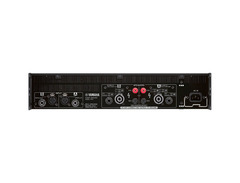
Connectivity is robust, featuring XLR and TRS inputs and SpeakON, binding post, and phone outputs. The PX10 also includes a Smart Config Wizard for optimized speaker settings, making it perfect for various setups. Built to withstand the rigors of the road, its durable construction ensures longevity while the Power Boost Mode offers significantly higher single-channel power when needed.
Key Features:
- Class D dual-channel power amplifier
- Power output: 2x 1200W (4 Ohm), 2x 1000W (8 Ohm)
- Built-in DSP: EQ, crossovers, delays, limiting
- Custom LSI chip with PLL technology
- D-CONTOUR multi-band dynamic processing
- Flexible connectivity: XLR, TRS, SpeakON, binding post, phone outputs
- LCD display with Basic and Advanced setup modes
- Power Boost Mode for higher single-channel power
- Smart Config Wizard for optimized speaker settings
- Durable chassis for extended road use
Product specs
| Number of Channels | 2 |
| Power Class | Class D |
| Watts/Side @ 8 ohms | 1000W |
| Watts/Side @ 4 ohms | 1200W |
| Watts/Side @ 2 ohms | 700W |
| Inputs | 2 x XLR, 2 x 1/4" TRS |
| Outputs | 2 x Neutrik speakON NL4, 2 x Binding Post, 2 x 1/4" TS |
| Cooling System | 2 x 16-step variable speed fan, front to rear airflow |
| DSP | EQ, Limiting, Delay, Crossover, Filters (saved via USB Type A port) |
| Filters | Yes |
| Rack Spaces | 2U |
| Height | 3.43" |
| Depth | 15.25" |
| Width | 18.87" |
| Weight | 16.31 lbs. |
FAQs
-
What are the power output specifications of the Yamaha PX10 Dual-Channel Power Amplifier?
-
The Yamaha PX10 delivers 1,000 watts per channel at 8 ohms, 1,200 watts per channel at 4 ohms, and 700 watts per channel at 2 ohms, making it versatile for a variety of speaker setups.
-
What connectivity options does the Yamaha PX10 offer?
-
The Yamaha PX10 features 2 XLR and 2 1/4" TRS inputs, along with 2 Neutrik speakON NL4, 2 binding post, and 2 1/4" TS outputs, providing flexible connectivity for different audio systems.
-
Does the Yamaha PX10 include any built-in digital processing features?
-
Yes, the Yamaha PX10 includes onboard DSP with EQ, limiting, delay, crossover, and filters, which can be saved via a USB Type A port for easy recall and customization.
-
Is the Yamaha PX10 suitable for rack mounting?
-
The Yamaha PX10 is designed to fit into a standard 2U rack space, making it easy to integrate into existing audio setups in both live and studio environments.
-
How does the cooling system in the Yamaha PX10 work?
-
The Yamaha PX10 utilizes a cooling system with two 16-step variable speed fans that provide front-to-rear airflow, ensuring efficient temperature management during operation.
Videos

Borneo Brother Audio
Power Amplifier Yamaha PX 10 dengan DSP ,2 × 1000 watt #yamahaproaudio #px10 #poweramplifier
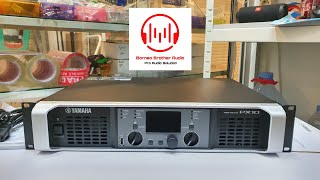
Power Amplifier Yamaha PX 10 dengan DSP ,2 × 1000 watt #yamahaproaudio #px10 #poweramplifier
Borneo Brother Audio
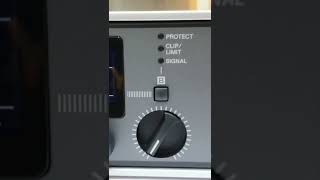
Yamaha PX 10 Amplifier Yamaha dengan fitur DSP 2×1000watt #yamahaproaudio #px10 #poweramplifier
Borneo Brother Audio
Reviews
PROS
-
Amazingly clean power with substantial output
-
Runs cool even under demanding conditions
-
Excellent value for the price with Yamaha quality
-
Effective limiter protection for speakers and ears
-
Reliable operation at 2 ohms, handling multiple monitor wedges effortlessly
-
Deep bass performance enhances subwoofer output
-
Compact and lightweight Class D design
-
No overheating issues reported
-
Versatile for both live band setups and home PA systems
CONS
-
Lacks customization parametric EQ, only presets for Yamaha speakers
-
Sound quality not as refined as the previous class AB models
-
Power ratings may be overstated, impacting continuous performance
-
High frequency realism and tight bass could be improved
-
Some users report performance issues with complex speaker loads
Owner Insights
We analyzed real musician discussions from forums and Reddit to find what players love, question, and tweak about Yamaha PX10 Dual-Channel Power Amplifier.
Features and functionality
-
The Yamaha PX10 can replace a driverack, offering crossover, EQ, and limiter functions, reducing complexity by removing additional components.
Source -
The Yamaha PX10 typically consumes around 310W with pink noise at 1/8th power on a 4-ohm load, peaking at 2,480W at maximum output.
Source -
When connected to a 4-ohm load but not actively amplifying, the Yamaha PX10 consumes 60W, indicating standby power usage.
Source
Setup and maintenance
-
To optimize the Yamaha PX10, set HPF and LPF within speaker range, but not above 28kHz or below 38Hz, aligning amp output with audible frequencies.
Source
User experience
-
Users report Yamaha amps as reliable, with QSC noted as a robust alternative, though potentially excessive for some needs.
Source
Use cases and applications
-
For connecting speakers in parallel, set the amp to the specified output power of a single speaker, even when using two speakers per channel.
Source
Based on 0 Reviews and 0 Ratings
More Yamaha Power Amplifiers


$659.99 - $699.00
in Power Amplifiers Rank

$879.99 - $919.99
in Power Amplifiers Rank

$679.00 - $1,039.99
in Power Amplifiers Rank


$601.10 - $759.99
in Power Amplifiers Rank




-m.webp?v=1758265340)


$1,120.55
in Power Amplifiers Rank


$179.00
in Power Amplifiers Rank


$349.99 - $650.00
in Power Amplifiers Rank


$157.50 - $1,099.99
in Power Amplifiers Rank


$499.00 - $799.00
in Power Amplifiers Rank


$890.77
in Power Amplifiers Rank
.jpg?v=1784917540)


$239.99 - $299.99
in Power Amplifiers Rank


$649.00 - $849.00
in Power Amplifiers Rank

$699.99 - $1,150.00
in Power Amplifiers Rank


$499.99 - $599.99
in Power Amplifiers Rank

$505.00 - $919.00
in Power Amplifiers Rank

$950.16
in Power Amplifiers Rank


$140.00 - $380.99
in Power Amplifiers Rank

$237.54
in Power Amplifiers Rank


Accessories & Related Items




Artist usage


Community setups


Similar


Gear Guides








Most Popular Power Amplifiers
Most Popular Brands
-
Added to Equipboard on by
 equipboard
GearIQ 4934
-


