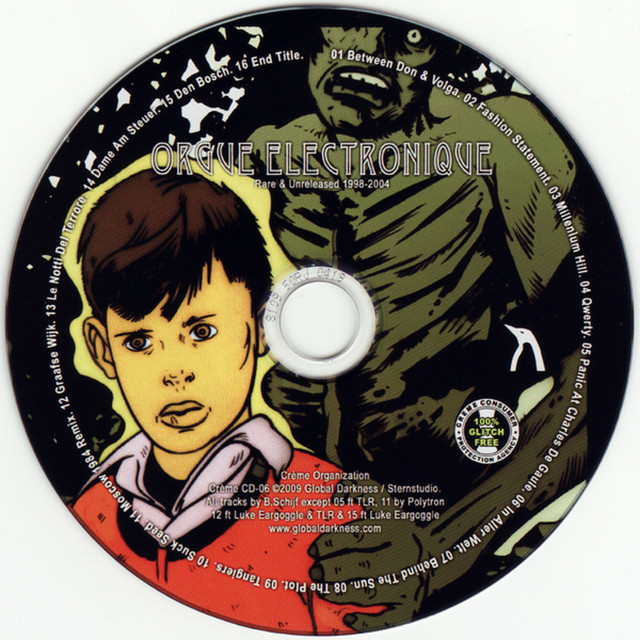
Orgue Electronique
Orgue Electronique's Gear


Orgue Electronique uses the Teac Tascam Series 32-2, an analog multitrack recorder, in their studio setup. According to Sternstudio, this model is particularly suited for studio use due to its recording capabilities at 7.5 ips and 15 ips. It's important to note that the Series 32-2 should not be confused with the Tascam 32, as they are distinct models.
Find it on:


Orgue Electronique discusses their use of the Akai AX80 in comparison to the AX60 on Sternstudio's website. They note that while the AX80 offers a richer sound, particularly in the lower tone regions, the AX60 is a more versatile synthesizer with consistent strength across all ranges. The AX80's interface, featuring pushbuttons and a data wheel, is praised for its intuitive, analog-like feel, contrasting with the slider-based interface of the AX60.
Find it on:

Orgue Electronique uses the Roland TR-707 Rhythm Composer, as detailed on Sternstudio's website. This drum machine is celebrated for its role in Chicago House music, featuring 64 patterns, 998 bars, and a comprehensive step edit function. Its 15 distinct drum sounds, including punchy bass drums and gritty hi-hats, make it a versatile and essential tool. The TR-707's design includes individual outputs for each sound, offering flexibility for both simple stereo output and more complex setups.
Find it on:

Orgue Electronique uses the Boss Dr. Rhythm DR-660, a drum machine designed by Roger Linn, known for its prominent sound on many Dance Mania records. This connection is detailed on Sternstudio's website.
Find it on:

Orgue Electronique utilizes the D&R Dayner modular mixer, as documented on Sternstudio's website. This mixer, designed in Holland between the late '80s and early '90s, features a customizable frame with various module options, including line and split channel modules, a patchbay, and a master module with extensive controls. The Dayner is renowned for its 'floating subgroup' system, providing flexible subgroup placement and numerous summed outputs. Despite its age, the Dayner remains a quiet and transparent mixer with considerable headroom, favored over typical home studio mixers. Potential buyers should note that maintenance is essential due to its vintage nature, with issues like ribbon cable wear or PSU faults being common.
Find it on:

Sequential Circuits Drumtracks is in the 2nd second of this video form his FB page.
Find it on:

Shrutti is laying next to the SCI Drumtracks in the first 2 seconds of the video.
Find it on:

• An interesting 2 VCO synthesizer, very versatile but especially great for 8 bit sounding patches. Akai originally intended it to compete with the Juno 106, but I feel it’s far better then just a Juno clone, and it sounds rather different. Fun addition is that it has a filter input, originally designed to use with older akai samplers, making use of a 16(?) pin DIN cable. It comes with a far better interface than the AX-73, but it does make me rather curious of the AX-80. So erm... if you are selling one, you do know where to find me! Edit: my dear friend Legowelt knew where to find me and is sold me his!
Find it on:

Orgue Electronique is known to use the Casio CZ-101 synthesizer, as mentioned on Sternstudio's website. The CZ-101, a standout in Casio's CZ series, is appreciated for its unique Phase Distortion synthesis, which offers a distinct alternative to FM synthesis by altering the waveform's phase. Despite its compact size as the smaller sibling of the CZ-1000, the CZ-101 delivers a distinctive sound that has been influential in early Detroit techno, Chicago house, and mid-80s synthpop. With features like 8-voice polyphony, portamento, and noise/ring modulation, the CZ-101 creates sounds that are difficult to replicate with typical subtractive synthesizers, making it a valuable tool for artists like Orgue Electronique.
Find it on:

Orgue Electronique uses the Crumar Bit 99, a synthesizer designed by Mario Maggi, noted for its dual oscillators, full MIDI implementation, and versatile features like velocity sensitivity and bi-timbrality. This information is detailed on Sternstudio's website.
Find it on:

Orgue Electronique utilizes the Casio RZ1 drum machine, as noted on Sternstudio's website. Known for its distinct sound and quirky nature, the RZ1 is ideal for crafting unconventional drum tracks, avoiding cliché rhythms.
Find it on:

Orgue Electronique is listed on Sternstudio's website as using the Commodore Amiga 1200 in their setup.
Find it on:

Orgue Electronique utilizes the Yamaha RS7000 as a versatile and hands-on live sequencer, according to Sternstudio. While the RS7000's internal sounds may be quirky yet enjoyable, its robust sequencer and capable sampler make it a viable alternative to software like Ableton for live performances.
Find it on:

Orgue Electronique utilizes Renoise, as documented on the Sternstudio website.
Find it on:

Orgue Electronique uses the Revox PR99 MK3, an analog multitrack recorder primarily aimed at the semi-professional market, according to Sternstudio. Unlike the Teac models, the PR99 MK3 offers advanced features like balanced connectors and sophisticated transport controls, including loop functions and location memory. This model was often used in broadcasting and editing due to its accessible tape mechanism. Interestingly, in the early 1990s, the PR99 was also available as the Studer PR99, aligning with the design of the Studer A810 and A820 series.
Find it on:


Tascam M-3700 is standing in the back of the video. https://www.youtube.com/watch?v=0EpE3DaObI4
Find it on:

Airbase99 in this video: https://www.youtube.com/watch?v=tiC0DQplHrU
Find it on:

Orgue Electronique has incorporated the Casio CZ-1 synthesizer into his setup at Sternstudio. The CZ-1 offers several enhancements over the CZ-101, including additional user patches, chorus, velocity sensitivity, aftertouch, a modulation wheel, four modulation types, glide, and adjustable output levels for its two DCAs. While the CZ-1 can technically achieve 16 voices, practical use typically limits it to 8 voices, providing a richer sound palette than the CZ-101. Notably, it supports SysEx dumps and allows sound exchange with the CZ-101. Though the sound engine remains similar between the two models, the CZ-1's chorus adds a slightly warmer, albeit noisier, dimension. This information is detailed on Sternstudio's website.
Find it on:

Another Rack Synth is this first Clavia attempt to make a decent Virtual Analogue synthesizer. Needless to say, this machine is a modern classic, inspired by the SCI Prophet 5 (even the presets are clearly intended to clone the P5 ). I don't know whether Clavia succeeded there, but they did came up with a workhorse that is able to come quite close to some of the budget analog and digital synths I own. Because it's a bit of a chameleon it's been my favored live-synth for almost 10 years. But don't expect really big sounds from it, it sure won't mimic the classic analogs 100%. Unless you treat it with some analog effects and filters it's just not strong enough and it will always keep that typical Nord digital edge. Especially in the higher octave ranges it never really convinces. It's a great synth for starters and once you collected a few more desired (analog-)synths it just might become the tool that will give room for those classic synths to take care of parts that really matter. I wouldn't get rid of it, perhaps if I ever get the desire to buy a slightly more versatile (4 outputs, 16 voices and some other extra features) Nord Lead 2 I might get rid of it.
Find it on:

Analoge filters and 16 sampled waveforms... this is an old Korg flagship. Altho I liked to think of it as the black sheep in my studio, I use it more and more. Its sounds are truly great, a welcome variation to the Yamaha DX synthesizers and a nice addition to the Casio CZ.
Find it on:

Orgue Electronique uses the Korg 707 synthesizer, as detailed on Sternstudio’s website. This FM synth, known for its unique sound derived from Yamaha’s 4-operator FM technology, offers a distinctive, albeit thin, sound. Although Orgue Electronique finds editing the synth challenging and primarily relies on its presets, the Korg 707 remains a part of their creative setup.
Find it on:

Richer, better, nicer, more reliable compared to the 106. The Juno 60 is a beauty, no doubt. The Juno 60 made me realize that it's about time I'd get rid of all those silly budget analogs and start upgrading to the real thing... The JSQ60 kinda sucks, but it came with the juno 60 so I won't complain. I did get me a Roland MD-8 midi -> DCB interface, to have some midi control (note on and of ;) ) over my Juno60. Working with the arp triggered by a tr-707 was really workable, but it's a shame to use this lovely synth only monophonic. I got the MD-8 for a nice price, but there are better interfaces around. Nice thing however about the MD-8 above other interfaces is that it works two ways: you can also set it to DCB -> midi.
Find it on:
-m.webp?v=1784013619)
Orgue Electronique uses the Roland Juno-106, a classic synthesizer renowned for its enduring appeal in analog music production. As highlighted on Sternstudio's website, this synth is a staple in his studio setup, exemplifying its lasting value and versatility for artists at any stage of their career.
Find it on:

Orgue Electronique utilizes the Roland JX-8P, a reliable six-voice analog synthesizer renowned for its classic Roland strings and bass sounds. As noted on Sternstudio's website, this synth, featuring 12 oscillators with 2 DCOs per voice, is a staple in Orgue Electronique's studio setup.
Find it on:

Nice italian made analoge machine, looks like some sort of Korg Poly800 clone. Nothing special, but since they are cheap it's always a good buy, no doubt. There is this whistling kinda sound in the lower ranges, but I never cared too much about that. Low budget is not a choice you make, so you better do with what you have. I used it a lot on 'The Eye That Never Sleeps', and it was an important synth for that track called 'The Plot', of which you can find an excerpt on the mp3 page.
Find it on:

Orgue Electronique has used the Yamaha DX100, as highlighted on Sternstudio's website. This synthesizer, known for its ease of editing compared to the DX7 and its distinct metallic sound, was the first synthesizer Orgue Electronique ever purchased, often used alongside the Casio CZ 101 by various artists.
Find it on:

Orgue Electronique utilizes the Yamaha TX7 Desktop Module, as detailed on Sternstudio's website. The TX7, a module version of the DX7, is designed for integration and editing with the DX7, offering expansive FM synthesis capabilities. This setup provides a powerful and affordable way to achieve rich sound output.
Find it on:

Orgue Electronique is known to use the Yamaha DX7, a revolutionary synth that significantly influenced artists like Brian Eno. According to Sternstudio, this synth remains a cornerstone in Orgue Electronique's setup, highlighting its enduring impact and versatility.
Find it on:

Orgue Electronique uses the x0xb0x synthesizer, as detailed on Sternstudio's website. Known for its convincing emulation of the legendary 303, Orgue Electronique appreciates its sound quality and finds its sequencer a valuable addition to his setup.
Find it on:
This is a community-built gear list for Orgue Electronique.
- Find relevant music gear like Studio Equipment, Software Plugins and VSTs, Headphones, DJ Setup, and other instruments and add it to Orgue Electronique.
- The best places to look for gear usage are typically on the artist's social media, YouTube, live performance images, and interviews.
- To receive email updates when Orgue Electronique is seen with new gear, follow the artist.
Discography