Table of Contents

Equipboard
Equipboard is the world's largest community of artists and their gear. Read our review process.
We are reader-supported. When you buy through links on our site, we may earn an affiliate commission. Learn more.
Our Picks

Legendary Reliability: This slope-shouldered dreadnought has earned its reputation as Gibson's most dependable acoustic, beloved by working musicians for its versatility and consistent performance across eight decades of production.
Read more


-l.webp?v=1784991512)
Vibrant Personality: Introduced in 1960, the Hummingbird combines striking visual aesthetics with a bright, articulate voice that has made it a favorite among rhythm guitarists and performers who want their instrument to make both a sonic and visual statement.
Read more

Commanding Presence: The SJ-200's jumbo body and ornate appointments make it the most visually striking and sonically powerful acoustic in Gibson's lineup, earning its royal nickname through sheer force of personality and projection.
Read more
Intimate Expression: This smaller-bodied Gibson offers focused midrange punch and remarkable touch sensitivity, making it the choice of blues legends and modern fingerstyle masters who value nuance over sheer volume.
Read more

Gibson Acoustic Songwriter EC Custom Acoustic-electric Guitar
Contemporary Excellence: The Songwriter EC Custom represents Gibson's successful effort to create a modern instrument that honors traditional craftsmanship while meeting the demands of today's recording artists and performers.
Read more
Step into any recording studio from Nashville to Abbey Road, and you'll likely spot a Gibson acoustic leaning against the wall. For nearly a century, Gibson has made instruments that transcend their role as mere tools, becoming partners in the creative process for countless artists. While the company's electric guitars often steal the spotlight, their acoustic instruments represent something equally remarkable - a commitment to tonal excellence that has shaped American music since the 1930s.
From their dedicated acoustic facility in Bozeman, Montana, Gibson continues to build guitars that honor traditional craftsmanship while meeting the demands of modern musicians. The Montana workshop, established in 1989, is the place where master luthiers combine time-tested techniques with carefully selected tonewoods to create instruments that improve with age.
Today, we’ll explore five of Gibson's most celebrated acoustic models, examining their unique histories, construction details, and tonal characteristics.
Gibson J-45
5.0 (73)
The Workhorse
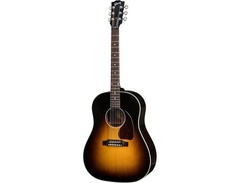
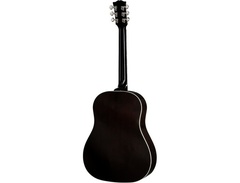





Average Price: $2,813
High-end/Boutique
$200
$601+
Budget
Standard
High-end
- Superb craftsmanship with a classic sunburst finish
- Versatile sound suitable for various genres and settings
- Unique tonal profile with vibrant highs and bassy lows
- Comfortable to hold and play, even during long sessions
- See 6 more
- LR Baggs pickup may not meet all users' expectations
- No cutaway, limiting access to upper frets
- High price point, with recent significant price increases
A Brief History
The J-45 emerged during World War II in 1942, when Gibson faced material shortages and workforce challenges. Originally marketed as a more affordable alternative to the company's premium models, it quickly proved that sometimes limitations breed innovation. The guitar's simple appointments and robust construction made it an instant hit with traveling musicians who needed an instrument that could handle the rigors of the road.
Throughout the 1950s and 60s, the J-45 became the go-to guitar for folk singers and country artists. The model's popularity never waned, even as musical tastes shifted through rock, punk, and alternative movements. Today, the J-45 continues to be relied upon by touring and recording artists across all genres.
Design & Build
The J-45's construction reflects a philosophy of purposeful simplicity. Its round-shoulder dreadnought body creates a comfortable playing experience while delivering substantial volume. The signature slope-shoulder design contributes to the guitar's balanced tonal response by slightly reducing the bass-heavy characteristics typical of square-shoulder dreadnoughts.
Most J-45s feature a Sitka spruce top paired with mahogany back and sides. The top's X-bracing pattern provides structural integrity while allowing the soundboard to vibrate freely. The mahogany neck, typically featuring a 24.75-inch scale length, joins the body at the 14th fret with a traditional dovetail joint. Simple dot inlays mark the fretboard positions, while the iconic Gibson script logo completes the headstock.
Sound Profile
The J-45's voice can best be described as woody and warm, with a pronounced midrange that makes it exceptionally versatile. Unlike some dreadnoughts that overwhelm with bass, the J-45 maintains clarity across all frequencies. The mahogany back and sides contribute to a focused, punchy tone that records beautifully and cuts through a band mix without harshness.
Fingerpickers appreciate the guitar's responsiveness to dynamics, while strummers love how it handles everything from gentle folk patterns to aggressive bluegrass rhythms. As J-45s age, they develop even more complexity and warmth, with vintage examples particularly prized for their opened-up sound.
Why It Remains Notable
The J-45's enduring appeal lies in its remarkable versatility and reliability. While other guitars might excel in specific applications, the J-45 handles virtually any musical situation with aplomb. It's the guitar you grab when you need something that just works, whether you're writing songs, recording in a studio, or performing at a festival. This continuous presence across genres and generations speaks to the guitar's fundamental correctness of design.
See how artists use this




Gibson Hummingbird
4.5 (44)
Square-Shouldered Statement
-s.webp?v=1784991512)
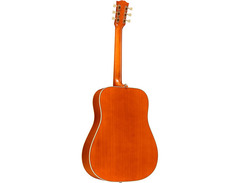
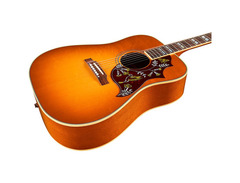
Average Price: $3,617
High-end/Boutique
$200
$601+
Budget
Standard
High-end
- Iconic design with a unique, hand-etched pickguard admired by many owners
- Rich, full-bodied sound with a balance between bright and dark tones
- Warm, resonant mahogany back and sides project an amazing tone
- Inspiring aesthetics and craftsmanship make it a joy to own and play
- See 4 more
- High purchase price, making it less accessible for budget-conscious buyers
- Some setups may require adjustments for action out of the factory
- Occasional minor cosmetic issues, like rough edges or unfinished areas
Origin and Evolution
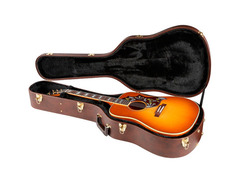
Gibson launched the Hummingbird in 1960 as their first square-shouldered dreadnought, directly competing with similar designs from other manufacturers. The company wanted something that would stand out visually while delivering a distinctive tonal character. The guitar's name comes from its elaborate pickguard design, featuring engraved hummingbirds and flowers that immediately set it apart from more conservative instruments.
Throughout the 1960s and 70s, the Hummingbird became associated with the folk-rock movement. Its bright, cutting tone perfectly complemented the jangly electric guitars and close harmonies that defined the era. Artists discovered that the Hummingbird could hold its own against those electric instruments without sacrificing acoustic character.
Construction Details
The Hummingbird's square-shoulder dreadnought body creates a slightly different tonal foundation than the J-45's round-shoulder design. The broader upper bout increases internal volume and emphasizes bass response, while the square shoulders provide a larger soundboard area for enhanced projection.
Traditional Hummingbirds feature a Sitka spruce top with mahogany back and sides. The top's scalloped X-bracing allows for greater flexibility and responsiveness, contributing to the guitar's characteristic shimmer and sustain. The elaborate pickguard, traditionally featuring engraved hummingbirds and flowering vines, is created through a multi-step process that combines hand engraving with careful inlay work. The cherry sunburst finish has become synonymous with the model.
Tonal Characteristics
Where the J-45 offers warmth and balance, the Hummingbird provides brightness and projection. Its square shoulders and bracing pattern create a more immediate attack with enhanced treble response. This gives the guitar excellent clarity when playing complex chord progressions or when you need your acoustic to cut through a dense mix.
The Hummingbird excels as a rhythm instrument, particularly for players who favor a pick over fingerstyle technique. Its strong fundamental notes and quick decay make it perfect for driving folk-rock rhythms or country train beats. Recording engineers often reach for a Hummingbird when they need an acoustic guitar that won't get lost in a busy arrangement.
Cultural Impact
The Hummingbird's influence extends beyond its technical merits to its role as a cultural icon. Its distinctive appearance made it instantly recognizable on television and in photographs, helping establish the image of the serious singer-songwriter. The model's association with the 1960s folk revival cemented its place in music history as the guitar you saw at folk festivals and in Greenwich Village clubs.
See how artists use this







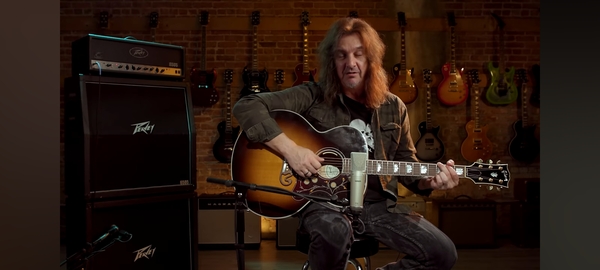
Gibson SJ-200 Original
King of the Flat-Tops

Average Price: $5,199
High-end/Boutique
$200
$1001+
Budget
Standard
High-end
- Perfect action setup, low but not buzzy
- Deep, balanced sound with a tight low end
- Superb craftsmanship and flawless finish
- Lifetime investment quality and durability
- See 6 more
Historical Significance
The SJ-200, originally called the Super Jumbo, emerged in 1937 as a custom instrument for cowboy singer Ray Whitley. Gibson wanted to create something that could compete acoustically with big bands and orchestras, resulting in what would become the company's flagship acoustic model. The guitar's massive body pushed the boundaries of what an acoustic guitar could be, both visually and sonically.
As country music evolved from Western swing to honky-tonk to the Nashville sound, the SJ-200 remained a constant presence. The 1960s and 70s saw rock musicians embrace the SJ-200's bold character, demonstrating that it transcended genre boundaries and appealed to any performer who needed maximum acoustic power.
Design Philosophy
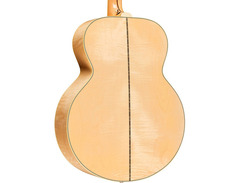
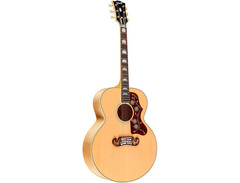
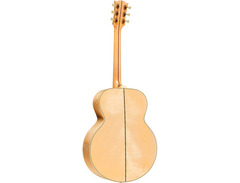
The SJ-200's jumbo body creates an enormous acoustic chamber that produces unmatched volume and projection. This size isn't arbitrary; every dimension was calculated to maximize acoustic output while maintaining playability. Most SJ-200s feature a Sitka or Adirondack spruce top with flame maple back and sides. The maple construction provides clarity and note separation that prevents the guitar's massive voice from becoming muddy.
The visual elements of the SJ-200 are as carefully considered as its acoustic properties. The distinctive mustache bridge, crown inlays along the fretboard, and elaborate pickguard design create an unmistakable aesthetic. Multiple-ply binding on the body, neck, and headstock adds both protection and visual depth.
Sonic Capabilities
Playing an SJ-200 is an experience unlike any other acoustic guitar. The immediate impression is one of power and depth, with a bass response that can be felt as much as heard. Yet this low-end authority doesn't come at the expense of clarity. The maple back and sides ensure that even complex jazz chords ring with definition.
The SJ-200's voice is particularly well-suited to rhythm playing and vocal accompaniment. Its strong fundamental notes and controlled overtones make it ideal for players who need to fill sonic space without additional instruments. Despite its size, the SJ-200 responds well to fingerstyle playing, rewarding those who master it with unparalleled dynamic range.
Modern Relevance
Today's SJ-200 continues to attract artists who need maximum acoustic presence. The guitar's ability to project without amplification makes it valuable in acoustic settings, while its controlled feedback characteristics work well with modern pickup systems. It remains the standard by which all other jumbo acoustics are measured.
See how artists use this










Gibson LG-2
5.0 (4)
Blues Heritage

Average Price: $2,615
High-end/Boutique
$200
$1001+
Budget
Standard
High-end
- Bright, full, and complex voice ideal for various playing styles
- Vintage soft-V neck for comfortable play, especially for small hands
- Excellent balance and clarity in mid frequencies, perfect for fingerpicking
- Rich harmonics and impressive sustain, enhancing the overall sound quality
- See 6 more
- High action may require adjustment for optimal playability
- Neck dimensions can feel too chunky initially for those used to C-shape necks
- High strings can be prone to slipping off the fretboard if not careful
- Plastic bridge pins could detract from tonal warmth, requiring an upgrade
Blues Roots
The LG-2 traces its origins to 1942, when Gibson created an affordable, smaller-bodied instrument during World War II. The LG-2 quickly found favor with blues musicians who appreciated its portability and distinctive voice. The focused midrange and quick response perfectly suited the intimate settings of juke joints and house parties.
The folk revival of the 1960s brought renewed interest in the LG-2. Artists seeking authentic blues tone sought out vintage examples, driving prices up and inspiring Gibson to reintroduce the design. Modern blues and americana artists continue to prize the LG-2 for its historical authenticity and unique tonal properties.
Compact Construction
The LG-2's body measures approximately 14.75 inches wide, creating a fundamentally different playing experience than dreadnoughts. The reduced body cavity emphasizes midrange frequencies while naturally compressing bass response, creating a focused, punchy tone that records beautifully.
Traditional LG-2 construction features a Sitka spruce top with mahogany back and sides. The guitar uses X-bracing that's lighter than what you'd find on a dreadnought, contributing to its quick response and woody tone. The shorter 24.75-inch scale length makes the guitar easier to play, particularly benefiting players with smaller hands.
Tonal Focus
The LG-2 sound is immediately recognizable: dry, woody, and remarkably direct. Unlike larger guitars that bloom and sustain, this instrument delivers a more immediate, percussive response. Fingerstyle players particularly appreciate the touch sensitivity the LG-2 offers. The focused midrange ensures vocals are never overshadowed when self-accompanying.
The LG-2 excels at slide playing, where its quick response and controlled sustain prevent notes from becoming muddy. Many players find that songs written on an LG-2 have a different character than those composed on larger instruments, often more intimate and introspective.
Contemporary Appeal
Modern musicians have rediscovered the charm of the LG-2, recognizing that bigger isn't always better. Singer-songwriters appreciate how the guitar complements rather than competes with vocals. Gibson's current production includes both historically accurate LG-2 reissues and updated versions, proving that its appeal extends far beyond blues purists.
See how artists use this









.jpg?v=1784920144)

Gibson Acoustic Songwriter EC Custom Acoustic-electric Guitar
Modern Classic

Average Price: $4,680
High-end/Boutique
$200
$1001+
Budget
Standard
High-end
Recent Innovation
Gibson wanted a guitar that combined the warmth of vintage Gibsons with the needs for modern performance and recording. Building on the standard Songwriter platform introduced in 2003, the EC Custom incorporates specific refinements that excel in modern recording environments.
Modern Materials
The EC Custom features a Sitka spruce top with East Indian rosewood back and sides, chosen for their exceptional tonal balance. The bracing pattern incorporates a slightly stiffer top that provides better note definition under aggressive playing.
The EC Custom includes a cutaway for improved upper fret access. The L.R. Baggs Element pickup system is seamlessly incorporated, providing studio-quality amplified tone. The bound ebony fretboard features mother-of-pearl diamond and arrows inlays, while gold Grover tuners provide rock-solid tuning stability.
Studio-Ready Sound
The Songwriter EC Custom's voice can best be described as refined and articulate. It offers a more controlled response than vintage-style dreadnoughts, with a balanced frequency spectrum that responds exceptionally well to recording techniques. The rosewood back and sides add complexity and overtones that enrich the fundamental notes without muddying the mix. It results in a scooped frequency distribution, perfect to compliment songwriters that add mid-range with their vocals.
Live performance is where the Songwriter EC Custom truly distinguishes itself. The integrated L.R. Baggs system delivers consistent, feedback-resistant amplification that maintains the guitar's acoustic character. Its balanced frequency response means less EQ adjustment at the board, while clear articulation ensures every note cuts through a band mix.
Future Classic Status
The Songwriter EC Custom has already established itself as a modern standard among professional musicians who need absolute reliability and tonal excellence. The guitar appeals to players who respect vintage instruments but need something designed for contemporary music making with modern reliability.
Comparison Overview

Understanding the distinctions between these five iconic Gibson models helps players make informed decisions based on their musical needs and preferences.
| Model | Body Shape | Primary Tonewoods | Scale Length | Bracing Pattern | Best For |
|---|---|---|---|---|---|
| J-45 | Round-shoulder dreadnought | Sitka spruce/Mahogany | 24.75" | X-bracing | All-around versatility |
| Hummingbird | Square-shoulder dreadnought | Sitka spruce/Mahogany | 24.75" | Scalloped X-bracing | Rhythm and projection |
| SJ-200 | Super Jumbo | Sitka spruce/Flame maple | 25.5" | Graduated X-bracing | Stage performance |
| LG-2 | Small body (00) | Sitka spruce/Mahogany | 24.75" | Light X-bracing | Blues and fingerstyle |
| Songwriter EC Custom | Square-shoulder dreadnought | Sitka spruce/Rosewood | 25.5" | Modern X-bracing | Recording and contemporary |
Conclusion
These five Gibson acoustic guitars represent distinct musical philosophies and historical moments. The J-45 continues to prove itself as the reliable workhorse, offering musicians a tool that never fails to deliver. The Hummingbird brings visual flair and sonic brightness to any performance, while the mighty SJ-200 remains the undisputed king when maximum acoustic power is required. The LG-2 keeps the blues tradition alive with focused, intimate tone, and the Songwriter EC Custom demonstrates that artist collaborations can perfectly complement traditional craftsmanship.
Whether you're drawn to the versatile warmth of the J-45, the sparkling projection of the Hummingbird, the commanding presence of the SJ-200, the focused intimacy of the LG-2, or the refined clarity of the Songwriter EC Custom, you're choosing an instrument with proven heritage and continued relevance.
Top Ranked Steel-string Acoustic Guitars on Equipboard


-m.webp?v=1784991568)
-m.webp?v=1784978090)

About the authors

S. Jino is an accomplished multi-instrumentalist and music producer based in Kolkata, India, distinguished by his self-taught mastery and unique blend of technical acumen and musical performance. His extensive experience was forged through hands-on dedication, starting with the full restoration of a broken guitar. Jino's capabilities span keyboards, pedals, and advanced digital production, reflecting a comprehensive skill set developed independently. As a significant contributor to the music scene, Jino regularly performs with worship bands and college ensembles. He has also established himself as a reliable and authoritative professional in freelance mixing, mastering, and original music creation. Inspired by the innovative sounds of Brian May and David Gilmour, and influenced by Kolkata's vibrant metal community, Jino is committed to the intricate art of vintage gear restoration and the continuous exploration of music and technology fusion. His current professional setup, featuring a meticulously restored nameless guitar, a Fender Player Strat, and a Boss Katana 50. Read more
New in Steel-string Acoustic Guitars

$2,111.00 - $2,299.00


$2,285.00 - $2,499.00


$14,999.99 - $19,590.00


$4,199.99 - $5,190.00


$3,799.00 - $4,199.99