
By Gear Experts
Table of Contents

Equipboard
Equipboard is the world's largest community of artists and their gear. Read our review process.
We are reader-supported. When you buy through links on our site, we may earn an affiliate commission. Learn more.
Anyone who’s played the guitar for a while knows that feeling: you strum a familiar chord and it just doesn’t sound right. A guitar that’s not in tune can seriously throw off any performer. If you’re playing in a band, you’ll soon learn that a group of out-of-tune musicians is a recipe for disaster.
However, guitar tuning is even more important for beginners and amateur players. If your guitar is not in tune, it can be difficult to distinguish between correct and wrong notes. This can be a major setback for your improvement as a guitarist. Knowing how to tune a guitar will ensure that every ounce of effort you put in will go towards improving your skills.
The Basics of Guitar Tuning
Even though some performers have been known to play around with their guitar tuning, the most common, and convenient, standard is the EADGBE tuning.
It starts with a low E, has a fourth interval between each of the next three strings (from E to A, A to D, and D to G), a major third from G to B, and another fourth, ending with a high E on the last string. This tuning makes it easy to play common chords and scales without straining your wrist.
While there are a wide variety of guitars, the process of tuning them is more or less the same. The following guide is applicable for classical, acoustic, semi-acoustic and electric guitars.
In order to tune your guitar accurately, you need a pitch reference. A pitch reference is basically any method you can use to compare the pitch of your guitar string to the actual note it needs to be tuned to. This article will explore a variety of guitar tuning techniques based on the pitch reference used. Digital equipment can range from a specialized guitar tuner to a simple smartphone app. Experienced musicians could even tune a guitar by ear using a piano or a tuning fork as their reference.
What Equipment Do I Need to Begin Tuning My Guitar?
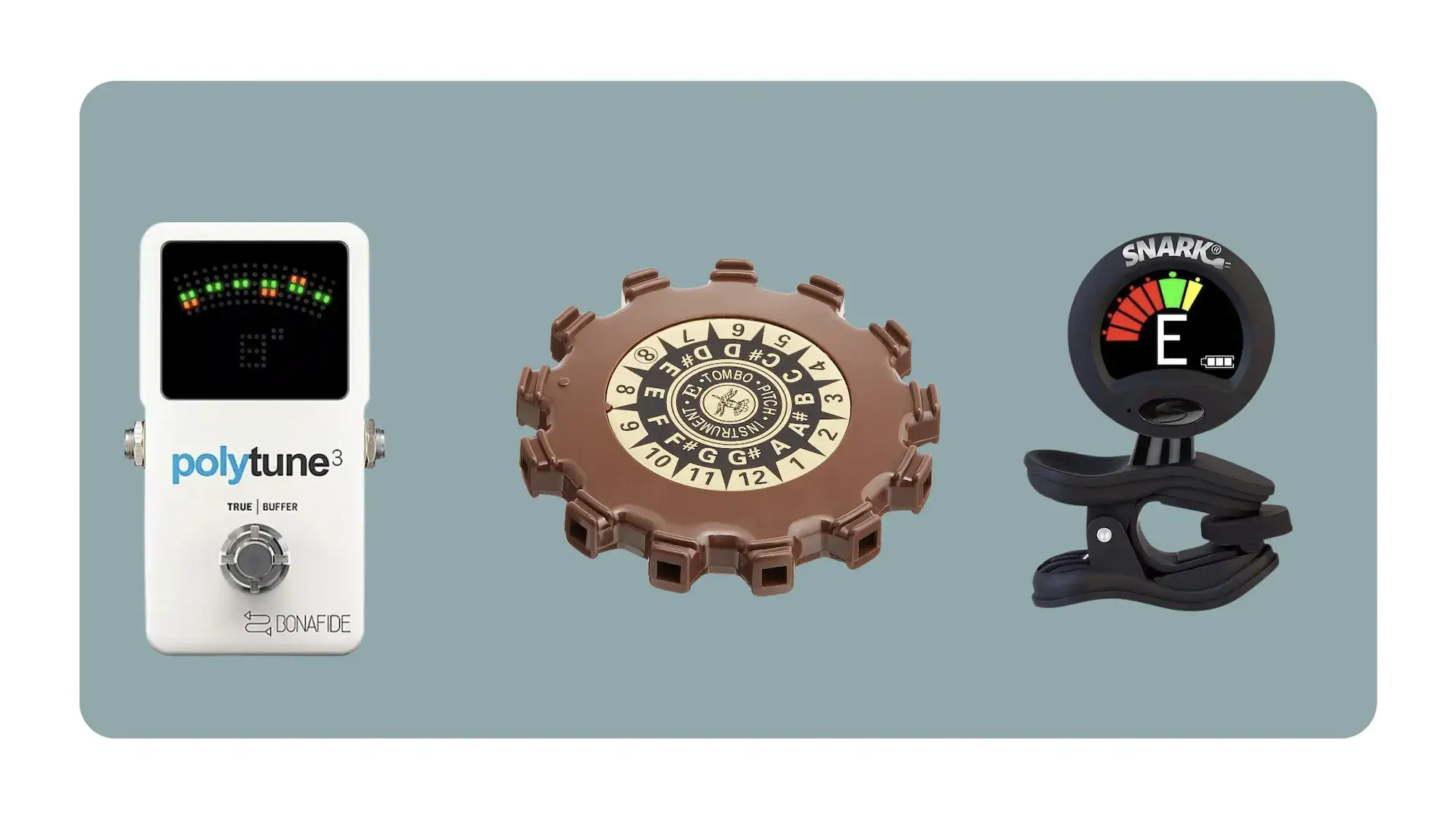
For the vast majority of guitar players, the best reference is a digital tuner. If you aren’t ready to invest a few dollars in one, there are plenty of free smartphone apps and online tuners. These are a great option for when you’re on the go and forgot to bring your equipment along. However, you should be suspicious of the accuracy of these. Always go for apps with good reviews or those published by reputable guitar companies and musicians.
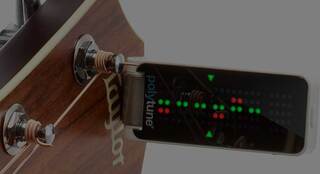
If you’re ready to spend a bit of money, a simple clip-on guitar tuner is a convenient and reliable tuning tool. This device is attached to your guitar’s headstock with a clip and detects the vibrations from your string when you pluck it.
An alternative to the clip-on that is especially useful for electric guitar players is the tuner pedal. Many performers even include tuner pedals on their pedalboards to help them stay in tune during a concert. A pedal tuner registers your guitar’s pitch using an audio jack and displays the note that it detects.
If you're still deciding on a tuner, check out our comprehensive guide to guitar tuners.
Players who tune their guitars by ear prefer more old-school equipment such as tuning forks or pitch pipes. These devices generate specific pitches by striking and blowing respectively. The benefit of using analog equipment is that they don’t suffer from failures in electronic components like digital tuners.
Note: For quick tuning on the go, free tuning apps can be useful, but their accuracy may vary. Always go for apps with high ratings or those recommended by reputable music brands. Our current favorite is Fender Tune, which is available in the Apple App Store and on Google Play.
Tuning a Guitar with an Electronic Tuner
Turn on the tuner and select the mode
If your tuner has multiple modes, your first step will be to select one. Beginners should select the “guitar” mode as it guides you to the standard tuning. However, if you have some experience playing guitar, it is fine to choose “chromatic”. This mode detects all notes, so you will need to be familiar with the EADGBE tuning. Most clip-on tuners that do not display a mode are set to chromatic by default. Pedal tuners will generally have multiple modes.
Most tuners default to 440 Hz for the "A" note and decide the remaining pitches based on that. If you own an advanced tuning device, make sure it's set to 440 Hz unless you’re tuning to a different pitch.
Pluck Each String and Check the Display:
Start with the low E string (the thickest one). Pluck the string and watch the tuner’s display. The tuner will indicate the pitch it detects. Usually a string can be flat (producing a lower note than when in tune) or sharp (producing a higher note than when in tune).
Turn the tuning peg:
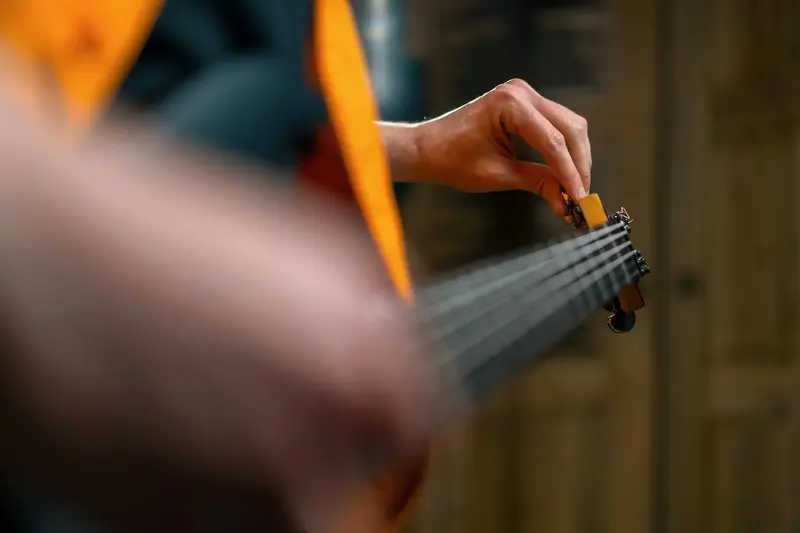
If your string sounds flat, that means the string is too loose. You must tighten it by turning the peg clockwise. On the other hand, if your string is too sharp, loosen the peg by turning it counter-clockwise.
However, do not use this method to bring the string in tune. Loosen the peg till the string sounds a bit flat, and then tune it back up. You do this because adding tension makes the string more secure, keeping it in tune for longer.
Usually, the tuner will have a needle or lights to indicate whether your guitar is in tune. When the needle falls on the right note or the light turns green, you know your guitar is in tune.
Tune the Remaining Strings:
Lastly, repeat the process for each string in order (A, D, G, B, E). You can also check and adjust again if necessary, Sometimes, tuning one string can slightly affect others. Go back through each string and make minor adjustments if needed to ensure they're all in tune
Even if you follow all these steps, an issue in the tuner could make your guitar sound out of tune. The most common reasons for inaccuracy are low battery and damage to the tuner. These can be resolved easily by replacing the battery or your device. Sometimes, a tuner could give wrong results because it's not calibrated properly. If you’ve been using a tuner for a long time, make sure you recalibrate it every now and then.
Tuning a Guitar by Ear
If you don’t want to rely on a tuner, you could always try tuning your guitar by ear. This can also be a great ear-training exercise. The steps for tuning are the same as above. However, this time, you will use a tuning fork as your reference pitch and compare it to the guitar string.
If you don’t have any equipment on hand, you could tune a guitar by using itself as a reference.
As mentioned earlier, every string in the standard tuning is 5 steps above the previous one, except for the B string, which is 4 steps above G. So if you play the low E string while pressing on the 5th fret, it should exactly match the A string. So play the A note while holding down the fifth fret on the low E string while also strumming the open A string. Tune the A string accordingly depending on whether it sounds flat or sharp.
You can repeat this process for all the other strings. Keep in mind that you should hold down the fourth fret on the G string when you are trying to tune the B string. The main drawback of this technique is that it depends on your low E string being in tune. If it is not, you risk making your entire guitar go out of tune.
Alternate Guitar Tunings

Once you’re confident in your tuning abilities and are comfortable with the standard tuning, it's time to explore the alternate tunings that might match your style.
For example, the drop D tuning is a popular tuning used by metal and rock artists. This is because it makes it easier to accompany singers with a low voice and to play certain power chords. The drop D tuning is also relatively simple. The only difference from standard tuning is that the low E is switched to a low D. Thus, the guitar strings are tuned to D, A, D, G, B, E. To tune your guitar to drop D, just tune it as usual, and use a tuner to bring your low E one step down to a low D.
Another more dynamic tuning is the open G tuning. It is named so because you can play a G chord with all the strings “open”. This is just a side effect of the intended purpose though. The open G tuning transforms the tone of your guitar, making it better suited for folk and blues music. Open G tuning makes three changes to the standard tuning. your low E string is tuned down to low D. the A will drop down a full step to G. the high E string is lowered to a high D as well. Your D, G, and B strings will stay the same.
Keeping Your Guitar in Tune
After tuning your guitar, the next challenge is keeping it that way. For this, you need to understand why a guitar goes out of tune. Just like everything else, guitar strings grow old and go out of tune with wear and tear. Make sure you replace your guitar strings frequently to maintain a great sound.
The other major factor that affects your tuning is the environment. Factors like heat and humidity can affect how your guitar sounds. While you can’t control where you perform, at least make sure that your guitar is kept in a dry place out of direct sunlight when you’re not playing it.
Wear and tear on the truss rod, bridge, nut, and tuning pegs can also make a guitar go out of tune. It’s best to seek professional help to address these issues.
Regularly tuning your guitar ensures optimal sound and instrument health, while mastering different tuning methods enhances versatility. Practicing by ear hones your musical intuition, and exploring alternate tunings unlocks new creative possibilities. Embrace tuning as a skill, and let it deepen your connection to the music and your instrument.
Top Ranked Pedal Tuners on Equipboard


About the authors
Juan Spinelli is a multi-instrumentalist musician, but more of a guitarist than anything else. Based in Buenos Aires, Argentina, he started playing at a very early age and learned various instruments such as flute, clarinet, percussion, didjeridoo, cavaquinho, bass and more. Today, he also works as a music producer and sound engineer, collaborating in several projects in his city and with artists from all over the world. Read more
New in Pedal Tuners

$139.00
in Pedal Tuners Rank

$98.00 - $129.99
in Pedal Tuners Rank

$56.41 - $69.00
in Pedal Tuners Rank
.jpg)