Glass Animals
Glass Animals' Gear
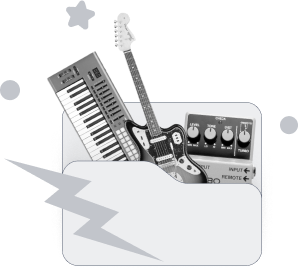


"In contrast, the huge chord sounds heard on “The Other Side Of Paradise” is the ARP 2600 recorded 30 times playing each note of the chord individually, resulting in 32 tracks, super-stacked, panned off hard left and right, with a little bit of a chorus for the widest chord sound Bayley could create. The Jupiter-6 is what he likes for pad sounds and EMS VCS3 for effects."
Find it on:


The writing studio’s compactness leant itself nicely to Bayley’s process. Keeping his essentials within arm’s reach, he has guitars: Hofner 176, Fender Stratocaster, Selmer Classical, Fender Precision bass with flat-wound strings, Roland Jupiter-6, Korg MS-20, ARP 2600—which made it onto every song on the album—a vintage Neumann U 87 microphone, and a couple of API preamps. Recording happens into Pro Tools, with Ableton preferable for sequencing and programming. Keeping things simple allows Bayley to whiz around, patching in what he needs quickly.
Find it on:


The writing studio’s compactness leant itself nicely to Bayley’s process. Keeping his essentials within arm’s reach, he has guitars: Hofner 176, Fender Stratocaster, Selmer Classical, Fender Precision bass with flat-wound strings, Roland Jupiter-6, Korg MS-20, ARP 2600—which made it onto every song on the album—a vintage Neumann U 87 microphone, and a couple of API preamps. Recording happens into Pro Tools, with Ableton preferable for sequencing and programming. Keeping things simple allows Bayley to whiz around, patching in what he needs quickly.
Find it on:

The writing studio’s compactness leant itself nicely to Bayley’s process. Keeping his essentials within arm’s reach, he has guitars: Hofner 176, Fender Stratocaster, Selmer Classical, Fender Precision bass with flat-wound strings, Roland Jupiter-6, Korg MS-20, ARP 2600—which made it onto every song on the album—a vintage Neumann U 87 microphone, and a couple of API preamps. Recording happens into Pro Tools, with Ableton preferable for sequencing and programming. Keeping things simple allows Bayley to whiz around, patching in what he needs quickly.
Find it on:


-m.webp?v=1784905101)
The writing studio’s compactness leant itself nicely to Bayley’s process. Keeping his essentials within arm’s reach, he has guitars: Hofner 176, Fender Stratocaster, Selmer Classical, Fender Precision bass with flat-wound strings, Roland Jupiter-6, Korg MS-20, ARP 2600—which made it onto every song on the album—a vintage Neumann U 87 microphone, and a couple of API preamps. Recording happens into Pro Tools, with Ableton preferable for sequencing and programming. Keeping things simple allows Bayley to whiz around, patching in what he needs quickly.
Find it on:


-m.webp?v=1784905380)
Here keyboardist Edmund Irwin-Singer can be seen using the Akai 232 in performance
Find it on:

The writing studio’s compactness leant itself nicely to Bayley’s process. Keeping his essentials within arm’s reach, he has guitars: Hofner 176, Fender Stratocaster, Selmer Classical, Fender Precision bass with flat-wound strings, Roland Jupiter-6, Korg MS-20, ARP 2600—which made it onto every song on the album—a vintage Neumann U 87 microphone, and a couple of API preamps. Recording happens into Pro Tools, with Ableton preferable for sequencing and programming. Keeping things simple allows Bayley to whiz around, patching in what he needs quickly.
Find it on:


(Guitar rig) [Referring to pedals:] " I've got all sorts... Harmonist... " Visible in Live Rig pedalboard at 01:27, it's identifiable as the HR-2, specifically, by the darker blue colour of the pedal.
Find it on:

(Guitar rig) Though quite blurry it's nevertheless clearly identifiable as part of his Live Rig pedalboard at 01:27, next to what is probably a BOSS DD-7, though I won't add the latter to this page because I can't say for certain which BOSS DD-series pedal it is. [EDIT: it's visible again (more clearly) at 02:19]
Find it on:

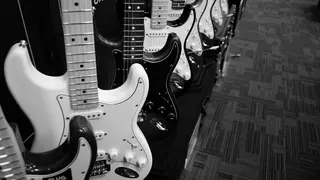
Lead singer and guitarist Dave Bayley uses this guitar in performances and occasionally writes his music with it too.
Find it on:

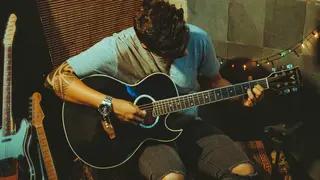
Dave can be seen using the DiPinto Galaxie 2 in their Triple J session
Find it on:

Guitarist Drew MacFarlane can be seen using his Fano JM6 with a bigsby in this Triple J session and many other concerts.
Find it on:
-m.webp?v=1784891784)
“I’ll record all those synthesizers and re-amp them to give them another bit of texture and forwardness that they don’t necessarily have if you record straight in,” Bayley says. “I tend to go through a Roland JC-120 amp, but if it’s a low synth I’ll go through an Ampeg B-52, and if it’s a simple mono synth line I’ll get it through whatever guitar amp I have lying around.
Find it on:

(Guitar rig) Visible in Live Rig pedalboard at 01:27
Find it on:

The writing studio’s compactness leant itself nicely to Bayley’s process. Keeping his essentials within arm’s reach, he has guitars: Hofner 176, Fender Stratocaster, Selmer Classical, Fender Precision bass with flat-wound strings, Roland Jupiter-6, Korg MS-20, ARP 2600—which made it onto every song on the album—a vintage Neumann U 87 microphone, and a couple of API preamps. Recording happens into Pro Tools, with Ableton preferable for sequencing and programming. Keeping things simple allows Bayley to whiz around, patching in what he needs quickly.
Find it on:


"The writing studio’s compactness leant itself nicely to Bayley’s process. Keeping his essentials within arm’s reach, he has guitars: Hofner 176, Fender Stratocaster, Selmer Classical, Fender Precision bass with flat-wound strings, Roland Jupiter-6, Korg MS-20, ARP 2600—which made it onto every song on the album—a vintage Neumann U 87 microphone, and a couple of API preamps. Recording happens into Pro Tools, with Ableton preferable for sequencing and programming. Keeping things simple allows Bayley to whiz around, patching in what he needs quickly."
Find it on:
-m.webp?v=1784905110)
The writing studio’s compactness leant itself nicely to Bayley’s process. Keeping his essentials within arm’s reach, he has guitars: Hofner 176, Fender Stratocaster, Selmer Classical, Fender Precision bass with flat-wound strings, Roland Jupiter-6, Korg MS-20, ARP 2600—which made it onto every song on the album—a vintage Neumann U 87 microphone, and a couple of API preamps. Recording happens into Pro Tools, with Ableton preferable for sequencing and programming. Keeping things simple allows Bayley to whiz around, patching in what he needs quickly.
Find it on:

"On the overheads we had a Neumann U 67 and AKG D19, both in the center above the snare. We then would choose one or get a blend that worked for each song. Occasionally I added a second pair of overheads, some Sony pencil condensers in x-y, just in front of the kit about two meters off the ground. These microphones sound very hard and in your face, so it worked out great."
Find it on:
-m.webp?v=1784333712)
On the overheads we had a Neumann U 67 and AKG D190, both in the center above the snare. We then would choose one or get a blend that worked for each song. Occasionally I added a second pair of overheads, some Sony pencil condensers in x-y, just in front of the kit about two meters off the ground. These microphones sound very hard and in your face, so it worked out great.
Find it on:

"He states its intuitiveness as a draw for creating Pink Floyd-like loops and ambient space-y sounds. He also managed to get his hands on a Transcendent Synth 2000, which usually comes in a build-it-yourself kit, but Bayley’s used to belong to Martin Hannett of Joy Division."
Find it on:

“I’ll record all those synthesizers and re-amp them to give them another bit of texture and forwardness that they don’t necessarily have if you record straight in,” Bayley says. “I tend to go through a Roland JC-120 amp, but if it’s a low synth I’ll go through an Ampeg B-52, and if it’s a simple mono synth line I’ll get it through whatever guitar amp I have lying around.
There is no existing amplifier called Ampeg B-52, so I am going to assume the article writer made a spelling mistake, and meant the Ampeg B5R which is an amplifier for Bass synths and guitars. Which would make sense since he says he would only use low synths for it.
Find it on:

(Guitar rig) Visible in Live Rig pedalboard at 01:27
Find it on:

Dave Bayley uses the Mellotron M4000D Mini in the this video during their stripped back version of “Your Love (Deja Vu)”. Dave also uses this in his Instagram live covers.
Find it on:


"The writing studio’s compactness leant itself nicely to Bayley’s process. Keeping his essentials within arm’s reach, he has guitars: Hofner 176, Fender Stratocaster, Selmer Classical, Fender Precision bass with flat-wound strings, Roland Jupiter-6, Korg MS-20, ARP 2600—which made it onto every song on the album—a vintage Neumann U 87 microphone, and a couple of API preamps. Recording happens into Pro Tools, with Ableton preferable for sequencing and programming. Keeping things simple allows Bayley to whiz around, patching in what he needs quickly."
Find it on:

The writing studio’s compactness leant itself nicely to Bayley’s process. Keeping his essentials within arm’s reach, he has guitars: Hofner 176, Fender Stratocaster, Selmer Classical, Fender Precision bass with flat-wound strings, Roland Jupiter-6, Korg MS-20, ARP 2600—which made it onto every song on the album—a vintage Neumann U 87 microphone, and a couple of API preamps. Recording happens into Pro Tools, with Ableton preferable for sequencing and programming. Keeping things simple allows Bayley to whiz around, patching in what he needs quickly.
Find it on:

“We used condensers on the close kit for brightness and attack, with the exception of a dynamic on the hi-hat for a bit more chunk than sizzle,” says Wiggins. “A Coles 4038 was placed above the kick and distorted for when more crunch was needed.
Find it on:


(Synth/Keys rig) Seen here as part of Live Rig at 00:28.
Find it on:

(Synth/keys rig) Visible at 00:36 as part of their Live Rig
Find it on:

(Guitar rig) Visible as part of Live Rig pedalboard at 02:18, top row of the board above his foot.
Find it on:

In this article, Glass Animal's Frontman, Dave Bayley says "I use a Maestro Rhythm ‘N Sound which is actually a drum machine that you can plug your guitar into and you can push a button and play your bass pattern and then you can push another and play your snare. It's an incredible bit of kit. "
Find it on:
This is a community-built gear list for Glass Animals.
- Find relevant music gear like Microphones, Guitars, Amplifiers, Effects Pedals, Bass Guitars, Drum Sets, Cymbals, Snare Drums, Drumsticks, Pianos, Keyboards and Synthesizers, Studio Equipment, Software Plugins and VSTs, Headphones, and other instruments and add it to Glass Animals.
- The best places to look for gear usage are typically on the artist's social media, YouTube, live performance images, and interviews.
- To receive email updates when Glass Animals is seen with new gear, follow the artist.
-
Added to Equipboard on by
 tonyfrescoandthedreammachine
GearIQ 80
-
Updated
Discography