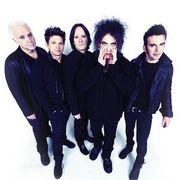
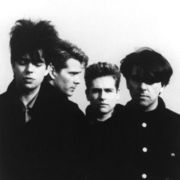
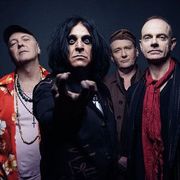
Robert Smith
UK guitarist, vocalist and songwriter for The Cure
Genre
Credits
Genre
Credits
Robert Smith's Gear


Robert Smith used an Olympic White Fender American Vintage '65 Jazzmaster early in his career, as evidenced by a user-uploaded photo.
Find it on:


In a video captured by LOV2ROK2VINYL during The Cure's performance in St. Paul, MN on June 7, 2016, Robert Smith is seen playing the Schecter Robert Smith UltraCure-XII guitar during the song "Snakepit."
Find it on:


1:18 a single speaker jazz chorus amp can be seen behind him
Find it on:


In this image from the Cure's 2016 performance at the Hollywood Bowl, which was posted on Supro's Facebook page, we can see that Smith's live touring rig includes two Supro 1695T amps as of this writing.
Find it on:
-m.webp?v=1783176997)
According to this 2007 interview with the Cure's front-of-house engineer Michael Brennan, Smith used a 58 for "decades" and when they had him test out a Sennheiser 935, he preferred the growl of the 58, as well as the fact that it didn't smear his lipstick off as easily, and he continued using the 58.
Find it on:


-m.webp?v=1783177167)
Smith can be clearly seen using this guitar from 1:20 into the video.
Find it on:

In recent tours, Robert can be seen playing a '62 AVRI (American Vintage Reissue) Jazzmaster in black. The identifying feature is the string tree's placement on the headstock being slightly higher than on other models. Only this and the Classic Player Jazzmaster have this feature.
Find it on:

-m.webp?v=1769151640)
In this scan of a Guitar World article it reads, "Smith's main amps were Vintage Vox AC30s, and old Orange and a Selmer Zodiac Twin 30."
Find it on:
-m.webp?v=1780671554)
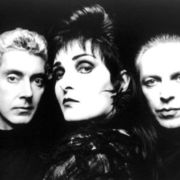
While Robert was playing with The Banshees he played a Vox Mark VI Teardrop as seen at :47s in this video.
Find it on:

In this article it states that The Cure used the ARP Solina String Ensemble extensively throughout their career as well as this interview where drummer and keyboardist Lol Tolhurst says how he uses it http://www.musicfanclubs.org/cure/press/I15.html
Find it on:
-m.webp?v=1781539641)
Robert Smith Playing a Gretsch Tennessee Rose during the Swing Tour.
Find it on:

Robert Smith can be seen playing a Fender XII, video from 1980
Find it on:

According to VSE, The Cure used a Minikorg 700 in the early days on records like '17 Seconds', and this 1981 clip of them performing 'A Forest' would seem to confirm this assertion. It's actually bass player Simon at the controls for the start, but I'll put it under Robert Smith as representative of 'The Cure'.
The clip is a bit blurry, but judging by the size of the instrument, the wooden end cheeks and the position of the control panel and big knob to the left, I think it's a Korg 700s.
Find it on:

Robert can be seen in this "Making 'The Cure' Album" video playing his signature Dubreuille at 4:53. There's also an article about this guitar from the French Guitarist Magazine.
Find it on:
-m.webp?v=1783177000)
In this archived article from Guitar World magazine's April 2000 issue, the Cry Baby is listed in the sidebar as being one of Robert's effects.
Find it on:

According to the 1996 rig diagram, Smith used the Boss PN-2 tremolo pan guitar pedal.
Find it on:

This transcription of an article from the June 1996 issue of Sound on Sound magazine discusses the making of Wild Mood Swings. "[The album] also saw the band making greater use of computers than previously. Having been away for five years, Roger O'Donnell was particularly well-placed to notice this change: 'When I left the group in 1990, there wasn't a computer in sight. I came back, and there's computers everywhere. We've really started using sequencing - all the keyboard parts have gone though it [Cubase Score for Macintosh]. The use of a string quartet and brass section is a strange contrast!'"
"Strange, perhaps, but Cubase Score proved a considerable help when it came to communicating with the classical players. Smith: 'It's been good using the Core package, because anything I play in can actually come out as musical score. Audrey would then hand-write it for the players, but it's really excellent, because you can instantaneously change pieces. Before, it was like trying to put your ideas over in another language.'"
Find it on:


In this article from the June 1996 issue of Sound On Sound magazine, Robert discusses his home studio setup. "When I do demos at home, I play a lot and build up the song. I use a little Casio home keyboard, a Musicman bass and an electronic Casio guitar with plastic strings, as well as an Ovation 6-string acoustic. Then there's a Tascam 8-track Portastudio. I also use a Roland R8 drum machine, but I always use presets on that, or drum sounds from the Casio keyboard as a basic timing."
Find it on:

This transcription of an article from the June 1996 issue of Sound on Sound magazine lists the Bluesbreaker among Smith's gear circa the recording of the Cure's Wild Mood Swings album.
Find it on:


In this image from a studio session, Smith sits surrounded by effects pedals. Behind him (on the left side of the picture) we can see his DL4 pedal.
Find it on:

Robert Smith playing his black Mosrite Joe Maphis during the 90s
Find it on:

In this image from a studio session, Smith sits surrounded by effects pedals. Behind him (on the left side of the picture) we can see his MM4 pedal.
Find it on:
-m.webp?v=1781358359)
In the early 1980s, Robert Smith used the Ovation Custom Legend 1759 for both recordings and live performances, contributing to The Cure's distinctive sound of that era. This guitar was also featured during their "Unplugged" sessions. The accompanying user-uploaded photo serves as visual proof of his use of this instrument.
Find it on:

In a June 1984 article in International Musician and Recording World on the last page he states he owns one of the synths. He complains that Roland will not give them any discount so the hide them on tour and he does not like to mention them!
Find it on:

In this archived article from Guitar World magazine's April 2000 issue, the SansAmp Classic is listed in the sidebar as being one of Robert's effects.
Find it on:

In this archived article of an interview from the April 2000 issue of Guitar World, the PCM-70 is listed among Robert's effects. Sound on Sound also writes about The Cure using this effect.
Find it on:

This article from the June 1996 issue of Sound On Sound magazine lists the C12 as being among Robert's microphones during the recording of their album Wild Mood Swings.
Find it on:

In this interview from the April 2000 issue of Guitar World magazine, Robert explains how he used the SM57 for both guitar and vocals on the Bloodflowers album.
Find it on:

Smith can be seen playing a Guild F-412 in a photo on this site.
Find it on:
This is a community-built gear list for Robert Smith.
- Find relevant music gear like Microphones, Guitars, Amplifiers, Effects Pedals, Bass Guitars, Pianos, Keyboards and Synthesizers, and other instruments and add it to Robert Smith.
- The best places to look for gear usage are typically on the artist's social media, YouTube, live performance images, and interviews.
- To receive email updates when Robert Smith is seen with new gear, follow the artist.
-
Added to Equipboard on by
 guedzilla
Gear IQ 819
-
Updated
Album Credits
-
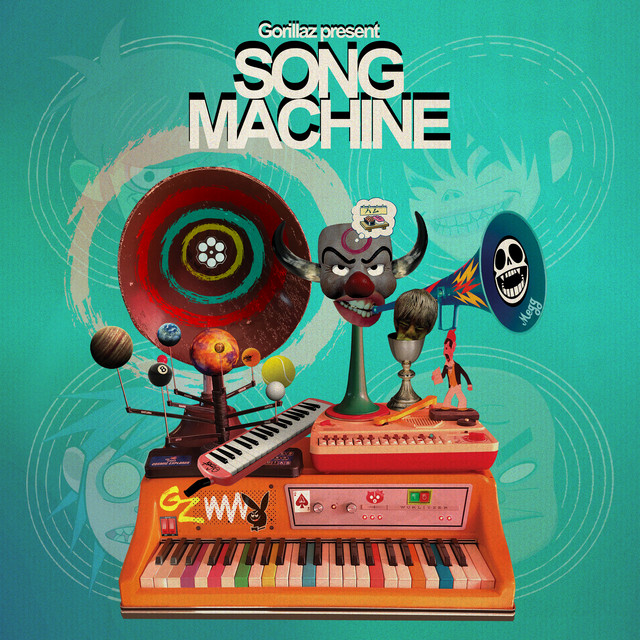
Gorillaz · 2020
Producer -

Eat Static · 2015
Recording Engineer