
miguel_angelo's Reviews
98 reviews Back to miguel_angelo's Equipboard

983
One of a kind!
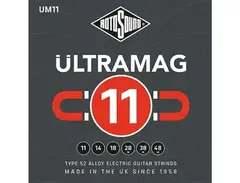
High quality strings!! From my experience the plain steel strings are not as strong as D'Addario NYXL, but they do have a special bark that sets them apart, definitely more mid-bass pronounced and a little higher output in comparison with the NYXL's. "Beefy" is the best word I can think of to describe their tone. Rotosound blends 52% nickel and 48% iron to achieve this highly magnetic string. I always lower my humbuckers a bit when I put these on which gives me really great dynamics and clarity. I also learned to avoid using string conditioners on these, like GHS fast fret, as it seems to accelerate their corrosion, so I just wipe them with some soft and dry tissue. Color coded ball ends are convenient and the packing is simple and effective, producing minimal waste.
983
Does the job
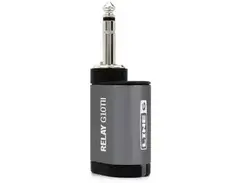
It doesn't have the biggest reach, but it works pretty well, providing no audible latency or noise. You can plug and unplug it without any noise or pop's, once it's unplugged it just shuts off.
983
An amp for every occasion
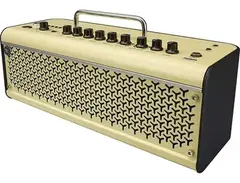
After ditching out amps with 12" speakers (sad reality of living in an apartment) and having integrated to great success small studio monitors with 3" speakers in my bedroom setup I decided to give this amp a try, it should sound and feel as good as my iloud Micro Monitors. Well to my surprise it felt even better! The amp features slightly bigger 3.5 inch full-range speakers (a must for my Piezo equipped PRS), each outputting 15W to a total of 30W of power.
This is a phenomenal piece of gear that every guitarist must try. The convenience of having a totally wireless unit (also using the Line 6 G10 Relay) is amazing and invites you to take it everywhere. But besides this convenience this little fella puts out KILLER tones, Yamaha's VCM technology is still really up to date and doesn't shy away from ANY of the competition, Spider V, Katana, Catalyst... I tried them all and somehow the THR was the one that struck me the most regarding the amp's response to playing dynamics and volume changes on the guitar. Just unreal for a solid state amp. The Gain and Master knobs are the true magic of this amp and offer really impressive pre and power amp interactions. And then the extreme convenience of a global volume output let you dial ANY combination of Preamp and Poweramp at ANY volume. From perfectly civilised to outrageously loud for such a small amp. I have not gigged with it yet, but I have tried some louder settings and man, I really think it can hold up against a loud drummer, definitely suitable for small gigs. I can surely summon the police with ease.
The THR editor app for Iphone and Mac works like a breeze. Bluetooth connection is instantaneous and the handy "audio" knob at minimum position makes sure I don't get scared if my phone rings while I'm playing, and also allow to find perfect blend between Backing tracks and Amp volume. With the app you can access more settings and effects, like different guitar cabinets, a noise gate and compressor, as well as settings for the effects. Worth noting is that all the standard modes on the amp have their own combination of cabinet, and if you change say the noise gate and cabinet, toggle to another mode, and then go back to the previous, it has reseted to the factory setting again. The only setting that is actually globally memorised throughout the modes is the delay type you choose (digital or tape). So I'm not sure why the Reverbs, Compressor, and specially noise gate (which I never use and ruins the special mode IMO) don't behave like this. Fortunately there is a workaround (kind of), saving your changes into presets, my 4th and 5th memory presets are set as effect presets, 4th preset I have the Modern Lead Amp with noise gate off and Plate Reverb and 5th the Classic Special Amp also with noise gate off and Plate Reverb. It wastes two of the five available preset banks, so it's not great. The idea with the presets is that once you recall them you should only mess with gain, volume and EQ, if you touch the effect section or amp mode it will forget your setting and go back to factory setting. For example for preset 3 I have 100% wet delay and reverb with long decay, but if I touch the effect knob just slightly it will reset the whole setting... This is really the only slightly negative point I can find in this amp. But hey, this is designed to be simple and straightforward, not to be a full blown modeller. And I love it's simplicity and the factory settings for the effects are nicely tuned. I just really wished the effects types (Gate, Compressor, Reverbs and Modulation) would be globally set like the Delay Type.
I wont stretch to much on commenting on the amps, you have all the classics emulated and all share the same quality overall, of course I have my preferences, the Modern Clean, all the Crunches sound terrific, Classical Lead is amazing Marshall emulation, and the special modes are ultra responsive to volume changes.
The flat mode is also nice to achieve Solid State like tones or to plug other instruments. The piezo, mixed feeling, the mic emulations are not that great IMO, but the gain knob acts as a blend between piezo pickup and microphone emulation, in in between you can get very nice acoustic tones, I just don't really like it all the way to mic side. None of these modes feature cabinet sections.
The effect section are OK, not being the strongest trait in this amp, but their more than decent and good enough for me to ditch any effect pedal, I'm not interested in using external effects that defeat the wireless features. The amp features Compressor, Noise Gate, Chorus, Flanger, Phaser, Tremolo, Digital and Tape Delays, and 4 Reverbs (Spring, Plate, Room and Hall). Each effect has control (via THR editor) over classic parameters such as tone, speed, depth, mix, delay time and repeats, reverb decay and pre-delay, etc. Very nice to have them on board. I just wish there was a wow and flutter parameter for the tape delay, as the stock is a bit too much fluttery for me. I just stick to digital delay with tone all the way down.
Finally there are the extremely cool Line Outs, which is just awesome to have since it turns this amp into a head amp that can go direct to a PA or sound interface.
The USB out works well and provides low noise and nice level at any gain setting. Unfortunately it's fixed 16 bit, with choice of running at 44 or 48 Khz. Not a big deal since you have the line outs, but worth noting. You do have the possibility to choose between Amp output or DI output for clean recording or use with other amp simulator VST's.
One last comment regarding the aux in... If you think this is a stone age feature you are wrong. You can use it with the line outs to create a Post Power Amp FX Loop! For example, you take the stereo line outs into a stereo looper/delay, then the outs of the pedal adapted to a stereo trs mini jack into the aux in. How cool is that??
Positive points:
- Classy looks (my girlfriend loves it)
- Possibly the best overall wireless desktop amp, portable and lightweight
- Line 6 GT10 integration
- Incredible dynamic response and volume
- Top notch amp sims with amazing pre and power amp interaction
- Great bluetooth integration for music playback and THR editor
- Line outs are a great bonus and make it possible to use as main amp in gigs and rehearsals
Negative points:
- Very weak headphone amp (can't drive my 80ohm Beyerdynamics)
- USB out limited to 16 bit
- Missing global settings for the effects
- Only 5 presets available
- A bit on the expensive side

983
Classic tone and feel
I'm the kind of guy who prefers EL34 to EL84 power tubes, but can't really discern between Sprite and 7Up. These strings sound and feel as good as Ernie Ball Slinkies, but come in a more environmental friendly packaging, like D'Addarios. These PRS strings feature brass ball ends which I enjoy most, for the looks. So it's the perfect match for me, great playability, less waste, nice looks. I read around the internet they are rebranded D'Addarios made to PRS specs. I also read that Marlboro uses the same tobacco leaves as L&M, just a different cut and pack. Right now I prefer Marlboro cigs, Sprite, and PRS strings. Have a nice day!
Edit: I turned down to 4 stars because the strings don't offer the same tuning stability as other brands. I thought it was my guitar's neck that was changing due to temperature and humidity, but even after 2 weeks the strings still don't offer the same tuning stability as say the NYXL's.
983
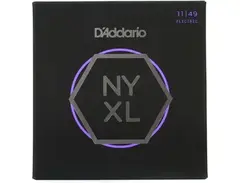
The Standard
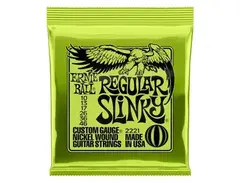
Competitively priced, great sounding, available everywhere, classic feel, balanced tone, played by legends... I love them and I also prefer the brass ball ends looks. But comparing it to the competition and discriminating every single trait, there is one negative aspect: packaging. One pack produces considerably more waste than any other string set I've bought. Besides the dense plastic outer wrap each string is individually packed inside a paper wrap. So it produces way more waste than a set of D'Addario's for example. I mean it's not the end of the world, I always recicle the packaging, but these are probably the most sold string set on the Planet, and being such a high grossing company they could set an example.
983
Modern Standard, long and stable lifespan
Can't go wrong with these, They feel great and last long. No doubt the strongest string I ever tried, never broke one. They're definitely on the bright side with high output. Lots of finger grunge on the wound strings. Compared to the .10's these sing louder and impart a bigger more full bodied sound, great for Jazz. Thumbs up for environmental friendly packaging and paints. Colour coded ball ends are super convenient also.
-s.webp?v=1785017067)
983
Modern Standard
Can't go wrong with these, They feel great and last long. No doubt the strongest string I ever tried, never broke one. They're definitely on the bright side with high output, lots of finger grunge on the wound strings. Thumbs up for environmental friendly packaging and paints. Colour coded ball ends are super convenient also.
983
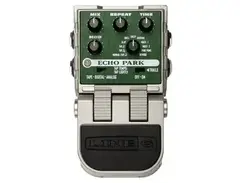
Best compact digital delay
This unit dethrones any competition in the compact stereo stompbox format. Everything I missed in the Boss DD7 (my first ever effects pedal) the Echo Park has, namely trails, modulation knob, and separate voicings/modes. It looses looping function, but the sounds and added flexibility make up for the absent looper.
I was very lucky to find a brand new unit on an old local music shop (2022), and for 140€ with full warranty this 2003 built pedal is still very much up to date.
Very well thought out pedal, built like a freakin' tank, only negative thing I can point out is the mix and mod knobs are kind of fiddly, offering different degrees of resistance/drag, which makes fine tuning kind of tricky.
Positive points:
- Compact stereo delay;
- Dedicated 3 position voicing/mode switch;
- Each mode has its own specific modulation type, tape (wow and flutter), digital (chorus), analog (vibrato);
- Digital mode with maxed repetition provide infinite and steady repeats;
- Analog and tape mode with maxed repetition provide stable runway oscillation without need to bring mix down;
- Mix knob offers 100% wet at full clockwise position;
- Great functionality via Function knob, with filter sweep, volume swell, ducking, reverse, etc;
- 2 great multi tap settings and ping pong for rhythmical stereo delay taps;
- 9V battery ready, low power consumption, 40 to 60 mA current draw;
- Can also be used as chorus/vibrato/filter pedal, as well as a auto volume swell;
- Super silent operation using internal 9V battery;
- No discernible colouring of signal.
Negative:
- Small knobs and irregular pot drag/resistance;
- Requires a pretty hard press to engage bypass;
- Can't find info on I/O impedance.

983
Reliable, fast and portable
Pretty happy with this M1. Runs DSP heavy VST's with ease. Some bugs using Amplitube, but Guitar Rig 6 is super well implemented and stable. Also there are no drivers whatsoever for any device you plug in, every operation is straight forward taken care of by opening Audio Midi Setup. For new players Macbook comes with Garageband, which is pretty incredible for a first DAW. Also, since it has the magic touchbar, there is this unique and free synth app called Samplr Touchbar, any user MUST try this app! Also I've seen some folks integrate it for various commands and customisable controls for various softwares.
983
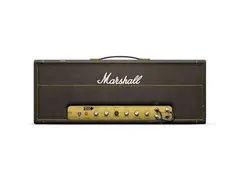
Desert Island Guitar Amp Simulator
I love it because it's medium/low gain sound is so rich and responsive to the guitars volume pot, I think it's one of the best amp sims out there, period. Never played the real thing but I believe Softube and Marshall made an effort to replicate a very specific "golden unit" from Marshall's vault.
This plugin just delivers amazing results in a very simple yet very flexible plugin, featuring the classic non master volume amp section with jumpable inputs and 3 "channel strips" to power up your tone, each with it's own unique character: VALVE, FET, DYNAMIC and OFF.
Each of the 3 modes feature a different mic preamp topology with two corresponding speaker microphones and one room microphone (for some air), and some handy high and low cut filters on the main out. Each microphone has independent volume and pan. One stop shop for great guitar tone!
I can easily enjoy some of the best Hendrix single coil tones I ever heard, as well as some Mark Knopfler Humbucker tone (seriously tasty Brothers in Arms tone*), some Jimmy Page tones... The resemblance to the original records is uncanny. I bought it with crazy 90% discount via the plugin suite that's included with the UAD Volt 276 interface, what an amazing value! Sounds so good that I never used other IR's with it.
If I could only have one Amp Sim, it would most likely be this one.
Highly recommend!
*Mark Knopfler recorded Brothers in Arms track with a Gibson Les Paul and the Marshall JTM45, not the 1959 Super Lead
983
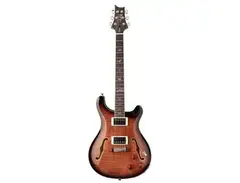
Absolutely fantastic instrument
Before talking about the PRS let me just do a quick intro that may inspire you to save some money... Before this I made the crazy move and bought a brand new 2021 Figured Gibson ES-335, a 3300€ guitar which I later sold, it featured:
- Pleked fretboard, 5 star playability
- Most beautiful guitar I ever laid my eyes upon, stunning figured top and back, amazing gloss nitro finish;
- Played very well, great action, great intonation, some minor buzzes;
- Didn't love the pickups (too hot and compressed).
- Volume pot developed severe cracking very fast.
- Didn't love the weight (4,5 kg)
- Tiny workmanship flaws in fingerboard, binding, headstock...
- Terrible tarnishing start appearing fast on the nickel hardware.
Although I loved it I decided it was just too much value to hang out of home, and was a bit disapointed with some quirks on the finish, a lot of cracking on the pots and noisy/faulty neck pickup, so I decided to sell it and re-invest on a new mid-priced guitar that was as well constructed but didn't cost + 2000€, something like a used Ibanez JSM100 (I previously had the JSM10 and loved it).
I never before played or even considered buying a PRS guitar, although I always digged the idea of a guitar body design that had both Fender and Gibson influence. I knew I wanted a semi-hollow maple body with 24.75 scale on a mahogany neck with quality fingerboard and even frets. So my research was down to:
- Japanese Ibanez JSM100 (2300€)
- Japanese Yamaha SA2200 (2000€)
- Indonesian Ibanez JSM10 (1090€+600€ hardware upgrade and plek service) * I had this guitar before
- And the last-minute contender from China, the PRS SE Hollowbody II (1359€)
I was aware of the American made 4600€ PRS Hollowbody II Piezo with it's beautifully carved solid maple tops and backs, but not an SE version of it with more traditional laminate construction and a nice 1300€ price tag. I was very interested as soon as I learned about it, but was uncertain about two things, the slightly longer 25 inch scale and the solid wrap-around bridge instead of the most classic ABR-1 bridge and tailpiece.
It was really great to find it in a local store of mine, had the chance to try it in person, 30 min after testing, I imediatelly bought it. I believe it's actually the most expensive SE at 1300€, and you can feel a lot of effort and attention was put into this guitar... My honest first impression was that it felt at least as good as my previous Gibson ES-335, and even better in some areas.
- Amazing and flawless construction, oiled neck, polished frets, damn even the maple binding on the F-Holes is exquisitely finished;
- Superb action and intonation;
- Very light weight with no neck dive;
- BIG resonant sound with great dynamics, great to play unplugged;
- Amazing pickups
- Amazing tuning stability
- Internal buffer and flexible outputs
- and of course, the most distinctive spec, the LR Baggs preamp.
Man I've got to say the bridge feels like a work of art. It's super confortable to rest your hand, super stable, and allows for fine adjustments in any direction for proper string setup (intonantion, buzz, string height). It definitely can deliver excellent performance, I dare to say it's just better than the ABR thanks to longer sustain and better tuning stability. Underneath the bridge there's a small plug that connects the piezos through a tiny hole under the bridge to the preamp. Basic maintenance is a breeze.
Ebony fingerboard (à lá Gibson Custom) with mother of pearl bird inlays looks and feels stuning, old-school mahogany neck and sides, laminate maple top and back with figured maple veneer and binding (yes, it costs 1/3 of a Gibson and it has figured maple binding, including on the F-Holes!). I must really applaud the craftmanship, Cor-Tek make these guitars to PRS specs, but make it in full style and attention to detail. The guitar is completely hollow inside (almost), with the only exception being a block of wood connecting bridge and back of the guitar. I was afraid it would neck dive due to mahogany neck and ebony freatboard, but the maple and mahogany on the body nicely balance the instrument.
At first I didn't really pay attention to the piezo side of it, but meanwhile I ended up incorporating it's dedicated piezo output to great success, the LR Baggs piezo bridge produces very big and rich acoustic sounds, as good as my Yamaha CPX 900 with state of the art transducers and preamp, and the ability to mix it just a tiny bit with the magnetic pickups is really a work of magic, especially if you're playing jazz and want to bring additional presence and body to your magnetic sound, the scooped nature of the piezo preamp really compliments the AMAZING 58/15 S pickups. The pickups are low-medium output with amazing dynamics and a nice warm and midrangy sound. Honestly these are some of the the best pickups I ever played, and they are potted(!), I don't know what kind of black magic PRS incorporated here.
My favourite feature on this guitar is it's routing options, you can run it as simple passive pickup guitar via the "MAG" output with all of it's impedance variables and no buffer or battery, just pure passive experience. Or, you can just run the "MIX/PIEZO" output and have the whole signal cleverly buffered inside the guitar with independent volume for pickups and piezo. Honestly this is the best way to get full power from your passive pickups, no matter the ammount of effects or size and quality of your cables, the internal 9V battery powers a super transparent buffer that can drive even low input impedance interfaces. I remember before with my Ibanez JSM-20 I had a crazy ideia of taping with velcro a mini buffer pedal on the lower back of my guitar, had a small but super high quality patch cable running the output directly to input of pedal (I was using the Xotic Super Clean for this, with 9v battery inside). My objective was to avoid as much as possible losing high end due to cable impedance, but I didn't want to use active pickups. This PRS SE Hollowbody II Piezo does the same (or not, as you desire), except it is much more conveniently installed inside the guitar. Here is a link to PRS wiring diagram https://support.prsguitars.com/hc/article_attachments/4420458056219/prs-se-hollowbody-piezo-wiring-diagram.pdf It looks like the tone and volume are wired to a 50's wiring, but I'm not sure...
The way I'm running it for practice is both outputs direct to the two inputs of my Volt 276 interface, the MAG pickup into hi-z instrument input (1 MegaOhm) and the piezo into mic input (3 kOhm, although you can get extra high end if you switch to Hi-Z, but it has too much volume for me and I honestly enjoy the warmth of the Lo-Z mic input), one going left and the other going right, then I have Guitar Rig 6 running 100% wet effects (delay and reverb) and I toggle direct monitor on the Volt so I have glorious fat and defined DI sound with no A/D conversion, just the Volt 276 Compressor and Vintage EQ and a wet digital insert on top running reverbs and delays. To record or play with amp simulators I disable direct monitoring, compressor and EQ, and mix wet/dry on Guitar Rig. Super happy.
Once you have both outputs being used the mix/piezo output only outputs the piezo. So on my left channel I have my traditional 100% passive pickup tone experience with nice and clear 1MOhm input impedance. Here I can place any fuzz, wah, delay, and play around with the volume and tone pots of the guitar and get proper passive behaviour from those (also important if you're running virtual amp modellers). And on the right channel, whenever inspiration asks, I have a hi-fi piezo tone, to beef up some parts or to completely change to an acoustic character. And then a whole new world of effects come to mind, like running 100% wet effects on the piezo output like a dirty tape delay that you summon anytime with a simple volume sweep on the piezo knob and let it trail out on the background while you riff your humbuckers. That's IMO a killer feature and a hell lot of value for the price.
This guitar can do everything and anything, and do it in style. The flamed maple veneer is very beautiful and the Black Gold Burst (kinda like a deeper sunburst) contrasts nicely with the ebony fingerboard and mother of pearl bird inlays, lending it a modern classic look. It plays as well as 3300€ Gibson yet costs 1/3. If you're looking for a set neck ES-335 inspired guitar I strongly suggest you try this guitar. If you don't notice the SE on the headstock it will probably feel like a USA made instrument to you. Sure it doesn't have a nitro finish, but one day I might honestly get a luthier to refinish it in high gloss nitrocellulose. That would be like a 150€ job at worse. The Gibson's lacquer was very effective in keeping dust and fingertips off the finish, as well as looking STUNNING. This sticky Polyurethane finish is the only slightly negative point about the guitar. It's well applied and all, but just can't compete with the neat shine of Nitrocellulose.
Also worth to mention these Chinese made guitars are set up at PRS United Kingdom headquarters before being delivered in a decent hardcase with some tools to EU clients and stores, like a final QC control with a QC check chart. Indeed the guitar was PERFECT straight from the case, featuring Daddario NYXL strings. The guitar had been sitting in the store for only 1 month. Nicely delivered, bravo PRS!
983
Beautiful piece of gear
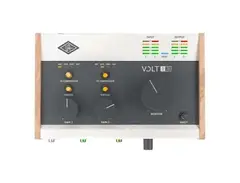
I previously had (and reviewed here on Equipboard) the Volt 2, but it had some minor quirks I wasn't enjoying so I decided to replace it with the 276 mainly due to better control layout and proper visual metering, but I was also curious about the compressor. I was pleasantly surprised by the upgrade and can say the 100€ price difference is worthy, and not just because of the compressor. I'm not sure if the Volt 2 has a different Quality Control (maybe the 276 has tighter tolerances?) but really the 276 feels a bit better in almost everything, so here are the 4 main differences I noted between the two units I tested:
Layout and metering are obviously much improved on the 276, the Volt 2 front panel was just too crowded and made me accidentally hit wrong buttons. Operating the 276 is way more convenient.
It's heavier and bigger! Now I can switch the power button without pushing the unit out of it's place.
Headphone amp on the 276 definitely has a bit more power, at least on my units. Julian Krause didn't notice it in his measurements, that's why I'm guessing it has to do with tighter QC on the 276.
Monitor knob on the 276 feels to have a bit less steep logarithmic curve, in other words it feels more linear compared to the Volt 2.
276 doesn't make speakers pop when turning on power, unlike my previous Volt 2.
And of course, the 276 has the built in compressor/limiter.
If none of these are important to you then I suggest you spare yourself 100€ and check out the Volt 2, as it sounds just as good as the the 276.
The interface is solidly built, sounds terrific and has a really nice design with that vintage mojo to it. I like it's "vintage" EQ setting and found the compressor very useful to limit and beef up piezo equipped guitars.
As for the compressor, "inspired by the UA 1176 limiting amplifier"... Of course it's not even close to an 1176, I'm really not sure what kind of circuit it is, but my guess is just a very simple FET limiter/compressor. You can't blame Universal Audio for the Marketing, and you can't expect for it to behave like a unit that costs 10 or 20 times more... Switching it on it boosts your signal by +7dB, which also raises noise floor (as expected). The FAST preset is nicely tuned for the maximum gain of the 276 preamp so that you can never actually never clip your signal, it limit's it (very hardly indeed) to -3dB, even if you use boost or overdrive pedals. It has a fixed ratio of 6:1, and the 3 different presets have different values of attack and release. According to the manual these are the values (approximated):
- VOC Attack 2 ms / Release 300 ms
- GTR Attack 1.5 ms / Release 700 ms
- FAST Attack 30 µs / Release 35 ms
Since you can't clip your input using the FAST preset it makes me guess that the compressor circuits are placed after the preamp and before the AD conversion. This is a unique feature on the Volt 76 range, since it allows you to intentionally generate from light to pretty intense analog distortion without clipping the digital converters, which really lends itself to experimentation, like you would on an analog console. I found myself using the unit standalone without plugging it to a computer (yes, it's possible!) using a 5V phone charger (don't risk plugging anything with more than 5V!) and enjoy really dirty console like distortion, using the fast setting on the compressor you guarantee your converters never clip (thanks to ultra fast attack time). Actually you can power it and play "direct" standalone from a 5V phone charger with both USB-C and standard 5.5mm x 2.1mm barrel DC connector, center negative! The unit even recalls your last settings compressor and vintage settings after power cycling, really nice touch!
If you think about it you actually get no one, but two independent compressors, one for each input, as simple as they are it's a feature that adds value to the Volt 276 IMO. There maybe some very nice compressors on the market around 100-150€ price range, like the Wampler Ego Mini, and you can say that's a way more flexible compressor, yes, but the convenience of having a simpler compressor that's built into a bus powered audio interface with xlr combo inputs and phantom power, that might appeal to a lot of people.
Overall I liked the Volt 2 very much, but I gotta say I love the Volt 276. I highly recommend both.
I hope UA adds loopback functionality in future firmwares and develops some kind of virtual console. If you could tweak the compressor values and direct monitoring level on this hypothetical virtual controller (it must be possible since the analog compressor is most likely digitally controlled), that would definitely place the 276 as the new King of non DSP audio interfaces.
Oh, and for guitar players, there is an AMAZING discount for Softube's Marshall Plexi Super Lead 1959, the plugin costs 100€ but registering your device you get something like 85% discount!! I just payed 12€ for it!I honestly think it's one of the best Marshall plugins out there.
983
My first amp
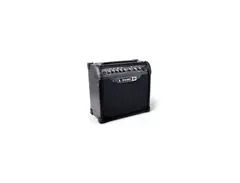
This was my very first electric guitar amp back in a day. Had a great time with it. Small and portable, tough as steel and good power for home playing. Cleans were ok, overdriven sound was not very dynamic, and the insane mode was just insane (not in a good way), but the cleans are pretty usable. Now you can find these dirt cheap on the used market, and I think it's still a good purchase for a begginer or anybody who just wants a cheap, small and rugged practice amp.
983
Amazing audio interface
This is a high quality device made in Italy. It specs out most of the competition with amazing dynamic range and amazing headphone amp, but what really sets this interface apart is:
The amazingly simple impedance knob, which really allows you to taylor your sound and the way your guitar's volume pot works in conjunction with the amp sims you're using. So simple yet it enhances passive pickup experience, I rediscovered some Marshall Amp Sim Plugins thanks to this simples knob, get's rid of a lot of harshness, it round's and warms up your overall tone.
The multiple input topology is another amazing feature, the inferface easily accepts active pickups, passive pickups, ultra low noise and hi-fi DI or warm JFET input. Simply amazing. Plugin my PRS SE Hollowbody II piezo output to channel 2 line input and the humbucker output to passive JFET input.
CV inputs, built-in tuner, and programable rotary/switch knob really set this interface apart from the crowd. You can plug a conventional expression pedal and two switch selector and have them mapped to anything in seconds. You can also program it's preset selector to control any parameter on your DAW, like presets, start/stop, markers, etc.
Tuner switch can also double as a monitor mute.
Superb headphone amp, with huge power to drive high impedance headphones.
Comprehensive controller application (although it always asks to be updated, even though it has the latest firmware)
Highly recommend this one. I also recommend Amplitube 5 Max pack (I got this one), although I had a couple of issues using the standalone app in Macbook M1.
Only thing missing is loopback, hope they add it in future firmware upgrades.
983
Very nice, but could be better
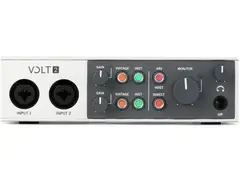
The interface is solidly built and sounds very good indeed. Compared to other interfaces in the same spec/price the Volt is better at almost everything, including headphone amp, input dynamic range, and noise floor. Also it's built in EQ filter (vintage button) was the most usable of all other brands I tried, but that's all subjective of course.
Midi I/O is a welcome as well as power switch and also the possibility to power via DC adapter or USB-C. Vintage mode adds a nice colour to your sound, which can be useful. Instrument button toggles to 1 Mega Ohm impedance, which is great for connecting passive instrument pickups. 48V phantom power has 5 second delay, blinking warning and mutes your out's to avoid loud pop's, nice. USB-C connection is also a plus, and UAD even includes a USB to USB-C cable and USB to DC power cable! I was really surprised because the more expensive Apollo's don't include any cable. Power button is there! Love it, although it is kind of hard to press, since the unit is so light I had to hold it with one hand while pressing the power switch with the other.
Things I dislike:
Poor visual metering, only two tiny LED strips, the top one changes to orange to display -3 db and red is clipping.
The controls layout feels a bit too cramped next to each other, many times I was hitting the wrong switches, thankfully the 48v has 5 second delay but still it's impossible to cancel it's activation, if you press it accidentally you must quickly unplug any sensible gear. Also it's really difficult to operate it with low light because all the buttons in the two rows are identical;
Monitor knob is not linear, instead the volume get's a lot louder only in the last quarter of travel;
Direct Monitor button is nice, but it's impossible to blend DI with Processed sound, you have to lower your master out on your daw to get the same level;
Headphone amp is very good but it could use a bit more power, although I had no problem using 80 ohm cans, but I had to max the output level, so I would't recommend using higher impedance headphones;
No loopback feature (which is handy nowadays but inexplicably absent from this unit as the time of writing this review);
No dedicated virtual controller/mixer (as of time of writing this review);
Bundled software could be better. Relab LX480 Reverb is very nice and also Softube's "Lite" version of the Marshall Plexi is great, one of my fav Marshall emulations.
Why do UAD include Ableton Live Lite and not adapt their amazing Apollo Console to the Volt series, so it integrated with Luna? Beats me.
As far as sound quality and I/O performance It's a solid 5 star interface. I'm thinking about upgrading to the Volt 276 just for the cleaner layout and proper metering display. If that's not important to you then I highly recommend this unit.
983
Does the job
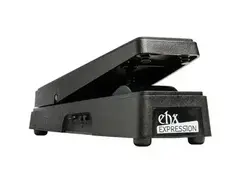
Does the job pretty well and has a bunch of handy features like polarity reverse, etc. Plastic housing is not the best, but the rocker feels very good and precise, travel is small, similar to regular cry baby. For the money I highly recommend it.
983
Almost perfect
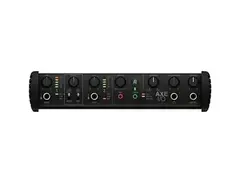
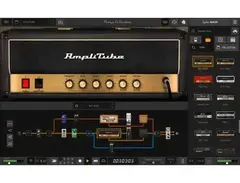
After completely migrating to a totally digital guitar rig with the Universal Audio Apollo and Softube Plugins I decided to change to Amplitube 5 with the Axe I/O interface. The Axe I/O is a superb interface, but using Amplitube 5 standalone app with a M1 Macbook was not that pleasing with multiple bugs such as:
- Axe I/O controller software always asking for updates when it was up to date;
- Impossible to open projects directly from project files, must run amplitube in default mode and then open project after saying no to save the current default project I didn't even touch;
- Sometimes when running dual amps the app simply crashed, I would say 30% of times;
- No count in for recording (maybe there is, I just couldn't figure it out);
- Expression control pedals as wah and volume wouldn't get recorded (again, maybe I'm just dumb);
- Effect pedals and racks we're on the avarage side, none of them really stood out, octaves are just bad IMO.
- Very confusing to switch between record mode, looper mode and live mode, as changing between them also changed the whole rig;
- Older legacy amps and effects just can't compete with newer stuff, but everything is mixed up;
- Navigating amp or effects section is not smooth, since the drop down menus won't stay collapsed if you switch menus from amp to pedals for example.
- Only a few wah pedals have auto-off option...
What I did like was the ease of use and sound of the amps, super easy to assign midi controlls including expression pedal connected to the CV input of the AXE I/O. I really liked the Fenders and Orange, didn't really like the high gain amps. The tuner is very good and the cabinet section is just amazing with infinite and simple tweak-ability.
If it weren't for a couple of minor annoyances related with operation with M1 macbook, I think this is a really solid product from IK Multimedia well worth it's price.
I was also disappointed the MAX version didn't include the new X pedals.
983
High quality device, amazing console interface
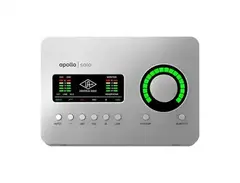
This device marked my transition to digital guitar rig's, I just couldn't properly enjoy my amps in my apartment and I also wanted something I could take with me to a hotel bedroom when out for work for long periods of time. I was blown away with the results, it gave me the best tones I ever had and helped me manage my GAS. The convenience of plugging headphones and play silently with awesome quality and the portability factor have totally converted me. My girlfriend also enjoyed the extra space my amp's left in our apartment.
High quality converters and preamp, amazing headphone amp (using DT770's, 80ohms, loud and clear), internal DSP and Unison tech makes this a very appealing interface for the guitarist on the go, very simple operation, just plug and play using Console. I eventually grew tired of the limited guitar oriented plugins available from UAD. But I can say the Fender Tweed and Marshall Plexi sounded phenomenal with no latency and amazing response to boost pedals and interaction with the volume of the guitar.
Positive points:
- Gain staging is a breeze, the main controller knob cycles between preamp level, another preamp/tone control, and master level;
- Plug and play with only a thunderbolt cable, the unit and console automatically recall your last settings. I didn't even have to open any software, just turned on the computer, plugged apollo in, waited no longer than 5 seconds, and bam!
- Internal DSP means your computer is really just a controller, so no load on your cpu and absolutely no perceivable latency (only with DSP driven UAD plugins of course).
- Beautiful and robust design, simple yet powerful interface, amazing sound quality. Very inspiring unit indeed.
Negative points:
- Doesn't include a thunderbolt cable (and those are quite expensive)
- No tuner included. Not even possible to buy a Tuner plugin.
- Guitar Amp Sims take up a LOT of DSP power. Using Fender Tweed I could only throw in either a Chorus or a Reverb, not the two.
- Not possible to manually adjust the instrument input impedance, which is a shame since it can actually do that, but only automated depending on the plugin you're using on the Unison slot. But would like to mess around with that.
Although this is a high quality device I think guitarists that simply plug Direct in instrument input are better of using something like a physical amp modelling unit (Helix, Iridium, etc) or if they have a capable computer just a regular audio interface with good dynamic range on the instrument input and use VST's (Amplitube, Bias FX, etc).
But to record your own amps and microphones this is a really outstanding unit that doesn't get in the way of your creative process.
983
My first electric guitar
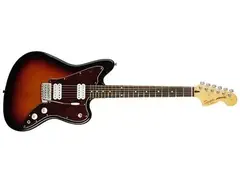
Had a nice time with this guitar back in the day. Loved it's ease of use, finish and the shorter 24 inch scale was a joy to play. It was borrowed from a friend who Modded this guitar heavily, scuffed the paint off, installed acoustic pickups (terrible idea). The pickups sounded quite nice. For the price it's an excelent guitar that covers pretty much all your needs.
983
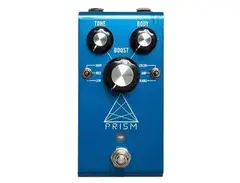
One boost to rule them all
This is a very special pedal indeed, it does so much and yet is very simple to operate. It's a booster, a preamp/overdrive, a buffer (1MegaOhm Input 100kohm output), and an active baxandall style EQ. Beautiful build, amazing sounds, really high end stuff.
The unit features 3 different and totally independent boost circuits, an 18V transparent JFET boost, a MOSFET "amp-like" boost reminiscent of the Echoplex inspired preamps (like the EP booster), and a Silicon Treble Booster. Of course Jackson Audio went for silicon and not germanium... It's just more reliable, has more gain, and of course is much cheaper... This Color mode is definitely the cherry on top of the cake, simply amazing!
When you engage the right mini 3 way toggle you actually hear the internal relays engaging to send your signal to it's respective circuit (there is the slightest silent delay when switching them). The other 3 position mini toggle works like a "drive" knob, but instead of a potentiometer Jackson Audio gave us a switch, I like it, it basically runs the circuits hotter or cooler, the coolest being the highest headroom and hottest being the dirtiest and most characterful.
Anyone who enjoyed pedals such as the Chase Bliss Brothers and Condor will definitely love this. The post boost active EQ is genius and sounds soooo good, just perfectly tuned for guitar, really allows you to taylor your sound without ever sounding over the top. You can also use it as mids boost, since it cuts or boosts frequencies, just cut a bit of highs and bass and there you have your mids hump.
Honestly, one of the best pedals I ever tried, it's really that good.