
By Gear Experts
Table of Contents

Equipboard
Equipboard is the world's largest community of artists and their gear. Read our review process.
We are reader-supported. When you buy through links on our site, we may earn an affiliate commission. Learn more.
Our Picks


There’s never been a better time to buy a semi-hollow bodies guitar, but with all of the choices available choosing the right one for your needs can be more than a bit overwhelming. If you’re not sure where to start you’ve come to the right place! This article will give you all the information that you need to make an informed purchase, as well as giving you ten great recommendations to help aid you in your search for the best semi-hollow guitar for your needs.
What Is a Semi-hollow Body Guitar?
When most players refer to a hollow body guitar they’re referring to an electric guitar with dimensions similar to that of an acoustic archtop (but with a pickup), though technically there are ES-335 (a thinner guitar played by Chuck Berry, Eric Clapton, and B.B. King to name a few) type guitars that are also hollow bodied instruments.
The confusion comes from whether or not the speaker views the term “hollow body” as a classification for a type of instrument or as a literal specification. This tends to vary from musician to musician.
Hollow bodied electric guitars came about as a gradual shift from acoustic archtops to electric instruments. Professional musicians began attaching pickups to acoustic archtops once the technology became widely available. Companies then started selling guitars with factory installed pickups to meet the demands of gigging musicians. They also began attaching pickups in the way commonly seen today to increase the stability of the electronics in the instrument as well as help prevent feedback issues. This design caught on with musicians all over the world, but it was especially popular in jazz. Because this design was so popular in jazz the hollow body guitar gradually became the go-to instrument for those who wished to play the genre, which is why it’s still in use today.
Semi-hollow body guitars are similar to hollow body guitars, but typically have a solid block of wood running through the center of the guitar, with hollow wings. Semi-hollows do not typically have the feedback issues that pure hollow body guitars have, and have a bit more sustain due to the solid part of the body connecting with the neck of the guitar in a flow through construction.
Why Would I Need a Semi-hollow Guitar?
While these days you can play jazz on just about anything, many professional jazz and other musicians play hollow body guitars from tradition and stylistic choices. Hollow body guitars generally use lower output pickups with a warmer sound, which is ideal for the majority of jazz sub-genres.
For proof, look at Danny Gatton and Ted Nugent. Danny Gatton is one of the most highly regarded jazz musicians to ever touch a guitar, and Ted Nugent has a well earned reputation as “The Motor City Mad Man”. Danny Gatton played a Telecaster throughout the majority of his career, and Ted Nugent played a Gibson Byrdland (a hollow body guitar). Both musicians were at the top of their field, and they’re a great example of how most guitars are very versatile.
How Did We Select Our Recommendations?
At Equipboard, we think about what we play ourselves and our personal opinions and preferences. We also research what gear professionals are using and what our community is using to recommending and discuss the pros and cons of each guitar we highlight. As always, our recommendations are meant to give everyone reading this article a viable choice. We know that a $10,000 Custom Shop Gibson is generally going to sound better than a $200 Ibanez, but the vast majority of players just can’t justify that expense per the cost difference. When we recommend a piece of equipment in a certain category, we recognize the fact that everyone has a different financial situation and we definitely consider value as a big part of the equation. In short, the best option for you may not be the best option for your fellow musicians, but we showcase some of the best hollow body guitars out there so you can consider which one is best for you.
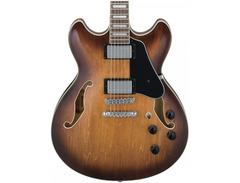
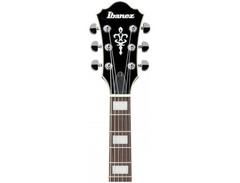
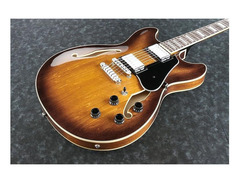
Ibanez Artcore AS73
4.5 (36)









Average Price: $443
Budget/Beginner
$500
$1201+
Budget
Standard
High-end
- Stunning finish and eye-catching design
- Versatile tones suitable for jazz, blues, and rock
- Strong, reliable tuners and quality hardware
- Smooth fretwork with no sharp edges
- See 6 more
- Neck is slightly fatter, might not suit all players
- Action might need adjustment upon delivery
- Some reports of scratchy pots and gritty frets
- Stock pickups may not satisfy advanced players
- See 1 more
Though as a company Ibanez is generally considered to cater more towards rock and metal enthusiasts, the brand has actually always put out some really solid hollow and semi-hollow body guitars. The brand has even been endorsed by some of the most talented jazz musicians to ever pick up a guitar,
While the Ibanez Artcore AS73 is a bit more budget conscience than the instruments played by the musicians who have endorsed the brand, it’s just as high quality of an instrument as anything produced by Epiphone, Gretsch, or Rondo Music at this price point. In fact, depending on your personal preferences you may actually find this instrument to be superior to other models that retail for a similar amount.
Right out of the gate, the most impressive thing about the Artcore AS73 is how lively the pickups are for a guitar at this price point. The pickups found in many budget guitars are dull and uninspiring, but the pickups found in the Artcore AS73 (Classic Elite in both the bridge and neck positions) are both remarkably articulate and surprisingly well balanced considering that this guitar retails for under $500 new.
Though it’s debatable how much this it effects the overall tone on a electric guitar, the AS73 is built with maple top, back, and sides. Some people claim that maple helps enhance high end frequencies in an instrument, though the effects of tonewood in an electric guitar have never truly been verified.
The scale length of the AS73 comes in at 24.7”, which will make it feel a bit easier to play when compared to a guitar that utilizes the more commonly found scale length of 25.5”. While it may not be a huge difference, an increase in scale length does correlate directly with an increase in tension. A guitar with a longer scale length will also have frets that are placed farther apart, which may make it a bit difficult for beginners to stretch their fingers to different frets for some chords. While this isn’t much of an issue for a musician who has been playing for awhile, it does make the Ibanez Artcore AS73 a bit more approachable for the beginner guitarist.
Surprisingly, the Ibanez Artcore AS73 comes with a set neck. The term set neck refers to the neck being glued into position, rather than bolted on. It’s a feature that up until now has largely been exclusive to much more expensive guitars. Though you won’t notice a night and day difference, a set neck definitely boosts the sustain when compared to a bolt on.
The AS73 comes in three distinct finishes, Antique Amber, Tobacco Brown, and Transparent Cherry. Unfortunately, unless you want to change out all of the hardware yourself (which is easy to do, but can get really expensive really fast) you will be limited to the factory standard chrome as the AS73 only comes with one hardware finish available.
As far as sound is concerned, when reviewed on its own merits the AS73 is competent but not extraordinary. The pickups are definitely serviceable, but they won’t have the clarity or tonal response of the pickups that you’d find in a higher quality instrument. However, swapping out pickups is a fairly easy job all things considered. That’s not to say the pickups are bad by any stretch of the imagination, there’s just a noticeable difference between the sounds the AS73 is capable of achieving and the sounds that something like a genuine Gibson ES-335 (the inspiration for the AS73) is capable of. However a Gibson ES-335 can run you upwards of $2000 at time of writing, so while it may sound better overall it doesn’t sound so much better that it justifies a $1500 price difference.
As far as overall quality is concerned, the Ibanez AS73 is on par with every other guitar in it’s tier. It’s just as rugged as an Epiphone, and it’s just as well assembled as any Fender. Obviously there will be guitars that have structural issues, that’s just life. There’s too many variables in the guitar making process to ensure that every guitar turns out perfect, and even if you could turn out a perfect instrument 100% of the time they can still be damaged by improper storage on the part of distributors or store owners. However, there is nothing inherent to the model that would suggest that the AS73 is inherently flawed. Just be sure to inspect the guitar at the time of purchase (or when you receive it should you buy it online) to double check that there aren’t any issues.
While it may not be on the level of an expensive custom instrument, the Ibanez Artcore AS73 will serve the vast majority of musicians very well. It’s undoubtedly a great buy for what it is, and in the hands of the right guitarist it really does have the potential to sound phenomenal.
See how artists use this








Fender Classic Series '72 Telecaster Thinline
5.0 (56)




Average Price: $725
Standard/Professional
$500
$1201+
Budget
Standard
High-end
- Versatile sound range from country twang to smooth jazz and hard rock
- Excellent combination of acoustic feel and classic Telecaster format
- Comfortable, light build with a chunky neck
- Durable, glossy poly varnish finish
- See 4 more
- Pickups can be muddy and require swapping for optimal sound
- Common buzzing issue that needs technical adjustment
- Heavier than typical Thinline models, around 8 lbs
- Thick plastic finish can feel less premium
- See 1 more
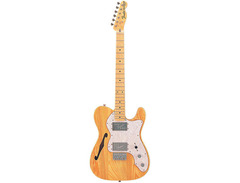
A reproduction of an American classic, the Fender Classic Series ‘72 Telecaster Thinline is a faithful homage to a guitar with a legacy unrivaled by almost any other instrument. Wielded by everyone from Keith Richards of the Rolling Stones to Jonny Greenwood of Radiohead, the Fender Classic Series ‘72 Thinline Telecaster presents an unparallelled value to the musician on the hunt for a versatile instrument.
If you’re considering buying this instrument, the most important thing you need to know is that it’s a very unique sounding guitar. In some ways, it’s a bit like a Gretsch. They’re still very versatile instruments, but some guitarists find them off putting because they don’t sound like a traditional Fender or Gibson.
The Telecaster Thinline series has generally come equipped with Fender Wide Range Humbuckers, designed by Seth Lover for Fender in the 1970s. These pickups have the character and output of a normal humbucker, but they’re geared towards high-end frequencies and retain clarity when used with distortion in a way similar to a single coil pickup. If you don’t dial in your amp correctly these pickups have a tendency to sound shrill, However, when paired with a good setup these pickups are capable of covering a very diverse amount of genres.
As far as construction is concerned, the Fender Classic Series ‘72 Thinline Telecaster is pretty similar to the majority of Fender guitars in terms of dimensions. The standout feature is the chambered ash body, which while it has a negligible effect on the tone it definitely does make the guitar feel significantly lighter. The neck is made from maple and features a “U” profile, which is a bit thicker than the more standard “C” neck profile. Though once you adapt the majority of players really aren’t going to notice much of a difference between the two different styles. The Fender Classic Series ‘72 Thinline Telecaster comes in two finishes, natural and 3-color sunburst.
The vintage-style string through body is also a huge plus. For those not aware, Telecasters generally come in two different configurations in regards to the bridge. Hard tail and string through. A hard tail bridge lies flush with the body and the strings are strung parallel to the neck. In a string through configuration the strings are fed through holes in the back side of the body. This enhances sustain and resonance, though a string through bridge is a bit more difficult to restring than a hard tail bridge.
While it’s a bit hard to describe the sound of this guitar, it can be thought of as the middle ground between a Fender and a Gibson. It’s clear and piercing but it still capable of moderate amounts of gain. It doesn’t have the warmth or breadth of tone that you’d find in something like a Les Paul, but it’s capable of approximating something similar.
The build quality on this instrument is representative of every other Mexican made Fender produced within the last 15 years or so. Though Mexican made instruments haven’t always been very high quality, factories all over the world have really stepped up their game in the last decade. The quality of current Mexican made instruments is almost on par with American made guitars. America is not the only country turning out high quality instruments anymore, and there’s definitely nothing wrong with playing a non-domestic guitar. In fact, though they might not be quite on the level of a good American guitar, a foreign made instrument is better suited to being a workhorse guitar because it’s generally more replaceable.
The Fender Classic Series ‘72 Thinline Telecaster is just as well made as any other guitar in its price range. You’ll never have to worry about this guitar letting you down when you need it the most so long as you perform proper maintenance and upkeep. As always, be sure to either play the guitar in person before you purchase it or purchase it from an online retailer with a fair return policy. While there aren’t any flaws inherent to this model, there’s always the possibility that you’ll run into a lemon.
While no guitar is capable of playing everything, the Fender Classic Series ‘72 Thinline Telecaster is among one of the most versatile instruments produced today. The build quality is great, and most importantly it plays incredibly well so long as it’s properly set up. While it may not be the most traditional instrument around, in the hands of the right musician it truly is capable of extraordinary things.
See how artists use this

.jpg)









Gibson ES-335 Memphis Studio
5.0 (3)

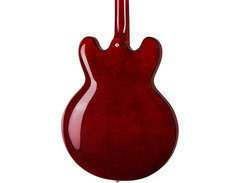
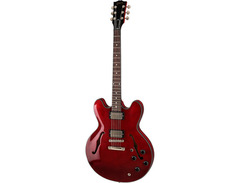
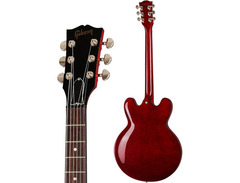
The world’s first commercial thinline archtop guitar, the Gibson ES-335 has a well deserved place in music’s modern history. Since its inception in 1958 the 335 has been used by some of the most notable guitarists the world has ever seen, including but not limited to Eric Clapton, Otis Rush, Warren Haynes, Dave Grohl, Eric Johnson, Chuck Berry, and Alvin Lee.
Though the guitar may be seen as a blues machine first and foremost, in the right hands it’s an incredibly versatile instrument. Everything from sweet modern jazz to crunchy garage rock can be achieved with this guitar, and though it may not be the most affordable option out there it’s undoubtedly a very high quality instrument.
This review is centered around the Gibson ES-335 Studio model, which is the most affordable ES-335 model that Gibson is currently producing. The Studio line has always been directed at working musicians, so while these guitars don’t have the bling you’d find on a Custom Shop or Memphis line instrument you won’t find it lacking in tone or playability.
With that out of the way, the definitive feature of the 2016 ES-335 Studio is that it comes with either 57 Classic or Super 57 humbuckers while the other ES-335 models come equipped with Burstbuckers. While the difference between 57 humbuckers (both the Classic and Super variations) and Burstbuckers are up to personal interpretation, the former is generally considered to emphasize high-end frequencies while the latter are generally thought to be a bit warmer and more well rounded.
The Gibson ES-335 studio features maple top, back, and sides as well as a maple center block. The effect the wood has on the tone is debatable, but maple is generally considered to enhance clarity and treble frequencies in a guitar. That’s why you see it commonly used on archtops and jumbo guitars.
While Gibson’s approach to building a semi-hollow archtop has been copied countless times, it does bear mentioning that this is not a fully hollow instrument. The guitar uses a maple block that runs down the center of the instrument. A center block performs a similar function to that of a soundpost in a violin. Both of these construction techniques make the top and back of an instrument resonate as one piece, which isn’t ideal in an acoustic instrument (this is part of the reason the Loar LH-400 never took off) it helps prevent feedback issues in a guitar that’s going to be amplified.
As far as construction is concerned, the ES-335 is a great combination of elegance and form. The one piece set maple neck helps provide stability and lessens the chance that the neck will deform or snap under strain, and the 17 degree headstock angle helps to increase resonance and sustain. The 2016 Gibson ES-335 Studio is available in two finishes, wine red (red, but a darker shade than Chuck Berry’s guitar) and Ginger Burst.
The Gibson ES-335 Studio is a vintage voiced guitar. While the Classic and Super 57 humbuckers are capable of achieving moderate amounts of gain, like other vinage voiced pickups they lose clarity at higher levels of distortion. Of course this can be compensated for based on your amp and pedal EQ settings, but it’s going to be a consistent problem. However, it does nail old school rock and blues tones perfectly.
As far as quality is concerned, the Gibson ES-335 Studio is comparable to any other mass produced American made instrument. In fact, Gibson’s Studio line is arguably one of the best values on the market in terms of quality control. The line is comparable in quality to any Gibson instrument, and because they’re more stripped down they cost significantly less.
However, you do have to be much more careful with a Gibson instrument than you do with other brands. Though the headstock angle does have a very positive effect on the tone of the instrument it does also make it more fragile. So be sure not to leave any Gibson instrument with a “paddle” headstock sitting out on the stand if you have pets or small children running around.
Though the Gibson ES-335 Studio isn’t the most affordable instrument around, it does present a great value to the musician who is looking for a professional quality instrument. There’s nothing about this guitar that’s lacking in any way, shape or form. While it may not be the perfect fit for everyone, if it’s good enough for some of the most famous musicians the world has ever known odds are that the majority of you will find that the Gibson ES-335 studio is a great fit for your rig.


Rickenbacker 360 Electric Guitar
4.5 (58)


Average Price: $2,466
High-end/Boutique
$500
$1201+
Budget
Standard
High-end
- Iconic and distinctive sound, perfect for 60s music and beyond
- Stunning aesthetics, considered a work of art by many
- High-quality craftsmanship with impressive finish and build details
- Easy playability despite the notorious neck reputation
- See 6 more
- String changes can be cumbersome and risk damaging the finish
- Narrow neck can be challenging for players with larger hands
- Single coil pickups can be noisy, lacking humbucker quietness
- New pickups may lack the brightness of traditional "toasters"
- See 1 more
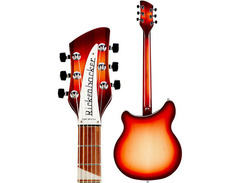
The trademark instrument of the British invasion, the Rickenbacker 360 (as well as its 12 string version the Rickenbacker 360/12) has been used extensively by some of the most famous musicians the world has ever seen.
The Rickenbacker 360 is well suited to musicians looking for a unique chiming tone (think Tom Petty and George Harrison) though the guitar is definitely no one trick pony, as evidenced by it’s use in Against Me! by guitarist Laura Jane Grace.
The signature Rickenbacker look, feel, and sound are completely exclusive to the instruments made by the brand. The company is a lot like Gretsch in that they fill a very specific niche. They’re not a guitar that’s ever going to be mistaken for something else.
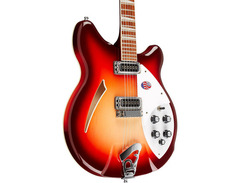
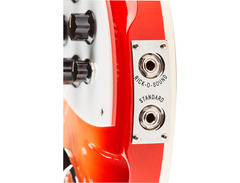
As far as features are concerned, the first thing most players notice when they see a Rickenbacker is the distinctive shape and appearance. The guitar is definitely an eye catcher, and though it may look a bit awkward at first glance most guitarists actually find the body shape to be pretty comfortable. The guitar is made with Rickenbacker’s “crecent moon” cutaway shape, and features rounded edges and a bound body. The neck of the guitar is also bound, which will help prevent fret ends from poking out of the wood in the event of rapid changes in humidity. The tailpiece is also a classy touch, though it’s a matter of debate as to how much it will effect the tone.
Interestingly, both the body and neck of the Rickenbacker 360 are made from maple. Tonewood doesn’t have a very noticeable impact on the tone of an electric instrument, though using quality wood is always a plus when it comes to overall feel and durability. The fretboard is made from rosewood, and features Rickenbacker’s unique triangle inlays.
The neck on the Rickenbacker 360 is a bit thinner than the industry standard of 1 and 11/16ths, though the difference is so small that it’d be relatively imperceptible to all but the most astute. Finally, the Rickenbacker 360 features a set in neck. A set in neck prevents enhances sustain and resonance, which comes in handy for musicians that find themselves playing with low to moderate levels of distortion.
It would be a disservice to Rickenbacker’s legacy to compare the 360 to another instrument. The guitar is so unique sounding that it truly is in a class of its own. However, there are a few elements that you should be aware of before you purchase this guitar.
The key thing to keep in mind about Rickenbacker is that at the end of the day their very “chimy” instruments. They have an almost bell-like quality, and that always shines through regardless of the situation. While this makes them a great fit for a lot of genres (everything from old school rock to Americana music in the style of Tom Petty and the Heartbreakers) it does mean that the instrument really is not an ideal fit for genres that require high amounts of gain. It’s not that the guitar can’t handle it, it’s just that it’s not the ideal sound of the genre. Which of course shouldn’t dissuade anyone from trying it, but if you’re trying to emulate musicians who play heavier genres of music you may find that you never really end up bonding with the guitar. This is especially problematic when you consider that a guitar (much like a car) loses about 30% of its value as soon as it leaves the store. As far as quality is concerned, the Rickenbacker 360 is on par with other American made guitars, which it should be considering that it carries a suggested retail price of $2499 (the source for this is the Rickenbacker U.S.A. retail price list, which you can find by searching “Rickenbacker 360 price” on Google. The result is a PDF file with retail prices effective as of February 18th, 2016).
The Rickenbacker 360 is a premium quality instrument, and while it may have a limited appeal for musicians looking for a more standard sound (there is absolutely nothing wrong with that) it does have a unique feel and sound that you just can’t get with any other instrument. The quality is superb, and though they may not be very easy to track down in the right situations you would be hard pressed to find a better guitar. Sure, it may not be the most affordable instrument around, but if you can justify the price you may find that the Rickenbacker 360 is the last guitar that you’ll ever need.
See how artists use this







Epiphone WildKat
4.5 (43)

- Stunning aesthetics with a beautiful flame maple finish
- Versatile sound suitable for multiple music genres
- Master Volume control offers excellent tone shaping
- P-90 pickups deliver a unique, punchy sound
- See 5 more
- Bigsby tremolo can cause tuning instability
- Visible wiring through the F-holes may require adjustment
- Some users report a "muddy" sound without modification
- Lacks separate tone controls for each pickup
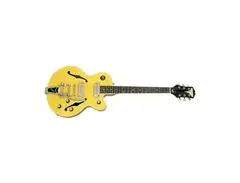
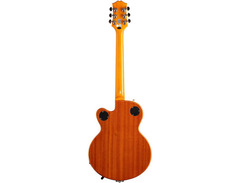
A unique and visually stunning instrument, the Epiphone Wildkat holds all the charm of a vintage semi-hollow archtop with the reliability and playability exclusive to modern guitars. Taking advantage of more than a century’s worth of experience, the Epiphone Wildkat present a unique value for the musician on the hunt for a great electric guitar that won’t break the bank.
Before we get too far into the review, it should be mentioned that this review will only cover the features and specifications of the Epiphone Wildkat. There have been a few different versions of the guitar produced over the years (the model made its debut all the way back in 1999) and as of writing there are two main variations; the Epiphone Wildkat and the Epiphone Wildkat Royale. The two guitars are pretty similar, though the Royale is a bit different aesthetically and comes in a wider variety of colors.
The main appeal of the Wildkat is that it’s a semi-hollow guitar with smaller dimensions than the standard ES-335 shape (think the Epiphone Dot, a guitar at a similar price point). Players who are smaller in stature than the average musician may find that the guitar is a really good fit for them in terms of feel. The nut width is 1.68”, which is the standard nut width for most electric guitars. If you feel like most necks are too wide for your hands you may not really bond with this guitar. However, if you feel comfortable with most guitar necks but have a hard time finding a guitar that fits well against your body you may find that the Epiphone Wildkat is more comfortable than other guitars in a similar style. The Wildkat’s neck is described as a slim taper “D” profile, which will be wider and thinner than the standard “C” profile.
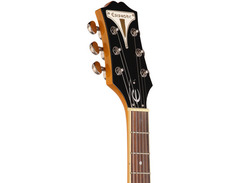
The Wildkat comes equipped with P-90 Classics, which are vintage voiced P90 pickups (more on these in the next section). The guitar also comes with a Bigsby B70 vibrato, It’s definitely a plus that Epiphone decided to equip the guitar with a genuine Bigsby, as most after market copies aren’t quite on the same level of quality. This particular model of Bigsby tremolo has also been as highly received as any other on the market, so while there are occasional tuning problems caused by this type of vibrato unit (though this is generally caused by improper use as opposed to a structural flaw) the guitar should stay in tune provided that it receives a proper set up.
Structurally, the Epiphone Wildkat is pretty interesting. The guitar features a set neck, increasing the sustain and resonance in the instrument. The guitar’s body is made from mahogany and features a maple “cap”. This doesn’t really effect the tone, but the flamed maple top is pretty pleasing to the eye. The guitar also comes with 18:1 ratio Grover machine tuners, which feature exceptional tuning stability.
To understand the sound of the Epiphone Wildkat, you first have to be aware of the tonal characteristics of P90 style pickups. These types of pickups are one of the least common on the market (second only to floating archtop and Gretsch pickups) so a lot of players don’t really know what they’re getting themselves into.
Essentially, a P90 is the middle ground between a humbucker and a single-coil pickup. It has a higher output than what you’d generally find in a single coil pickup, but it still doesn’t have the output of most humbuckers. Tonally, it’s warmer than the standard single coil pickup but thinner than most humbuckers.
The best part of a P90 is that it’s perfect for moderate levels of gain, and the pickups in the Wildkat are no exception. These pickups are perfect for the “crunch” type tone common in Americana and blues music, though some may find that the guitar doesn’t perform very well for heavier genres of music. Of course your results will vary, but so long as you don’t use too much distortion (you can get probably get levels similar to garage blues rock a la The Black Keys but not much more) you should be in good shape.
As far as quality is concerned, the Epiphone Wildkat is just as good as any other Epiphone. The brand has been known to have the occasional quality control issues (poor fretwork mostly), but when you find a good one it will hold up for decades. Epiphone makes some of the most durable instruments you’re likely to come across, which is great if you’re looking to perform live or travel with your guitar.
The most attractive part of the Epiphone Wildkat is that it’s not afraid to be unique. It’s wildly different to its competition in sound, dimensions, and visual design. This is a guitar for the musician who’s not afraid of breaking convention. Provided you take care of it, this guitar has the potential to sound exceptional and look great doing it.
See how artists use this







.png?v=1784922061)

Top Ranked Semi-Hollowbody Electric Guitars on Equipboard


About the authors
Mason is a freelance music gear writer that contributes to Equipboard, Reverb, TuneCore, Music Aficionado, and more. He plays the guitar and mandolin and resides in Wyoming. Read more
New in Semi-Hollowbody Electric Guitars


$1,435.00 - $1,799.99