Air
French band
Air's Studio Equipment


The main reverb on this album is an AKG BX20 they own — they have a BX5 too. It's mono, and it's on every track. Whenever we needed stereo reverb, Jean?Benoît added his Lexicon 200, always using the same preset. No reverb plug?in was ever used!
Find it on:


There were no plug?ins in their computer, so I installed several that I needed to work. I also made them buy some outboard [two Chandler Germanium compressors and an Alan Smart C2] and a PreSonus FaderPort, to work easier.”
Find it on:




-m.webp?v=1783177141)
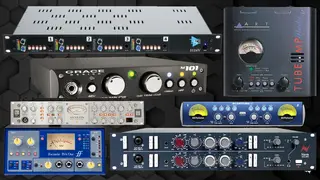
There is also 'modern' audio gear in the racks: two Avalon VT737 input channels, two Chandler Germanium compressors, a Demeter Stereo Tube Direct and two Urei 1176 compressors, along with some vintage Ibanez (AD230), Ensoniq (DP4), Korg (SDD2000) and Roland (SBF325) effects — an essential ingredient of the AIR sound from the beginning. In the studio itself, there's a Yamaha grand piano, a drum kit, a vibraphone, some kalimbas, a Neumann U47 microphone and Godin's collection of guitar and bass amps.
Find it on:

There is also 'modern' audio gear in the racks: two Avalon VT737 input channels, two Chandler Germanium compressors, a Demeter Stereo Tube Direct and two Urei 1176 compressors, along with some vintage Ibanez (AD230), Ensoniq (DP4), Korg (SDD2000) and Roland (SBF325) effects — an essential ingredient of the AIR sound from the beginning. In the studio itself, there's a Yamaha grand piano, a drum kit, a vibraphone, some kalimbas, a Neumann U47 microphone and Godin's collection of guitar and bass amps.
Find it on:

We wanted a large control room, to host most of our keyboard instruments, but not too large either. We could choose from around 20 keyboards, always ready to use, connected to a 16-input Speck X-Sum, used as a line mixer, and place them as we wanted. There's an analogue console in the middle, a 28-channel Trident T24, and Acoustic Energy AE1, K+H O300 and Auratone speakers. No large speakers, we don't need them. Huge windows at the rear give us natural light, there's wood everywhere, and the acoustic is dry.”
Find it on:


Famous drum machine made by Linn. S.O.S interview of Air members on how they built their own studio. Air give up the names of their synths plus photo of them
Find it on:
-m.webp?v=1782917887)
S.O.S interview of Air members on how they built their own studio. Air give up the names of their synths plus photo of them
Find it on:

There were no plug?ins in their computer, so I installed several that I needed to work. I also made them buy some outboard [two Chandler Germanium compressors and an Alan Smart C2] and a PreSonus FaderPort, to work easier.”
Find it on:

"On this record, we play every instrument we ever used in our career, and new ones too,” adds Dunckel. "Vibraphone, for example, or Mellotron, heavily filtered most of the time. We had bought some new instruments that we had never used in our records until then: a Moog Source, a PPG Wave 2.2, a Prophet 5, a Vermona DRM1, an Elektron Monomachine SFX60. We even bought a Vox guitar amplifier, for its warm sound and its tremolo, and a vintage Neumann microphone too, to record our voices.
Find it on:

There is also 'modern' audio gear in the racks: two Avalon VT737 input channels, two Chandler Germanium compressors, a Demeter Stereo Tube Direct and two Urei 1176 compressors, along with some vintage Ibanez (AD230), Ensoniq (DP4), Korg (SDD2000) and Roland (SBF325) effects — an essential ingredient of the AIR sound from the beginning. In the studio itself, there's a Yamaha grand piano, a drum kit, a vibraphone, some kalimbas, a Neumann U47 microphone and Godin's collection of guitar and bass amps.
Find it on:

There is also 'modern' audio gear in the racks: two Avalon VT737 input channels, two Chandler Germanium compressors, a Demeter Stereo Tube Direct and two Urei 1176 compressors, along with some vintage Ibanez (AD230), Ensoniq (DP4), Korg (SDD2000) and Roland (SBF325) effects — an essential ingredient of the AIR sound from the beginning. In the studio itself, there's a Yamaha grand piano, a drum kit, a vibraphone, some kalimbas, a Neumann U47 microphone and Godin's collection of guitar and bass amps.
Find it on:

AIR's success spread to England and the US, where their first tour was documented in a film by Mike Mills, appropriately named Eating, Sleeping, Waiting & Playing, and Sofia Coppola asked them to write the music for her breakthrough movie, Virgin Suicides. Even though the album was still recorded at Saint?Nom — on an Akai DR16 this time — and mixed by Alf, it sounded different.
Find it on:
-m.webp?v=1783249286)
"I recorded direct, then reamped through an Ampeg SVT. The mic is again a Neumann U47. I use old basses, like the Fender Mustang, into a Neve 33135 mic pre and a UREI 1176 compressor. We're not a band so we don't need a lot of mics. We used one or two Neumann U47s for each instrument for the whole record. We did that on Moon Safari as well, using an AKG C 414. We also used the Neumann for vocals and drums with a Royer R122 for cymbals. The treble of the U47 would feed back too much but the Royer has a really nice high treble. We have three U47s, all vintage."
Find it on:

S.O.S interview of Air members on how they built their own studio. Air give up the names of their synths plus photo of them
Find it on:

S.O.S interview of Air members on how they built their own studio. Air give up the names of their synths plus photo of them
Find it on:

Seen and heared tweaking in the music video La Femme D'Argent beginning at 2:39.
Find it on:

In the ARTE Concert video titled "Air en concert sous la Coupole Niemeyer à Paris," Air can be seen using a Roland MKS-70, positioned beneath the Moog Source.
Find it on:
-m.webp?v=1783177121)
The main reverb on this album is an AKG BX20 they own — they have a BX5 too. It's mono, and it's on every track. Whenever we needed stereo reverb, Jean?Benoît added his Lexicon 200, always using the same preset. No reverb plug?in was ever used!
Find it on:

There were no plug?ins in their computer, so I installed several that I needed to work. I also made them buy some outboard [two Chandler Germanium compressors and an Alan Smart C2] and a PreSonus FaderPort, to work easier.”
Find it on:

There is also 'modern' audio gear in the racks: two Avalon VT737 input channels, two Chandler Germanium compressors, a Demeter Stereo Tube Direct and two Urei 1176 compressors, along with some vintage Ibanez (AD230), Ensoniq (DP4), Korg (SDD2000) and Roland (SBF325) effects — an essential ingredient of the AIR sound from the beginning. In the studio itself, there's a Yamaha grand piano, a drum kit, a vibraphone, some kalimbas, a Neumann U47 microphone and Godin's collection of guitar and bass amps.
Find it on:


We wanted a large control room, to host most of our keyboard instruments, but not too large either. We could choose from around 20 keyboards, always ready to use, connected to a 16-input Speck X-Sum, used as a line mixer, and place them as we wanted. There's an analogue console in the middle, a 28-channel Trident T24, and Acoustic Energy AE1, K+H O300 and Auratone speakers. No large speakers, we don't need them. Huge windows at the rear give us natural light, there's wood everywhere, and the acoustic is dry.”
Find it on:

The gear they used included an Apple Mac G5 running Digidesign Pro Tools; a bevy of period keyboards including an ARP Solina, Korg MS20, Sequential Circuits Prophet 5, Wurlitzer, Memorymoog, Moog Source and Minimoog; a classic Roland TR-808 drum machine; and some modern synths such as an Elektron Monomachine and a Manikin Memotron. They patched and mixed everything through a 24-channel Trident Series 65 console, and also employed a '70s-era Rogers drum set, various MoogerFooger processors and three Neumann U47 mics.
Find it on:

This is a community-built gear list for Air.
- Find relevant music gear like Studio Equipment, Software Plugins and VSTs, Headphones, and other instruments and add it to Air.
- The best places to look for gear usage are typically on the artist's social media, YouTube, live performance images, and interviews.
- To receive email updates when Air is seen with new gear, follow the artist.
-
Added to Equipboard on by
 dahousetrack
Gear IQ 992
-
Updated
Discography