J
GearIQ 328
Joined Jun 2018
SF-based guitarist. Learning production for fun.
Every rig tells a story. Start yours.
Catalog your gear, wishlist what's next, and share the setups behind your sound — free.
Create your EquipboardGuitars 6

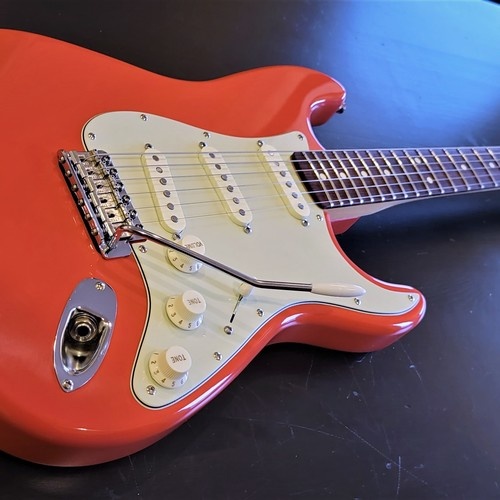
I picked this up secondhand a few years ago, stock other than the pickups (Fralin Woodstock 69s, which are excellent and probably worth half the value of the guitar at the time). It's a '97 model. I've since re-done the wiring, changed the pickguard out for a Fender Mint Green, and swapped the Kluson vintage-style tuners with Kluson vintage-locking tuners (a lot easier to deal with on stage).
It's a great workhorse Strat, plays great with medium jumbos and a C-neck profile. It sounds amazing with the Fralins, although I'm sure it sounded fine with the original Fender pups. Fender used the same USA-made hardware for these as the '62 reissues. It was painted in Mexico, but is otherwise made in USA.
The finish seems to be thin poly. The Fiesta Red is definitely on the "Coral" side of the Fiesta spectrum (for those not aware, Fiesta Red is less one color than it is a range of possible hues, due to the myriad inconsistent ways Fender has mixed it over the years).
This is a great model to be aware of if you're looking for a good used deal. All the fundamentals that make a great classic Strat are there, can't really go wrong!


A great and practical acoustic guitar for recording or gigging. Taylor guitars tend to have an even, smooth tone. A bit darker than most Martins I've played, but it's versatile and I think you could use it for just about anything. The neck is truly a joy to play, as is the case with all Taylors.
The internal pickup system is solid. You can put together a quick and dirty dual-track recording set-up with one mic and the guitar plugged in and get surprisingly great results.


Bass Guitars 1

Misc Instruments 3


I found this on sale somewhere, seems to be easy to find discounted. For the price it's hard to complain, plus these things are pretty fun.
I experimented a bit with some really thick strings trying to tune it to E, but it sounds kinda muddy and it can be tough to keep it in tune. The recommended tuning is A, but by getting some dense nylon strings and tuning to G, I've found that it's a good compromise; it mostly stays in tune without sounding quite so overtly uke-like.

Strings 2


Current Board 10


-m.webp?v=1782632247)


Recording 10


I use this mostly to track acoustic guitar, and for that purpose it's quite good. The pickup in my Taylor is also pretty good, so usually I double track with that and the AT2020 for a very serviceable easy-but-good acoustic sound. There are better mics out there, but you'd have to spend a lot more for them.


I got my pair of HD 280 Pros circa 2008. The price was great then and it's great now... even with more options available nowadays, it's still hard to go wrong with these if you're looking for a reliable pair of headphones to use for tracking vocals and instruments.
To be clear, these are great recording headphones, but not ideal for mixing. You could do worse, but the EQ response is really not flat, plus you'd want open or semi-open backs if you're gonna mix with headphones. These are what you want for when you're recording yourself playing guitar, for example. Headphones like this are great to have in a studio for that purpose.
I've had mine so long that the pads have needed to be replaced twice, but they just keep on chugging along.


Amplifiers 2


Pedal Collection 12


What's cool about Astro Tone is how the tone knob sweeps from the thin and brittle sound of the original Sam Ash Fuzz Box (kinda like an old busted Tweed amp) to a huge fuzzstortion. Clockwise from noon is the Sam Ash sound, counterclockwise from noon is the bigger, fatter sound.
I think most players will leave the tone somewhere between noon and 9 o'clock. It's a big sound, but not as massive as a Big Muff, cuts through the mix, and still cleans up pretty well with guitar volume. It's basically a medium-low gain fuzz and the sound is applicable to a wide range of uses from classic rock and psychedelic to shoegaze, stoner, desert rock, etc.

There are a surprising number of features packed in for an analog delay, and what's cool is that they all seem tailored to play to the strengths of analog delay in particular. The hold functions make it fairly simple to achieve some of the staple oscillation and feedback effects that you used to have to bend down and start turning knobs to achieve... but you can still bend down and turn the knobs if you want to, so nothing is lost and it doesn't feel gimmicky like some analog-emulating digital effects can. As others have said, using long delay repeats does seem a bit less useful, maybe there's a reason most analog delays don't feature this; still, it's not like this *detracts anything*, so I don't see why it should knock any points off. If you want super-clean, 1 second+ repeats, you're looking for a digital delay. This pedal isn't that, nor is it meant to be.
I like the idea of the effects loop, although I feel like I've barely scratched the surface of the sounds you could design using that feature. I put my flanger in there sometimes and it sounds pretty great. Haven't tried it, but pitch-shifting seems like it could be pretty cool in the loop.
Other great additions include a very usable modulation effect (which the Tempo Hold uses to create modulated feedback), and a Tone control, which is not unique to this pedal, but is something I find sorely missing from many delays nonetheless. Being able to control the tone of your repeats is great for lo-fi sounds.
If you're a fan of bucket-brigade style analog delay, this really won't leave you wanting for much.

Great analog flanger. Try it both before and after distortion pedals for dirtier and cleaner sounds, respectively.
Don't be put off by the lack of controls... you might be thinking you need more than two knobs, but you're probably wrong :)

During a certain period of time in the mid-aughts, the Bad Monkey reigned as the de facto "affordable tube screamer." For that reason, it became my first ever pedal purchase.
Having used many tube screamers since, I'd say it's a solid clone. Separated bass and treble EQ give it some sculpting potential that's a bit different from the norm, and the mixer out actually has some sort of "cab sim" applied that lets you use this pedal as an "amp-in-a-box" DI if you want to go into an interface. I wouldn't say it sounds like any amp in particular, it's mostly just meant to be an improvement over plugging straight in (which it is). I used to use it for recording demos in college for fun, going from guitar into Monkey into cheapo M-Audio interface.
I've still got the Monkey in a drawer somewhere. I joke that eventually it'll explode in price when someone famous is revealed to have been using it.
EDIT: It happened. The JHS guy apparently made a video about how the Bad Monkey sounds as good as every other overdrive, and now people are paying like $300 for them. We've all lost our minds :)


Other Gear 5


Need to sell 4


Had 35


-m.webp?v=1783782504)


Great high gain fuzz pedal for when you're not messing around. The gain knob only really has play from 7 o'clock (off) to around 9 o'clock... after that the only question is do you want a lot of fuzz or A LOT of fuzz? Caroline mentions that the lower gain positions are like a "classic overdrive" but even the minimum setting is still high gain.
Your guitar controls have minimal impact on the sound of this pedal. it's not very reactive with either tone or volume, has little clean roll-off to speak of. Where this pedal really shines is in its own double EQ controls. One of them is a fairly standard tone control, but the other one seems to be some kind of variable parametric adjustment. It's very usable, and the combination of the two has enabled me to get Muff tones that are EQ-balanced with all my other drive pedals. So if I switch between my Astro Tone and this, it doesn't sound like I've changed rigs or something. If I want it to cut through the mix, easy. If I want it to be a wall of noise sitting in the back of the mix, easy.
The octave feature is good too. I set the jumper to have the octave always on (this turns the second footswitch into a kill switch), and I usually have a small-but-noticeable amount of octave dialed in. It still sustains like a Muff, but with a slight buzzy crunch when you hit a chord. Very cool sound IMO.
Things this would be good for: garage rock, stoner, shoegaze, desert rock, David Gilmore solos.

As far as I can tell, Digitech seems to be clearing out all the DOD-branded stuff. I think a few of their releases from their last 5 years or so are really going to be sought-after items in the years to come, particularly the Rubberneck and this guy, the Looking Glass. I've also heard great things about the Carcosa, though I haven't played one, might be worth looking into.
I think the Rubberneck is one of the best analog delay pedals ever released, a true marriage of authentic vintage SFX with a modern feature set. It's hard to make such definitive claims about overdrives, especially with so many options out there and stellar examples seen from both larger brands and boutique shops. But the Looking Glass is really a bit of both, a collaboration between Digitech and SHOE, a small builder known for interesting designs.
Insofar as this pedal has a reputation, it seems to be as a transparent drive; and it can be, but it has interesting features that help it offer a bit more than that. The input filter is a bit like an amp's "presence" control, helping tame certain frequencies without changing the character of the drive much. What's really interesting to me though is that the "bass cut" control is pre-gain in the circuit, meaning that this control has a dramatic effect on how much drive you get out of the pedal. Just this one control makes it work quite differently from any other overdrive I've used, and it's important to know this when trying to dial in sounds. Everything else is fairly straightforward.
I like the jumper in the Low position, but there is quite a lot of distortion available in the High setting if you turn up both the bass cut and gain. The Looking Glass sounds REALLY good with single coils. If you find a good price on this (~$120 or less would be a steal at the time of this writing, but I imagine it'll be harder and harder to find them) it's definitely worth a look. One of the few ODs out there that does things a little bit differently than usual.