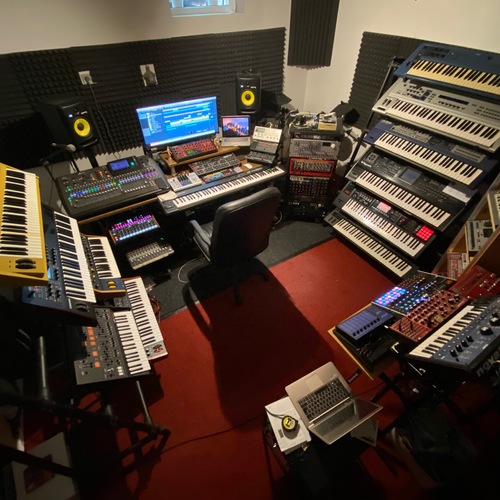
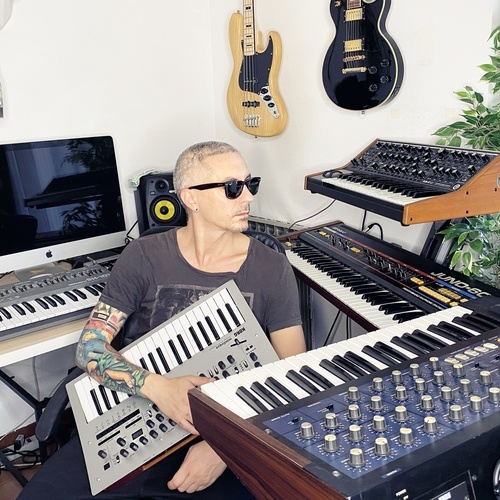
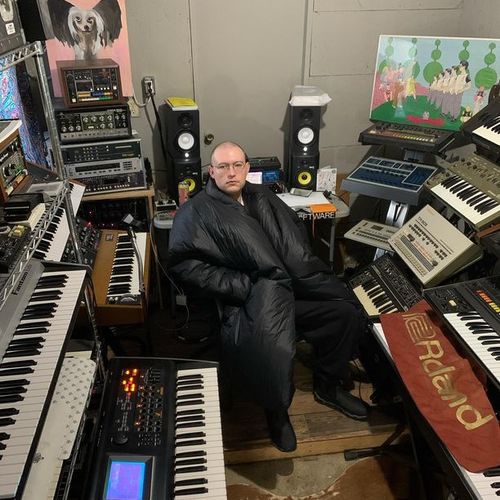
mach4's Electronic Synth Setup


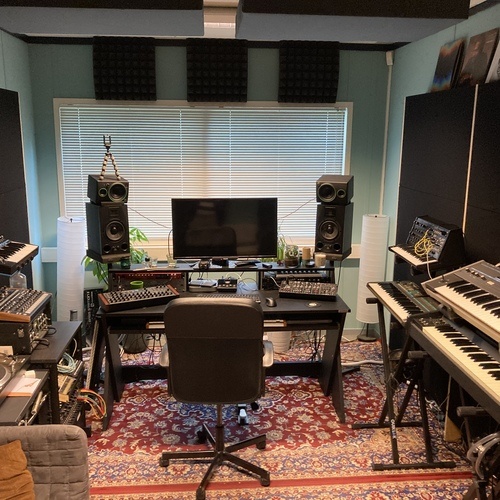
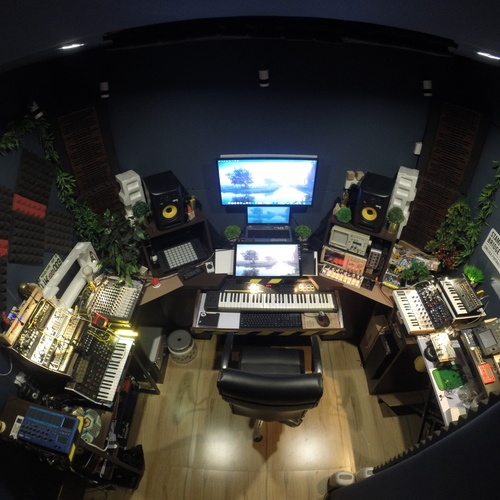
Another setup at the previous house. The orientation often changes when new gear arrives.
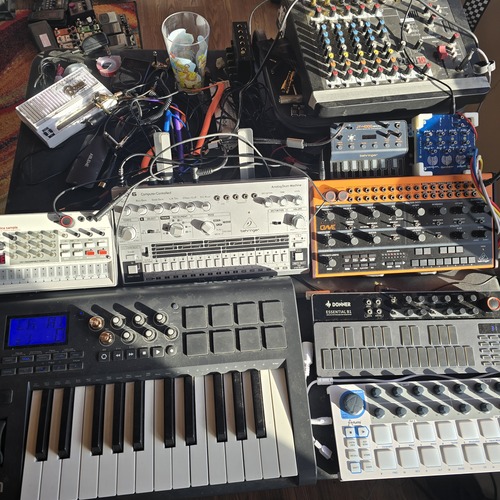
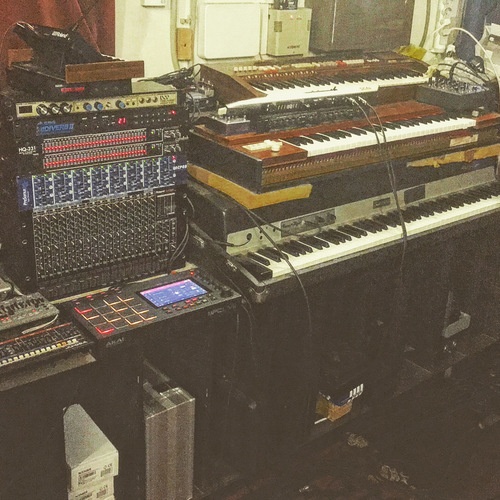
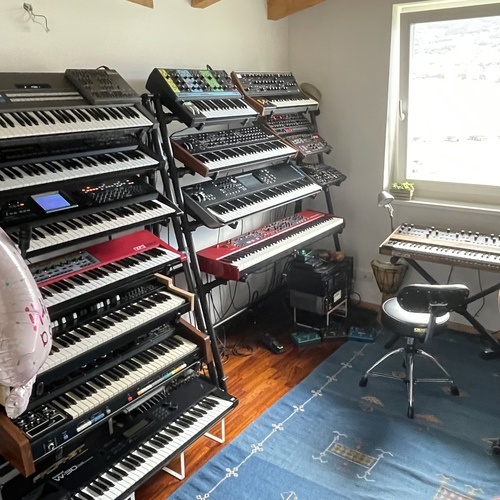
More gear photos from mach4
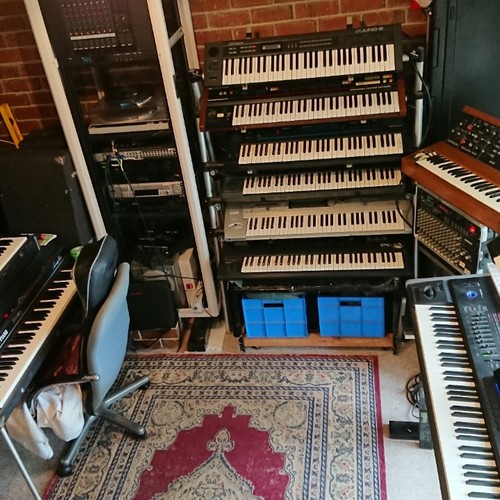


Gear in this photo
This rig
~$12,054
Value by category
- Keyboards and Synthesizers 94.0%
- Studio Equipment 6.0%
Price mix
A wide range of price points

Boldest pick: Behringer Xenyx 502
Only 5 pro artists on Equipboard own it, but it's ranked #8 in Mixers.


MIDI controller, weighted 88-note velocity sensitive (no AT), bank and program messages, splits and layers
MIDI controller with a velocity sensitive, weighted 88-note keyboard. No aftertouch, but it does include the usual Roland combination pitch-bend/mod switch with sliders for adjustable depth and delay time. It has 4 MIDI outs (1 in, 1 thru), will send msb, lsb, and program changes, and can split or layer 2 zones. 128 memories (8 banks, 16 presets) which store all panel settings (except for the Transposer). It has a conveniently large flat top which will easily accommodate another synth (even another 88-note keyboard). It is a very solid keyboard, and is also very heavy (the sort that OH&S regulations would demand two people should move!)

Solid synth/workstation and controller keyboard with a good weighted key action
The KT comes in 76 and 88-note models with exactly the same synth and sequencer architecture. Editing can be potentially tiring on the 2-line (large print!) display, but thankfully, due to dedicated buttons for practically all pages, there's not a huge amount of menu diving.
Synth architecture is almost identical to the Ensoniq SQ series (SQ-1, SQ-2, SQ-R) with many of the same waveforms, but also with some of their proprietary Transwaves along with expanded drum and keyboard samples. 100 Sounds are stored in ROM and another 100 in user-storable RAM. There's also potential for a further 200 user banks via a PCMCIA card (if you can still find one of course).
Sounds can be combined into "Presets" (what Korg would call a "Combi") allowing for layering and zoning of up to 8 Patches. These can also be used as Tracks in a sequence.
Presets also allow for empty tracks to send out via MIDI only making the KT a very flexible controller since a MIDI track can be treated the same way as an internal Patch (ie, zones/splits/transposing/patch changes, etc). GM sounds are also available over and above the onboard patches, and the internal effects are culled from Ensoniqs popular DP-4.
Key action on the 76 is semi-weighted and on the 88 is fully-weighted. It also has channel aftertouch (marginally disappointing given that Ensoniq had a long range of good-quality poly AT keybeds in previous models). But all in all, with the sure key action, good range of pleasant sounds and the 8-track sequencer, this makes for a solid and very useable instrument - one which kind of slipped under the radar with these later Ensoniq products.

Avg price: $279.12
Powerful synth/workstation, 512 programs/384 combinations/24 drum kits, 16-track sequencer, sample upgrade available
The lightest of the Triton family (hence Le) but still a powerful workstation sharing the same HI (Hyper Integrated) synthesis system, 32MB PCM ROM with 425 multi-samples & 413 drum samples (all 48-kHz). 512 sounds in Program mode (including GM sounds), 384 Combinations each of which can have up to 8 layered/split programs.
Two polyphonic and fully programmable arpeggiators, 16-track sequencer with capacity for 200,000 notes and 200 songs. 89 effects types with routings for 2 master sends and 1 insert send.
Sampling is available but only with user installation of the EXB-SMPL board (available separately - and increasingly difficult to find). Another area where corners were cut in producing the Le was the keybed - it's very average, and even though it has channel aftertouch, it's difficult to use expressively. Some users have added weights to give it the feel of a semi-weighted keyboard.

Avg price: $928.45
Serious sound creating!
Arguably one of the best synths from Roland in a while, allowing relatively unique means of manipulating samples (and internal waveforms) using their Variphrase and COSM technology. Variphrase allows for - among other things - direct control over the formant of any sample (or internal waveform) which in turn has a significant effect on how the sounds are manipulated. The many COSM models (especially in the filter section) go some steps further in treatment of the oscillators.
Don't be fooled by the presence of "only" two oscillators, because when you get digging into what you can do with just one oscillator, you'll hear that it doesn't take much to make some huge pads, fat basses and leads, etc, etc (although sometimes at the expense of polyphony).
The large LCD touchscreen and a wealth of dedicated and assignable controls allow for an immediacy of editing. The dual D-beam is assignable to practically any parameter, as is the Time-Trip pad which, among other things, allows the performer to "freeze" a sample and wind it backwards or forwards in realtime.
Arpeggiator and 4-track Step-Modulator allow for even greater sound mangling possibilities. It also has three effects sends allowing for a ton of choruses, delays, reverbs, distortions, EQs, etc, etc. They even include emulations of the classic Roland tape effect units (Space Echo and Space Chorus) along with some old Boss pedal emulations. Many of the effect parameters are able to be modulated via the D-beam or T-T pad.
Probably the biggest drawback with the original V-Synth is the discontinuation of the VC-1 and VC-2 cards which remain extremely hard to find and much sought after. Although not essential, they do expand the V-Synth's already substantial tonal capabilities (the VC-2 Vocoder especially)

Sequential Circuits Prophet VS
Avg price: $5,543.66

The last in a noble line that lived up well to its name. A monster synth with some cool and distinctive features.
Interesting to think that this auspicious beast from 1986 was Sequential's first digital synth, but the penultimate one to bear the "Prophet" moniker before the company folded a year later. However, without it (and some of Sequential's residual boffins), the popular Korg Wavestation would not have turned out the way it did.
Initially something of a test-bed for a range of ideas - including digital wavetables, the capacity to arbitrarily crossfade between selected waves across 4 oscillators, envelopes that went beyond the standard ADSR steps and which featured loopable stages - they all ended up in the Prophet VS.
There are 96 waves available in RAM and a further 32 that are user programmable. Essentially what this meant was that you could set up any combination of the RAM waves in the 4 oscillators (each with their own volume) and save that as a new single waveform - a neat way of expanding the sonic palette. It was possible to import sample data into the RAM, but that was (is) a little complicated.
Mixes between the 4 oscillators could be programmed using a dedicated Envelope and LFO allowing for some great, animated, and unpredictable patches, and this was a significant part of the VS's charm. The vector joystick also allowed realtime control over the oscillator mix which would override whatever was programmed in the patch setting. This was all routable through an analogue (Curtis chip) resonant filter, and on top of that was a modulation matrix allowing a ton of flexible routings.
It's often overlooked, but the onboard arpeggiator was worth spending time with as it was damn near a sequencer, you can program your own steps and store them as part of a patch. And with the keyboard featuring a programmable split point, it was possible to set up some cool, sequencer-like patterns on one half of the keyboard whilst playing solos or pads on the other half.
A slightly more quirky feature (initially a programming accident which Dave Smith insisted that the designers keep) is the random patch generator achieved by pressing the Enter button and patch button no.2. You're then treated to some serious, sonic psychedelia - rarely possible to play a tune with, but an ear-opening demo of what the VS can do. And you'll never hear the same one twice! (unless you save it).
All in all, I think it's a shame the Prophet VS didn't fare a little better in it's time. Whilst it's spirit was certainly revived in the Korg Wavestation and the Yamaha SY22, I for one am very happy to have the original blueprint in my collection. It's one very powerful and versatile synth.
-m.webp?v=1784818691)
Avg price: $297.47
Beast of a sampler/sequencer with lots of performance controls, expressive keyboard with poly-aftertouch, and tons of quality effects.
The Grand-daddy of the Ensoniq sampler family - a family that started unpromisingly with the somewhat arcane Mirage, but then rapidly evolved with the vastly improved EPS, then the EPS16+, then the imperious ASR-10. ASR stood for Advanced Sampling Recorder, and for its time (early 1990s) it may well have been the most advanced (at least for those available at a consumer level, we will discount the sorts of ubermenschen who could afford a Synclavier or Fairlight).
If you were already familiar with the EPS and the 16+, the ASR was simple to use, the same architecture and layout applied, but with a ton of extra features which really opened up the sampling, sequencing and production possibilities (and a few of these were actually thanks to Ensoniq listening to customer suggestions). If you were fortunate to have all the additional bells and whistles such as the digital I/O and the SCSI expansion, you were into an early form of HDD recording as well.
The ability to resample its own audio, with or without effects was also a great idea, and a shortcut to freeing up sequencer tracks if you needed to. Some people complain about Ensoniq keybed quality, but I've never had a problem with them. The ASR has always felt solid and responsive, and the poly aftertouch has never given any grief. The modulation routings on the ASR are almost without number.
All in all, this sampler really kicks.

Avg price: $49.00
Spend a little time with it and you won't be sorry.
The ESQ-1 is what I call the "quiet achiever" of the 80s digital synth market. Yamaha brings out the game-changing DX-7 (replete with that godawful electric piano sound which found its way into far too much radio-friendly tripe).
And then about 5 years on, Roland says "Okay, our turn! Cop this" and releases the D-50. Both with their positive and negative points, the DX-7 was probably the most user-unfriendly synth available (one J.M. Jarre reports it as being "a pain in the arse to programme") and the D-50 perhaps tried a little too hard with some new lingo ("Linear arithmatic" "partials" etc).
Meanwhile, without any fuss, Ensoniq brings out an absolute charmer in the ESQ-1. 3 digital oscillators (osc sync, FM, and ring mod available) each with 32 waveforms, some analogue, some sampled. A ton of modulation possibilities with 3 LFOs, 4 6-stage ENV generators, each freely routable to practically any parameter.
An analogue resonant filter. Velocity sensitive keyboard. MIDI. A large display with dedicated buttons to access each section and parameter (compared to those other two - easy!) Oh yes, and an 8-track sequencer ... I mean really, we're getting into workstation territory here (minus effects though).
What's not to like?

Avg price: $2,000.00
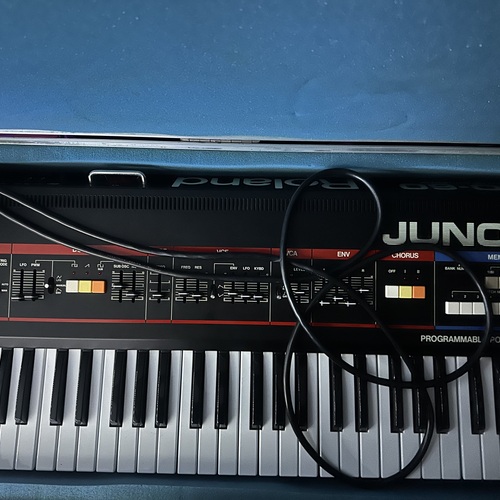
Just how good can a single oscillator, 6-voice synth get?
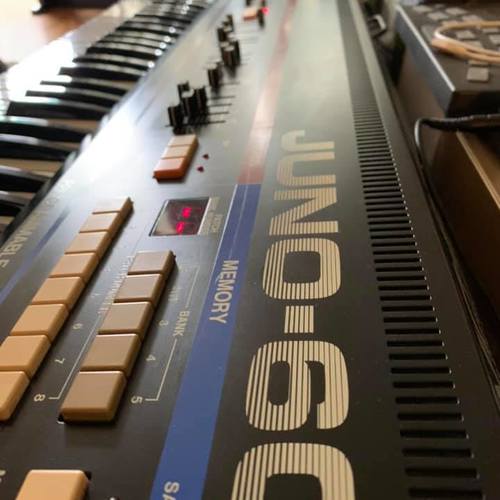
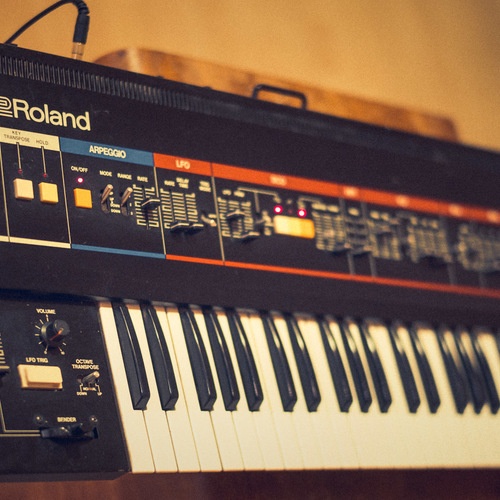
If you care to read a number synth forums around the globe, you'll find (after wading through sometimes too much inane trolling) that the otherwise humble Juno 6 or Juno 60 was the first synth for a significant number of players, and that it still remains a firm favourite in the eyes, hands, and ears of many.
Its architecture could not really be simpler: a single DCO with sawtooth, pulse, and a square wave sub-osc with dedicated level control. Pulse width can be controlled manually, or by LFO, or by the envelope. There is a self-resonant LPF and an HPF with a stepped level control. Standard ADSR envelope and two of the popular Roland Chorus effects.
There is also an arpeggiator and a transpose function. Sounds basic and probably is, but for reasons that I can't sufficiently explain, there is an intangible friendliness about the Juno - something beguiling (probably not unlike its namesake), something downright decent about it. I would not be without one.

-m.webp?v=1784818893)
Avg price: $418.68
Classic 70s string machine, pleasantly versatile.
Released in the mid 1970s, this was the first string synth from Roland to feature what was to become their much-loved Ensemble/Chorus. One might not expect much from a single sawtooth oscillator, but with the divide-down circuitry, it is fully polyphonic.
There are three presets - Strings I, Strings II, and Brass - each on switchable rocker tabs. There are also some simple envelope controls (a tab switch for soft or hard attack, and sliders for release time which they've labelled "Decay"), two basic Low-Pass Filters ("Tone" - one for Strings I & II, the other for the Brass), and LFO ("Vibrato" - which has a fixed rate, but sliders for adjustable depth and delay).
The keyboard has a fixed split-point dividing the bottom 2 octaves and the top 3. All presets are independently adjustable for each half as are the soft/hard attack switches and the release controls. There's also an attenuation tab switch for each half so that one half can play softer or louder than the other.
All of this topped off with that sumptuous Ensemble effect, and it makes for a refreshingly versatile stringer.


Bespoke British synthesis at its best
Modular synthesis in a highly distinctive box. "Modular?!" people shout in disbelief. "It doesn't occupy half a room, it doesn't have cable spaghetti everywhere!" Correct, but that's what the pin matrix is for. When you notice that the modules on the front panels are clearly labelled, and that those labels are duplicated along the left column and top row of the matrix, it's a simple case of placing a pin at the meeting point et voila, you have just connected one module to another - without a patch cable.
So, now that's out of the way, we have ourselves a rather unique member of the vintage synth fraternity. The brainchild of Peter Zinovieff, Tristram Cary, and David Cockerell (the founders of EMS) produced a conveniently-sized powerhouse with both the VCS3 Mk I (nicknamed the 'Putney') and the Mk II (the 'Synthi'). The photo here is a Mk II.
The principal difference between the Mk I and Mk II was that the Mk I allowed individual patching of each VCO waveform on the matrix board, whereas the Mk II dispensed with this and allowed for more input/output routings.
3 VCOs (each VCO has a vernier dial for frequency, and two waveforms with dedicated level controls); VCO 1 has sine and sawtooth (sine can be skewed), VCO 2 has square and triangle (both of which can be skewed), VCO 3 is the same as VCO 2 but produces much lower frequencies and so can double as an LFO.
A resonant filter; a Ring mod; white/pink noise; spring reverb; one of the more unique envelopes in analogue synthesis, with its curious Trapezoid (basically allowing for a variable +/- polarity of the envelope signal).
Among the criticisms levelled against the VCS3 were lack of a keyboard (although two were produced - DK 1 and DK 2 - exclusively for use for use with either the Putney or the Synthi), and the instability of the oscillator tuning. The matrix board was also unbuffered which meant that every time you put a new pin into the matrix, something else went awry. For the more creative users however, this was a significant part of its strength and character.
There is also the joystick, the X and Y axes of which are independently patchable to every part of the VCS3 making it the most immediate means of control if you're not fortunate enough to have the DK-1 or DK-2.
Aside from the fact that it can produce a stunning array of sounds, one thing I've always admired about the VCS3 is that it ably reflects the character of its creators - inventive and eccentric British boffins!

Slightly above the "average" Electone
Perhaps the littlest brother of the D-family of spinet+solo synth keyboard organs, but still not without a number of features that push it some way past the standard "home organ" fare. Okay, it looks like a regular Electone - the coloured tabs, the gray/white drum machine buttons, the balance and sustain paddles, etc, etc. However, the built in rotating speaker combined with the many flute stops on the lower and upper manual make for a passable (if slightly clean) Hammond impersonation. The upper and synth manual have some useable solo sounds, and the synth manual in particular has numerous modulation possibilities, not the least of which is the famous Yamaha side-to-side wiggle for vibrato/wah-wah. There is also an arpeggiator for the lower manual - an interesting and another useful feature not found on that many Electones. Some great YouTube demos can be heard here: https://www.youtube.com/watch?v=fKcv85r9mDY


Avg price: $57.73


About this setup
This gear photo by mach4 features 21 pieces of gear, including Roland MKB-1000, Ensoniq KT-88 / 76, and Korg Triton Le61. The setup spans Keyboards and Synthesizers and Studio Equipment, with a wide range of price points. Artists with this kind of gear are most often found in the Electronic, Rock, and Pop scenes. Notable artists with overlapping gear include Prince, Martin Glover, and Vangelis.
Similar Artist Setups
Pro artists whose gear list overlaps with this photo.