bart_van_zon's Electronic Studio Setup

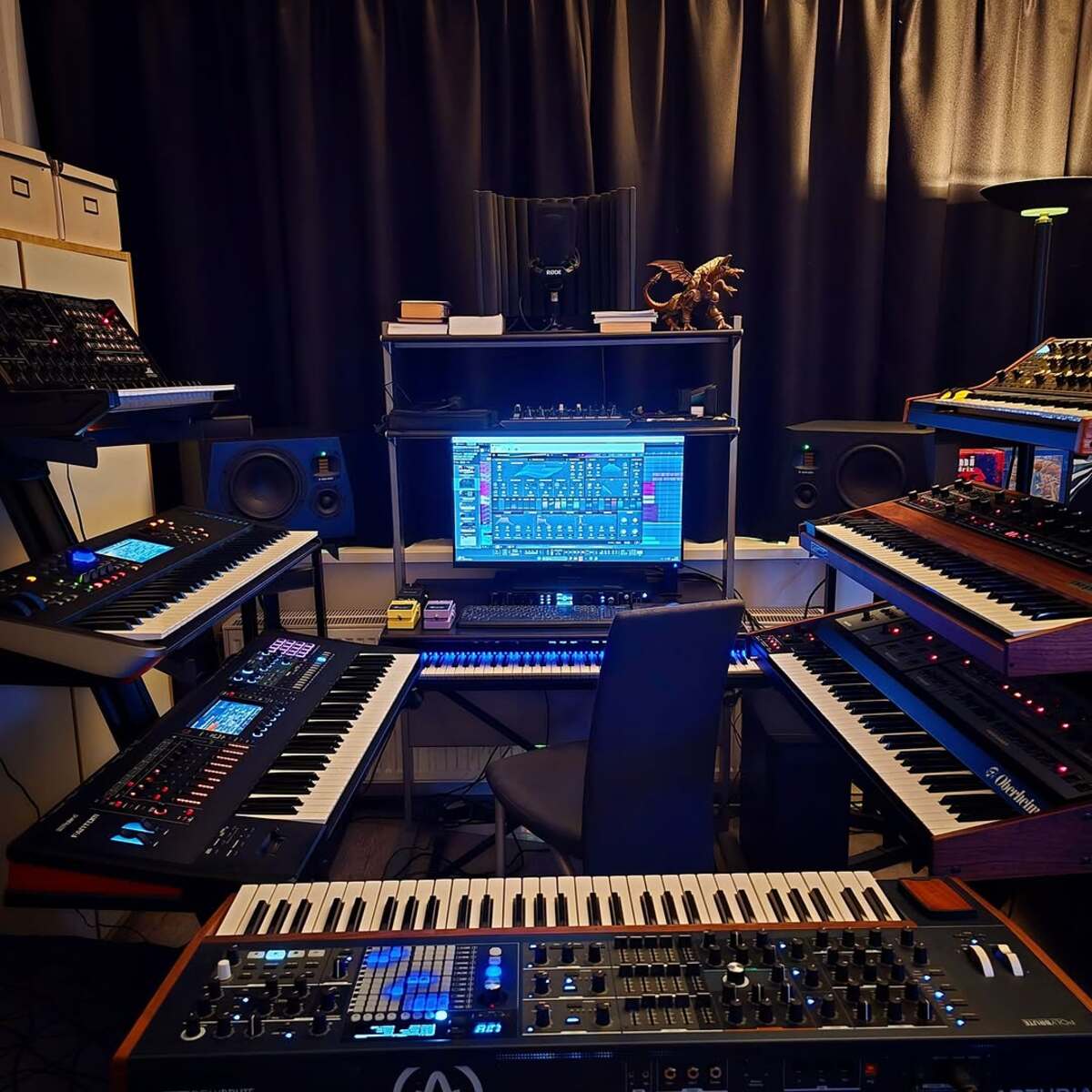
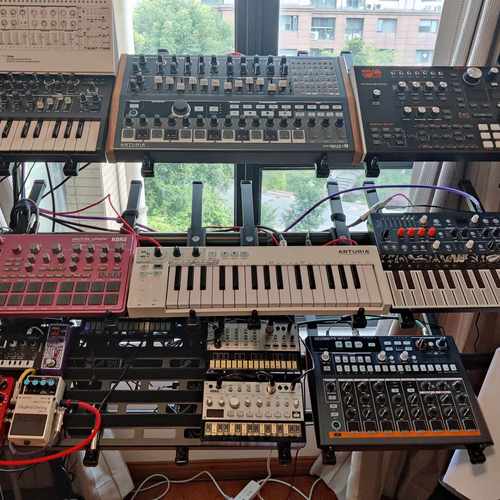
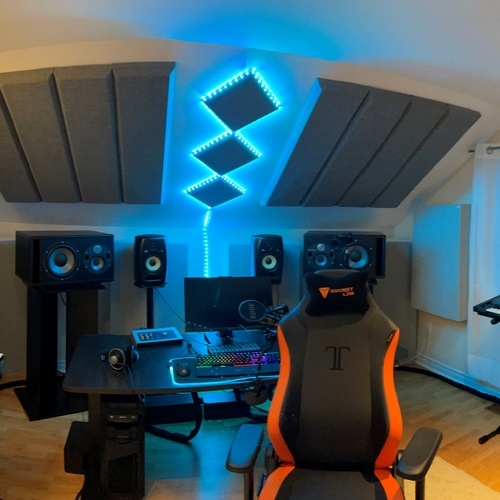
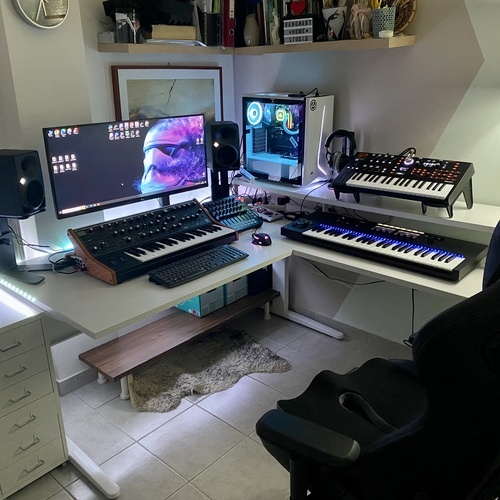
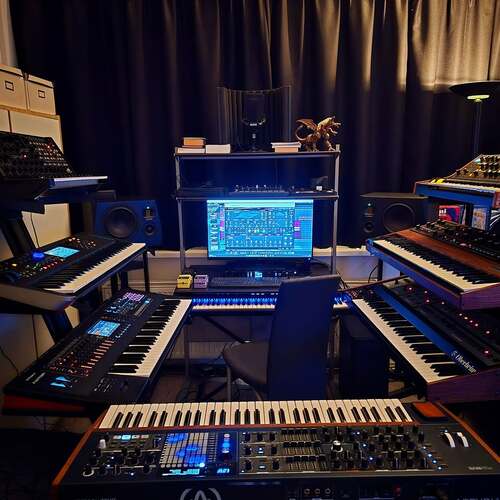
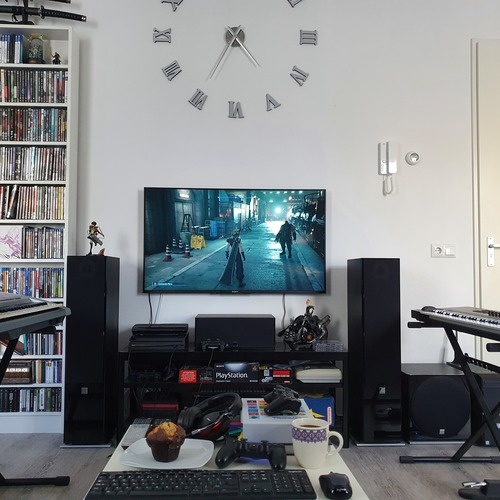
Home studio setup 2025. Mostly software and a few hardware synths and effects.
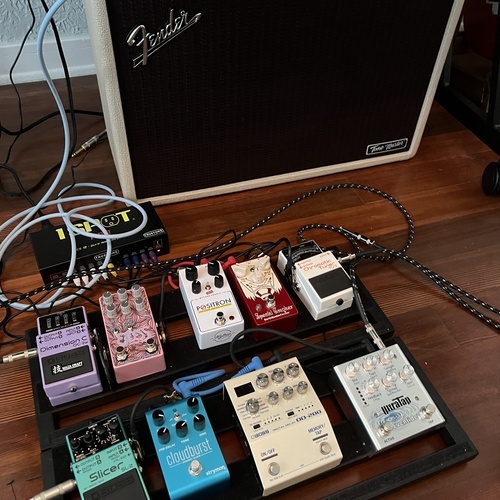
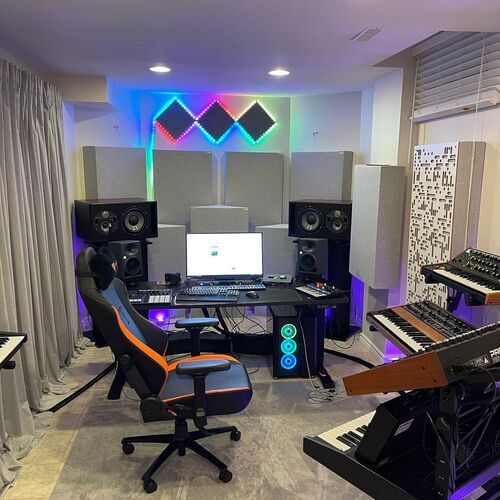
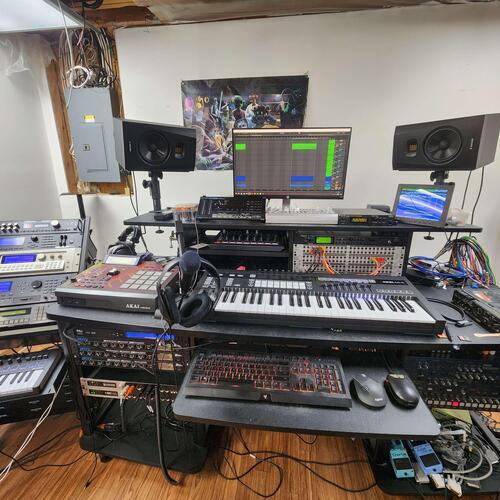
More gear photos from bart_van_zon

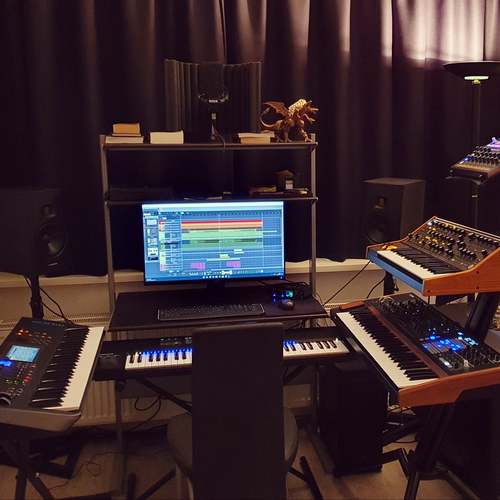
Gear in this photo
This rig
~$27,427
Value by category
- Keyboards and Synthesizers 71.4%
- Studio Monitors 13.4%
- Studio Equipment 8.5%
- Effects Pedals 2.4%
- Music Accessories 1.6%
- DAWs 1.4%
- Microphones 0.9%
- Software Plugins and VSTs 0.4%
Price mix
Mix of high-end and standard

Boldest pick: K&M Spider Pro
Only 5 pro artists on Equipboard own it, but it's ranked #1 in Keyboard Stands.

Avg price: $1,770.14


Ballsy yet refined
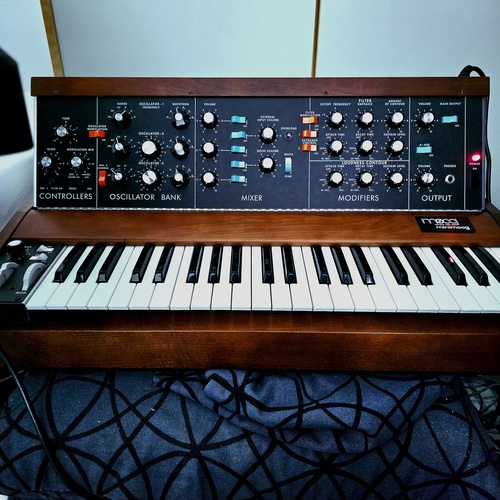
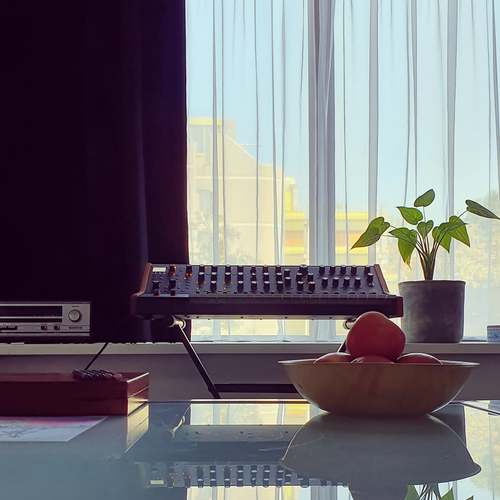
This was my first mono analogue synth. I always liked the Minimoog Model-D but didn't believe buying an old synthesizer would be the best investment. My first analogue synth the Polybrute taught me modern analogue synths could be great yet affordable compared to vintage or re-issued synths. The Subsequent 37 isn't that expensive compared to a Minimoog, but it's still a real Moog and has a full high quality sound. The Polybrute also looks great and the Subsequent 37 as well. They're both designed by Axel Hartmann and look great together.
Some people say the Subsequent 37 has a vintage sound. I suppose that's because of the roll off at the high frequencies. That makes it can sound a bit "muffled" and makes it best suited for sounds that don't need to sound bright like most leads. On the other hand it sounds really dry and direct which makes it sound modern. Many other synths sound a little more woolly, like it's coming from further away. The Subsequent 37 sounds pure unfiltered. The Moog Minitaur which has a similar raw sound, but can get a little unpleasant, while the Subsequent delivers the same sound in a more refined way. It's very powerful and punchy with a lot of energy in the mids, from mid low to mid high. This makes it great for basses, sequences, some leads that sound really in your face and don't need a lot of high frequencies. It can also do some really Interesting effecty type sounds. It's generally an easy to grasp instrument that's very cool to play and create sounds with.

Sequential Circuits Prophet 10 rev 4
Avg price: $4,377.74

Legend
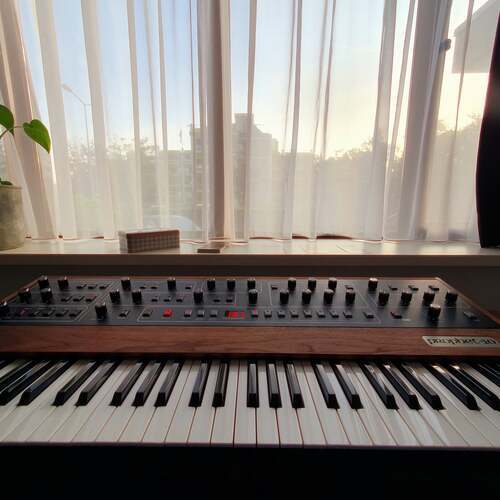
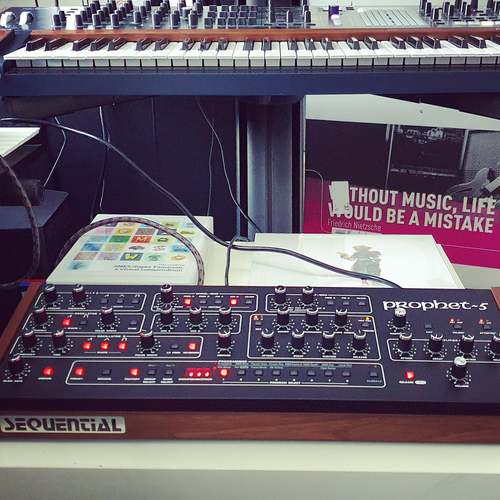
I don't know really know what to write about the Prophet-10. I wrote a couple of reviews before, but this instruments speaks for itself. The more I write about it, the stupider it sounds.
It's a re-issue of the classic Sequential Circuits Prophet-5 from 1977, that has been used on countless songs by so many artists. This version has 10 voices as opposed to 5, which was something they tried to do in the early days, but was difficult to get right because of overheating issues. It also lets you choose between 2 different filter types; a remake of the old one from the rev1 and rev2 and the newer one from the rev3. It has a vintage knob to make it go from relatively modern and stable to very old and wild. I assure you, this is not an effect or a gimmick, but really part of the core sound that makes this instrument what it is. A modern synth that can do vintage sounds. They've also added after touch to the rev4, which is something the old ones didn't have, but is a great addition.
I used to own a Prophet-5 Desktop Module, but after little over a year, I sold it to get this one. I liked the sound of the Prophet-5 Desktop, but it was difficult to work with. I had tuning issues, the pods didn't turn smoothly and it was a bit of a shame you couldn't play it right away, but had to hook up a midi-controller. The full version looks and feels like you actually have a piece of music history at your fingers. It's much more inspiring to make music with. The pods move smoothly right from the start. Even the tuning issues seem to be gone for some reason.
The original Prophet-5 only had 5 voices, so you'd think that's enough, but in practice it isn't. You can't play two full chords with two hands. Even if you play a basic 3 note chord, if it has a long release time, one of the notes will cut off as soon as you play the next chord. With 10 voices I don't have these issues. Even the monophonic unison sounds are fuller and more lively with double the number of oscillators.
It's hard to describe the sound. It's timeless. Very neutral and versatile. It can do all of the basic synth sounds very well. Better than any other synth. It has no "character" or "personality", but that's possibly because you've heard it a million times. It always sounds exactly how you expect a synth to sound, while every other synth is a variation of that sound at best. Even without the distinct character you'd still be able to instantly recognise this synthesizer, because it's the only synth that sounds exactly how it's supposed to. It has a full warm and organic sound. It can go from soft and ethereal to punchy and upfront. It never sounds thin or fragile and never becomes harsh and nasty. Always remains refined and elegant. It's a solid backbone for your sound palette.
The only disadvantage is, it's a re-issue of a synth from 1977, and doesn't have many of the features common in later synths that you may take for granted. For instance, it has no stereo output, no sub oscillator, no lfo-sync, only low pass filters and no build in effects. It's also quite expensive for what it can do. If you don't care about the history behind this synth and are simply looking for a great sounding synth for a descent price, this is not the synth to get in this day and age.
Preferred Settings + Usage:
This synth can do anything. Punchy basses, full brass sounds, atmospheric strings or pads. The most unique sounds may be the oscillator sync leads or the "Tom Sawyer"-like effects where all of the oscillators dance around each other in a very musical way. I know Tom Sawyer was performed on an Oberheim, but on a Prophet-10 in mono with 20 oscillators these type of sounds are even better.

Avg price: $4,618.99

Characteristic Oberheim sound
Beautiful instrument. Out off all my synthesizers, this one has the best sound. A typically 80s electric sound. It is in the style of the old late 70's to mid 80's Oberheims, the OB-X, OB-Xa and OB-8. As a result, it is very limited in terms of possibilities, compared to modern synthesizers, but it can do more than all of the aforementioned synths combined. Also in appearance it may not be the most beautiful. Slightly clunky and dated looking. In reality it's a lot more stylish than in the pictures though. With this huge instrument with metal housing and wooden side panels you really feel like you have a piece of synthesizer history at your finger tips. The keys feel really good. With the simple interface and huge buttons, it is very easy to create beautiful sounds. You always know what you're doing and it always sounds great. Except that it has a "page 2" with hidden parameters that allow you to do so much more than what you can do with the hardware UI, but makes it more difficult to see what's going on exactly. Maybe it's just not as easy as with my Prophet 5. That one has an interface that is just a little more obvious and has a more neutral, versatile sound. Still, I'm happier with my OB-X8. It has more character, a stereo output and is less prone to go out of tune. It inspires to create music.

Avg price: $2,689.36
Fantastic analogue synth with vintage character but modern capabilities.
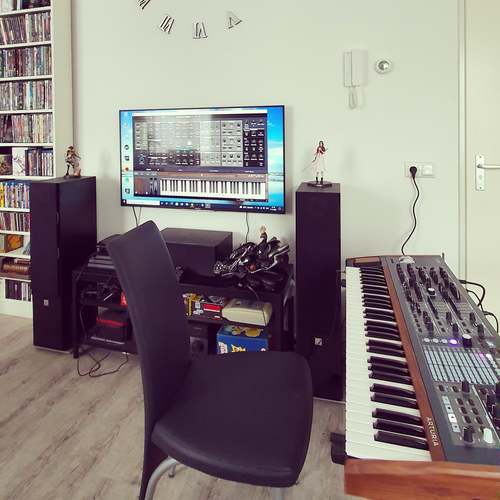
Arturia started out 30 years ago as a creator of software emulations of classic synthesizers. They've gained quite a bit of experience in that time, and have applied that in their creation of hardware synthesizers. They don't have the arrogance of bigger older companies that live on old fame and release classic synthesizers with limited capabilities at inflated prices. Arturia on the other hand, built the Polybrute from the ground up. They looked at what made the classic synthesizers that great, took the best aspects of each and designed hardware around that with the most intuitive UI that would be most affordable to produce in present day.
The Polybrute is an absolutely fabulous analogue synthesizer. A pleasant vintage sound comparable to old synthesizers that cost many times more (like the Prophet 5 and OB-Xa), but with a lot more possibilities to fine-tune your sounds and get something really interesting. All of that whilst the interface remains easy to understand. On top of that, it has a lot of modern effects and features to get sounds that you only get from modern synths.
Arturia also gives you a free VST editor, so you can connect the Polybrute to your computer via USB, and load the VST into your DAW that you operate with the Polybrute, or you can operate the Polybrute with the VST. The boundaries between hardware and software disappear. With my Sequential Prophet 5 and Oberheim OB-X8 which are much more expensive, I had to buy the VST editors separately for $160 each, and they didn't work nearly as well as Arturia one for the Polybrute. Moog also offers free VST editors, but I also have more problems with those than with the Polybrute. Arturia also releases frequent firmware updates that never gave me any trouble and helped make the instrument even better. Arturia released tons of great free presets.
The Polybute is solidly built. Metal housing with wooden side panels, sturdy metal and plastic pods and rubber buttons with multicoloured LEDs inside. The look is timeless. It combines 1960s teal and wood, with 1980s rubber buttons with LEDs in them and deep black and pure white keys and knobs that are very modern. The most beautiful synth I've ever seen. In terms of sound it's right up there with my Prophet 5, OB-X8 and Subsequent 37. Different character but at least as good.

Arturia AudioFuse 16Rig USB Audio Interface
Avg price: $1,272.14
bart_van_zon's rating:
-m.webp?v=1784844238)
Avg price: $278.74
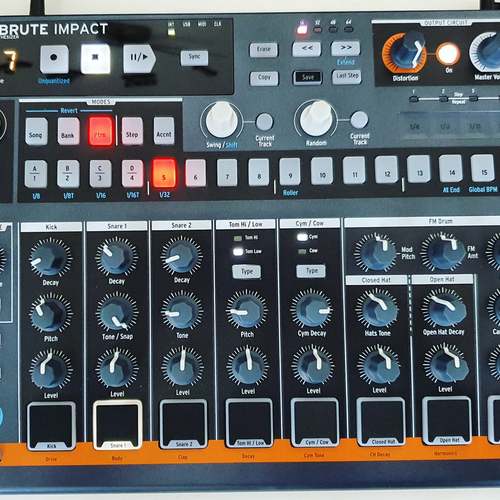
Most affordable usable analogue drumcomputer
Very affordable way to get a good quality analogue drum sound.
I like old analogue drum computers. Mostly the Roland TR808 and TR909. Those are quite expensive to get second hand though, even though they weren't that expensive back in the day. There are virtual analogue hardware re-issues by Roland, or real analogue clones by other brands. Neither are the real deal though.
Instead I chose the Arturia Drumbrute Impact. It's a real analogue drumcomputer with an original sound. It's not a TR808 or 909 clone but it has a similar sound that's equally usable but more unique. Not every song has to be the same old 80's sounds after all. It's very affordably priced.
It can't do a lot of sounds, just the basics stuff; kick, two snares, hihats, toms, crashes, cowbell and a strange FM effect. No interesting stuff like congas, claves or other unusual percussion. The sounds it can create are usable. It only has five analogue output, so if you are a bit limited in how you can mix it.
It looks and feels okay. Plastic and rubber, but solid. Not the most beautiful instrument ever, but better looking than most. Nice multicoloured LEDs.

Roland FANTOM 6 EX Synthesizer Workstation
Avg price: $3,374.13
Solid, useful workstation for live or studio that also looks good.
So, I'm a composer for video games and animations and such and I'm part of a pop/rock duo. I play keyboards and mix and master the tracks. Most of my work I do on the computer because it's fastest. I collaborate with a live singer and guitarist I have 5 analogue synths and an analogue drumcomputer to add liveliness to the computer music that can sound a bit too clean and sterile. I also have a digital keyboard, a MODX6 for when I want FM synthesis, run out of Kontakt samples or in case I need to play sampled instruments live. the MODX6 is useful and lightweight, but a bit flimsy and kinda ugly.
I bought a Fantom 6 EX because I didn't want to pay for a Roland Cloud subscription and because the Fantom has a lot of sounds that Roland Cloud can't do anyway. I bought it mainly for the ACB engine that sounds more accurate to the original analogue hardware it models, than what they use for Roland Cloud or digital hardware like the Jupiter X and Juno X. Since a vintage Jupiter 8 cost's over 20.000 euro's/dollar's nowadays this is the closest I could get to an original Jupiter 8 without spending the price of a car. The other instruments like the TR-808, TR-909 and even sample based instruments are all fine. The sounds are less processed than those in the MODX6 or (other digital Yamaha instruments) and are more versatile and sit better in the mix. With a sing push of a button you can turn of the effects, which I like to do before recording.
The Fantom EX looks great. It was designed by the same person who designed my Polybrute and the predecessor of my Subsequent 37 (the Little Phatty), so it looks fine alongside my pretty analogue synths. It has a solid metal housing. It's very heavy though.
I haven't fully explored this synth so I can't tell for sure, but the only downside seems to be there's a lot of menu diving. Things aren't categorised the way I like. The ACB synths aren't listed as separate instruments. Instead you'll find them here and there depending on what presets were created for them. For instance you may suddenly find them under "piano" if they have a preset that makes them sound somewhat like a piano, or under "strings" if they have a string-like preset. In other words, the way things are ordered is very preset/sound based, while I like to see instruments like a JV-1080, Jupiter 8, or TR-909 as individual instruments rather then them being categorised under several different instruments types depending on what kind of sound a certain preset happens to be. Maybe there's a way to do that that I haven't found yet.
Preferred Settings + Usage:
ACB synths (mainly Jupiter 8) and typical Roland samples.

Avg price: $1,362.40
Lots of digital goodness at an affordable price.
I'll have to admit I don't use this synthesizer often. I have a lot of analogue hardware and digital music software. This synthesizer is fully digital. Most things it can do, you can do better or more easily on a computer. Having said that, there's nothing inherently wrong with the instrument and I must respect it. It sounds particularly good for the price. Good for live performances, or in the studio for a backlog of sounds.
I bought this instrument for live usages, so next to my hardware analogue synths I can get it digital synth sounds and samples, without having a computer on stage. It's a stripped down version of the Montage line, which are Yamaha's flagship synthesizers. It has the exact same sound but in a cheaper casing. Plastic instead of aluminium, less buttons and sliders, and a lower quality key bed. The MODX6 cost's 4x less than the Montage8, but has the same sound (only halve the polyphony with the FM engine though). It looks and feels like a toy keyboard only one 3rd the the price, but sounds like a synthesizer 3 times the price. If you buy it just for the sound, it's a bargain.
It can do authentic FM synthesis like the old-skool DX7. You can load in all patches from the DX7. But it has an FM-X engine that has 8 part FM synthesis instead of just the 6 part of the DX7, and it has more wave forms that the sine of the DX7 and a polyphony of 64 instead of 16.
On top of the FM-X engine, the MODX6 also has a wavetable engine that lets you do all of the classic sounds from the Motif series and many more. It's obviously not as realistic as high quality Kontakt libraries, but you get a lot of sounds for relatively little money and they're actually reasonably good. It's a good thing to have an extensive library of sounds at hand for if you need them. For example I once needed a solo jazz flute, but all I had were these classical orchestral Kontakt library flutes from OrchestralTools - Berlin Woodwinds Solo. I used the legato and runs from the Berlin Woodwinds, but the thrills and overblown jazzy sounds from a MODX6 presets. I Frankensteined the two together, and in the mix it sounded like a quite acceptable jazz flute solo. Most of these wavetable sounds are very upfront and overproduced. Sometimes I use the MODX6 for snare samples that cut a little clearer through the mix than most high quality drum samples. It can be nice to pit the overproduced Yamaha samples against your more realistic Kontakt libraries. Let them grow towards each other. You can dirty up the Yamaha samples to liven them up, and mix the Kontakt samples in such a way they can stand their ground against the very in-your-face Yamaha samples. This way you get a really energetic mix. You'd need some less aggressive sounds to fill the back ground though. The MODX samples work best for instruments that aren't supposed to be too realistic, but have that classic digital synthesizer sound. Those sound actually pretty nice and interesting. Not too clean. You can use the super knob to change the character as you play, to create evolving sounds. It can do cool granular sounding pads. For granular synthesis I prefer to use software though, because it makes it easier to see what I'm doing and it feels like it gives me more control.
If you're thinking about getting a vintage DX7 or Motif, you're better of getting a MODX6 that's the same price as each of them, but does what both of them do, only better. It can even combine FM synthesis with wavetable.
On top of that, you've got some great build in effects to make your sounds complete. You can use these effects on an external signal.
The MODX6 is very lightweight so it's easy to take along to gigs.
The AD converter isn't as good as that of the Montage. In the studio it doesn't matter, since you can use the USB for digital audio out with no compromise. For live gigs it may be a problem.

Avg price: $1,399.99
Raw, gritty and capable of doing unusual sounds
The Korg MS-20 FS I bought, because it adds a raw, lively somewhat unpredictable sound to my productions. I create music for video games as well as more pop oriented music like rock, synth-pop and elektro. Mostly I work on the computer with samples and vst's, but I also sing and collaborate with live singers and guitarists. To add some more liveliness to my tracks I also have a lot of analogue synthesizers. I don't have actual vintage synthesizers. The oldest one I have was released in 2017. They're retro-style or re-issues of vintage synths, because I like that sound, but I need modern features like usb connectivity for my workflow, and I don't the time and money for equipment that could break down any minute. I'm a musician, not a mechanic. This is why I bought the MS-20 FS. It's a re-issue of the MS-20 released in 1978, with the same size, the two filter types (One that sounds like the KORG35 and another that sounds like the later LM13600, though I believe neither are made with the original components from the late 70's early 80's). I also got the black one because that's how the original used to look.
The MS-20 is not the backbone of my studio. For a long time I thought I didn't even like the sound of the MS-20. It has a sound that none of my other synths have, so it adds something new to my palette. While my other synthesizers sound nice most of the time, this one can sound really nasty. You need that kind of synth to get some of the grittier sounds that are outside of the range of the others. It's difficult to describe the character in words, but I would say it's very bare bones and raw. It sounds exactly like what it is; a tiny rectangular metal box with a lot of pods and a complex patch bay. It can do a lot of weird complex sounds that most of the time don't sound "nice", but that are very interesting and sometimes usable. A happy accident machine. Even if you know what you're doing, it's difficult to find the sweet spot. I use it for squelchy leads, industrial machine sounds, computer-like sequences and blocky basses. Btw, this has the worst keybed of any of my synths (including the MODX6). The way you have to change the filtertype is also really strange. Instead of a simple switch on the frontpanel you need to hold three notes on the keybed while booting it up. Other than that, it feels pretty solid.
Preferred Settings + Usage:
The "ring" setting on oscillator 2 is my favourite. Sounds very gnarly.

Native Instruments Komplete Kontrol S61 MK2
Avg price: $767.43
bart_van_zon's rating:
-m.webp?v=1784819567)



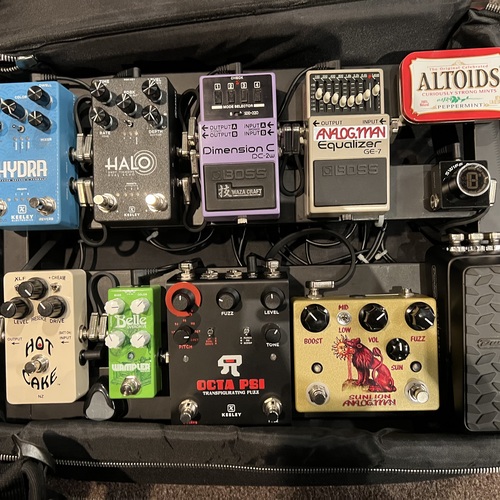
Dunlop JHF1 Jimi Hendrix Fuzz Face
Avg price: $174.42
Good sound and looks. Disappointing build quality.
Reissue of a vintage Jimi Hendrix guitar fuzz effect. Sounds and looks like a blast from the past. It has a nice metal casing with a nice shape and colour. There's a smaller version available, but since I wanted a modern classic, I decided to spend a bit more money on the big one that looks more like the original. It's a bit bigger than I expected though to the point it's a little inconvenient, yet it's surprisingly light. It needs a battery to power, but there's no battery compartment. You need to unscrew the entire bottom, and when you do you see nothing much is going on inside and nothing is held into place properly. Looks like a few good shakes will break it. The on/of switch ins incredibly noisy and needs more force force to press than I'm willing to expose this flimsy thing to. The pods are made of cheap plastic and aren't put on straight, so they change angle as you turn them. The volume pod moves much smoother than the one for fuzz.
It's more expensive than any of my Boss pedals, even though those are twice as small, just as heavy and feel ten times more solid and can be powered using an adapter or even just with the line in.
I'd give it five stars for sound and looks, but only 2 for build quality. Sound is most important, so that makes 4. Let's just hope it won't break too soon.
Preferred Settings + Usage:
Try turning the fuzz pod all the way down, slowly crank up the volume until the sound breaks up and you get a buzzing sound. Drive that signal hard into a high gain pre-amp to get overdrive from the amp and give the signal more body. Optionaly, put a wahwah pedal between the fuzz pedal and the pre-amp. This is great for guitar solo's.

Boss DC-2W Dimension C Waza Craft
Avg price: $213.38
Beautiful chorus that doesn't destroy the integrity of the original sound.
I bought this one for my analogue synthesizers. My former music teacher said: "If you use digital effects on an analogue synthesizer, you might as well use a VST". I don't agree with that statement, because I really like certain digital effects. You can do a lot with digital reverb you can't do with analogue or physical reverb and you're still able to tell the difference between a VST or analogue synthesizer. Some effects really benefit from being analogue though. Analogue chorus sounds more organic and alive. This is a beautiful chorus that doesn't destroy the integrity of the original sound. Some would say it's too dark and subtle, but if the original sound is already good, this just makes it fuller. It can instantly transform a bland mono pad into lush wide stereo, without weird unpleasant artefacts or phasing less refined chorus effects are known for. Boss is a subsidiary of Roland and I'm told this pedal has the same components and sound of two famous Roland chorus effects. Namely the Juno-60 Chorus in mode S, and the SDD-320 in the other. You can choose 4 flavours of each sound, and up to two at the same time for even more complex sounds. 1 is most focused. It makes it sound thicker and gives it more body. All the way up to 4 which is least stable and gives it a lush sound. There's no dry/wet knob which is a shame. I'd say in mono it sounds very subtle it's sometimes barely noticeable. In stereo it's probably to wide. I'd connect it in stereo to a mixing console and make it more mono until it sounds right. That's the easiest way to control the perceived amount of chorus.
Preferred Settings + Usage:
What sounds "best" all depends on the input source, what your song needs and personal taste. It's a matter of trying combinations that work for your sound. I like the SDD-320 mode best. It has a more interesting sound than the S mode it seems. Then I press the buttons 1 and 4 at the same time. 1 gives a focused chorus that give the sound more body. 4 gives it a fluttery layer on top. It still sounds like one effect, but since 1 and 4 are so far apart they clash less and give you the least phasing, even though there wasn't much to begin with.


Boss MT-2W Metal Zone Waza Craft
Avg price: $149.80
bart_van_zon's rating:


Arturia Pigments 6 Polychrome Software Synthesizer
Avg price: $99.00
bart_van_zon's rating:
About this setup
This gear photo by bart_van_zon features 20 pieces of gear, including Moog Subsequent 37, Sequential Circuits Prophet 10 rev 4, and Oberheim OB-X8. The setup spans Keyboards and Synthesizers, Studio Monitors, and Studio Equipment, with a mix of high-end and standard pieces. Artists with this kind of gear are most often found in the Electronic, Rock, and Pop scenes. Notable artists with overlapping gear include Andrew Huang, Tony Anderson, and Rick Beato.
Similar Artist Setups
Pro artists whose gear list overlaps with this photo.