This page about Gulbransen KS20 MIDI Adaptor is a stub. You can help improve it:


Pricing and availability




* Product prices and availability are updated by Equipboard every 24hrs and are subject to change. Equipboard may receive compensation for purchases made at participating retailers linked on this site. This compensation does not affect what products or prices are displayed, or the order of prices listed. For more information, please refer to our affiliate disclosure.


Reviews
Critic Reviews
Based on 0 Reviews and 0 Ratings
Artist usage
Add artist
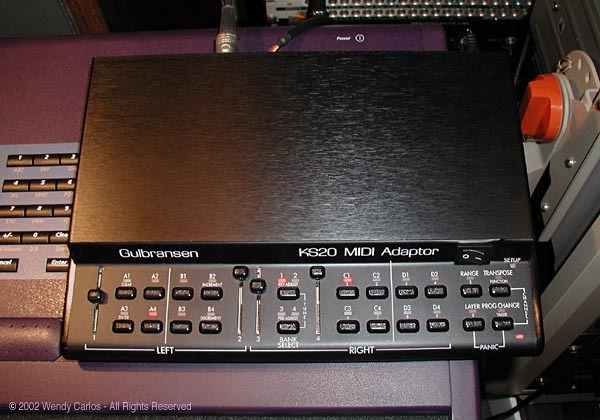
In an article on Carlos's official website, Carlos explains the 2001 installation of a KS20, including photographs and a companion article for setting up the device.
Excerpt from "Something Old -- Something New" by Wendy Carlos (2004)
In the summer of 2001 I wondered if there was a way to add on some kind of MIDI pedalboard, even a small one, so that I might be able to practice some actual organ parts with it. I spent several weeks searching for something I could afford, and tried out a few of the options in the local music stores. Um. What I learned was that there were two distinct camps. You could find a few reasonable one octave pedalboards which supported velocity sensing, and some other convenience features from MIDI that would be depressing to give up. A few were rather flimsy affairs, and jumped around the floor when played briskly. Yuk. The other camp supported what you'd need for an electronic organ: standard organ pedalboard size, but no velocity or aftertouch, no program changes, or customization, other things I was unwilling to put up without. I also didn't have the tools, experience and parts to build my own from scratch, as Clark had. Nutz.
Then I remembered that my acoustic piano up in the front of the loft has a retrofit Gulbransen optical pickup system. It's a wonderful device, and has been dependable and powerful and most welcome. Unfortunately, it's not in the studio proper, where I do my composing and recording. So it's gotten less use that I hoped for originally, when it was given to me by some generous people at the company. I wrote again to my contact there, Jack Butler. Did they have any devices that could turn an old organ pedalboard into a good MIDI controller?
The answer I got back from Jack was sorta no and sorta yes. No -- they did not have an actual pickup device for pedalboards. Yes, they did have a solution that might work. One of their engineers had come up with an "off the record" modification to their KS-20 unit recently. It was one of those amusing stories, his daughter was a church organist, and had started to use a pair of Gulbransen pickups beneath the keys of the manuals, so she could save her performances and improvisations each week via a MIDI sequencer. Ah -- but the pedalboard -- what to do for that?! Was there any way her engineering dad could figure out to reproduce those notes as well?
The solution he devised was extremely clever and logical. I'd have tried cutting up a keyboard strip and mounting the individual note pickups along a wood strip, one pickup beneath each pedal key. Wire them together again. That ought work. But it was a lot of risky work, tearing apart the printed circuit boards like that, one might damage the whole thing. Instead he'd taken a full 88-note strip, disassembled it into the four 22-note boards that make it up, and then mounted them on wood supports in four overlapping segments beneath the pedalboard keys. There was at least one pickup on every note. THEN -- you'd tell the onboard computer what sensors were going to be played by which notes and "map out" the rest (many pickups fell in the cracks, only about a third would be useful, due to the vastly different note-spacings). The procedure was simple -- just play the pedals one at a time slowly, from lowest to topmost note. And a new software subroutine he added did the rest. Damn clever.
Jack suggested I might consider this kit, even though the company did not formally "support" organ pedal installations. Other customers already were using it that way, though, and all reported good to excellent results. I decided to give it a try, since my old and not often used Yamaha Electone E-5 organ has a very study and attractive 25-note pedalboard. If I could retrofit the new pickup boards beneath this, I might be in business, and it would cost a lot less than a new similar sized board, even forgetting for a moment about velocity and pressure sensing (btw- both poly and channel pressure are supported by Gulbransen -- hey!). Yes, it would be a compromise, the E-5 doesn't use a full AGO 32-note set of pedals, but the smaller flat but radiating 25-note version made popular on Hammond and other electronic organs. Since I'm no organist, and seldom would need the extra top seven notes, this seemed a reasonable place to start.
I could always change over to an AGO size later. With the limited space I have, and the clumsiness of using a computer beside the rig if the pedals sat over 10" above floor level to each side, I'm not convinced that the purist approach would be preferable. Concave is easier to play than flat, but for 25 notes the maximum difference is less than an inch (and Ethel Smith managed pretty dern well). Shux. I ordered the KS20 installation kit Butler suggested. When unpacked I found one long steel supported pickup strip, which I placed on top of the new K2600's keyboard to examine closely:
[https://www.wendycarlos.com/wurlynew/striptop.JPG] K2600 wi Gulbransen
The kit included sundry connecting cables, mounting hardware, complete instructions, plus the brains of the pickup system, the KS20 control box shown next (also resting on top of the new 2600), below left. It's a well-engineered device, I've grown very fond of it since using it. If you look closely at one end you'll get a good idea of the elegant way the sensor strip is arranged, below center. Those precision optical moving vanes resemble the famous Loch Ness monster prankster photo from 1934. (Robert Wilson, the prankish London physician and coperpetrator with Wetherell, later confessed in great detail, like the similar "crop circle" partners in crimininy sakes, Bower and Chorley. But by then many had grown too fond of the hoax to admit they'd been cleverly duped. Think also of Conan Doyle, far too proud and gullible to admit he'd fallen for two schoolgirls' cutout "fairies".) The manufacturer impishly calls them "Nessies." Unlike the modeling clay (plasticine) long neck and head on a toy submarine of that well circulated image (below right), the Gulbransen "Nessies" are not a "fake in the lake." So reports of seeing and touching them on a sensor strip count as verified "Encounters of the Tangible Kind" (wink nudge say no more)...
[https://www.wendycarlos.com/wurlynew/KS20.JPG] Gulbransen KS20
[https://www.wendycarlos.com/wurlynew/sensideCUsml.jpg] Some Real "Nessies"
[https://www.wendycarlos.com/wurlynew/nessfakesml.jpg] A Fake "Nessie"
[...]
NOTE: There may be other musicians who will want to assemble a similar MIDI pedalboard custom installation. I can definitely recommend the Gulbransen KS20 as a solution with a great deal of elegance, power and little compromise. (The company now has a new name, MIDI 9, a new website, new lower prices, and has replaced the KS20 with a new line of controllers, some of which provide for organ pedal installations -- yeay!) You will have to find a physical set of organ pedals from one of several sources (even eBay occasionally has these on auction), and be willing to attempt some modest woodworking assembly on your own, as the factory DOES NOT supply nor support custom pedalboard installation kits. If you do go ahead, I've saved a set of instructions that should be studied when you initialize your unit to operate with whatever pedals you choose (12 to 32-notes AGO or more). You can construct a full MIDI organ, or head in more innovative directions. Please note, these were written for my own purposes only, but I will post them here for curious, enterprising musicians to print out and refer to, if you wish. It makes initialization a straightforward series of steps, avoiding several pitfalls of this nonstandard application. Initializing Instructions for Pedalboard use of the KS20 HERE. (Opens a new window you may print from. Close that window, as with any of the photos here, to return here.)

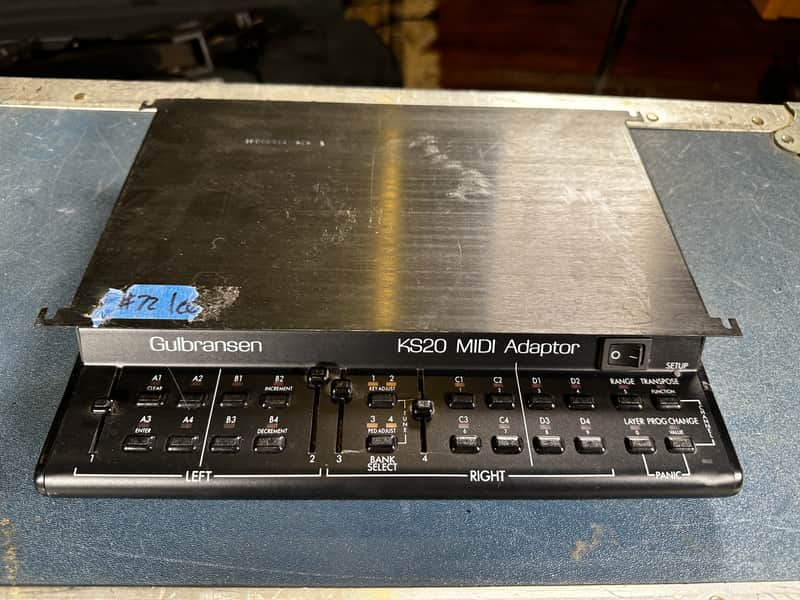
Listed on Reverb.com by Recording Services and Supply in 2023.
Gulbransen KS20 MIDI Controller Adapter from Leon Russell Estate
We are honored to be selling items from the Steve Ripley (The Tractors, Bob Dylan, Ripley Guitars, The Church Studio) and the Leon Russell Estates.

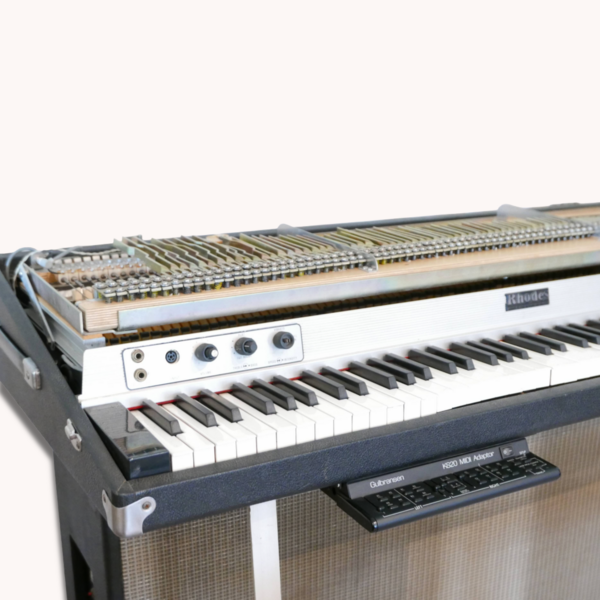
As described and photographed in the Wax Poetics auction listing for Ware's 88-key Mark I suitcase Fender Rhodes, it was outfitted with a Gulbransen KS20. The auction ended on April 30, 2026.
This Fender Rhodes Piano was owned by Leon Ware from the late 1970s through to his passing, forming a central part of his creative life during a defining period of his career.
[...]
Configured as a Suitcase model with integrated amplifier and speaker cabinet, this Rhodes reflects the premium studio setups of the era. It was later fitted with a Gulbransen KS20 MIDI adaptor, a period modification that speaks to evolving studio practices and Ware’s continued engagement with new production technologies.
[...]
Key Details
[...]
- Fitted with Gulbransen KS20 MIDI adaptor (period modification)
[...]
Collectibility
Provenance: From the personal studio of Leon Ware, owned and used by the artist for the remainder of his life
Genre Usage
Based on how artists on Equipboard use this gear, it is most commonly found in the following genres.
More MIDI Interfaces

$89.64 - $285.00
in MIDI Interfaces Rank


$54.99 - $69.00
in MIDI Interfaces Rank


$179.00 - $199.99
in MIDI Interfaces Rank

$99.95 - $549.96
in MIDI Interfaces Rank


$358.00 - $525.89
in MIDI Interfaces Rank


$177.00 - $208.99
in MIDI Interfaces Rank


$89.99 - $324.67
in MIDI Interfaces Rank


$129.99 - $139.00
in MIDI Interfaces Rank


$348.00 - $399.99
in MIDI Interfaces Rank
.jpeg?v=1783110491)


$225.00
in MIDI Interfaces Rank


$29.99 - $48.00
in MIDI Interfaces Rank


$118.00 - $139.00
in MIDI Interfaces Rank


$627.55
in MIDI Interfaces Rank


$81.00
in MIDI Interfaces Rank


$69.95 - $85.00
in MIDI Interfaces Rank


$95.00 - $130.90
in MIDI Interfaces Rank

$34.99 - $39.99
in MIDI Interfaces Rank


$57.00 - $78.40
in MIDI Interfaces Rank

$40.00 - $124.95
in MIDI Interfaces Rank

$19.00 - $82.36
in MIDI Interfaces Rank


$95.00 - $130.90
in MIDI Interfaces Rank

$44.45 - $52.94
in MIDI Interfaces Rank

$73.00 - $99.99
in MIDI Interfaces Rank


$39.00 - $39.99
in MIDI Interfaces Rank

$549.00
in MIDI Interfaces Rank


$168.00 - $240.90
in MIDI Interfaces Rank

$169.99 - $219.00
in MIDI Interfaces Rank


$39.00 - $451.07
in MIDI Interfaces Rank


$101.17
in MIDI Interfaces Rank


$148.24 - $160.00
in MIDI Interfaces Rank


$99.95
in MIDI Interfaces Rank


$197.00
in MIDI Interfaces Rank


$29.95 - $58.95
in MIDI Interfaces Rank

$44.17 - $99.99
in MIDI Interfaces Rank

$48.38 - $149.00
in MIDI Interfaces Rank

$55.99 - $69.00
in MIDI Interfaces Rank

$215.00 - $249.99
in MIDI Interfaces Rank


$99.99
in MIDI Interfaces Rank


$88.35 - $99.99
in MIDI Interfaces Rank
Community setups


Similar


Most Popular Brands
-
Added to Equipboard on by
 eyeseeofficial
Gear IQ 161522
-


