
E-Mu
99Also known as: EMU, E-mu Systems, Emu Systems
UnclaimedE-mu Systems was founded in 1971 in Santa Cruz, California by Dave Rossum, Steve Gabriel, Jim Ketcham, and Scott Wedge, initially with the goal of building custom modular synthesizers. Through the 1970s the company produced highly regarded modular systems for universities and studios, and derived significant income from patent licensing — most notably a keyboard scanning patent licensed to Sequ...

$1,193.94
in Production & Groove Rank


$75.00
in Sound Modules Rank


$49.99
in Sound Modules Rank


$567.12
in Sound Modules Rank


$41.19
in Sound Modules Rank


$3,000.00
in Production & Groove Rank


-m.webp?v=1783781996)


$1,143.87
in Drum Machines Rank


$226.85
in Controllers Rank


$375.00
in Sound Modules Rank
.jpg?v=1783852063)


$475.00
in Sound Modules Rank


-m.webp?v=1783782061)
$143.27
in Audio Samplers Rank


$537.28
in Audio Samplers Rank


$1,671.52
in Sound Modules Rank


$750.00
in Audio Samplers Rank


$520.00
in Production & Groove Rank


$800.00


$600.00
in Production & Groove Rank


$750.00
in Audio Samplers Rank


$1,193.94
in Audio Samplers Rank


$390.00
in Sound Modules Rank


$350.00

$475.00


$770.85


$250.00
in Audio Samplers Rank


$5,400.00


.jpg?v=1783461063)


$480.72
in Audio Samplers Rank


E-mu Systems was founded in 1971 in Santa Cruz, California by Dave Rossum, Steve Gabriel, Jim Ketcham, and Scott Wedge, initially with the goal of building custom modular synthesizers. Through the 1970s the company produced highly regarded modular systems for universities and studios, and derived significant income from patent licensing — most notably a keyboard scanning patent licensed to Sequential Circuits for use in the Prophet-5.
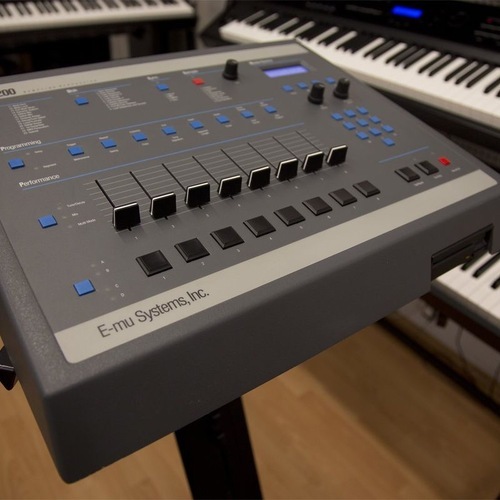
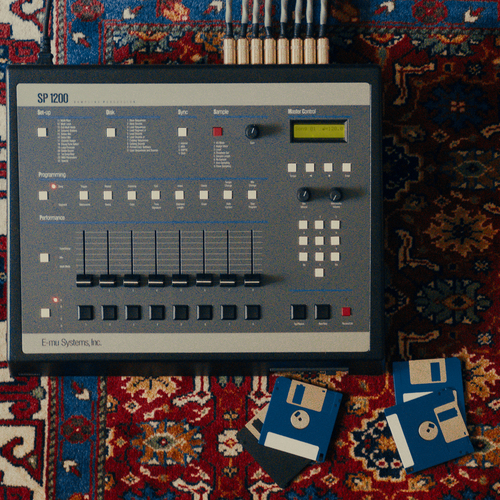
The company's trajectory shifted dramatically in 1981 with the introduction of the Emulator, one of the first commercially available samplers, priced at $7,900 compared to the $30,000 Fairlight CMI it competed against. E-mu followed with the Drumulator (1983), a sub-$1,000 sample-based drum machine, and the SP-12 and SP-1200 drum samplers (1985 and 1987 respectively). The SP-1200 became a defining instrument of the golden age of hip-hop, favored by producers including Marley Marl, Pete Rock, DJ Premier, Public Enemy's Bomb Squad, and Dr. Dre for its distinctive gritty, warm sound. The Emax sampler series extended E-mu's reach into professional studio use.
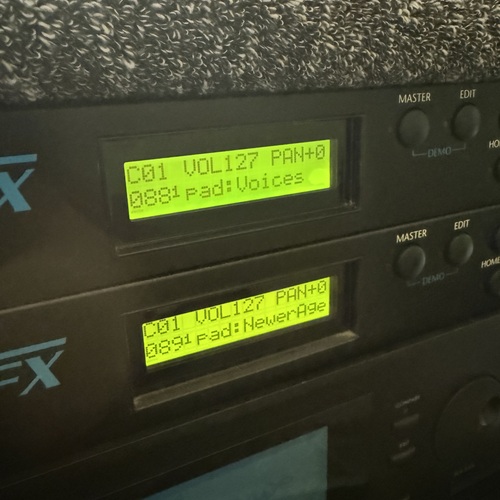
In 1989–1990, E-mu introduced the Proteus, a rackmount ROM-based sound module that offered a large library of high-quality samples at an accessible price, spawning numerous variants including orchestral and world music editions. The company was acquired by Creative Technology (parent of Creative Labs) in 1993 and later merged with Ensoniq in 1998. Hardware instrument production was discontinued in 2002, though E-mu subsequently released software products including the Emulator X and Proteus X software samplers, and a line of professional audio interfaces and sound cards.
E-Mu has 105 products cataloged on Equipboard, including Synthesizers, Sound Modules, and Audio Samplers. Their gear is featured by 488 artists, with the strongest followings in Electronic, Rock, and Pop. Notable users include Martin O’Donnell, Kenji Kawai, and Josh Mancell. E-Mu's catalog spans the full price spectrum — from entry-level options to high-end flagships.
Artists Who Use E-Mu


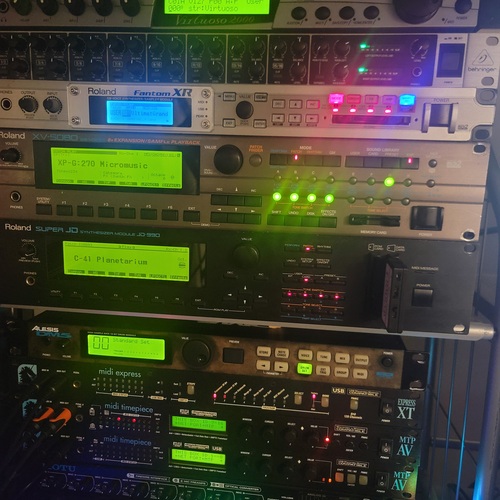
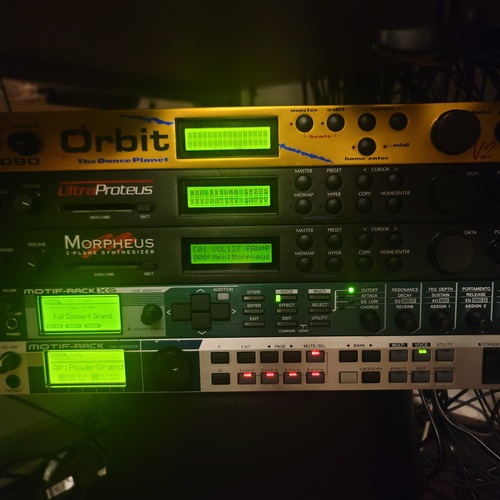
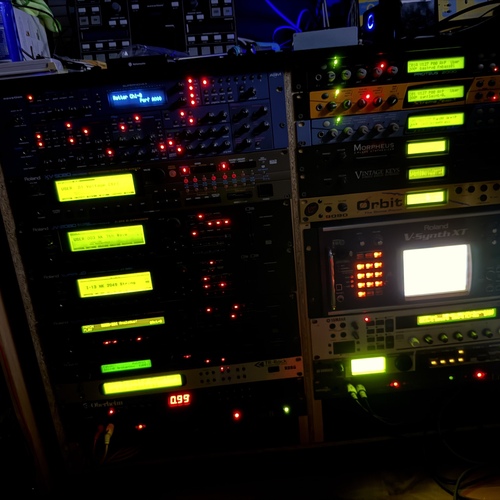
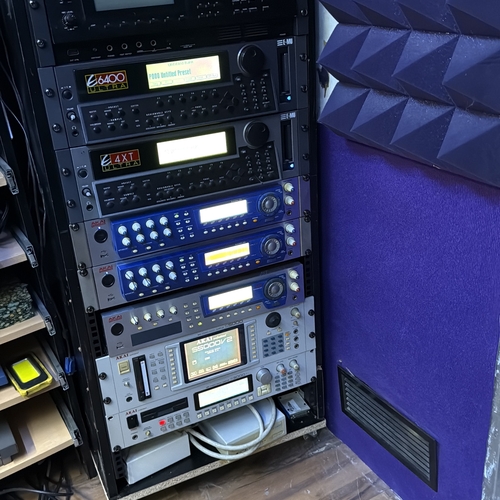
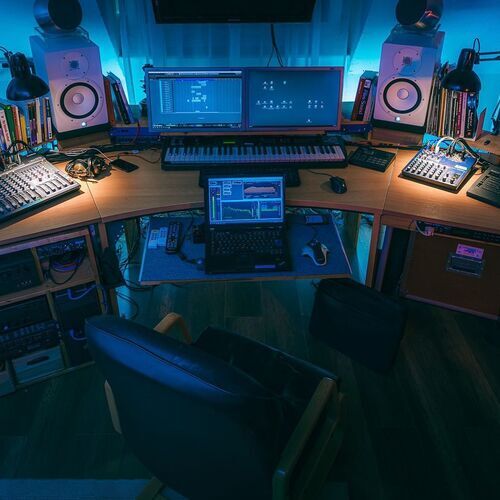
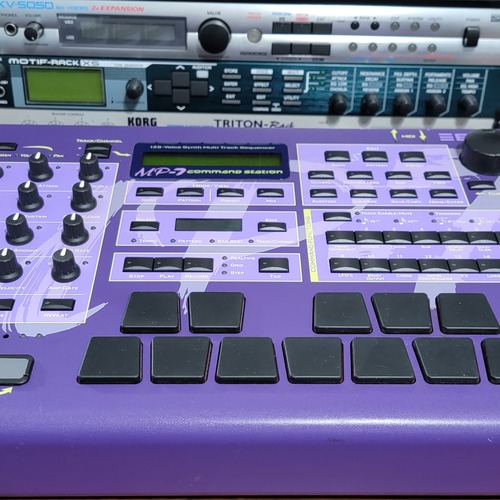
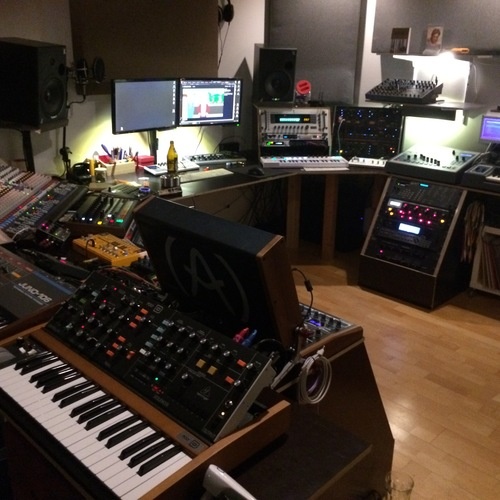
Community setups featuring E-Mu
Show yours




.jpeg?v=1725818427)











Are you on the E-Mu team?
- Be the first to know when an artist is spotted using E-Mu gear
- Curate the E-Mu catalog, images, and product details
- Respond to community photos and reviews of E-Mu gear
- See how E-Mu gear is trending on Equipboard
 Ensoniq
 Oberheim
 Sequential Circuits
 Waldorf
 Korg
Korg
 Dave Smith Instruments
 Modal Electronics
 Studio Electronics
 Clavia Nord
 ARP
ARP
 Mellotron
 ASM
ASM