
Pricing and availability




* Product prices and availability are updated by Equipboard every 24hrs and are subject to change. Equipboard may receive compensation for purchases made at participating retailers linked on this site. This compensation does not affect what products or prices are displayed, or the order of prices listed. For more information, please refer to our affiliate disclosure.
Description
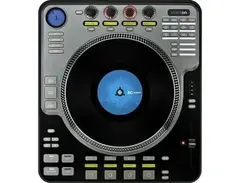
Step into the DJ booth with confidence using the Stanton SCS.1D, a robust and innovative DJ controller designed for both aspiring and professional DJs. This controller is engineered to meet the high standards of live performance, offering a tactile and intuitive experience that ensures your set is always at its best. The motorized platter offers a vinyl-like feel, perfect for DJs who value the traditional touch of a turntable while embracing modern technology. Its high-resolution MIDI control allows for precise mixing, scratching, and effects manipulation, making it an essential tool for any dynamic performance.
The SCS.1D boasts a customizable control surface, providing flexibility to adapt to your unique style and preferences. With its advanced mapping capabilities, it seamlessly integrates with leading DJ software, ensuring you can effortlessly sync tracks and craft the perfect mix. Whether you're in the studio or performing on stage, the Stanton SCS.1D delivers reliability and precision that enhances your musical creativity.
Key Features:
- Motorized platter for authentic vinyl-like control
- High-resolution MIDI control for precision mixing
- Customizable control surface for personalized setups
- Seamless integration with popular DJ software
- Advanced mapping capabilities for versatile performance
- Built for both live performance and studio use
Videos

Solotech Audiovisual Equipment
Stanton SCS-1D & SCS-1M Firewire Turntable DJ Mixer PSSL.com
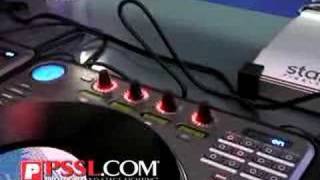
Stanton SCS-1D & SCS-1M Firewire Turntable DJ Mixer PSSL.com
Solotech Audiovisual Equipment
![Video thumbnail for Stanton SCS.1D with B-Side [Winter NAMM 2011] | UniqueSquared.com by UniqueSquared](https://img.youtube.com/vi/XtDDdbgoH6M/mqdefault.jpg)
Stanton SCS.1D with B-Side [Winter NAMM 2011] | UniqueSquared.com

UniqueSquared
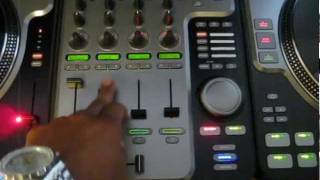
Stanton SCS-1 (SCS.1d & SCS.1m) Digital DJ System Video Review

DJBooth Pro Audio
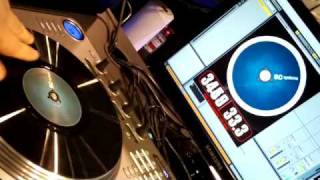
NAMM 2009 **NEW** Stanton SCS-1d Ableton LIVE Scratching Demo

agiprodj
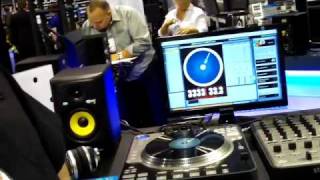
NAMM 2009 **NEW** Stanton SCS-1d Vinyl Coupling
agiprodj
Reviews
2.5 out of 5
Based on 2 Reviews and 2 Ratings

620
One back to the lab was not enough.
NAMM 2009: Stanton announces Stanton SCS.1 system which is a combo controller/audio interface in 2 unit types: the mixer controller named SCS.1M with audio interface, and the SCS.1D which is a turntable-like controller.
At the time everything was to do be done in the digital (DVS) DJ market, and Stanton to prove the performance of its SCS.1D presents a diagnostic tool of their own that shows a resolution of about 3500 points per rotation: one of the best yet, and basically as natural as a turntable/vinyl/DVS. It was the first scratch controller that promised to give about the same experience as using a turntable.
So they released it in 2009 before removing it from the shelves, due to being plagued with Firmware issues. TWO WHOLE YEARS LATER, they re-released the system promising they fixed every single problem the units had.
They didn't: the units still had major issues and this time they just pulled the plug on the most promising DJ hardware at the time without looking back. I'm no insider at all, but after that it seems Stanton who once was a staple in the DJ hardware market took a huge hit and never was the same as before. They were about to win most of the entire market and instead decided to call off.
FFW 10 years later, and the 1.D still has some features that are missing from today's offering. As if it was so ahead of its time you can almost forgive them for releasing such an unfinished product. The only hardware that is a tad like the 1.D is of course the Rane Twelve controller.
But when you look at the Rane Twelve, it doesn't have half the features the 1.D had when it was released. Except for the obvious turntable platter, here's what the 1.D had that even modern controller doesn't:
- Complete loop/stutter/sample playing section at the bottom with 4 big pads that feels good to play. They are not pressure sensitive, but anyway felt good to play samples or rises.
- MOTORIZED PITCH FADER: Okay, now this is one of the most underrated features that should be present on any turntable-like controller. On the 1.D, you could place the fader in any position, hit a button and it would slowly or quickly go back to 0%. You could also bend using +/- buttons and the fader would move accordingly. The pitch fader position also allowed for excellent instrument scratching: play a trumpet note looping, set the fader to 100% and glide the instrument notes using the fader.
- Rane Twelve left aside, there's no other 10in platter controller on the market. 10" platter is perfect since it's more forgiving than 12", but still retains lots of torque under the vinyl that it doesn't feel completely light either. It feels a lot like playing 12", and the adaptation period was little to none.
- Complete effects section at the top. The 4 clickable knobs and buttons at the top allows you to select, load and tweak DVS effects.
- 1/2/3/4 layers: up to 4 virtual decks selection per hardware deck
- Use the platter for browsing: this one I loved a lot, but since I also had the 1.M with dedicated browser knob I didn't use as much on the 1.D.
2009 was a strange time for innovation. Peripherals connection standards were not set in stone yet (USB/Firewire), and makers were having a hard time betting on one or another for their newest products. There was some kind of bar though: "Pro gear had to be Mac compatible, so Firewire was the high-end one". And of course, every single product that was based around Firewire ended up getting E.O.L. in the long run, while most USB products are still plug-and-play today. It was totally like Beta vs VHS. MOTU is a good example of this era, with their dual/hybrid USB/Firewire products, like the Ultralite. For some reason, USB was getting the "not pro" tag, maybe because Apple really was the best computers to use at the time for music production. Either way, it makes SCS.1 system very hard to connect and use on modern computers:m if you have a Thunderbolt 3 port, you have to get two separate adapters connected together: Apple's TB3 to TB2 adapter, and Apple's TB1 to Firewire 800 adapter. Since TB2 and TB1 have the same physical connector and TB2 is backward-compatible, the Firewire connection is automatically converted to TB2. This also works with most hardware with Firewire port, but they need to be working on Windows 10 or latest MacOS to use. Now that Firewire has completely disappeared from modern computers except in TB3 form this places the SCS.1 system in the "done-so" closet.
The display strips on the units were also of very poor quality and gave up one after another, until only displaying some symbols. Fortunately, SCS.1D no-nonsense layout makes it easy to remember what knob/button does what. I opened one unit to see if parts numbers were there, but most electronics were Stanton-made and thus f.u.b.a.r.
Around 2014-2015, a huge amount of SCS.1 systems was dumped on eBay at prices around $30 USD per unit. I bought 4. Since then it's pretty rare to see one for sale.
I can confidently say that the hardware is Windows 10 compatible even though it never was updated. The SCS.1 system is plug and play in Virtual DJ which is the DVS I use. It also is compatible with Traktor, but afaik the rotating platter was not working properly. VDJ is now a superb piece of software that works perfectly with SCS.1 system.

192
When you're a pioneer, you can't get it 100% right at first try.
The Stanton SCS.1D is a Firewire-based turntable controller. It sports the same direct drive motor as the flagship Stanton ST-150 turntable. It has many buttons, knobs, displays, a motorized pitch slider, and a 10" platter instead of the classic 12" size.
First thing first; when Stanton announded this product, nothing on the market even came close to being as advanced as this. Its closest competitors were traditional turntable combined with a Serato SL or Traktor-driven interface, and CDJs with the same setting. But Stanton played themselves by marketing this as the new best thing: delays caused by development issues finally caught up with the public interest. For months we only had a 1 minute video demo to rely on. Stanton came back to NAMM next year with what they said was where they were in development stage, showing only a software counting the platter resolution. While this at the time was revolutionary (the count was about 1000 per round IIRC), people were starting to believe this was all vaporware, and I deeply believe this played a huge part on how things turned for Stanton there after.
Product was released early, and was plagued with bugs and hardware issues. Parts were nowhere to be found, distributors couldn't fill their orders. The first issue users noticed was small displays were burning out, or displaying data randomly. Traktor support was non-existent while the controller was supposed to be automatically mapped, platter didnt behave as supposed (had to be used as a scrub wheel instead of an actual turntable emulation. VirtualDJ though was the first DJ software to properly support the SCS.1D, with good results.
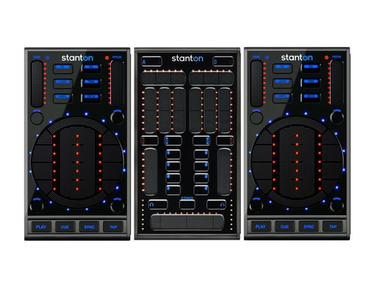
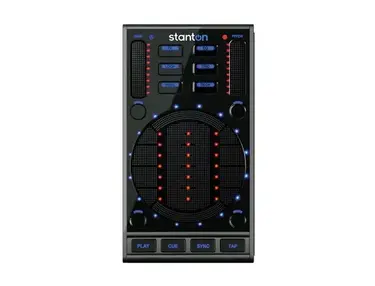
But this never took off. Stanton discontinued the SCS series shortly, leaving many unhappy customers with mostly useless units in their hands. Stanton also released USB touch strips controllers around the same thime, and while their low prices gave them many sales, the controllers were seen as toys more than real DJ hardware.
The rest is history, Stanton has been sold to Gibson and since then, nothing much came out of it. But how's the SCS performs today?
I have a VirtualDJ lifetime license which I bought for next to nothing back in the days, and it still supports the SCS very well, for what's working on it. Every knob and button are mapped properly, but you have to have good memory since none of them could be labeled properly on the long-gone displays.
BUT, and it's a big BUT, if you're a turntablist, scratch DJ, or simply want to get into live remixing, the SCS still stands its ground today. The motor is working as good as day 1, the layout is pretty intuitive and the most well hidden gem is the motorized pitch fader.
The motorized pitch fader allows you to many things if you map it to other functions, but out of the box, it gives you instant zero % recall at the touch of a button, and can do the same but progressively, slowly moving towards 0%. I never understood why such a feature was never done by another DJ-industry company on any product; this was revolutionary, and should have a place on today's controllers instead of inaccurate touch strips.
That platter/motor... It just feels great. 10" is really a great compromise between the standards 12" and 7". Denon had put 9" platter on its DN-SC3900, I always wondered how it compared to this.
In 2015, for a reason I can't explain, Stanton SCS series were basically given up on eBay. It was probably the american distributor who got rid of all its left open box stocks. The original SCS.1D was aoove $1200 USD, and you could now get one for less than $100.
If you forget about the display issues, and pay $60 for the product as I did, it's probably the closest thing you can get to a Rane Twelve or a Reloop RP-8000 turntable with an interface. I don't think the new Denon Prime-M small turntable can compare to this as it's a world of difference in engineering and product quality, still, can something beat a larger platter to a scratch DJ? Don't think so.
The benefits of using VirtualDJ instead of Traktor or Serato are plenty, but being able to easily program things and use VST effects are a good starter. You can program the start/stop time of the platter in a matter of seconds. You can dial in an effect and control it with the top 4 knobs and buttons, feels natural.
So to sum this up, this was a product that was supposed to be the new turntable. Idea-wise, this was so promising; imagine having CDJ-like controls over a real turntable! No more needles, tonearm, crates, none of this would matter because you be a club-DJ or turntablist, this got you covered. I'm a little sad thinking about this to be honest. I hate seeing good ideas such as this get discontinued and all efforts, marketing, everything is ruined.
But it still works to this day and I still use it in my studio, and even live sometimes.
Genre Usage
Based on how artists on Equipboard use this gear, it is most commonly found in the following genres.
More Stanton DJ Controllers





$219.00 - $386.00
in DJ Controllers Rank


$800.00
in DJ Controllers Rank


$152.00 - $225.00
in DJ Controllers Rank


$718.00 - $929.00
in DJ Controllers Rank


$226.85 - $379.99
in DJ Controllers Rank


$219.00 - $386.00
in DJ Controllers Rank


$259.00 - $799.00
in DJ Controllers Rank


$1,200.00 - $2,135.00
in DJ Controllers Rank


$508.44 - $1,199.00
in DJ Controllers Rank

.jpeg?v=1783962127)


$99.00 - $777.00
in DJ Controllers Rank


$870.00 - $2,698.00
in DJ Controllers Rank


$899.99
in DJ Controllers Rank


$259.00 - $1,749.82
in DJ Controllers Rank


$184.50
in DJ Controllers Rank


$2,549.00
in DJ Controllers Rank


$177.00 - $219.00
in DJ Controllers Rank


$425.00
in DJ Controllers Rank


$1,449.99 - $1,649.00
in DJ Controllers Rank


$1,324.67 - $1,899.99
in DJ Controllers Rank


$1,349.99 - $1,399.00
in DJ Controllers Rank


$249.00 - $295.00
in DJ Controllers Rank


$170.00 - $249.00
in DJ Controllers Rank


$64.99 - $158.00
in DJ Controllers Rank




$311.00 - $449.00
in DJ Controllers Rank


$55.00 - $218.00
in DJ Controllers Rank


$777.00
in DJ Controllers Rank


$599.99 - $849.00
in DJ Controllers Rank


$1,165.27 - $2,499.00
in DJ Controllers Rank

$235.00 - $349.99
in DJ Controllers Rank


$1,359.00 - $2,718.00
in DJ Controllers Rank


$700.00 - $1,699.99
in DJ Controllers Rank


Artist usage

Community setups


Similar


Gear Guides






Most Popular DJ Controllers
Most Popular Brands
-
Added to Equipboard on by
shrikeGearIQ 192
-


