Daft Punk
French electronic duo
Daft Punk's Effects Processors


From a 2001 interview with Daft Punk: "We have a really small compressor, the Alesis 3630, which is $300. That's the main one we used on Homework and Discovery. The one we used the most is one of the cheapest ones on the market."
Find it on:


Per the official Mutronics website, Daft Punk are listed as Mutator customers. Good of Mutronics to keep the page alive despite the Mutator being discontinued in 2007.
Find it on:

Used on Discovery, as stated in this May 1, 2001 Remix interview.
You use vocoders and phase shifters on many of your tracks.
Bangalter: People always ask us what vocoder we use, but every one of our vocal tracks uses a different vocoder effect. We have the old Roland one [an SVC-350], Auto-Tune, and a Digitech Vocalist. We take the same approach with phase shifters. Every track on this album uses a different phase shifter. We have a Mu-Tron phaser, a Moogerfooger pedal, an old AMS phaser, and an Ensoniq DP-4. With the older items, you can have several of the same model and they all sound different.
Find it on:

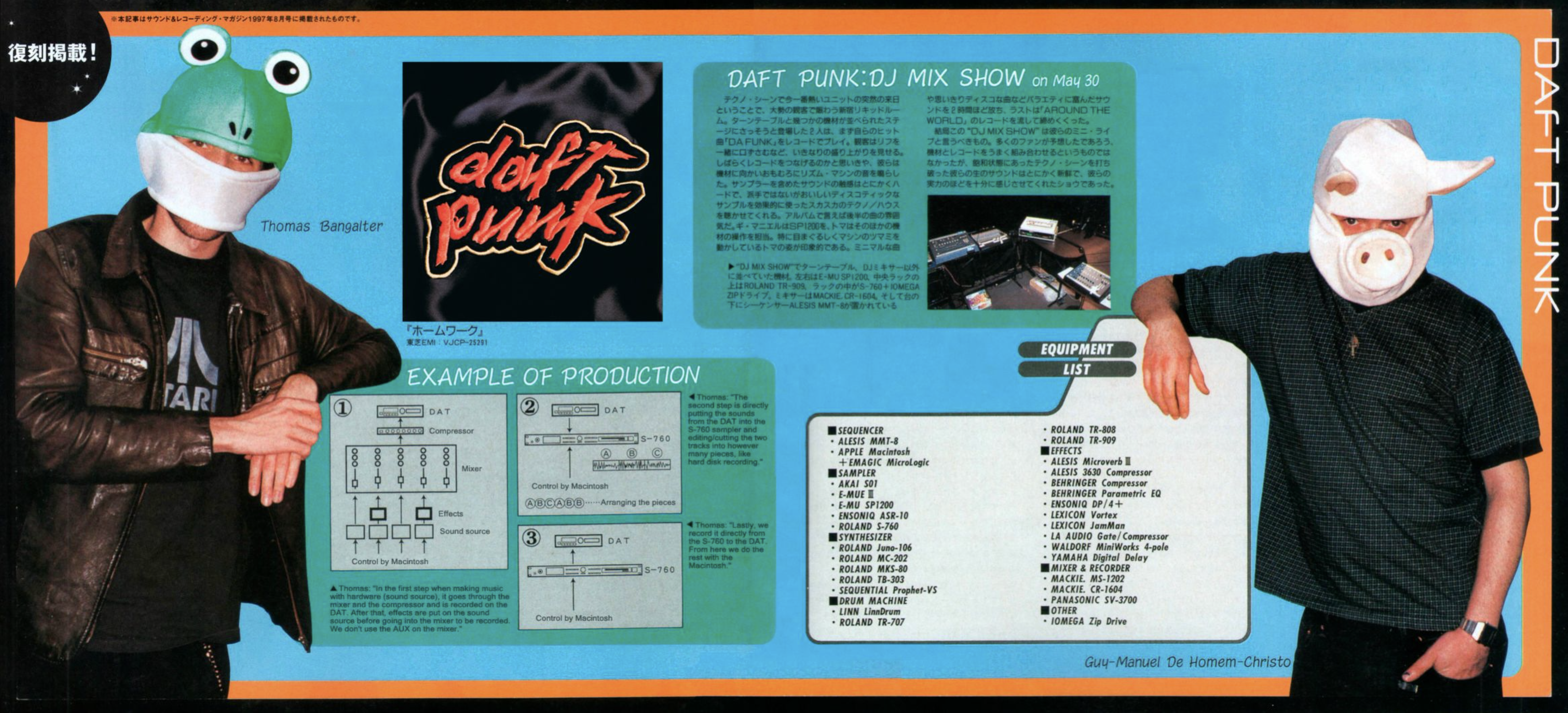
this japanese interview shows daft punks equipment used to record homework
Find it on:

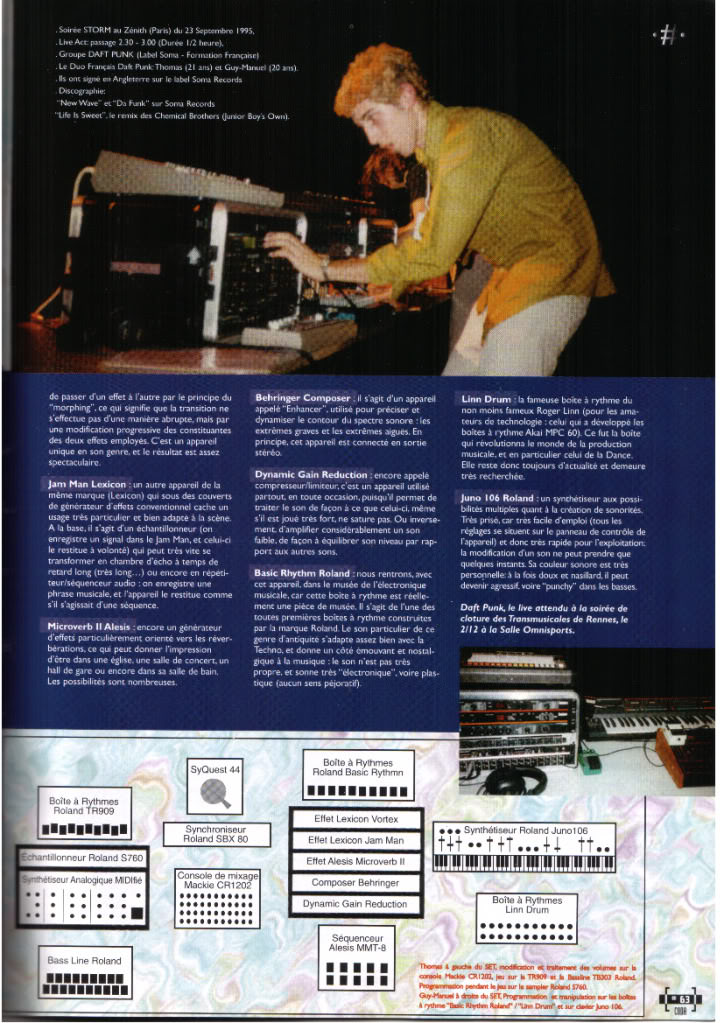
In this enlarged photo from a French music publication you can see the familiar black and silver cosmetic and distinctive font of a Valley People Dyna-mite on the piece of gear 2nd from bottom below the Composer. Full CODA magazine page here: https://images.equipboard.com/uploads/source/image/62883/7Tx7Fmq.jpg
I would know the dynamite, I have 3 of them including one of these early ones... apart from the font you can't miss those awful circular Valley power and link buttons on the right of the unit that don't light up but just have a colored piece of paper push forward to indicate they're engaged. The device is on because the yellow paper is showing through the power button on the right but we know daft punk's channels are not linked because the link button on the left is showing black in the clear plastic.
Find it on:

A Microverb III can clearly be seen in this photo of Daft Punk's late-90s live rig - courtesy CODA magzine. Note: the article cites this as a Microverb II, which was half-rack size, but the photo in question clearly shows a rack-sized Microverb III.
Find it on:

Daft Punk record bass guitar via a Neve 1081 and Teletronix LA-2A. The LA-2A was also used to record a couple of vocalists, and during the mixing process it was used for parallel compression on the kick and snare.
Find it on:


The Enmore Audio article lists the Waldorf MiniWorks 4-Pole among the equipment Daft Punk used to record their album "Homework."
Find it on:

"We spent some time auditioning compressors, like several 1176s, LA2As and Neve 33609s, and used what individual piece of gear sounded best to us. Daft Punk actually bought a vintage reconditioned 33609 and it didn't quite sound the same, so they traded the one that they had spent a ton of money on for the 33609 that they had at Conway, because everybody loved that one! This is one of the fun things about analogue gear, every individual piece sounds a little different."
Find it on:

In addition to the Universal Audio Precision De-Esser Plugin, the DBX 902 was used to process guest vocalists for Daft Punk's album, to "make the vocal brighter without it being sibilant."
One tip from mixing engineer Mick Guzauski is to very narrowly cut the vocals around 3-4kHz.
Find it on:

A Lexicon Vortex is shown in this diagram of Daft Punk's late 90's live setup. Source: CODA Magazine.
Find it on:
-m.webp?v=1783263531)
Steel guitar for Daft Punk was recorded using a Neumann U87 mic, which went through a Neve 1073 as well as the Universal Audio 1176LN.
The 1176 was also used on the kick and snare for parallel compression during the mixing process.
Find it on:

The API 2500 compressor was used for parallel compression on Daft Punk's drum tracks during the mixing process.
Find it on:

In addition to the API 2500, the Chandler TG12413 was used for parallel compression on Daft Punk's drum tracks, specifically in the big section of the song "Touch".
Find it on:



Per the superb detective work of @eyeseeofficial and @jimmarchi1 in this forum thread it has been determined that the Behringer Composer cited in this late-'90s interview with CODA magazine and this late-'90s Japanese publication could only be a Behringer Composer MDX2000.
The unit's overall appearance in the photo provided, along with it's timeframe, 23rd of September, 1995, narrow it down to only the MDX-2000 or the brand-new-at-the-time MDX2100, but the lack of a white "in/out" graphic above the Auto button for the Attack and Release controls provide a positive ID of MDX2000.
Full credit to @eyeseeofficial for noticing this key aesthetic differentiator.
Find it on:

Used on Discovery, as stated in this May 1, 2001 Remix interview and in this October 1, 2001 Mix Online interview.
Remix
You use vocoders and phase shifters on many of your tracks.
Bangalter: People always ask us what vocoder we use, but every one of our vocal tracks uses a different vocoder effect. We have the old Roland one [an SVC-350], Auto-Tune, and a Digitech Vocalist. We take the same approach with phase shifters. Every track on this album uses a different phase shifter. We have a Mu-Tron phaser, a Moogerfooger pedal, an old AMS phaser, and an Ensoniq DP-4. With the older items, you can have several of the same model and they all sound different.
Mix Online
The key principle that de Homem-Christo repeatedly invokes in discussing Daft Punk's compositional approach is bricolage, a French term referring to the art of taking found materials (in this case, found sounds) and incorporating them into something new. “Sometimes we use an instrument in a way that it was never created for,” he explains. “Some people might say, ‘You're doing something wrong using this effect like that,’ but we always try to do different tricks and techniques that are maybe a little bit wild for usual sound engineers. But by experimenting with some crazy ideas, you find some crazy sounds.”
To get those sounds, the pair uses many vintage keyboards, including Korg, Roland and Moog gear from the '70s. “We use the big ones that were used in the '70s, like the Juno. It depends on how you use it — if you put a distortion effect on a Juno, you can't tell it's a Juno.” Their main synths include a TR-909, TR-808, Juno-106, ARP Odyssey, E-mu 3 and AMS Phasers.
Find it on:


Daft Punk used the Sennheiser VSM 201 vocoder on their album "Random Access Memories." This vocoder, also used by Herbie Hancock, is featured in the official video for "I Thought It Was You." Daft Punk reportedly created 18 custom copies of this vocoder, each valued at approximately $20,000.
Find it on:

In this video from a live performance in Chicago, 1996, Daft Punk can be seen using an LA Audio 4x4 Gate/Compressor. Additionally "LA Audio Gate/Compressor" is listed in this late '90s interview provided to a Japanese publication.
Find it on:

The JamMan live looper can be seen in this diagram and photo of Daft Punk's late-90s live setup. Courtesy CODA Magazine.
Find it on:

In a photograph of Guy-Manuel de Homem-Christo's studio from around 2002, an Alesis Quadraverb 2 can be seen on the zebra print box to the right, serving as confirmation of its use by Daft Punk.
Find it on:
This is a community-built gear list for Daft Punk.
- Find relevant music gear like Studio Equipment, Software Plugins and VSTs, Headphones, and other instruments and add it to Daft Punk.
- The best places to look for gear usage are typically on the artist's social media, YouTube, live performance images, and interviews.
- To receive email updates when Daft Punk is seen with new gear, follow the artist.
Discography

Homework
1997

Discovery
2001
Alive 1997
2001

Daft Club
2003
Human After All
2005
Human After All (Remixes)
2006

Alive 2007
2007
TRON: Legacy - The Complete Edition (Original Motion Picture Soundtrack)
2010
TRON: Legacy
2010
TRON: Legacy Reconfigured
2011

Daft Punk | Random Access Memories | The Collaborators
2013

Random Access Memories
2013


.png?v=1782922288)