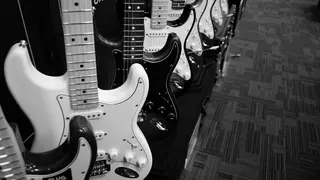
Gemma Thompson's Gear


From The Line of Best Fit, 12 June 2012: "Well, I have a 1966 Fender Duo-Sonic in Daphne Blue. I was playing a show with John and Jehn in France, in their hometown. We had a few days before this show, and John took me to this guitar shop where he’d bought a lot of his instruments. He knew the guy, and he said he’d lend me this guitar for two days. He didn’t tell me how much it was. So I sat round the fireplace in France for two days before the show just playing this guitar, and I completely fell in love with it. I gave it back, and I came back to the UK. But I couldn’t stop thinking about this guitar.
By then he’d told me the price, and I just thought, no way. But I did everything I could in my power to get hold of this guitar, and I ended up picking it up from a French lorry driver on an industrial estate in east London. He held up all the traffic. I’m in the corner of this industrial park looking out for a specific French lorry, getting some weird looks. But eventually he came, stopped all the traffic coming off this A road, got out of his cab and gave me this guitar and off he went."
From Wikipedia entry for Fender Duo-Sonic: "Third version – Duo-Sonic II (1964–1968) In 1964 the Duo-Sonic was redesigned based on the Fender Mustang that had recently been added to the student model line but without the vibrato tail-piece. The student guitars now all featured larger and slightly offset bodies, necks with larger headstocks and rosewood fingerboards and plastic pickguards with the volume and tone controls mounted on a separate metal plate. Pickup selection was moved above the pickups on both the Duo-Sonic and the Mustang and utilized two 3-position on-off-on switches that allowed for in and out-of-phase sounds. The pickups were also reverse-wound/reverse-polarity, which made them into a functional humbucker when both pickups were used simultaneously. Also added in this redesign was the option of a 24 inch scale neck in addition to the 22.5 inch scale. This re-designed model was renamed Duo-Sonic II although decals with and without the II designation were used occasionally. In addition to white, Daphne Blue and Dakota Red colors added.
The Duo-Sonic lasted until 1969 when it was dropped most likely because the Mustang with its tremolo tail piece was far more popular.
The Duo-Sonic I and II are both considered rare and have displayed growing collector value. The Duo-Sonic II in particular is often seen as a desirable alternative to the more popular Mustang, since it lacks the difficult-to-maintain tremolo bridge."
Find it on:


In > Boss RE-20 Space Echo (A/Mono In > B Out) > Boss TU-3 Chromatic Tuner > Moog MF Boost > MXR Distortion + > Fulltone OCD > Maxon OD808 ReIssue > MXR Blue Box Octave Fuzz > Flux Liquid Ambience > Morley ABC IN > Morley A and B out > Boss DD-20 Giga Delay > Red Custom Box Signal Kill Switch > Stereo Out to Amps
Find it on:


-m.webp?v=1783403065)
Gemma Thompson, guitarist for Savages, uses the Fulltone OCD Obsessive Compulsive Drive in her pedalboard setup. This setup is detailed in the "Savages’ Gemma Thompson Pedalboard Breakdown" by Brian J. Beatrice, which outlines the signal chain starting from the Boss RE-20 Space Echo to the Stereo Out to Amps.
Find it on:


In the Instagram post https://www.instagram.com/p/BUZ_NpCASW_/?igshid=1xor3ytpznw8x we see an image of her pedal board which includes the Strymon Flint.
Find it on:



In the included image you can clearly see both the pedal and the box it came in, in her new pedal setup.
Find it on:
-m.webp?v=1783402989)
Gemma Thompson of Savages uses the MXR M104 Distortion+ as part of her pedalboard setup, as detailed in the "Savages’ Gemma Thompson Pedalboard Breakdown" by Brian J. Beatrice. The pedal is integrated into her effects chain, following the Moog MF Boost and preceding the Fulltone OCD.
Find it on:


In > Boss RE-20 Space Echo (A/Mono In > B Out) > Boss TU-3 Chromatic Tuner > Moog MF Boost > MXR Distortion + > Fulltone OCD > Maxon OD808 ReIssue > MXR Blue Box Octave Fuzz > Flux Liquid Ambience > Morley ABC IN > Morley A and B out > Boss DD-20 Giga Delay > Red Custom Box Signal Kill Switch > Stereo Out to Amps
Find it on:

"I have a 1966 Fender Duo-Sonic in Daphne Blue. I was playing a show with John and Jehn in France, in their hometown. We had a few days before this show, and John took me to this guitar shop where he’d bought a lot of his instruments. He knew the guy, and he said he’d lend me this guitar for two days. He didn’t tell me how much it was. So I sat round the fireplace in France for two days before the show just playing this guitar, and I completely fell in love with it. I gave it back, and I came back to the UK. But I couldn’t stop thinking about this guitar.
By then he’d told me the price, and I just thought, no way. But I did everything I could in my power to get hold of this guitar, and I ended up picking it up from a French lorry driver on an industrial estate in east London. He held up all the traffic. I’m in the corner of this industrial park looking out for a specific French lorry, getting some weird looks. But eventually he came, stopped all the traffic coming off this A road, got out of his cab and gave me this guitar and off he went."
Find it on:


In this user-uploaded photo from Denaflows, Gemma Thompson is seen playing a white Fender Jaguar during the BIME 2015 festival with Savages.
Find it on:

In this interview with Premier Guitar magazine, Thompson explains that she uses an AC-30HW2X because she prefers vintage sounds, and feels it best approximates older Vox units. "It’s the handwired reissue with the Celestion Blue alnico speakers," she says. "It’s the closest modern Vox AC-30 I’ve found to the original sound of the ’60s ones."
Find it on:

In > Boss RE-20 Space Echo (A/Mono In > B Out) > Boss TU-3 Chromatic Tuner > Moog MF Boost > MXR Distortion + > Fulltone OCD > Maxon OD808 ReIssue > MXR Blue Box Octave Fuzz > Flux Liquid Ambience > Morley ABC IN > Morley A and B out > Boss DD-20 Giga Delay > Red Custom Box Signal Kill Switch > Stereo Out to Amps
Find it on:
-m.webp?v=1783409247)
In > Boss RE-20 Space Echo (A/Mono In > B Out) > Boss TU-3 Chromatic Tuner > Moog MF Boost > MXR Distortion + > Fulltone OCD > Maxon OD808 ReIssue > MXR Blue Box Octave Fuzz > Flux Liquid Ambience > Morley ABC IN > Morley A and B out > Boss DD-20 Giga Delay > Red Custom Box Signal Kill Switch > Stereo Out to Amps
Find it on:

Gemma Thompson uses the Morley ABY Footswitch as part of her pedalboard setup. According to the pedalboard breakdown on Brian J. Beatrice's website, the Morley ABY Footswitch routes signal from the pedal chain, which includes effects like the Boss RE-20 Space Echo and MXR Distortion +, to multiple amplifiers.
Find it on:

In this interview with Premier Guitar magazine, the sidebar lists the .73 mm Dunlop as Thompson's plectrum of choice.
Find it on:
-m.webp?v=1783349859)
From this live picture on flickr, it can be seen that Gemma playing a Fender Mustang candy apple red. Shot by Stefano Masselli.
Find it on:

In > Boss RE-20 Space Echo (A/Mono In > B Out) > Boss TU-3 Chromatic Tuner > Moog MF Boost > MXR Distortion + > Fulltone OCD > Maxon OD808 ReIssue > MXR Blue Box Octave Fuzz > Flux Liquid Ambience > Morley ABC IN > Morley A and B out > Boss DD-20 Giga Delay > Red Custom Box Signal Kill Switch > Stereo Out to Amps
Find it on:

In the article https://www.premierguitar.com/articles/23617-sonic-savage-gemma-thompson?page=2 it mentions in the gear list Gemma Thompson uses Elixir .011-0.49 electric guitar strings.
Find it on:

In the Instagram post https://www.instagram.com/p/BUZ_NpCASW_/?igshid=1xor3ytpznw8x Gemma shows her pedal board which includes the Strymon DiG delay.
Find it on:
-m.webp?v=1783402278)
In the post [https://www.instagram.com/p/BUZ_NpCASW_/?igshid=1u1fmwtwbzn2o] to Instagram the EHX 720 can clearly be seen looped into her pedalboard effects loop.
Find it on:

Visible in this May 22, 2017 Instagram post.
Find it on:

Gemma Thompson uses the Boss TU-3 Chromatic Tuner as part of her pedalboard setup. This is detailed in the "Savages’ Gemma Thompson Pedalboard Breakdown" by Brian J. Beatrice, where the tuner is listed in her signal chain alongside other effects, illustrating its role in her live and studio performances.
Find it on:

In this interview with Premier Guitar magazine, Thompson indicates that she played a vintage ES-125 during the recording of Savages' album Adore Life. "It was a Gibson ES-125 from 1960. It created some really beautiful low-end feedback, which was interesting. An MXR Blue Box on that instrument was quite an interesting sound."
Find it on:

In this interview with Premier Guitar magazine, the sidebar lists the MF Drive among Thompson's effects used during the recording of Savages' album Adore Life.
Find it on:

In this interview with Premier Guitar magazine, the sidebar lists the MF Delay among Thompson's effects used during the recording of Savages' album Adore Life.
Find it on:

In this interview with Premier Guitar magazine, the sidebar lists the Hotcake among Thompson's effects used during the recording of Savages' album Adore Life.
Find it on:

In the final image from this interview with Premier Guitar magazine, we can clearly see the Pedal Power 2 Plus on Thompson's board.
Find it on:

In this Instagram Post [https://www.instagram.com/p/BUZ_NpCASW_/?igshid=1xor3ytpznw8x] we can clearly see her new EarthQuaker Devices Pitch Bay pedal and she mentions in her caption the new addition to her board.
Find it on:




Visible in this May 22, 2017 Instagram post.
Find it on:
This is a community-built gear list for Gemma Thompson.
- Find relevant music gear like Guitars, Amplifiers, Effects Pedals, and other instruments and add it to Gemma Thompson.
- The best places to look for gear usage are typically on the artist's social media, YouTube, live performance images, and interviews.
- To receive email updates when Gemma Thompson is seen with new gear, follow the artist.