
Peter Frampton
Role
Role
Peter Frampton's Effects Pedals
Filter by


"This, I've got the Foxx Tone Machine, which I've had for years. This is a newer one, but I just Foxx, and I love that just for one "Hendrix-ey". The octave that goes just to the sky, you know. It's very beautiful. So, very thin sound, but It's a beautiful, especially with a delay on it or something like that." - Frampton about Foxx Tone Machine.
Find it on:


"And this is another one. So I have one (Mu-Tron III) set on going the low octave, and one (this one) on the high octave. They're different era pedals, but they're gonna work for what they're selected for."
Find it on:

Peter Frampton talks about his signature Framptone Talkbox in this video at (9:45). "1973, I just messed around with it for awhile and started using it live on 'Do You Feel' just in the end section there, and it was really effective. I mean, it's a real simple gadget," he said.
Find it on:
-m.webp?v=1783230544)
"But also, I love the Fulltone OCD, which is always in here, too." - Frampton about Fulltone OCD at 51:35 minute mark.
Find it on:


-m.webp?v=1783231036)
"Oh, and here's the MXR. I have bought vintage, as you can see. Very used. Original MXR, kind of like the one I would've probably had for Frampton's Camel." - Frampton about MXR Phase 90.
Find it on:

On Twitter from Eventide, they shared this post showing the pedalboard from Peter Frampton. Two units of Eventide H9 can be seen on the pedalboard.
Peter also retweeted the post and said:
For me, you need less on a pedal board because of the depth of the H9s. Love 'em!
Find it on:

"I've got the Klon Centaur that I've had for years and love it. It's just the one for me. It works for me." - Frampton about Klon Centaur at 51:00 minute mark.
Find it on:

"This one is an old Boss chorus, the original one, and it's on its last leg, but it still sounds good. And that, I use for another, I think 20 seconds, I use it on the E-Bow intro to "Black Hole Sun". It just makes it a little mysterious sounding. So, everything's for a reason." - Frampton about Boss CE-1.
Find it on:

On XTS's website, they shared photos of pedalboard they built for Peter Frampton. Crowther Hotcake can be seen to the left of Klon Centaur on pedalboard.
Find it on:

On Twitter from Eventide, they shared this post showing the pedalboard from Peter Frampton. Dunlop Echoplex delay can be seen on the pedalboard.
Find it on:

Peter Frampton uses a Digitech Whammy pedal on his auxiliary pedalboard, as seen in this video at (3:05). "It's a very nice pedal, it's got a very nice different sort of sound," Frampton said.
Find it on:

According to Peter Frampton, "the Gig-FX Mega Wah is very cool because you can control it very easily...and it has a backwards sort of sound, a trigger sound, a crybaby sound, but it can be automated too," he said at (3:30).
Find it on:
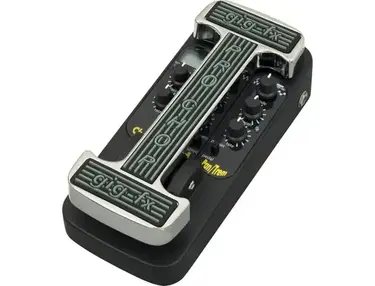
Peter Frampton uses a Gig-FX Pro Chop, as seen in this interview at (3:10). It's "a very nice effect...chops the sound off for a long chord or something," he said.
Find it on:

Peter Frampton is listed as an artist who uses the Seymour Duncan 805 Overdrive pedal, according to the Seymour Duncan website.
Find it on:


"Oh, and the Mu-Tron effects, which I just by chance, picked up this one and I also had an octave pedal as well of theirs. But this one has got that auto-wah sound, but it's..I'll show you that. It gets heavily featured on "Black Hole Sun", which is on the "Fingerprints" record. It's just got this really nice auto-wah kind of... It will open up depending on how you play a note. So it's really interesting." - Frampton about Mu-Tron III.
Find it on:

Mentioned in Fuzz: The Sound That Revolutionized the World at 11:21. Frampton is also mentioned in the official product description.
Fuzz: The Sound That Revolutionized the World (2007)
I hooked up with Robert Keeley because of the work he did. I had a Tube Screamer that he modded for me, which is obviously how he got to be known, by modding the original pedals... and then, we've just been good friends ever since and, in the end he loved Framptone stuff and it worked so well with testing out his stuff through two different amps and it was sorta, like, a good fit. So, we just, virtually said "Well, why don't you take it over? We'll call it Framptone by Keeley."
Product Description
The original Ibanez Tube Screamer made history, and Keeley's TS9 Mod Plus will have you making tonal history of your own. Used by guitarists including The Edge (U2), Peter Frampton, Jon Herrington (Steely Dan), and Larry Crane (John Mellencamp band), the TS9 Mod Plus has a number of enhancements over the original that give it a sound closer to the Ibanez TS808 Tube Screamer.
Find it on:
-m.webp?v=1783234846)
Mentioned in Fuzz: The Sound That Revolutionized the World at 11:21. As Frampton discusses, it was later modded by Robert Keeley.
I hooked up with Robert Keeley because of the work he did. I had a Tube Screamer that he modded for me, which is obviously how he got to be known, by modding the original pedals... and then, we've just been good friends ever since and, in the end he loved Framptone stuff and it worked so well with testing out his stuff through two different amps and it was sorta, like, a good fit. So, we just, virtually said "Well, why don't you take it over? We'll call it Framptone by Keeley."
Find it on:

"It's just a great pedal. It's got a very nice, different sort of sound," Peter Frampton says at 3:23 in this video, about his Digitech Whammy 4 pedal.
Find it on:

Peter Frampton uses the Seymour Duncan Pickup Booster & Line Driver, as noted on the Seymour Duncan website.
Find it on:



Peter Frampton is listed as an artist who uses the Fulltone PlimSoul overdrive pedal, as noted on Fulltone's official website.
Find it on:

Demonstrated in his rig on PremierGuitar.com
"It's very, very expressive... it works really well."
Find it on:

"This is the Creation Audio Labs boost pedal, and I use that just for a slight lift, if I'm just using the Marshall, which I don't set on clean, I set on some crunch sound, this will take me to in between a rhythm sound and a lead sound, like a quieter lead sound, so it just gives me a step up there." - Frampton about Creation Audio Labs MK 4.23 boost.
Find it on:

"They came up with this pedal recently, and really enjoyed the original Korg rack. So, the original Korg effect was an SD-3000, which I think I have one way back, and they finally, the Edge wanted that in a pedal. Because it had with its preamp and everything in it, it definitely has the warm sound that comes with this piece. So, I've got one and I love it. I kind of treated it like my Binson Echo, because if you set it on its own modeling on the SD-3000, its very very warm sounding delay, and I wanted one that decayed, and it sort of got a little duller, rather than staying bright. And this does that and as well as many other things. Obviously now, it's MIDI controlled and it is fantastic for my system and I can store as many delays as I want for different presets over there." - Frampton about his Korg SDD-3000 at approximately 56:50 minute mark.
Find it on:

"On the road and in the studio I always have an Eventide effects processor close at hand. It's the best. It's a piece of equipment that I cannot do without." - also below, there is TimeFactor Twin Delay listed to his name.
Find it on:

Peter frampton posted a photo of the Origin Effects RevivalDRIVE to his Instagram profile saying, "Game changing box for me."
Find it on:

On XTS's website, they shared photos of pedalboard they built for Peter Frampton. Boss RT-20 can be seen under the Framptone Amp Switcher on pedalboard.
Find it on:

Used live for "Do You Feel", in the studio for "Show Me The Way" and on Frampton Comes Alive!. The first is recalled by Frampton in this September 2013 Vintage Guitar article, the second is described by this Getty Images item, and the third was handwritten on the pedal by Frampton in 2003. The photo featured here was taken by Carl Lender and uploaded to Flickr on September 7, 2009. The unit also features as pedal 27 in Stompbox: 100 Pedals of the World's Greatest Guitarists, as can be seen in the quick browse video at 0:14. According to the Vintage Guitar article and this 2006 Musician's Friend interview with Bob Heil, Frampton's girlfriend Penny gave him the device as a Christmas present.
Frampton's writing
(This is the one on F.C.A.)
Peter Frampton '03
Vintage Guitar
When Peter Frampton began using the Heil Talk Box in 1974, he remembers it being viewed with skepticism as an “alien effect.” Similar contraptions had been around since 1939, but few people recognized them or their otherworldly capabilities. Frampton had yet to record with it, so when he used it onstage, it caused a furor.
“I was only using it on one number – ‘Do You Feel’ – and when the song goes very quiet into that jam at the end, I’d walk over to the center mic and start playing the Talk Box,” Frampton remembers. “No one had heard it before, so people snapped their heads around. It was a huge effect.”
(...) Peter Frampton first saw a talk box in action when Pete Drake came to Abbey Road Studios for George Harrison’s 1970 All Things Must Pass, on which a young, uncredited Frampton also played.
“Pete sets up opposite me, and in a slow moment in the studio, he gets out this little box and puts a pipe in his mouth, and all of the sudden the pedal steel sound is coming from his mouth!” Frampton remembers. “The pedal steel is playing the notes and he’s mouthing it and he sounds like he’s singing. That was the same sort of sound I’d heard [as the call signal] on Radio Luxembourg, except with a pedal steel it was very clean. It’s a sound that’s been very inspiring to me all of my life.”
Frampton later heard Walsh’s solo and Stevie Wonder’s use of Kustom Electronics’ 1969 The Bag talk box on his 1972 LP Music of My Mind. As Heil ran the sound system for Frampton’s previous band, Humble Pie, the two were pals.
“My girlfriend knew I was looking for a Talk Box,” Frampton says. “She called Bob up and said, ‘Do you have one I can buy?’ and he just gave her one to give me as a Christmas present. That was the one that was on Comes Alive.
“For a moment or two there, using it was pretty alien. Everybody was saying ‘What the hell is this?’ My management company let me use their rehearsal room in Manhattan, and I’d go in every day and practice with it. I started using it on ‘Do You Feel’ very early on, probably in ’74. The first time I ever used it on a record was back in England, where we were doing the Frampton record, and I used it on ’Show Me The Way’ – just tried it to see if it would work and I said, ‘Oh, well, I’ll keep it.’”
Frampton ran the Talk Box through a dedicated and modded ’70s Marshall amp. “I used to use [the amp] a lot cleaner, but found I could enunciate more when I had a bit of dirt on it,” he explains. “I use [the Talk Box] straight – no echo, no nothing. You make the wah-wah sound by manipulating your mouth. There’s not really any trick. My thing is that I close down the tube by putting pressure on it to help enunciate; I step on it like you would a garden hose.”
Getty Images
Part of the Bob Heil's collection for the Rock and Roll Hall of Fame include this serial #1 Heil Talk Box created by Heil for Joe Walsh and used on Joe Walsh's "Rocky Mountain Way." He also gave one to Peter Frampton to record "Show Me The Way." (Photo by Derik Holtmann/Belleville News-Democrat/Tribune News Service via Getty Images)
Musician's Friend, 2006
Joe Walsh had recorded "Rocky Mountain Way" using an 8" speaker and a funnel, a device used in Nashville by the steel guitar players. Well, it wasn't very loud so you couldn't use it live. So here we are, two ham radio operators on a Sunday afternoon out in my plant. We grabbed a 250-watt JBL, built a low-pass filter, got all the plumbing together, and voila—the Talk Box. That's how it started. After that tour, everybody's going nuts! "What's this thing he's got?" So I put together a commercial unit called the Heil Talk Box. Then Peter Frampton's girlfriend Penny called me wanting a Christmas present for Peter. So I sent a Talk Box. The rest of the story writes itself from there.
The first 50 were done in fiberglass, and Peter still carries his fiberglass one today. When you see him, somewhere in his gig box is that original Heil Talk Box. I have serial number 1 that will go in the Rock Hall with Peter and Joe's signatures.
Find it on:

On the official Rocket Series Octavia product page, Octavia inventor Roger Mayer reports that Frampton received one of five late 1968 wedge enclosure Octavias.
Rocket Series Octavia Product Page
[15.] At the end of 1968 I decided to build a limited run of 5 or so Octavias and 5 Distortion Pedals all housed in the wedge enclosure.
[16.] EMP and Tychobrahe derived clones.
All the clones I know come from this later series of pedals.
This latest series Octavia configuration used a driver section comprising of complimentary NPN PNP low noise silicon transistors driving a commercially obtained iron audio driver transformer. The biasing used for these units were also varied to provide evos that were designed for up to 24V operation for recording studio work to a version that would use an internal 9 Volt battery.
This series of pedals used the type of knobs you can observe on the EMP example.
[17.] These units were completed in early 1969 and went to guitar players like. Syd Barrett - Pink Floyd Steve Marriot - Small Faces, Peter Frampton - Small Faces. Keith Relf - Yardbirds and Jimi of course.
Find it on:

Peter Frampton is listed as an artist who uses the Seymour Duncan Vapor Trail delay effects pedal, as noted on the Seymour Duncan website.
Find it on:

Peter Frampton uses the Fulltone Full-Drive2 Mosfet overdrive pedal, as noted by Fulltone Musical Products.
Find it on:
This is a community-built gear list for Peter Frampton.
- Find relevant music gear like Guitars, Amplifiers, Effects Pedals, and other instruments and add it to Peter Frampton.
- The best places to look for gear usage are typically on the artist's social media, YouTube, live performance images, and interviews.
- To receive email updates when Peter Frampton is seen with new gear, follow the artist.
Discography
Album Credits
-
Peter Frampton · 1992
Producer -
Peter Frampton · 1976
Producer -
Peter Frampton · 1972
Producer




.webp)

