


Pricing and availability
We compare 600+ stores and found this item at 1 store. Prices updated .
Store
Reviews
Price




Average Price: $750
High-end/Boutique
$70
$251+
Price Tier
Budget
Standard
High-end
* Product prices and availability are updated by Equipboard every 24hrs and are subject to change. Equipboard may receive compensation for purchases made at participating retailers linked on this site. This compensation does not affect what products or prices are displayed, or the order of prices listed. For more information, please refer to our affiliate disclosure.
Description
Immerse yourself in the rich legacy of the Mu-Tron Musitronics III Envelope Filter, a legendary pedal that has been the secret sauce in the tone recipe of renowned artists since 1972. Renowned not just for its vintage charm, this analog envelope filter pedal excels in delivering a diverse palette of tones. Whether you're chasing the funky twang of Bootsy Collins or the melodic resonance of Jerry Garcia, the Mu-Tron III lets you shape your sound with its low-pass, bandpass, and high-pass filter responses. Tailored to adapt to a range of instruments, this is more than just a pedal, it's your creative companion on the journey to sonic nirvana.
Key Features:
- Analog envelope filter pedal
- Low-pass, bandpass, and high-pass filter responses
- Versatile and adaptable to a variety of instruments
- Iconic tone shaping tool used by legendary musicians since 1972
- Produces a broad spectrum of tones.
Product specs
| Brand | Mu-Tron |
| Model | Mutron III |
| Finish | White |
| Year | 1970s |
| Made In | United States |
| Categories | Filter and Wah Pedals |
FAQs
-
What type of sound can I expect from the Mu-Tron Musitronics III Envelope Filter?
-
The Mu-Tron Musitronics III Envelope Filter is known for producing dynamic, auto-wah effects that respond to your playing intensity. It delivers a funky, quacky sound popular in genres like funk and rock.
-
Is the Mu-Tron Musitronics III Envelope Filter suitable for bass guitar?
-
Yes, the Mu-Tron Musitronics III works well with bass guitars, providing rich, responsive filtering that enhances low-end frequencies without losing clarity.
-
How does the Mu-Tron Musitronics III Envelope Filter differ from a standard wah pedal?
-
Unlike a standard wah pedal, which is manually controlled by a foot pedal, the Mu-Tron III automatically responds to the dynamics of your playing, creating a more organic and expressive envelope effect.
-
Does the Mu-Tron Musitronics III Envelope Filter require a specific power supply?
-
The original Mu-Tron Musitronics III typically requires an 18V power supply, so ensure you have the correct adapter to avoid any power issues.
-
Can the Mu-Tron Musitronics III Envelope Filter be used with other effects pedals?
-
Yes, the Mu-Tron Musitronics III can be effectively combined with other effects pedals, such as distortion or modulation, to create unique and complex soundscapes.
Videos

BassTheWorld.com
MUSITRONICS MUTRON III
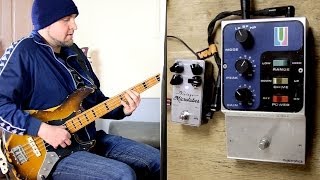
MUSITRONICS MUTRON III
BassTheWorld.com
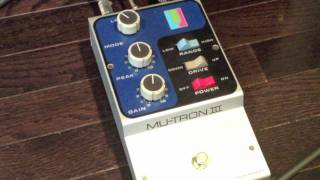
Bassicsgear Musitronics Mu-Tron III Envelope Filter Demo

Justin Goodman
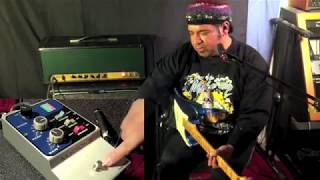
Vintage Mustronics Mu Tron III Funky Demo from 2012

Soultron
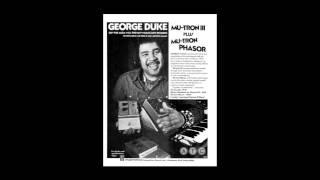
George Duke - Mu-tron demonstration record 1975.

Adrian Täckman
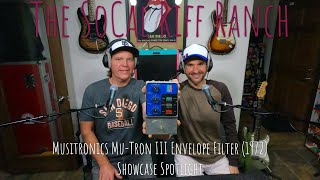
Musitronics Mu-Tron III Envelope Filter (1972) Showcase Spotlight

The SoCal Riff Ranch
Reviews
PROS
-
Warm, wet, and delicious sound
-
Authentic Jerry Garcia tones for Deadhead guitarists
-
Reliable and functional with maintenance
-
Superior to other envelope effect pedals in maintaining volume with a band
-
Unique funk and Jerry Garcia sound unattainable by other pedals
CONS
-
Requires maintenance and potentially repairs due to age
-
May arrive damaged due to vintage status
-
Needs modification for dual voltage power supply
Owner Insights
We analyzed real musician discussions from forums and Reddit to find what players love, question, and tweak about Mu-Tron Musitronics III Envelope Filter.
Comparisons
-
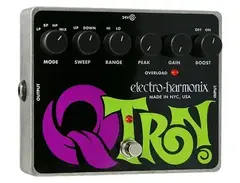
EHX Q-Tron, designed by the same engineer, offers a big box version with extensive features and a Nano version similar to the original Mu-Tron III.
Source -
The Qtron+ from EHX has a distinct chewy, rounded sound, closely related to the Mu-Tron but with its own unique characteristics.
Source -
3leaf Chromatron is highly regarded as a top-tier Mu-Tron style filter, but scarcity and high prices make it difficult to obtain.
Source -
The FARM pedals custom envelope filter is praised for its close replication of vintage Mu-Tron III tones, making it a standout alternative to the Micro-Tron IV.
Source -
The Lovetone Meatball provides greater flexibility, but for guitar or keys, the Mu-Tron III delivers comparable sound quality in a simpler format.
Source
User experience
-
Source Audio Spectrum receives praise for its ultra-tweakable nature, allowing users to adjust signal reception and trigger sensitivity independently.
Source -
Owners report that the Micro-Tron IV demands a high output signal for optimal performance, often requiring high output pickups or a boost pedal for consistent quack.
Source -
The Micro-Tron IV is recognized for its convenient 9V operation and smaller footprint, making it suitable for space-constrained pedalboards while maintaining usability.
Source -
Building the Mu-Tron III clone enhances understanding of playing dynamics, significantly boosting creativity and offering a hands-on learning experience in envelope filter usage.
Source
Features and functionality
-
The Microtron IV has been criticized for potential reliability issues and poor customer service, with some customers experiencing communication difficulties.
Source -
The Analogman Envelope Filter includes a reverse phase switch and is noted for being easy to dial in with settings at noon, offering versatile and approachable use.
Source -
The use of waterslide decals with a laser printer ensures durable graphics for the pedal while maintaining color accuracy and sharpness.
Source
Use cases and applications
-
Pairing the Earthquaker Spatial Delivery with Lizard Queen creates a punchy tone reminiscent of "Shakedown Street."
Source
Mods and upgrades
5.0 out of 5
Based on 1 Review and 16 Ratings

314
Psychoalphadiscobetabioaquadewloop
I have tried every other envelope type effect, its one of my favorites, and while the WMD Fatman comes close there is no other pedal that gives up the funk (Or the Jerry if that's your thing) better than the Mutron III You can hear the difference mainly when the whole band is playing- you don't get the same level drop most envelope followers have. A Classic and unbeatable really...
Artist usage
Add artist

In the October 1991 issue of Guitar Player, it is noted that Flea used the Mu-Tron Musitronics III Envelope Filter pedal on the Red Hot Chili Peppers track "Sir Psycho Sexy." Interestingly, the pedal's distinctive sound in this song was partially due to a dying battery. Despite replacing it, Flea preferred the original sound and opted to keep the dying battery in place.


During the Sex and Religion tour, Vai used a Mu-tron III in an offstage effects rack.


"We also went and got an old Mutron envelope filter. The one that gives you the Bootsy [Collins] sound. Awesome. The one we had would eat four nine-volt batteries in half an hour. It's awful. But it sounds amazing when the batteries are dying. We did a lot through that. in fact all the drums on "I Do Not Want This" was just one two-bar loop that Steve Perkins played. We just ran it through every effect we had in the studio--the Mutron, [Eventide] H3000 Harmonizers, a Digitech Whammy Pedal... Flood and I just went crazy.


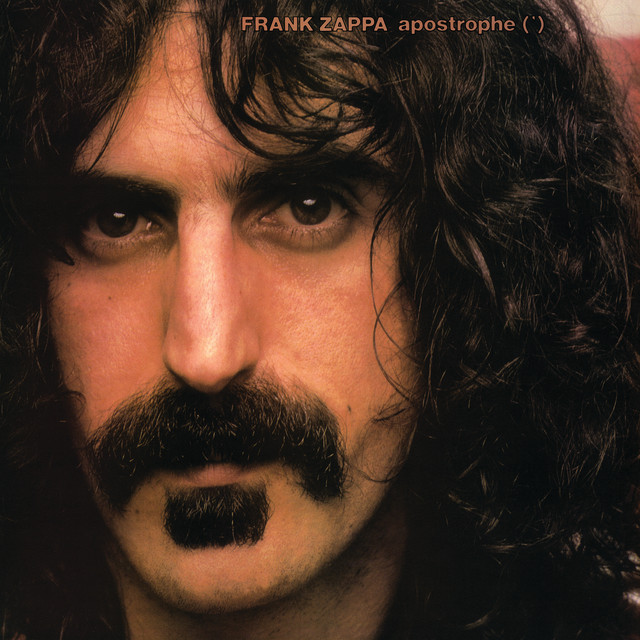
Used by FZ on countless songs. one of his best uses of the Mu-Tron Envelope Filter is on the solo from the album version of "Stink-Foot". FZ states in an 1983 article written for Guitar Player Magazine, "And on 'Stink-Foot' there's an interesting sound where I'm using an acoustic guitar with a magnetic pickup on it and a Barcus Berry on the bridge. The Barcus Berry is going into one channel and the magnetic pickup is going to a Mu-Tron and the other channel, so you have a sharp attack and an envelope attack. It gives a lot of space." he also installed the circuits from his Mu-Trons (and other pedals too) in his own custom made rack units.


“I had simple tools: a Telecaster, a Fender Twin, and maybe an MXR Phase 90,” Summers revealed to GP. “The next thing I got was a chorus, and that, along with the Echoplex, became very characteristic of the Police sound. I probably got up to four pedals taped to the floor before I could afford a custom Pete Cornish pedalboard with a MuTron, a couple of fuzz boxes, an envelope filter, chorus units, and phasers, all of which I’d combine with the Echoplex.”


According to this Reverb.com entry, by Resonance Guitars, Jerry Garcia used this Mu-Tron III Envelope Filter.
.png?v=1784755332)

In the documentary "Meet Squarepusher" from The Creators Project, previously unseen footage of Tom Jenkinson's studio from various periods (such as his 1995, 2000 and more recent setups) are revealed. If the video gets paused around the 3:06 mark, there are two effect units that can be spotted. One of them is what appears to be a modified Roland Space Echo RE-201 (as hinted by the extra black knobs on the top right portion of the unit), and sitting on top of it is the Musitronics Mu-Tron III.


At 16:18 a Mutron iii+ can clearly be seen on Chris's pedalboard.

The item can be seen 2:06 into this video https://youtu.be/1g-7-dFXOUU


Adam Granduciel is seen using the Mu-Tron Musitronics III Envelope Filter in an Instagram post on the War on Drugs' official account, showcasing his gear setup for a Letterman performance.


A pivotal component of Collins' funk bass sound with Parliament-Funkadelic, the Mu-Tron III was a mainstay of his rig until it was replaced with later reissues. Effects Database even quotes him saying "Without that Mu-Tron, there ain't no Bootsy". The following interviews document his use of the pedal:
Sounds, June 24, 1978, "Bootsy Collins: 'Don't Leave Home Without Your F.U.N.K!'" by Vivien Goldman
What are your favourite toys, really. I mean, apart from that joke buzzer and the toy gun...
Bootsy: "Apart from that..." (waves his dark red almond-toed boot in the air,) "It's gadgets. I've got a new thing that looks like R2D2, the Space Case. It's a bunch of different gadgets, a 3 way system, instead of one straight bass thing I got it set up – you'll be funked all the way up – with an MXR Digital Delay, an Eventide Harmoniser, a multi divider, there's three Big Muffs, Moreley fuzz, wah, three Mutrons, a coupla Space Echoes.
"It all comes out separately, I got 12 speakers so you might hear one thing out of this side and something else talking to ya on the other. In the middle of the concert hall I got this thing called the Space Station, so your ears will be going WAAAAANG. It's all in the space. I got the space spex, the space bass, the space case and the space station."
Guitar Player, 1979, as transcribed on TalkBass here and here from a reprint in Bass Heroes: Styles, Stories & Secrets of 30 Great Bass Players
What kind of amps do you use in your setup?
The entire system is divided into three different parts - high, mid, and low. But we're not just talking about amplification, we're talking about the effects in each part. On my highs I use a Big Muff fuzz, a Mu-tron III [envelope-following filter], an MXR digital delay, a Morley Fuzz/Wah, a Morley Power Wah, and an Eventide Harmonizer. The Harmonizer sits in a case that looks like R2D2 from Star Wars. It looks just like a little robot, so I call it R2FunkU. There's a sign hanging on it that says, "Can I Play?" Inside of it, there's also a keyboard for the Harmonizer that enables me to preset harmonized intervals to what I'm playing. That way I can play a note and have a fifth or a third coming out at the same time.
All of that equipment just for the highs?
Right. For the mids, I have a Big Muff fuzz, a Mu-tron III, and an MXR digital delay. On the lows, I use a Mu-tron Octave Divider, two Roland Space Echos, a Big Muff fuzz, and a Mu-tron III. I keep all my effects in one box called the Space Case. The highs and mids each have an Alembic preamp, two Crown DC-300A amps, and four Cerwin-Vega speaker cabinets.
What's in each cabinet?
The cabinets used for the highs are called V-32s. They have two 12s, one midrange horn, and two tweeters. The midrange cabinets are basically the same, except there's one 15" speaker instead of two 12s. Those are called V-34s. On the bottom end are three Acoustic 370 heads and six Cerwin-Vega cabinets. Two have one 18" speaker and one 12", two more have an 18 and a 10, and two have one 18" and an 8.
Isn't that a lot of equipment for onstage?
I don't play it that loud. I've just got it there so that I don't have to strain the equipment and everybody can hear. As a matter of fact, the whole stage is set up like that. The guitar player, the keyboard player, everybody is set up like that so there is no real strain.
Musician, May 1991, "Bootsy Collins Effects the Funk" by Gene Santoro
His twangy, rubbery, butt-thumping bottom can suddenly zoom into the stratosphere and turn vocalic or spacey or both, in a way that recalls tone-painting pioneer Jimi Hendrix.
That's no accident, according to Bootsy: "He changed the way everybody heard. He influenced my whole idea of the Mutron and all, because he was gadgetized. He had this magic thing — the look, the sound, all that kept pulling me. Black radio was only telling you about the Temptations. The whole message about Hendrix — the look, the sound, 'this is a guy who's got airplanes in his music' — was that you can't be flying that high. For me it was like, Damn, why're they telling us this magic's no good? I'm looking around and people are getting off, but radio's saying naaah. Once P-Funk got going and they started telling us naaah, I figured, 'This is the way they go.' I never was looking to get play from radio, so I wasn't surprised — until I did get some. We were way off to the left, but the world needs something this off-centered. They're trying to make us all straight, but that'll never work. Even a robot's gonna go nuts on you."
[...]
"My role was pretty fluid in P-Funk. I got to play all the things I'd been thinking about: bass, drums, guitar lines, joking with the voice. I got a chance to experiment. I was always in Manny's [music store] checking out new stuff. Today, the things all sound the same. Back then, different gadgets had different sounds. But the Mutron was the one. I use it for talking without opening my mouth — letting the speakers speak for me. It's about the way you hit the string, the mood you're in. It's a conversation going on between me and it and the world. And then there was the Big Muff: It was raw and rowdy and loud, it'd irritate anybody — gnnnahhh! It got back my momma and everybody else who always told me to turn that damn guitar down.
"I had 18 speaker cabinets on the set then, with four super-clean Crown amps, three Alembic tube preamps and all that shit on the floor to give me the dirt. It was a big wall of sound, and I got off on it. Black bands at the time would have the cheapest equipment onstage; the singers'd be singing and the band'd be real hush-hush. I was so tired of that, I figured I was on a mission: Seek out and deploy emblems of the funk." Working now with a revived Rubber Band and rappers like Deee-Lite, he's still scouting hyper-space with that goal in mind. •
MUFFS 'N' MUTES
BOOTSY'S RIG is far from simple. "On the pedalboard I've got all the old stuff: three Mutrons, one Big Muff, a Yamaha distortion, an old rackmount digital MXR, the small Boss DD-3. I've got a few new Digi-Techs for rackmount: the Time Machine 4000, the Smartshift Bass Harmonizer, a stereo Rat, an FX-500B. I'm using Roland Space Echo — of course. I've only got two Electro-Harmonix Bass-micro synths left, and I can't find no more. At least I've got a million Mutrons and Big Muffs!
"My amps are the QSC 4000: They run my two sets of subwoofers, which are four 18"s in each cabinet. On the mids I've got four cabinets, each with two 15"s, two 12"s and a horn; the highs are four 12"s and a horn. All my speakers are Celestions. The amps running the mids and highs are two Yamaha 2000As and one QSC 4000. I'm still going with three old Alembic preamps, which gives me that warm, clean sound; they're running my highs, mids and lows. I use that for the Bootsy Rubber Band; for Deee-Lite I lighten up. Oh yeah — always the Space Bass. But I'm starting to get into five- and six-string basses, and even fretless, since I've been working with Bill Laswell."
Bass Player, December 1998, quoted in Bass Player, "“Until I found the Mu-Tron, I never heard anything that made the bass sound totally wacko”: How Bootsy Collins’ mastery of the envelope filter became the flamboyant funkateer’s signature sound" by Bill Leigh (May 18, 2024)
"Until I found the Mu-Tron, I never heard anything that made the bass guitar sound totally wacko. When I played it for some girls in the studio, they said, ‘Ooh, what's that wet, watery sound? That's sexy!’ Oh, man – all of that rattle made me want to play every song with that sound!”
Bass Player, "In Session With Professor Bootsy Collins" by Jimmy Leslie (November 1, 2010)
Generally speaking, how would you compare old pedals to new ones?
The old Mu-Trons and Big Muffs were all slightly different, so you had to work with them. To me, that was fun. It helped push you creatively. Pedals are so preset and consistent now that they all sound the same. At F.U., we’re trying to get away from the domestication of sound. I’m not knocking manufacturers, but I want musicians to avoid getting locked in on a particular sound that everybody’s using. Find your own.
Promotional quote for the Biegel Labs Tru-Tron 3X (May 21, 2014) (see Bass Player and IndiePulse Music)
“Okay Funkateers, if you loved the original ‘Mutron’, then you are going to really love funkin’ with the all new ‘Tru-Tron 3X’,” says Bootsy Collins. “Why is it so much like the OG-Mutron? Because the OG maker of the original is doing the Dirty work on the ‘Tru-Tron’.”
“My motto is: Don’t Fake the Funk or your Nose will Grow.
Better get the real deal & stay away from the Dill-Doe!
Tell Mike Beigel that Bootsy sent you.
Funk away baba!”
Bass Player, "Bootsy Collins Still Stretchin' Out" by E.E. Bradman (inexplicit reference to "that underwater bubble sound") (Archive 1, Archive 2)
What inspired you to get into effects?
When I started out, I was searching for ways to not sound just like a bass player. When I hear an effect, it makes me play something different. It’s like certain women that touch you—you get a different feeling from different touches. Different sounds make you play different. I guess I was led by that, and it was always mysterious to me: “What does this sound like? What does that sound like?” And then I messed around and fell into that underwater bubble sound. I didn’t know that was going to be a signature sound that would be with me for years. I just knew I liked it. I was like, Wow! It was incredible. It was something I wasn’t hearing.
Folks must have been knocked out!
< When I first brought it to the studio, the engineer was like, “Nah, you don’t need no pedal. Just do it like we’ve been doing it. Plug in and play.” Nobody was down with me when I did it. After the fact, of course, everybody thought of it. “Yeah, I bought Bootsy that pedal. Yeah, I bought him all that stuff, his glasses and those sound effects.” But the real deal is, didn’t nobody want to hear that stuff until it got recorded.
And the collection just kept on growing.
I kept adding pedals, the engineer stopped resisting me, and he started being like, “Whatever you got, bring it on!” We did that first thing, and next thing you know, they wanted me to hook everything up. One thing led to another, and eventually I had to get a pedalboard. Nobody else was using a pedalboard with bass back then. I just started hearing this stuff in my head, and I was like, how can I get this sound? I started looking around, going to music stores, and I was always looking and trying to find something that moved me. Whatever moved me some kind of way, it got out into the audience, and it started moving them, too. Once that started happening, everybody was like, “Yeah! That’s the sound!”
What did you learn from that experience?
It taught me a lot about how people react to your first thing. If they resist and you feel good-heart-heavy about it, go with it. I started building on it, and I’m still building on it. You’d be shocked at all the pedals that are hanging around, waiting to be used. On this album, I tried to give a little variety to my pedal thing, using old stuff and new stuff, too.

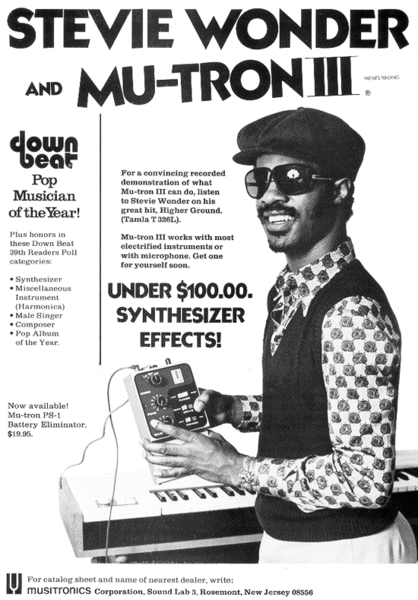
Album Usage
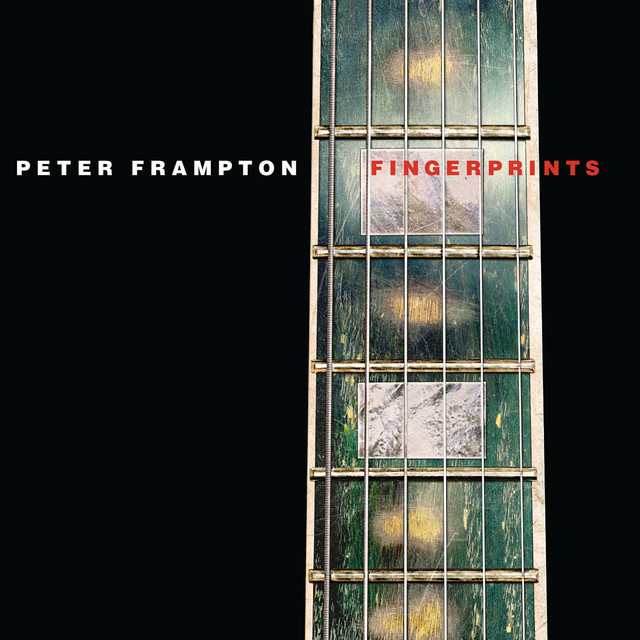
The Mu-Tron Musitronics III Envelope Filter has been featured on the following albums:


Genre Usage
Based on how artists on Equipboard use this gear, it is most commonly found in the following genres.
Used With
Based on how musicians on Equipboard use Mu-Tron Musitronics III Envelope Filter, it is most commonly used with the following gear.
-s.webp?v=1784905089)


-s.webp?v=1784732274)


Similar
Add recommendation13 alternative and related items for Mu-Tron Musitronics III Envelope Filter, curated by the Equipboard community.

$116.00 - $189.00
The Keeley Neutrino is an optocoupler based envelope filter, inspired by the classic Mu-Tron III design.

According to VFE;
The MINI MU is derived from the classic Mutron III envelope filter (aka autowah), and has all the same great fat and funky filter sweeps inside a much smaller box. A few extras have been added, namely an active clean gain stage and an "in between" position on the range switch. With the included charge pump, the MINI MU runs on +/-9V like the original without needing a special power supply or two batteries.

$383.76
The latest Mu-Tron envelope filter, that better mimics vintage units than the previous Micro-Tron III.

A smaller, more tweakable version of the Mu-Tron III, with an additional down sweep mode.

$335.00
A smaller, reissue version of the Mu-Tron III, created by the new Mu-Tron company. Now replaced by the Micro-Tron IV.

A hybrid digital/analog envelope filter inspired by the Mu-Tron III.
More Mu-Tron Filter Effects Pedals
$383.76
in Filter Effects Pedals Rank


-m.webp?v=1784905255)
$194.21 - $209.99
in Filter Effects Pedals Rank

.jpeg?v=1784855195)


$75.00 - $112.50
in Filter Effects Pedals Rank


$225.00
in Filter Effects Pedals Rank


$1,945.00
in Filter Effects Pedals Rank


$1,945.00
in Filter Effects Pedals Rank


$169.00 - $192.00
in Filter Effects Pedals Rank


$162.00 - $192.30
in Filter Effects Pedals Rank


$100.00
in Filter Effects Pedals Rank


-m.webp?v=1784905092)
$877.99
in Filter Effects Pedals Rank


-m.webp?v=1784905301)
$104.00 - $129.99
in Filter Effects Pedals Rank


-m.webp?v=1784905255)
$76.00
in Filter Effects Pedals Rank


$289.57 - $362.00
in Filter Effects Pedals Rank


$50.00
in Filter Effects Pedals Rank

-m.webp?v=1784894643)
$372.00 - $429.00
in Filter Effects Pedals Rank


$92.00 - $111.70
in Filter Effects Pedals Rank


$80.00
in Filter Effects Pedals Rank


$211.00 - $219.00
in Filter Effects Pedals Rank


$214.00
in Filter Effects Pedals Rank


in Filter Effects Pedals Rank


-m.webp?v=1784905207)
$500.00
in Filter Effects Pedals Rank


in Filter Effects Pedals Rank


$179.99
in Filter Effects Pedals Rank


$55.00 - $67.39
in Filter Effects Pedals Rank


$192.69
in Filter Effects Pedals Rank


$300.00
in Filter Effects Pedals Rank


$179.00
in Filter Effects Pedals Rank


$425.00
in Filter Effects Pedals Rank


$725.66
in Filter Effects Pedals Rank


$1,191.44
in Filter Effects Pedals Rank


$162.40
in Filter Effects Pedals Rank


$105.00 - $417.26
in Filter Effects Pedals Rank


$160.00
in Filter Effects Pedals Rank


$100.00
in Filter Effects Pedals Rank


in Filter Effects Pedals Rank


Accessories & Related Items




Community setups


Gear Guides
.jpg)





Most Popular Filter Effects Pedals
Most Popular Brands
-
Added to Equipboard on by
 paulrose32
GearIQ 342
-


