.jpg?v=1784640199)
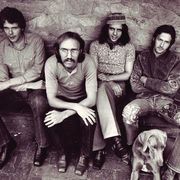
Keith Richards
Rolling Stones guitarist
Keith Richards' Gear


-m.webp?v=1784617758)
Richards acquired this butterscotch Telecaster in 1971. Nicknamed "Micawber", after a character in Charles Dickens's novel David Copperfield, it is set up for five-string open-G tuning (-GDGBD), and has only five bridge saddles. The neck pick-up has been replaced by a Gibson PAF humbucking pick-up, and the bridge pick-up has been replaced by a Fender lap steel pick-up (similar to a Fender Broadcaster pick-up). "Micawber" is one of Richards' main stage guitars, and is often used to play "Brown Sugar", "Before They Make Me Run", and "Honky Tonk Women".
This is a picture of Keith Richards playing his sonic blue 1966 fender telecaster. He acquired it in '66, and it was famously played by Brian Jones on the Jumpin' Jack Flash promo video in 1968, as well as being used by Keith until sometime in 1969.
Find it on:


-m.webp?v=1784631625)
In this photo, an Ibanez TS9 Tube Screamer can be seen below Keith Richards' amplifiers.
Find it on:


["Keith named this guitar “Tumbling Dice” (or “Dice” for short) after a decal of a pair of dice that once graced the front of the guitar near the control knobs. Note that the remnants of the white dice decal near the knobs that has been worn off. A set of Grover tuners and a Leo Quan Badass adjustable bridge have replaced the original factory parts. “Dice” has been one of Keith’s main guitars over the decades. A pair of Fender Tele knobs replaced the original Gibson volume and tone knobs.
This was the same model as Keith’s 1960 wine red Les Paul Junior with one black P-90, the main differences being its TV yellow color and a tortoiseshell pickguard instead of a black one. Keith used this guitar in standard tuning, usually with a capo on the seventh fret."](http://www.premierguitar.com/articles/20345-book-excerpt-rolling-stones-gear)
Find it on:

In this Keith Richards interview with "Guitar World", it reads,
"'The Stones had an endorsement deal with Vox around this time. Were those the amps you were using in the studio?'
'I have no doubt they were. The AC30's a damn good amp.'"
Find it on:

In this rather infamous video of The Rolling Stones performing "(I Can't Get No) Satisfaction" live in 1981 at Hampton Coliseum in Virginia, Keith Richards plays his beloved black 1975 Fender Tele Custom. He acquired the guitar during the 1975 Tour of the Americas, and played it for a good decade (or more) afterwards.
In this particular performance, at around the 1:10 mark a fan appears out of nowhere and rushes the stage. Keith Richards takes his Telecaster and takes a big swing at the "attacker", fending him off. He then straps the guitar back on and resumes playing, not missing a beat.
Find it on:
-m.webp?v=1784645877)
Keith can be seen in this image playing a Gibson Hummingbird. Gibson writes in this article "Or, depending on your taste in guitar heroes, the foundation of the Hummingbird mystique may have been laid by Keith Richards. He has preferred the ’Bird as his acoustic guitar of choice since 1964, and the model has fueled such famous Rolling Stones cuts as 'Street Fighting Man,' 'Not Fade Away,' 'Brown Sugar,' 'Angie,' 'Wild Horses' and 'Jumping Jack Flash.'"
Find it on:


Keith Richard used the Silhouette for the standard tuned songs on the Steel Wheels/Urban Jungle Tour.
Find it on:

Richards’ stock guitar amp setup in the studio is a tweed Fender Champ with an eight-inch speaker[...]
“And Keith is always plugged into Input 2 on the Champ, not Input 1. We turn the Champ up to about 4, no higher—to where it’s just starting to break up.” - Pierre de Beauport (Keith's tech)
Find it on:

What is the little red one to the right of it?<<
It's a Zinky Master Blaster. [www.iorr.org]
Find it on:

Richards’ stock guitar amp setup in the studio is [...] combined with a tweed Fender Harvard modified with a 6L6 output stage tube and a 12” speaker, nicknamed “One Love.” The modification makes the Harvard a single-ended or Class A amp.
“The Harvard adds a little bottom end and clarity,” - Pierre de Beauport (Keith's tech)
Find it on:

"Keith Richards’ trippy tone on “Shattered”? Phase 100. The intuitive operation and bullet-proof reliability of MXR pedals ensured that those guitar heroes could reproduce the sounds of their hit records night after night on the road as well as in the recording studio."
Find it on:

Keith Richards recorded using a Philips cassette recorder. In this article from the Wall Street Journal, he says,
Around this time, I became fascinated by one of the early cassette tape recorders made by Philips. The machine was compact, so it was portable, and it had this little stick microphone, which would allow me to capture song ideas on the fly. So I bought one, but as I watched the small tape-cartridge reels turn, I began to think of the machine not as a dictation device but as a mini recording studio. The problem is I couldn't use an electric guitar to record on it. The sound just overwhelmed the mike and speaker. I tried an acoustic guitar instead and got this dry, crisp guitar sound on the tape—the exact sound I had been looking for on the song.
At the time, I was experimenting with open tunings on the guitar—you know, tuning the strings to form specific chords so I could bang out the broadest possible sound. That's how I came up with "Street Fighting Man's" opening riff—even before I bought the Philips. I based the rest of the song's melody on the tone pattern of those odd sirens French police cars use [sings the siren and lyrics to illustrate].
Sometime in early '68, I took the Philips recorder into London's Olympic Sound Studios and had Charlie [Watts] meet me there. Charlie had this snap drum kit that was made in the 1930s. Jazz drummers used to carry around the small kit to practice when they were on the bus or train. It had this little spring-up hi-hat and a tambourine for a snare. It was perfect because, like the acoustic guitar, it wouldn't overpower the recorder's mike. I had Charlie sit right next to the mike with his little kit and I kneeled on the floor next to him with my acoustic Gibson Hummingbird. There we were in front of this little box hammering away [laughs]. After we listened to the playback, the sound was perfect.
Richards usage of a recorder is also documented in The Atlantic and in his autobiography Life
"That grinding, dirty sound came out of these crummy little motels where the only thing you had to record with was this new invention called the cassette recorder. And it didn't disturb anybody. Suddenly you had a very mini studio. Playing an acoustic, you'd overload the Philips cassette player to the point of distortion so that when it played back it was effectively an electric guitar. You were using the cassette player as a pickup and an amplifier at the same time. You were forcing acoustic guitars through a cassette player, and what came out the other end was electric as hell. [...]
In the studio I plugged the cassette into a little extension speaker and put a microphone in front of the extension speaker so it had a bit more breadth and depth, and put that on tape. That was the basic track. There are no electric instruments on "Street Fighting Man" at all, apart from the bass, which I overdubbed later. All acoustic guitars. [...] I wish I could still do that, but they don't build machines like that anymore. They put a limiter on it soon after that so you couldn't overload it. Just as you're getting off on something, they put a lock on it. The band all thought I was mad, and they sort of indulged me. [...]
"Street Fighting Man," "Jumping Jack Flash" and "Gimme Shelter" were all made just like that, on a cassette machine. I used to layer guitar on guitar. Sometimes there are eight guitars on those tracks. You just mash 'em up. Charlie Watts's drums on "Street Fighting Man" are from this little 1930s practice drummer's kit, in a little suitcase that you popped up, one tiny cymbal, a half-size tambourine that served as a snare, and that's really what it was made on, made on rubbish, made in hotel rooms with our little toys."
Find it on:
-m.webp?v=1784333038)
This rather renown photo is from a photoshoot by Annie Leibovitz. It's for a Louis Vuitton advertisement, where Keith Richards can be seen strumming his 1959 black ES 355 mono.
An article on Gibson's official site says, "His black 1959 ES-355 has been used for live versions of “(I Can’t Get No) Satisfaction,” “Oh No Not You Again,” “She’s So Cold,” “Little T&A” and others." (source: http://www2.gibson.com/News-Lifestyle/Features/en-us/keith-richards-0502-2011.aspx)
The stock photo shows a newer model 355. The Keith Richards original one does not have a pickguard, and obviously differs since it's a vintage from 1959.
Find it on:

In this photo, one can see Richards with a Gibson Les Paul Custom.
Gibson writes : "By 1966, Richards was using three-pickup Les Paul Customs (the so-called “Black Beauty”). He had four, at least. He first used one in ’66, but that was stolen on tour in 1967. He purchased a new one in London, and this one was later painted by himself and then-partner Anita Pallenberg. It is now apparently owned by a U.K. guitar collector.
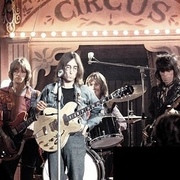
So why did that one go? Various stories say Keef gave it away or forgetfully left it in a Canadian guitar shop. He bought two new Les Paul Customs for the Stones’ 1969 tour, and used one for open-G tuning on “Jumpin’ Jack Flash” and “Street Fighting Man” (live), the other in standard tuning. Both these Black Beauties were reportedly stolen from Nellcote in July 1971. Bad luck or simple carelessness? By ’73, Keef was still using a ’54 Custom for “Midnight Rambler” on The Stones’ ’72-73 tours. The Rolling Stones’ Rock and Roll Circus film shows Keith rocking one of his early LP Customs."
Find it on:

In this photo Keith Richards can be seen with a Mesa Boogie Mark I.
In addition, he appears to be playing on this same amp in this photo.
Find it on:

In this photo two wide-boxed Tweed Fender Twins with the 5F8-A 80 watt circuit can be seen behind 'ol Keef as he struts his stuff playing a Mary Kaye Strat.
Find it on:

In this article, Richards says, “It was down to one little foot pedal, the Gibson [owners of the Maestro brand] fuzz tone [sic]… I’ve only ever used foot pedals twice [the other being an XR delay on Some Girls]… effects are not my thing. I just go for quality of sound… “I was imagining horns, trying to imitate their sound to put on the track later when we recorded. I’d already heard the riff in my head, the way Otis Redding did it later, thinking this is gonna be the horn line. But we didn’t have any horns, and I was only going to lay down a dub. The fuzz tone came in handy so I could give a shape to what the horns were supposed to do. But the fuzz tone had never been heard before anywhere, and that’s the sound that caught everybody’s imagination.”
Find it on:

Keith Richards plays a 1958 Fender Stratocaster, known as the Mary Kaye model, in standard tuning for songs like "Miss You" and "Under My Thumb." This usage is evident in a close-up photo available on Wikimedia.
Find it on:

Mesa/Boogie amps first appeared during the famous gig at the El Mocambo in 1977, and Kieth got a first glimpse of it some time earlier when Carlos Santana joined the band for a jam using his small Snakeskin combo. Although some sources indicate that Stones used more than 40 different Mesa/Boogie amps over the years, one that is perhaps most notable was a hardwood combo handcrafted personally by Randall Smith. This one was Keith’s favorite and he used it on Stones’ albums Love You Live, Some Girls, Emotional Rescue and Tattoo You, as well as on his solo albums.
http://www.groundguitar.com/keith-richards-guitars-and-gear/
Find it on:

Keith Richards is seen here with a Martin 00-21.
Find it on:

Keith Richards used the 1958 Gibson Les Paul TV Junior for nearly a decade. This is detailed in the Premier Guitar book excerpt "Rolling Stones Gear."
Find it on:

In this photo, one can see Richards with a Fender Telecaster Thinline.
Find it on:


Keith can be seen in this image playing a late 50s Gibson Flying V. Guitar Aficionado confirms Keith's use of this guitar by saying "Keith Richards also caught many guitarists’ attention when he played a late-Fifties V at the Rolling Stones’ Hyde Park concert on July 5, 1969." You can watch the concert in its entirety here.
Find it on:

Here you can see Keith playing an Ampeg VT-22 amplifier.
Find it on:

In this photo, Richards is visible with Gretsch 6128 Duo Jet.
Find it on:

In this photo, one can see Richards playing a Gibson ES-335.
Find it on:



Richards can be seen using a Rickenbacker 360/12 in this photo.
Find it on:

Hiwatt stack behind him. Probably tried it out being so close to The Who at the time.
Find it on:

Keith's iconic Telecasters (Micawber and Malcom) are set up in his "signature" 5-string open G tuning; the low E string (or what would be the low D string in open G tuning) is removed. For these guitars, Ernie Ball makes a custom set of strings to Keith's specified guages (.11 .15 .18p .30 .42) that are not available for sale to anyone else.
(https://garyrocks.wordpress.com/2009/02/16/keith-richards-and-his-5-string-guitar/) (https://www.guitarworld.com/gear/keith-richards-guitar-tech-reveals-keefs-studio-rig)
Find it on:

Used during the Muscle Shoals sessions, particularly for "Brown Sugar", as stated by mix engineer Jimmy Johnson in this September 21, 2018 ProSoundWeb interview.
What guitar was Keith playing?
It was a Gibson, but not a Les Paul. Do you know that model that was right under the Les Paul, the solid body double cutaway-what is that? Oh yeah, the SG. I think it was an SG, and as I recall it was black. I remember it had those sharp horns on the cutaways. That’s what he played most of the time he was here.
Find it on:
This is a community-built gear list for Keith Richards.
- Find relevant music gear like Microphones, Guitars, Amplifiers, Effects Pedals, and other instruments and add it to Keith Richards.
- The best places to look for gear usage are typically on the artist's social media, YouTube, live performance images, and interviews.
- To receive email updates when Keith Richards is seen with new gear, follow the artist.
Discography
Album Credits
-
Keith Richards · 2019
Producer -
Keith Richards · 2018
Producer -
Keith Richards · 1988
Producer -
Chris Farlowe · 1966
Producer