.webp)
Table of Contents

Equipboard
Equipboard is the world's largest community of artists and their gear. Read our review process.
We are reader-supported. When you buy through links on our site, we may earn an affiliate commission. Learn more.
Imagine you're in the middle of a session when the artist suddenly decides they want the song in a different key. The clock is ticking, studio time costs money, and everyone's looking around nervously. This exact scenario happens countless times in studios, rehearsal rooms, and live venues around the world. But there's a simple solution that could save the day: the Nashville Number System.
The Nashville Number System is a practical communication tool that transforms how musicians work together. This system has quietly revolutionized the music industry for over 70 years, yet many talented musicians still don't know how to use it effectively.
In this guide, we'll explore everything you need to know about the Nashville Number System, from its fascinating origins in 1950s recording studios to advanced applications that will enhance your musical versatility. You'll learn how to read and write number charts, transpose songs instantly, and communicate musical ideas with unprecedented clarity.
A Brief History

The Nashville Number System emerged from the bustling recording studios of Nashville in the 1950s, born out of pure necessity rather than academic theory. The country music capital was experiencing unprecedented growth, with multiple recording sessions happening simultaneously and musicians constantly rotating between different artists and producers.
The Birth of a Musical Language
Neal Matthews Jr., a member of the legendary vocal group the Jordanaires, created the system around 1959. The Jordanaires were backing vocalists for major artists including Elvis Presley, and they needed a way to quickly learn and adapt songs in different keys. Traditional sheet music was too rigid and time-consuming for the fast-paced studio environment that defined Nashville's sound.
Matthews realized that numbering chords based on their relationship to the key signature would create a universal musical language. Instead of writing "C major, A minor, F major, G major," musicians could simply write "1, 6m, 4, 5."
Studio Revolution
The system spread rapidly through Nashville's tight-knit musical community. Session musicians discovered they could learn entire albums worth of material in hours rather than days. Producers could experiment with different keys on the spot without stopping to rewrite charts. The efficiency gains were so significant that the Nashville Number System became the standard notation method for country, pop, and rock sessions throughout the industry.
What started as a practical solution for vocal harmonies evolved into the foundation of modern studio work. Today, from Los Angeles to London, professional musicians rely on this Nashville innovation to communicate musical ideas quickly and accurately.
How It Works
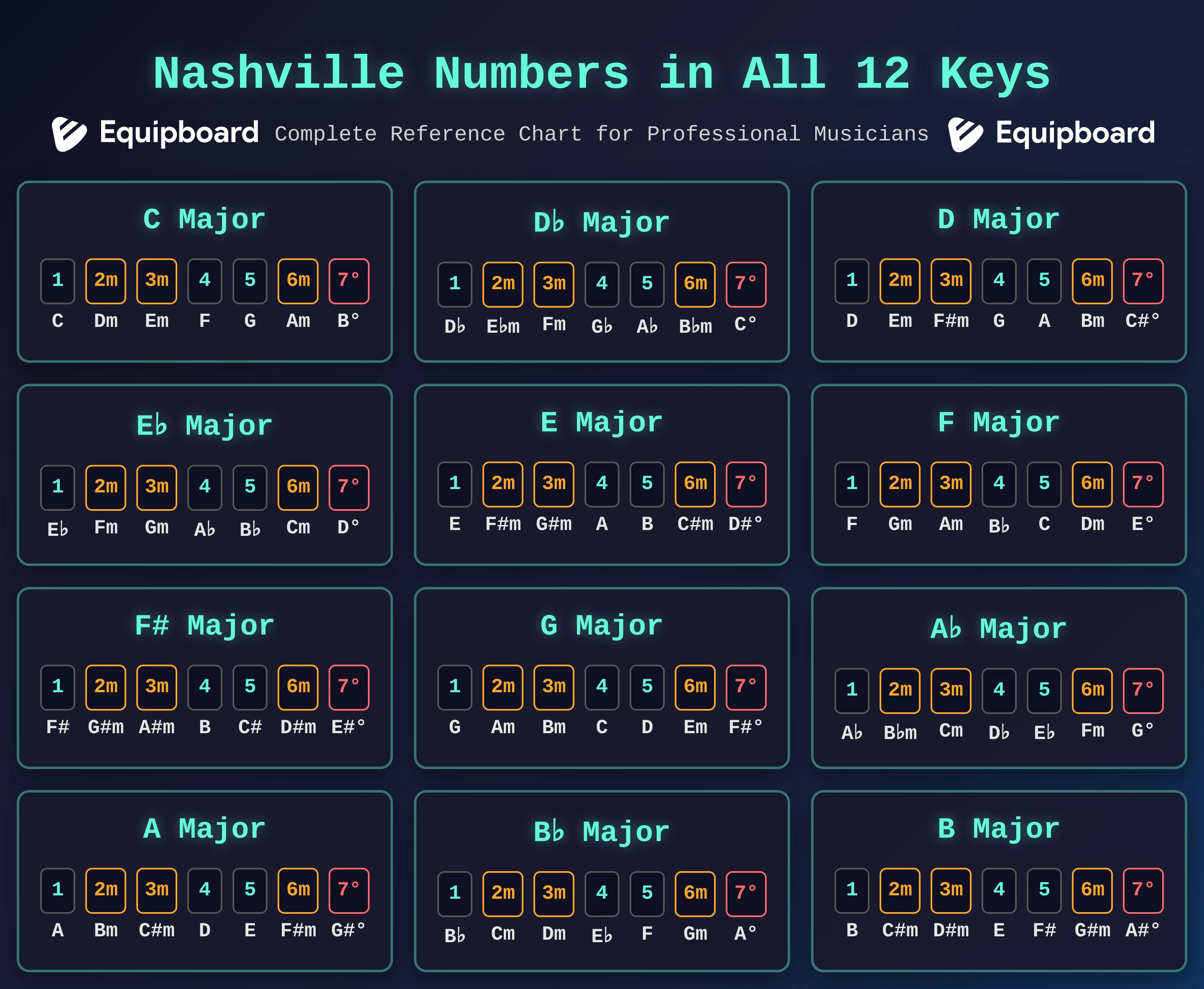
The Nashville Number System operates on a beautifully simple principle: every chord in a key gets assigned a number based on its position in the major scale. This fundamental concept transforms complex harmonic relationships into an intuitive numbering system that any musician can master.
The Foundation: Scale Degrees
Think of the major scale as a musical foundation with seven distinct positions. In the key of C major, these positions correspond to C, D, E, F, G, A, and B. The Nashville Number System assigns each position a number from 1 to 7, creating a roadmap that works in every key.
The chord qualities follow predictable patterns based on these scale degrees. Major chords naturally occur on the 1st, 4th, and 5th degrees, while minor chords appear on the 2nd, 3rd, and 6th degrees. The 7th degree produces a diminished chord, completing the seven-chord system that forms the backbone of Western harmony.
Roman Numeral Convention
Professional charts often use Roman numerals to distinguish between major and minor chords. Capital numerals (I, IV, V) represent major chords, while lowercase numerals (ii, iii, vi) indicate minor chords. The diminished chord on the 7th degree appears as vii°. This notation provides instant visual recognition of chord qualities, making charts easier to read at a glance.
Here's how this looks in practice across three common keys:
C Major:
- 1 (I) = C major
- 2m (ii) = D minor
- 3m (iii) = E minor
- 4 (IV) = F major
- 5 (V) = G major
- 6m (vi) = A minor
- 7° (vii°) = B diminished
G Major:
- 1 (I) = G major
- 2m (ii) = A minor
- 3m (iii) = B minor
- 4 (IV) = C major
- 5 (V) = D major
- 6m (vi) = E minor
- 7° (vii°) = F# diminished
Chord Extensions and Variations
The Nashville Number System easily accommodates chord extensions and alterations. A suspended fourth chord becomes "1sus4" or simply "1sus." Seventh chords add the number 7, creating "17," "47," or "57." Added ninth chords appear as "1add9" or "4add9."
These extensions maintain the system's clarity while providing the harmonic sophistication that modern music demands. A jazz-influenced progression might read "1maj7, 6m7, 2m7, 57," instantly communicating both the basic harmony and the specific colorings that define the song's character.
Reading Nashville Number System Charts
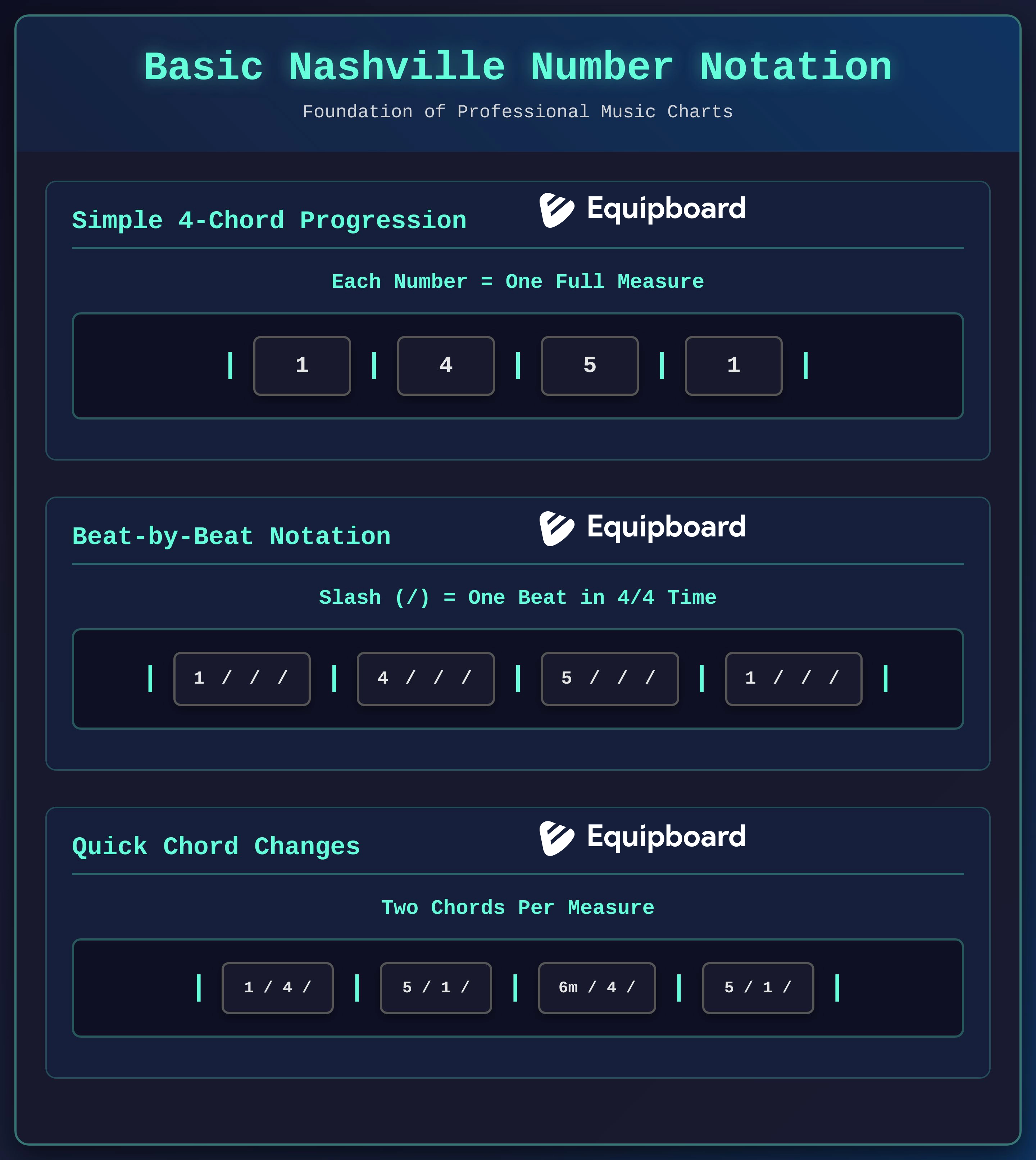
Understanding how to read number charts opens up a world of musical communication that transcends individual instruments and skill levels. These charts prioritize clarity and efficiency over visual complexity, focusing on the information musicians need most during performance.
Basic Progression Breakdown
Let's examine one of the most common progressions in popular music: 1, 6m, 4, 5. This progression appears in thousands of songs across every genre, from doo-wop classics to modern pop hits. The beauty of the number system becomes immediately apparent when you see how this same progression translates across different keys.
In C Major: C, Am, F, G
In G Major: G, Em, C, D
In A Major: A, F#m, D, E
The relationships between chords remain identical regardless of the key, but the number chart eliminates the need for separate chord sheets.
Chart Symbols and Notation
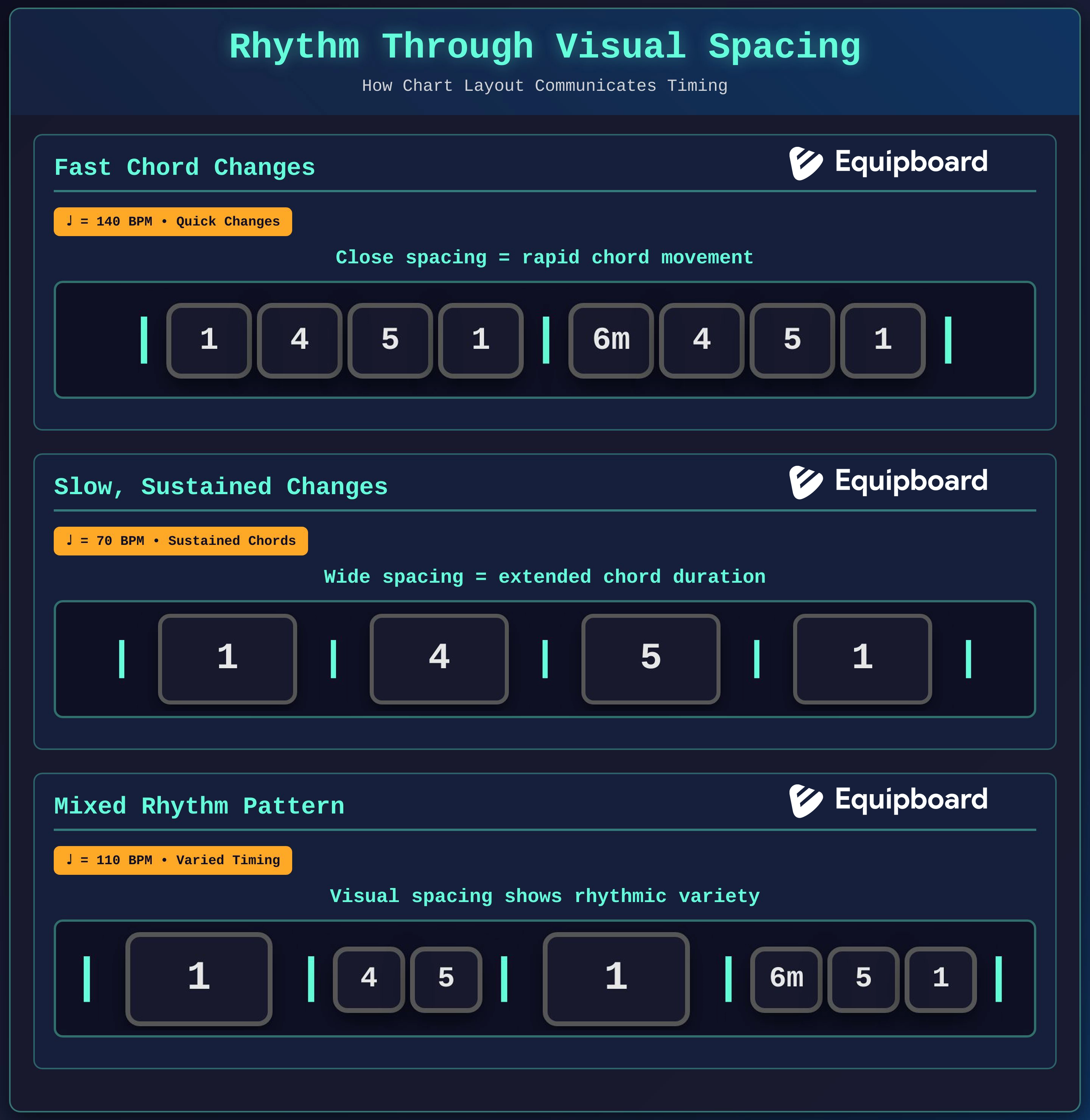
Professional number charts use specific symbols to communicate timing, dynamics, and structural information. Vertical lines separate measures, while double lines indicate section breaks. A slash (/) represents one beat, so "1 / / /" means the 1 chord plays for an entire measure in 4/4 time.
Chord pushes appear as underlined numbers, indicating chords that come in ahead of the beat. Hold symbols (^) show sustained chords, while parentheses indicate optional or passing chords. Dynamic markings use standard notation: forte (f), piano (p), and crescendo markings provide musical direction without cluttering the chart.
Reading Rhythm and Timing
The spacing of numbers on the page reflects their rhythmic relationships. Chords that change quickly appear closer together, while sustained harmonies get more space. This visual approach helps musicians internalize the song's rhythm while focusing on harmonic movement.
Section markers like "Verse," "Chorus," and "Bridge" provide structural guidance, often accompanied by rehearsal letters (A, B, C) for quick reference during recording sessions. Repeat signs and coda markings follow standard musical notation, ensuring that experienced musicians can navigate complex song forms without confusion.
Writing Your Own Chart
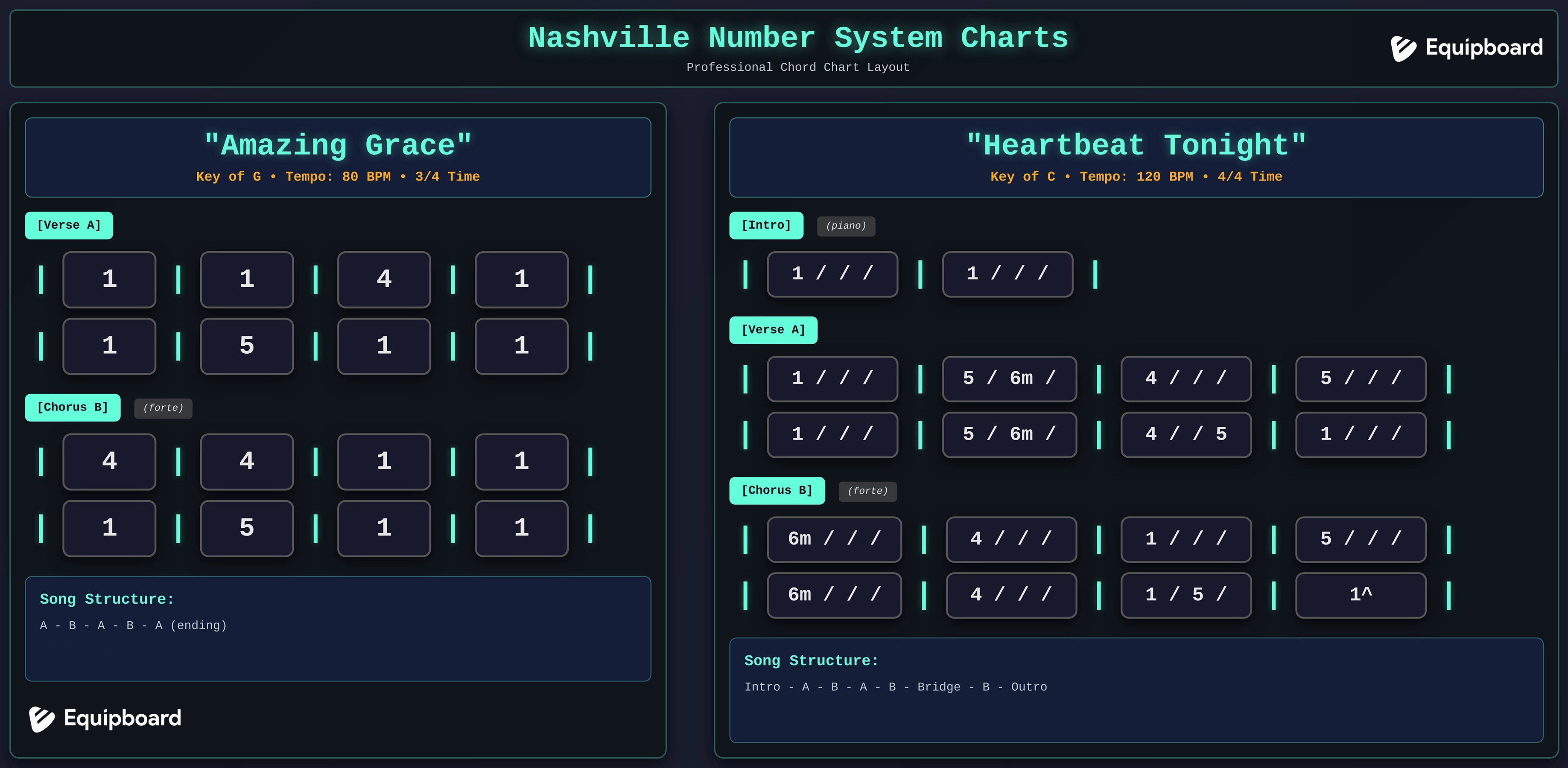
Creating effective number charts requires balancing completeness with simplicity. The best charts communicate essential information without overwhelming the reader, focusing on practical details that help musicians perform confidently.
Converting Songs to Numbers
Start with a song you know well and identify its key signature. Write out the chord progression using traditional chord names, then convert each chord to its corresponding number. Pay attention to the song's structure, noting where sections repeat and where variations occur.
Consider "Wonderful Tonight" by Eric Clapton. In the key of G, the verse progression moves through G, D, C, D, which converts to 1, 5, 4, 5. The chorus shifts to Em, C, D, G, becoming 6m, 4, 5, 1. This simple conversion reveals the song's harmonic logic in a way that works in any key.
Formatting Best Practices
Clear spacing makes charts readable under stage lights and in dimly lit studios. Leave adequate white space between sections and use consistent indentation for repeated sections. Avoid cramming too much information onto a single page, as this creates confusion during performance.
Write chord numbers above the lyrics where chord changes occur, just like traditional chord charts. Use bold text for section headers and maintain consistent font sizes throughout the chart. Include the original key at the top of the page, along with tempo markings and any special performance notes.
Songwriter Applications
Songwriters find the Nashville Number System particularly valuable for capturing ideas quickly. Instead of writing out full chord names, you can sketch progressions using numbers, allowing creative flow without getting bogged down in notation details. This speed becomes crucial when inspiration strikes and you need to document musical ideas rapidly.
The system also facilitates collaboration with other writers. When co-writing, you can communicate chord progressions instantly, regardless of each writer's theoretical background. A progression like "1, 5, 6m, 4" communicates the same musical information to a classically trained pianist and a self-taught guitarist.
Advanced Concepts
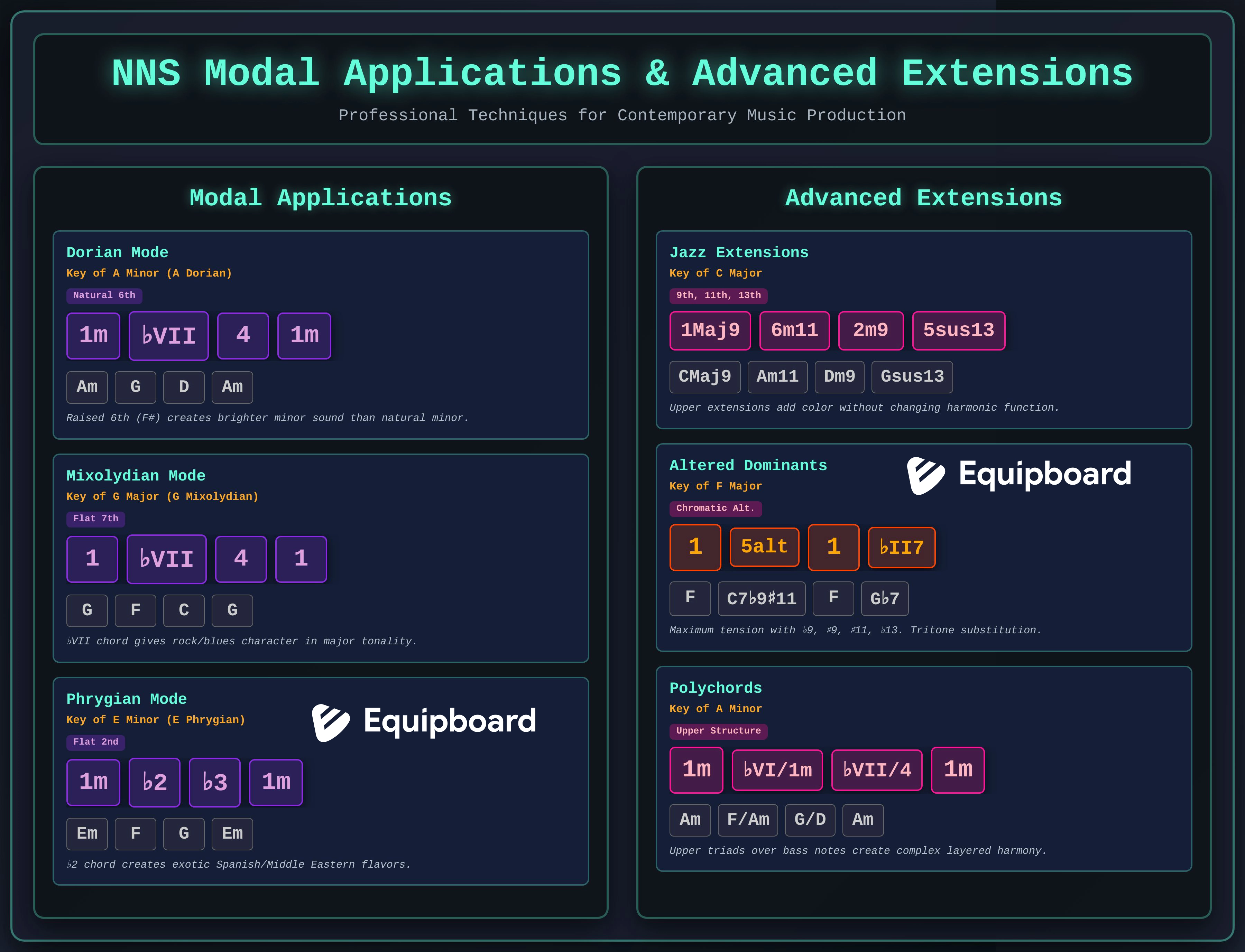
Once you've mastered basic number charts, several advanced concepts expand the system's versatility and power. These techniques address complex harmonic situations while maintaining the clarity and efficiency that make the Nashville Number System so valuable.
Non-Diatonic Chords
Not every chord in a song comes from the major scale. The Nashville Number System handles these non-diatonic chords using flat and sharp symbols before the numbers. The flat-seven chord (♭VII) appears frequently in rock and blues, while the four-minor chord (4m) adds emotional depth to major key progressions.
These borrowed chords create harmonic interest while remaining easy to notate. A progression like "1, ♭VII, 4, 1" immediately communicates the distinctive sound of classic rock anthems. The flat symbol alerts musicians to expect a chord outside the key signature while maintaining the system's logical structure.
Slash Chords and Inversions
Bass movement often defines a song's character, and the Nashville Number System accommodates this through slash chord notation. "1/3" indicates the 1 chord with the 3rd scale degree in the bass, while "4/1" shows the 4 chord over the root note. This notation clarifies bass lines without requiring separate bass charts.
Inversions add harmonic sophistication to simple progressions. The progression "1, 1/3, 6m, 6m/5" creates smooth voice leading through strategic bass movement. This level of detail helps rhythm section players coordinate their parts while maintaining ensemble unity.
Modal Applications
While the Nashville Number System originates from major key harmony, it adapts well to modal playing. Musicians working in Dorian or Mixolydian modes can use modified number charts that reflect the mode's characteristic intervals. A Dorian progression might emphasize the ♭VII chord, while Mixolydian harmony features the ♭VII chord prominently.
These modal applications require additional theoretical understanding but maintain the system's core advantage: universal transposability. A Dorian progression works in any key once you understand the mode's number relationships.
Real-World Professional Scenarios
Studio musicians encounter the Nashville Number System's advanced applications daily. During recording sessions, producers might request key changes to accommodate different vocalists or instrumental ranges. Number charts make these transitions seamless, allowing musicians to focus on performance rather than transposition mathematics.
Live performance situations benefit equally from advanced number system techniques. Wedding bands and cover artists use number charts to accommodate different singers' ranges, while original artists experiment with key changes to create dynamic concert experiences. The system's flexibility supports musical creativity rather than constraining it.
Helpful Gear

The right equipment enhances your ability to use the Nashville Number System effectively, whether you're performing live, recording in the studio, or practicing at home. Several categories of gear work particularly well with number-based musical thinking.
Capos and Transposition Tools
Capos represent the perfect marriage of the Nashville Number System and practical musicianship. When you understand a song in numbers, a capo becomes a transposition tool rather than just a guitar accessory. Place a capo on the second fret, and your "1, 4, 5" progression in G becomes the same pattern in A.
This relationship works beautifully for guitarists who think in number patterns. Instead of learning new chord fingerings for every key, you maintain familiar shapes while the capo handles the transposition. Browse capos that professional musicians rely on for consistent performance across different keys and musical situations.
MIDI Controllers and Digital Tools
Modern MIDI controllers excel at transposing entire arrangements with single button presses. When you've programmed a song using number-based thinking, changing keys becomes effortless through MIDI transposition functions. Keyboard players particularly benefit from this approach, as number patterns translate directly to different root positions.
Digital audio workstations support this workflow through transposition features that maintain the harmonic relationships you've captured in number charts. The combination of number-based composition and digital transposition tools streamlines the entire creative process.
Practice and Performance Essentials
Reliable tuning becomes crucial when working with number charts across multiple keys. Professional tuners help maintain pitch accuracy during key changes, while metronomes support the rhythmic precision that number charts communicate through their spacing and notation.
Music stand lights and tablet holders support number chart reading during live performance. Unlike traditional sheet music, number charts often fit on single pages, making them ideal for digital display on tablets and smartphones. The simplified notation reduces the visual complexity that can challenge performers in low-light situations.
Communication and Collaboration Tools
Recording equipment that captures high-quality audio helps when documenting number-based arrangements. Whether you're sketching song ideas or recording full arrangements, clear audio documentation preserves the musical relationships that number charts represent.
Consider how your current gear setup supports the collaborative advantages of the Nashville Number System. Does your equipment help you transpose quickly? Can you share number charts easily with band members? These practical considerations determine how effectively you'll integrate the system into your musical workflow.
Conclusion

The Nashville Number System represents more than just another approach to musical notation. It's a communication breakthrough that connects musicians across different backgrounds, skill levels, and musical styles. From its humble beginnings in 1950s Nashville studios to its current status as the industry standard, this system has consistently delivered practical solutions to real musical challenges.
Learning to read and write number charts will transform your musical collaborations, whether you're jamming with friends, recording in professional studios, or performing live. The system's emphasis on harmonic relationships rather than specific chord names develops your musical ear while expanding your theoretical understanding.
The beauty of the Nashville Number System lies in its immediate applicability. You don't need years of study to start benefiting from number charts. Begin with simple songs you already know, convert them to numbers, and experience firsthand how this approach clarifies musical structure and enhances creative possibilities.
As you integrate the Nashville Number System into your musical practice, remember that it's a tool designed to serve creativity rather than constrain it. The system works best when it supports musical expression rather than replacing musical intuition. Use number charts to communicate more effectively with other musicians, transpose songs confidently, and document your musical ideas efficiently.
About the authors

S. Jino is an accomplished multi-instrumentalist and music producer based in Kolkata, India, distinguished by his self-taught mastery and unique blend of technical acumen and musical performance. His extensive experience was forged through hands-on dedication, starting with the full restoration of a broken guitar. Jino's capabilities span keyboards, pedals, and advanced digital production, reflecting a comprehensive skill set developed independently. As a significant contributor to the music scene, Jino regularly performs with worship bands and college ensembles. He has also established himself as a reliable and authoritative professional in freelance mixing, mastering, and original music creation. Inspired by the innovative sounds of Brian May and David Gilmour, and influenced by Kolkata's vibrant metal community, Jino is committed to the intricate art of vintage gear restoration and the continuous exploration of music and technology fusion. His current professional setup, featuring a meticulously restored nameless guitar, a Fender Player Strat, and a Boss Katana 50. Read more














.webp)