
Dave Grohl
Genre
Credits
Genre
Credits
Guitars 56
Amplifiers 26
Effects Pedals 28
Drum Sets 25
Cymbals 16
Drumsticks 5
Snare Drums 5
Microphones 19
Software Plugins and VSTs 5
Studio Monitors 1
Strings 1
Drum Hardware 19
Studio Equipment 9
Bass Guitars 9
Music Accessories 7
Keyboards and Synthesizers 6
Headphones 1
Pianos 1
Other Gear 5
Dave Grohl's Effects Pedals
Filter by


"Sometimes we'd double a track using an old Pro Co Rat, and then hard-pan the parts so that a super-distorted guitar was in the left channel and a grindy guitar was in the right. Then we'd sprinkle in lots of clean guitar overdubs," explains Foo Fighters guitarist Dave Grohl about the Pro Co RAT Distortion Pedal.
Find it on:


-m.webp?v=1783335766)
Dave Grohl uses an MXR M-101 Phase 90 Pedal in his pedalboard. His MXR Phase 90 is hooked to both the Boss DM-2 Analog Delay pedal and the Whirlwind A/B Selector. The phase 90 can be seen at 3:31 throughout the performance.
Find it on:


-m.webp?v=1783349956)
Used in the early days of Foo Fighters, as stated by guitar tech Earnie Bailey in this August 21, 2017 Effects Bay interview.
What was the typical set up for Dave in those days?
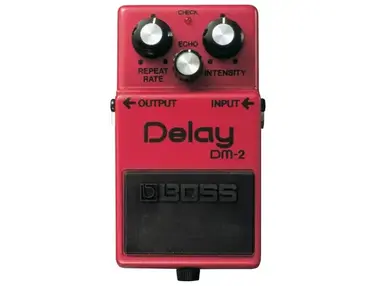
A ProCo Turbo Rat into a 100 watt Marshall JCM800, a black Gibson Explorer, an 80’s tobacco Sunburst Les Paul Standard and a white Les Paul Custom is the earliest setup I can recall. A Boss DM-2 delay and MXR Micro Amp were added around the time of the second album.
Find it on:


A pic of his pedalboard next to a Tu2, phase 90 and whirlwind selector box
Find it on:

Used with Foo Fighters "around the time of the second album", as stated by guitar tech Earnie Bailey in this August 21, 2017 Effects Bay interview.
What was the typical set up for Dave in those days?
A ProCo Turbo Rat into a 100 watt Marshall JCM800, a black Gibson Explorer, an 80’s tobacco Sunburst Les Paul Standard and a white Les Paul Custom is the earliest setup I can recall. A Boss DM-2 delay and MXR Micro Amp were added around the time of the second album.
Find it on:

The EP Boost can be seen sitting next to the Digital Delay during the 2020 SNL performance
Find it on:

"The main riff is an Explorer playing through the Memory Man and the Vox, and the harmonics were done with the same setup," explains Dave Grohl in reference to the production of the song Headwires. The item directly mentioned by Grohl is an Electro-Harmonix Memory Man Analog Delay Guitar Effects Pedal (not the later XO reissue).
Find it on:
-m.webp?v=1783349863)
In this source you can see the effects that Dave Grohl is using with the Foo Fighters.
Find it on:

Used on Grohl's background vocals for "The Pretender", as stated by mix engineer Rich Costey in this March 2008 Sound on Sound interview.
(...) Vocals: Mercury EQH, UA 175, Roger Mayer RM58, Waves DeEsser, Digidesign Reel Tape Saturation, Sound Toys Echoboy, Pultec EQP1A, SPL De-esser, Neve Portico 5042
"If I recall correctly, the lead vocal is doubled throughout the song. I used a Waves DeEsser plug-in on it, which I'm quite a fan of, as I've not heard a hardware de-esser that is competitive with it. The main signal chain after that was a Mercury EQH tube EQ and then a couple of vintage UA 175s. I hit the background vocals with the Roger Mayer RM58. I haven't mentioned any plug-ins yet, apart from the Waves DeEsser, because I hardly used them on 'The Pretender.' The only other ones I used were the Reel Tape Saturation and the Pultec EQP1A on the intro vocals, and the Sound Toys Echoboy on one of the end vocal overdubs.
"I used board EQ on all the vocals. The Pultec EQP1A plug-in on the intro vocals was to help them cut through. The Reel Tape Saturation was a plug-in that I had just bought. I wanted to warm the vocals up a little bit with it and make them a little bit crisper. Nothing too distorted. The Echoboy plug-in was used on a vocal overdub at the end for a tight delay. I don't tend to use plug-ins that much; they're really not that interesting, in my opinion. Finally, I also used an SPL De-esser on some vocals, and the Neve Designs Portico 5042 for a bit of crispness. It has its own sound, and I used it a lot on the whole Foo Fighters album.
"To complete the picture, I used an EMT plate and the room mics for general reverb, and my two EAR 660 limiters were my bus compressors, together with the Manley Massive Passive. We printed the mix to the ATR102, on half-inch analogue tape, from which it was mastered."
Find it on:
-m.webp?v=1783335620)
A Whirlwind Selector A/B Box gives Dave Grohl ultimate control over his guitars and gear, allowing him to alternate between two channels (A/B) or select both, without adding any noise, crackles or alteration to his tone. In Dave Grohl's pedalboard, his A/B box receives signal from an MXR M-101 Phase 90 pedal and outputs it to the Vox AC30 and Mesa Boogie Dual Rectifier amps.
Find it on:

You can see two Boss TU-3 Chromatic Pedal Tuners during this live performance of "Everlong" at :22s on Live on Letterman.
Find it on:


In this user-uploaded photo from a 2011 show, Dave Grohl is seen using the Line 6 DL4 Delay Modeler.
Find it on:


Used on There Is Nothing Left to Lose, as stated by Grohl in this 1999 Guitar One interview.
Can you talk a bit about some of the gear you used on this new record?
Most of the record was done with a Vox AC-30, with effects pedals like a Uni-Vibe or a Memory Man, or old BOSS delay pedals, Rat distortion pedals, Electro-Harmonix pedals, or Octave Fuzzes. I used a Talk Box on "Generator." Guitar-wise, I used my Gibson Trini Lopez, a Fender Telecaster, a Gretsch Duo-Jet, some Les Pauls, Explorers, and RD Artists. We used a Fender twin and a Marshall JCM 900 for some stuff. We also used a MESA/Boogie Maverick--it's a little head. But we tried to stay away from the MESA/Boogie Dual or Triple Rectifier sound because we did that on the last record a lot.
Find it on:

Dave is using the talkbox during the song Generator by the Foo Fighters. Here you can see him doing it during a show in 'De Melkweg' in Amsterdam from 02:25.
Find it on:

The Boss TU-2 Chromatic Tuner is a part of Dave Grohl's pedalboard.
Find it on:

In this source you can see the effects that Dave Grohl is using with the Foo Fighters.
Find it on:
-m.webp?v=1783349870)
In this photo, which originates from Foo Fighters' concert at Dingwalls, which was done on February 26, 2011 we can see a brief shot of Grohl's pedalboard - which included Ernie Ball VP Jr Volume pedal.
Find it on:

On this screenshot from the live at [V], October 4th 1999, we can see a big black box with 3 knobs in the middle like an original The Rat. Dave said in an interview from 1999 that they used an old ProCo Rat for recording the distorted parts of the guitars. I think that’s the Rat (the ‘The Rat’) that they used on the TINLTL recording and that Dave get it on his board for the Australian Tour.
Find it on:

In a user-uploaded photo, Dave Grohl appears to be using a Boss PW-2 Power Driver. The pedal's distinct orange-yellow hue, which differs from the typical SD-1 or OD-2 models, suggests it's the PW-2.
Find it on:

In a user-uploaded photo, Dave Grohl is seen with a green Boss PH-1 Phaser pedal at his feet, indicative of its use in his setup.
Find it on:

Dave Grohl uses an Arion HU-8500 Stage Tuner, as evidenced by a user-uploaded photo showing it at his feet during a performance.
Find it on:

In this live pic you can see the pedal next to the DD3
Find it on:

On top of the pedalboard you can see the Lehle dual amp switcher
Find it on:

According to Guitar Lobby, Dave used DM-2W.
Find it on:

In a photo from 2007, you can see the first generation Lehle Dual A/B Switcher on the top of Dave Grohl’s pedalboard.
Find it on:

At 0:33 you can see the pedal just behind his back
Find it on:
This is a community-built gear list for Dave Grohl.
- Find relevant music gear like Guitars, Amplifiers, Effects Pedals, Drum Sets, Cymbals, Snare Drums, Drumsticks, and other instruments and add it to Dave Grohl.
- The best places to look for gear usage are typically on the artist's social media, YouTube, live performance images, and interviews.
- To receive email updates when Dave Grohl is seen with new gear, follow the artist.
Album Credits
-
Bl'ast! · 2013
Mixing Engineer -
Ghost · 2013
Producer


.jpeg?v=1783323499)



.webp)