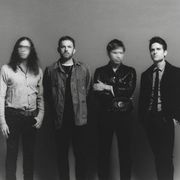
Caleb Followill
Caleb Followill's Gear

-m.webp?v=1783349868)
In a now-unavailable YouTube video titled "Kings of Leon - In-depth gear interview," Caleb Followill discusses his Gibson ES-325, describing it as his favorite guitar. He mentions, “Gibson, 1972, ES-325… it’s my favorite guitar ever in the history of guitars.” Followill also notes the guitar's significance to him, saying it has "had my heart" since he started using it, even referring to it as a source of comfort comparable to being home.
Find it on:


-m.webp?v=1783349875)
"I started with an AC15, a Vox, but eventually I went to an AC30 and then a Matchless. And then I got tired of all the big noise and I went back to the AC30. And I think I might be back at the AC15. If not, I've got four AC15s, four of the last ones, made and I'm going to make a room out of it. I'm going to put rubber all over them and it's going to be my kid's room. If my little kid hits his head I'll be like, 'Well, at least you hit your head on an AC15'. All of us have doubles of everything we've ever had."
Find it on:


-m.webp?v=1783350007)
VOX amps USA shared a photo of Kings of Leon performing live at The Governors Ball Music Festival 2013. Behind Caleb Followill, his two Vox AC15 combo amps can be seen. The photo is captioned:
Caleb Followill rocking two AC15s on-stage with Kings Of Leon at Governors Ball Music Festival!
Find it on:

"Caleb is playing the Matchless 2x12s DC. It’s kind of cool, it's its own thing. It's got tone selector switches, it sound can't really dial out the middle, bass, and stuff like that. It just gives you what it gives you. It's pretty good though, pretty loud if you want it to be," says Caleb Followill's guitar tech.
Find it on:

"...eventually I went to an AC30 and then a Matchless. And then I got tired of all the big noise and I went back to the AC30."
Find it on:
-m.webp?v=1782327089)
Caleb used a Black Tele for the California Waiting EP. He talks about this at around 1.13 in the video.
Find it on:


-m.webp?v=1783335627)
"Caleb plays a Hummingbird, this is a nice guitar. He just got it not too long ago in Australia. It's deep and rich. Gibson hooked us up," explains Caleb Followill's guitar tech around 2:19 into this video.
Find it on:


"We have an MXR which we use for more verb," says Caleb Followill's guitar tech.
Find it on:

In a Mix article, front-of-house engineer for Kings Of Leon Brent Rawlings reveals that while touring for the Only by the Night album, the vocal mics the Followills used are Sennheiser e 935s. Original article can be found here.
Find it on:

An MXR M-102 Dyna Comp Compressor Pedal appearsin this video at 5:16 in Caleb Followill's gear rack.
Find it on:

Caleb has started using this acoustic guitar live and can be seen with it trough the video. He no longer seems to use the Gibson Hummingbird.
Find it on:


"This is kind of like a Fulldrive MOSFET. It's real beefy and crunchy. It sounds really good," says Caleb Followill's guitar tech.
Find it on:

In a photo from the Kings of Leon's performance at the iHeartRadio Theater in LA, Caleb Followill is seen using a VOX AC15C1-CM Limited Edition amplifier. The image, provided by Zimbio, shows the distinctive cream-colored amps behind Caleb, while his bandmate Matthew Followill uses Matchless amplifiers.
Find it on:

A Boss TU-3 Chromatic Pedal Tuner appears at 5:02 in this rundown video of Caleb Followill's rig.
Find it on:

Caleb Followill's guitar tech points out at 5:09 a Boss TR-2 Tremolo Pedal used by Caleb Followill.
Find it on:

Caleb and his band (Kings Of Leon) use Sennheiser MD 431 for vocals.
Find it on:

Used for vocals on Because of the Times and Only by the Night, as featured in this June 1, 2007 Mix Online interview and as visible in the "Only by the Night Home Videos" series by Kings of Leon (particularly "Day 14" at 1:49 and "Day 18" at 1:04).
As on the band's previous recordings, Caleb Followill sang into a Shure SM7 live during tracking.
Find it on:

at the video supersoaker we can seen at the minute 2:55 the pedal
Find it on:

Used for the electric guitar on Only by the Night, as stated by producer Jacquire King in this December 2008 Sound on Sound interview.
"We had five or six guitar amplifiers available for each guitar, and again, we picked the ones that were most appropriate for the song. Angelo and I would listen to the guitar parts and mix and match amplifiers. Sometimes we'd put reverb on one amp and a delay on another, or effect pedals on both. We had all kinds of combinations, although we kept it to two amplifiers per performance for each player. I'd put an SM57 in front of one amp and a U67 in front of the other. The guitars went through API mic pres, an API 550A EQ, and I also used some APSI parametric EQs. Occasionally I'd put an 1176 in the signal chain, but in general I don't use much compression on distorted electric guitars going to tape, because there's not a lot of dynamic range to them as it is. The synth–like reverb you can hear on the guitar was done at Blackbird on an Eventide DSP4000 and added during the transfer to Pro Tools."
Find it on:

Used for Only by the Night, particularly on "Sex on Fire", as stated by producer Jacquire King in this July 31, 2019 interview with producer Warren Huart at 1:27:49.
Huart: And then the Selmer you were talking about that got used on the album quite a lot.
King: Yeah, I definitely know that it's on "Sex on Fire", I don't think it's on "Use Somebody". I think that was Caleb's Matchless that we used on "Use Somebody". And that's also the "Let It Go" song of James Bay, that's the guitar amp that was used for that.
Find it on:

In this YouTube video at 0:26 to 0:31 and 0:36 to 0:38, Caleb Followill can be seen using Visual Sound Liquid Chorus
Find it on:

"The Voodoo Lab ground switcher runs back into a rack," says Caleb Followill's guitar tech.
Find it on:


"It kind of sounds like an organ because it's a polyphonic generator," says Caleb Followill's guitar tech.
Find it on:

At 0:01 the Tiny terror Sits behind Caleb as his main Guitar Amp.
Find it on:

Used for the vocals on "Sex on Fire", as stated by Only by the Night producer Jacquire King in this December 2008 Sound on Sound interview. An image of the item can be found here.
- Vocals: Sound Toys Echoboy, Audio Ease Altiverb, Massenburg DesignWorks EQ, Neve 1099, Urei 1176, Dbx 902, Dolby A encoder, Teletronix LA3A
"I had a Sound Toys Echoboy delay and an Altiverb reverb, set to the EMT 140 plate, on the vocals. In fact, there are two or three delays and two or three reverbs in total, different amounts in different sections of the song. I had a Massenburg plug–in EQ on the vocal bus, and underneath it you can see my insert signal chain: Neve 1099 EQ/Urei Blue Stripe 1176/Dbx 902 de–esser. I pre-mix in my computer and things are coming out in stems, and going out into the desk and the Folcrom mixer for mixdown to stereo. The 1099/1176/902 were inserted in the analogue realm and daisy-chained. There's also a distant lead double in the chorus. I call that a performed effect. Instead of using a delay and modulation to get something in the background, you record a second performance in a different space and with a different microphone. You get something more deliberate and unique that way. Finally, once it came to summing, I also added some Dolby A to the vocals, which gives an excited high-frequency sound that I sent through an LA3A and blended back in."
Find it on:

Used for vocals on Because of the Times, as stated in this June 1, 2007 Mix Online interview.
Caleb Followill sang into a Shure SM57.
An SM57 was also used for the electric guitar and vocals on Only by the Night, as mentioned producer Jacquire King in this December 2008 Sound on Sound interview.
"We had five or six guitar amplifiers available for each guitar, and again, we picked the ones that were most appropriate for the song. Angelo and I would listen to the guitar parts and mix and match amplifiers. Sometimes we'd put reverb on one amp and a delay on another, or effect pedals on both. We had all kinds of combinations, although we kept it to two amplifiers per performance for each player. I'd put an SM57 in front of one amp and a U67 in front of the other. The guitars went through API mic pres, an API 550A EQ, and I also used some APSI parametric EQs. Occasionally I'd put an 1176 in the signal chain, but in general I don't use much compression on distorted electric guitars going to tape, because there's not a lot of dynamic range to them as it is. The synth–like reverb you can hear on the guitar was done at Blackbird on an Eventide DSP4000 and added during the transfer to Pro Tools. Caleb's vocals were recorded with a Shure SM57 going through a Chandler TG2 mic pre, a Neve 1073 EQ, an LA2A compressor, and I also had a Dbx 902 de–esser on them."
Find it on:

Used for Followill's electric guitar on "Sex on Fire", as stated by Only by the Night producer Jacquire King in this December 2008 Sound on Sound interview.
"We had five or six guitar amplifiers available for each guitar, and again, we picked the ones that were most appropriate for the song. Angelo and I would listen to the guitar parts and mix and match amplifiers. Sometimes we'd put reverb on one amp and a delay on another, or effect pedals on both. We had all kinds of combinations, although we kept it to two amplifiers per performance for each player. I'd put an SM57 in front of one amp and a U67 in front of the other. The guitars went through API mic pres, an API 550A EQ, and I also used some APSI parametric EQs. Occasionally I'd put an 1176 in the signal chain, but in general I don't use much compression on distorted electric guitars going to tape, because there's not a lot of dynamic range to them as it is. The synth–like reverb you can hear on the guitar was done at Blackbird on an Eventide DSP4000 and added during the transfer to Pro Tools.
(...) **Guitars: **Massenburg DesignWorks EQ, Sound Toys Echoboy, Cooper Time Cube, Digidesign delay, Audio Ease Altiverb
(...) "I also used an Echoboy for delay on certain sections, like in the choruses. There was a little bit of bus compression on the guitars and a little bit of EQ, all very minor stuff, because I had already recorded what I wanted. The only radical EQ is on the Cooper Time Cube delay, which I described above, and which I applied to Caleb's guitar. I took out everything below 861Hz to get rid of the darker tone that was obscuring the source tone a bit. There's also a bit of Digirack delay on Caleb's guitar, to give it a bit more dimension by panning it to the other side than the track itself."
Find it on:

Used for Followill's electric guitar on "Sex on Fire", as stated by Only by the Night producer Jacquire King in this December 2008 Sound on Sound interview.
"We had five or six guitar amplifiers available for each guitar, and again, we picked the ones that were most appropriate for the song. Angelo and I would listen to the guitar parts and mix and match amplifiers. Sometimes we'd put reverb on one amp and a delay on another, or effect pedals on both. We had all kinds of combinations, although we kept it to two amplifiers per performance for each player. I'd put an SM57 in front of one amp and a U67 in front of the other. The guitars went through API mic pres, an API 550A EQ, and I also used some APSI parametric EQs. Occasionally I'd put an 1176 in the signal chain, but in general I don't use much compression on distorted electric guitars going to tape, because there's not a lot of dynamic range to them as it is. The synth–like reverb you can hear on the guitar was done at Blackbird on an Eventide DSP4000 and added during the transfer to Pro Tools.
(...) **Guitars: **Massenburg DesignWorks EQ, Sound Toys Echoboy, Cooper Time Cube, Digidesign delay, Audio Ease Altiverb
(...) "I also used an Echoboy for delay on certain sections, like in the choruses. There was a little bit of bus compression on the guitars and a little bit of EQ, all very minor stuff, because I had already recorded what I wanted. The only radical EQ is on the Cooper Time Cube delay, which I described above, and which I applied to Caleb's guitar. I took out everything below 861Hz to get rid of the darker tone that was obscuring the source tone a bit. There's also a bit of Digirack delay on Caleb's guitar, to give it a bit more dimension by panning it to the other side than the track itself."
Find it on:

Used for the vocals on "Sex on Fire", as stated by Only by the Night producer Jacquire King in this December 2008 Sound on Sound interview. An image for the vocal settings can be found here.
- Vocals: Sound Toys Echoboy, Audio Ease Altiverb, Massenburg DesignWorks EQ, Neve 1099, Urei 1176, Dbx 902, Dolby A encoder, Teletronix LA3A
"I had a Sound Toys Echoboy delay and an Altiverb reverb, set to the EMT 140 plate, on the vocals. In fact, there are two or three delays and two or three reverbs in total, different amounts in different sections of the song. I had a Massenburg plug–in EQ on the vocal bus, and underneath it you can see my insert signal chain: Neve 1099 EQ/Urei Blue Stripe 1176/Dbx 902 de–esser. I pre-mix in my computer and things are coming out in stems, and going out into the desk and the Folcrom mixer for mixdown to stereo. The 1099/1176/902 were inserted in the analogue realm and daisy-chained. There's also a distant lead double in the chorus. I call that a performed effect. Instead of using a delay and modulation to get something in the background, you record a second performance in a different space and with a different microphone. You get something more deliberate and unique that way. Finally, once it came to summing, I also added some Dolby A to the vocals, which gives an excited high-frequency sound that I sent through an LA3A and blended back in."
Find it on:

Used for the vocals on "Sex on Fire", as stated by Only by the Night producer Jacquire King in this December 2008 Sound on Sound interview. An image of the item can be found here.
- Vocals: Sound Toys Echoboy, Audio Ease Altiverb, Massenburg DesignWorks EQ, Neve 1099, Urei 1176, Dbx 902, Dolby A encoder, Teletronix LA3A
"I had a Sound Toys Echoboy delay and an Altiverb reverb, set to the EMT 140 plate, on the vocals. In fact, there are two or three delays and two or three reverbs in total, different amounts in different sections of the song. I had a Massenburg plug–in EQ on the vocal bus, and underneath it you can see my insert signal chain: Neve 1099 EQ/Urei Blue Stripe 1176/Dbx 902 de–esser. I pre-mix in my computer and things are coming out in stems, and going out into the desk and the Folcrom mixer for mixdown to stereo. The 1099/1176/902 were inserted in the analogue realm and daisy-chained. There's also a distant lead double in the chorus. I call that a performed effect. Instead of using a delay and modulation to get something in the background, you record a second performance in a different space and with a different microphone. You get something more deliberate and unique that way. Finally, once it came to summing, I also added some Dolby A to the vocals, which gives an excited high-frequency sound that I sent through an LA3A and blended back in."
Find it on:
This is a community-built gear list for Caleb Followill.
- Find relevant music gear like Guitars, Amplifiers, Effects Pedals, and other instruments and add it to Caleb Followill.
- The best places to look for gear usage are typically on the artist's social media, YouTube, live performance images, and interviews.
- To receive email updates when Caleb Followill is seen with new gear, follow the artist.