

Pricing and availability




* Product prices and availability are updated by Equipboard every 24hrs and are subject to change. Equipboard may receive compensation for purchases made at participating retailers linked on this site. This compensation does not affect what products or prices are displayed, or the order of prices listed. For more information, please refer to our affiliate disclosure.


Videos

Cinemassacre
Commodore 64 - Angry Video Game Nerd (AVGN)
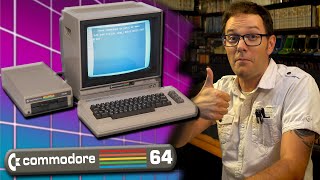
Commodore 64 - Angry Video Game Nerd (AVGN)
Cinemassacre

Pawn Stars: A Working Commodore 64 (Season 14) | History

Pawn Stars

My First Time with the Commodore 64

Vintage Geek
Reviews
Owner Insights
We analyzed real musician discussions from forums and Reddit to find what players love, question, and tweak about Commodore 64.
Comparisons
Use cases and applications
-
The C64 Maxi is praised for its easy out-of-box experience and USB storage, making it ideal for those who want a hassle-free setup for retro computing.
Source
Value and pricing
-
The C64 Maxi can be significantly cheaper when ordered from European sites, with shipping to the US offering substantial savings over domestic prices.
Source -
In Europe, C64 prices are generally lower than in North America, with complete setups fetching between €100 to €300, depending on condition and included peripherals.
Source
Software and compatibility
-
The C64 Maxi's UI requires specific configuration files for proper game setup, unlike the more user-friendly VICE interface.
Source -
The C64 mini provides a plug-and-play experience, ideal for those unfamiliar with emulators like VICE, although its emulation quality is sometimes questioned compared to CCS64.
Source -
C64 Dreams offers a curated collection of 3,500 games with full controller support, making it user-friendly for non-savvy users who want to relive C64 experiences.
Source
User experience
-
Owners find the included joystick inadequate for fast-paced games, recommending replacements for better performance.
Source -
Denise emulator, paired with OneLoad64, is highlighted for its simplicity, offering instant loading of over 2,000 cartridge-format games for a seamless gaming experience.
Source -
Real owners report that sourcing a CRT monitor enhances the visual experience significantly over modern LCDs, aligning more closely with original gameplay memories.
Source -
Using an SD2IEC for loading games is recommended over cassette tapes, which can be problematic and require frequent maintenance like adjusting the azimuth screw.
Source
Mods and upgrades
-
Owners have built adapters for original 9-pin Atari/Commodore joysticks using "zero delay" USB adapters, enhancing joystick options.
Source -
The Ultimate 64 is praised for combining authentic hardware experience with modern convenience, although it comes at a higher price.
Source -
The Pi1541 is highly recommended as a reliable and cost-effective floppy emulator, allowing easy loading of games via SD card.
Source
Features and functionality
-
The keyboard on The C64 Maxi retains the PETSCII graphics characters in their original positions, which is crucial for authentic programming experiences.
Source -
The C64 Maxi includes a VIC-20 mode, offering additional versatility for vintage computing fans.
Source -
Assembly64 serves as a front end for CSDB, allowing users to launch games without pre-downloading them, enhancing ease of use for game access.
Source -
The C64C model is considered more reliable than the original "breadbin" design, and many prefer it for this reason.
Source
5.0 out of 5
Based on 4 Reviews and 14 Ratings

605
The ‘64 is my favourite thing in the world
It really is. My favourite thing really is the Commodore 64.
When I was young I had the Sinclair ZX-81, then the Commodore VIC 20 and then the one and only; Commodore 64.
From Day 1 I was smitten, the look, the games and the ultimate thing about it: the MOS 6581 Sound Interface Device (SID)!
What a beast of a thing, the 6582 and the 8580 are also incredible but you can’t beat the original and best.
After the “bread bin” I did get the 64C that looked a little like the Amiga 500 which I used for a while as a kid.
I still own a number of these, I have the ones from my childhood and I acquired a bunch more about 18 years ago as well as floppy drives and other peripherals.
I have a number of SID synths and I also have a whole bunch of new old stock MOS 6581’s I bought years ago for various projects I still haven’t got around to.
I have the coveted Moog Song Producer for the Commodore 64 as well, stashed away in a box somewhere... I must dig that out and have another play.

27178
This speaks to me. I started with a hand-me-down C128 that ruled my world.
605
Oh the C128. Such an unloved piece of history. Shame it didn’t really, properly take off as the machine it was and what it was capable of.
The best thing about it was that you could switch if to C64 mode which, looking back seems like kind of a waste given the specifications.
I suppose the C64 was still just such an icon when the C128 came out and I suppose the cost had a major impact on its uptake as well.
You must’ve been proper posh back then ;)
27178
My C128 ran all C64 software, at a time when C64 software was permanently on sale... and that was plenty.
605
The C128 fetch crazy money these days.

415
Amazing analog synth for mindblowing 8-bit chiptunes
People may think I am weird, that I use a home computer form the 80s in my studio. But the SID chip sounds amazing. The very unique sound is a great addition for some tracks. I use it with a video capturing card, so I do not need a TV for it. The C64 is controlled via MIDI using the MSSIAH cartridge, and there are M4L devices which makes integration into Ableton Suite super easy. The C64 is a really affordable analog synth: about $70 for the computer (Craigslist) and about $50 (+shipping) for the cartridge.

111
My very first synth actually
Programming the Sound Interface Device (SID) on my C64 was my first experience with sound modeling on a synth. Sold mine, but got it back about ten years later, so still have it in my studio.

Amazing analog chiptune synthesizer
I presently run a single SID Commodore 64 with a Cynthcart 65
Artist usage
Add artist

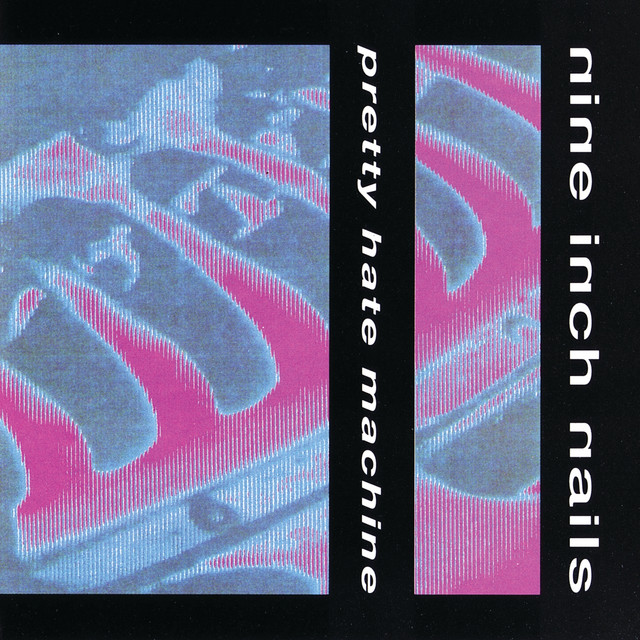
"I had a Commodore 64 with, I think, the Sequential Circuits Model 64 Sequencer Cartridge. And it was the greatest thing in the world (or so I thought at the time). Moving on… The first "real" platform I used for composition was a Mac+ running Performer. Pretty Hate Machine was done with this."


he used a modified Commodore 64, a Voyager 8, and a Korg MS-20 on Extraña.

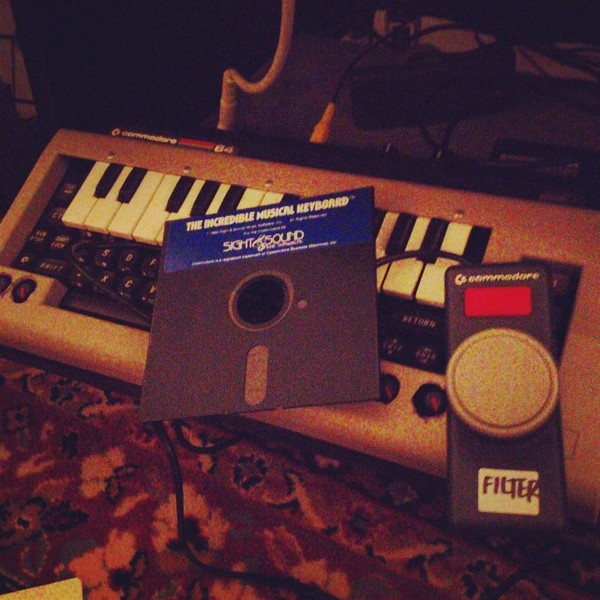
Kid Koala seen using a Commodore 64 Analog Synthesizer in his studio in a picture posted on his official Facebook.


"I bought a Commodore 64 solely to run Dr. T's Algorithmic Composer package! Jim Johnson's phrase generator allows you to outline scales, bars, change probabilities, weighting, and several more quite involved parameters; what comes out is very usable. Two or three of the most recent episodes (in the fourth series) have most of the music written in this manner. Monophonic phrases are generated (by the computer), played across to another sequencer and then layered and repeated. Miami Vice has long cues and this kind of music can help bridge, say, three scenes."


"In 1983 we used a Roland MC8 for recording some Golden Section tracks with Mike Howlett. ‘Twilight’s Last Gleaming’, for instance, was almost entirely sequenced by that. Mike was quick and efficient at programming it. I tried it out and ended up hating the damn thing.
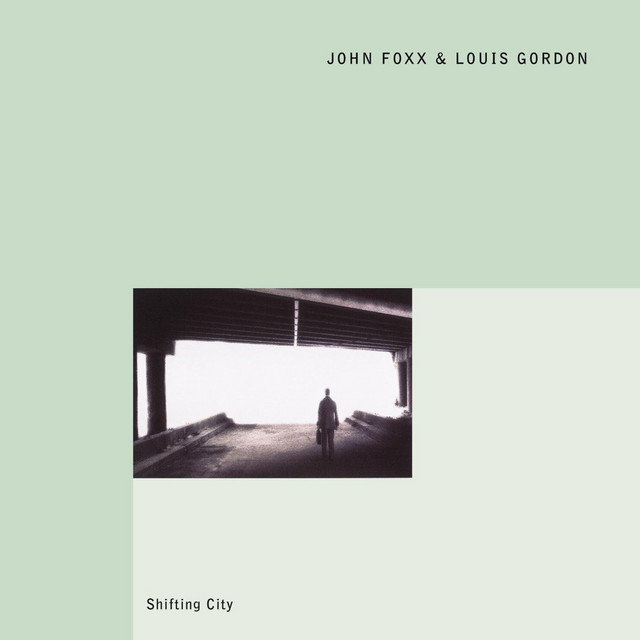
Then a Commodore 64 with Steinberg [Pro-16] when I was working with Tim Simenon [Bomb The Bass], then with Louis Gordon. Most of Shifting City and the next couple of albums were recorded using that system. It was good, straightforward and the triggering was bang on, for the time.
Overlapping this, I got a well‑designed and very useful all‑in‑one PC‑based system from Carillon, using Cubase, then finally went over to Logic on the Mac. As for present‑day sequencing and arranging, I really like the symbiosis of digital and analogue. You’re finally able to mix the beauty, richness and deviance of analogue with the stability and precision of digital."


"I have songs written on the Sinclair Spectrum, Commodore 64, Commodore Amiga, my Yamaha SY77, Cubase seqeuncer files from an Atari ST then a Falcoln, then PC. All are unreadable on an up to date version of PC Cubase and that's just my little world."


The 1997 album The Horrible Plans Of Flex Busterman : “Produced by Patric C. on Amiga 500 and Commodore 64 in Spandau-Berlin in 1996.”


"The first thing I did when I decided I was going to be serious about this record was get this in. It was either B16s or the washing machine in the corner of the room - a 24-track. I know people who actually use B16s to master so it's a pretty good setup. A Commodore 64 actually runs the desk and I'm going to get the Soundtracs SMPTE Interface that runs with the Commodore and reads SMPTE off tape in real time to allow me to mute and edit mutes and so on."


The instrument appears on the list of instruments on official artist's website (http://olszak.pl/).


Ryo Kawasaki played a pivotal role in reinventing the Commodore 64 as a musical instrument, through which his Kawasaki Synthesizer could be programmed.


"The sid was a great sound chip for the time. I liked the fact that you could assign different waveforms to different channels, and that the square wave had a variable pulse width register that you could change to create modulated type sounds. On the down side the filters were a bit dodgy on some of the C64s and a tune that sounded good on a normal C64 sounded totally different on one of the dodgy ones. Of course an extra channel would have been great, and a better implementation of ring modulation would have been useful." - Mark Cooksey
Album Usage
The Commodore 64 has been featured on the following albums:



Genre Usage
Based on how artists on Equipboard use this gear, it is most commonly found in the following genres.
Used With
Based on how musicians on Equipboard use Commodore 64, it is most commonly used with the following gear.

-s.webp?v=1783609041)


-s.webp?v=1783682919)


Community setups
Show yours
Similar
Add recommendation1 alternative for Commodore 64, curated by the Equipboard community.

$79.00 - $99.00
More Commodore Computers & Peripherals


$1,319.55
in Computers & Peripherals Rank


$69.59 - $79.00
in Computers & Peripherals Rank


$399.15 - $596.86
in Computers & Peripherals Rank


$133.00 - $239.99
in Computers & Peripherals Rank


$579.99 - $799.00
in Computers & Peripherals Rank


$1,192.00 - $1,914.49
in Computers & Peripherals Rank


$54.99
in Computers & Peripherals Rank


$83.83 - $99.00
in Computers & Peripherals Rank


$157.99 - $179.99
in Computers & Peripherals Rank

$109.99 - $129.99
in Computers & Peripherals Rank


$1,299.00
in Computers & Peripherals Rank


$149.00 - $192.08
in Computers & Peripherals Rank


$44.99 - $89.00
in Computers & Peripherals Rank


$365.00
in Computers & Peripherals Rank


$168.99 - $179.99
in Computers & Peripherals Rank

$509.00 - $867.00
in Computers & Peripherals Rank

$112.64
in Computers & Peripherals Rank


$119.98 - $119.99
in Computers & Peripherals Rank


$649.99 - $919.99
in Computers & Peripherals Rank


$25.00 - $1,619.99
in Computers & Peripherals Rank


$210.99 - $379.99
in Computers & Peripherals Rank


$1,399.00 - $1,699.00
in Computers & Peripherals Rank


$1,488.71 - $1,999.00
in Computers & Peripherals Rank


$87.00 - $199.00
in Computers & Peripherals Rank


$19.31 - $22.80
in Computers & Peripherals Rank


$128.00
in Computers & Peripherals Rank

$32.99 - $189.95
in Computers & Peripherals Rank


$497.79
in Computers & Peripherals Rank
.png?v=1783447610)


$189.99 - $249.99
in Computers & Peripherals Rank


$69.00 - $403.00
in Computers & Peripherals Rank

Gear Guides








Most Popular Computers & Peripherals
Most Popular Brands
-
Added to Equipboard on by
 nachomarty
Gear IQ 126
-


