

Pricing and availability




* Product prices and availability are updated by Equipboard every 24hrs and are subject to change. Equipboard may receive compensation for purchases made at participating retailers linked on this site. This compensation does not affect what products or prices are displayed, or the order of prices listed. For more information, please refer to our affiliate disclosure.
Description
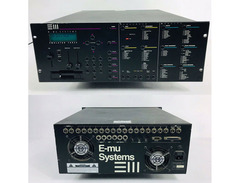
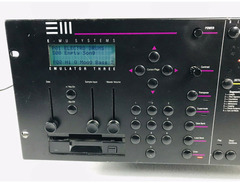
The Emulator III was introduced after the discontinuation of the Emulator II between 1987 and 1990. This rack-mountable version was introduced a year later. Rack 2 version with 4 or 8 Megabytes of memory, standard disk drive, and or / SCSI HD. The original EIII keyboard was the first sampler to offer 16-bit CD-quality specs with stereo or mono sampling at 44.1kHz or 33kHz. A 20-character backlit LCD, a 10-key pad, four cursor controls inc/dec buttons that double up for yes/no responses, a data entry slider, a number of dedicated buttons for the sequencer transport control and things like common disk functions, and a button per editing module. Analogue processing includes 3 envelopes: one VCA, one VCF, and one AUX that can go to pitch, panning, LFO rate, or LFO depth to pitch, volume, filter, or panning (more Brownie points). All envelopes are of the ADHSR stages. face EIII Edit functions: Classic looping tools with single stepping, zero crossing detectors, autocorrelation and crossfade looping for perfect loops. the special autocorrelation is a special zero crossing points. In all digital editing functions Crossfading may be linear or equal power, with adjustable length. Traditional function samples like truncate, cut/copy/paste features, also special resample function (for tiny memory) which is handy. A variation on sample rate conversion allows you to change the pitch of sounds with internal calculator features. Autopanning effects onto samples can be also routed to single LFO (too bad).
Hardware:
CPU Machine uses a National 32016 main CPU, clocked at 10MHz. The EIII is entirely controlled by computer software which is loaded from disk when it is powered on. The EIII kept with the overall EII design, using a micro controller for sample access, a main CPU and a scanner CPU (Rockwell 6502 processor. The 32016 main processor and 32081 floating point coprocessor run the operating system from 128k bytes of DRAM in overlay mode (each module is loaded from disk when needed). The 32016 boots from two 27128 EEPROM's
Sample Memory The 4 or 8 MB of sample memory on the EIII consists of 16 x 256kbyte (150nS DRAM), 4 or 8 x 1 MB (120nS DRAM) fitted on the top circuit board.
Digital Converters The stereo ADC is a Sony 20018 (rather surprising !) and the 16 voice DAC's are PCM53JGI's.
Analog Filters The EIII has 16 analog filters (CEM3387) which combine a 3 pole low pass filter, a 4 pole low pass filter with Q, plus gain and pan VCA's.
CPU
EIII rack Data
Type: Digital
Synthesis: Sampling
Oscillators: 2 layers
Osc Modulation: After Touch, Envelope, Fader, Keyboard, Knob, LFO, Mod Wheel, Pedal, Pitch Wheel, Glide / Portamento, Sequencer, Velocity
Sampling: 16 bit, 44.1 kHz, Gated, Loop, One Shot (Phrase), Multi-Sample
Sampling Notes: 8 MB Sample RAM
Envelopes: 2 Attack, Decay, Sustain, Release
Filter Types: 24dB Slope (4-pole), Low Pass
LFO: 1
Polyphony: 8
Timbrality: 4 parts
Modes: Mono, Polyphonic, Split
Storage: Hard Drive, Internal disk drive
Editing: MIDI, SCSI
Rack Size: 19", 4U, Full
Display Type: LCD Backlit
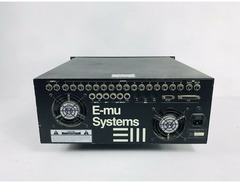
Audio Output Connections: 1/4" Phone Jack, Stereo Main, Stereo 2
Inputs: 1/4" Stereo
MIDI Ports: IN, OUT, THRU
Owner's manual
E-Mu Systems Emulator III EIII Synth Sampler User ManualVideos

INHALTVIDEO
E-MU Emulator III Demo by INHALT
E-MU Emulator III Demo by INHALT
INHALTVIDEO
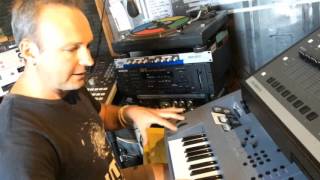
Monkey Marc showing off his vintage EIII sampler

Monkey Marc
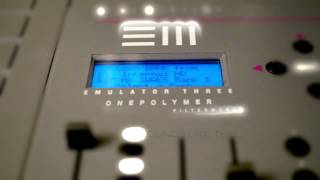
E-MU EMULATOR III 'FILTERWORKS'

ONEPOLYMER
Reviews
Critic Reviews
5.0 out of 5
Based on 0 Reviews and 1 Rating
Genre Usage
Based on how artists on Equipboard use this gear, it is most commonly found in the following genres.
More E-Mu Sound Modules

$75.00
in Sound Modules Rank


$49.99
in Sound Modules Rank


$506.36
in Sound Modules Rank


$41.10
in Sound Modules Rank


$350.00
in Sound Modules Rank
.jpg?v=1784685191)


$350.00
in Sound Modules Rank


$1,668.02
in Sound Modules Rank


-m.webp?v=1784905256)
$320.50
in Sound Modules Rank


$170.00
in Sound Modules Rank

.png?v=1784755332)


$1,156.83 - $1,999.99
in Sound Modules Rank


$1,388.00
in Sound Modules Rank


$750.00
in Sound Modules Rank


$238.29
in Sound Modules Rank


$2,299.00 - $2,330.00
in Sound Modules Rank


$625.00
in Sound Modules Rank


$119.00
in Sound Modules Rank


$259.00
in Sound Modules Rank

.jpg?v=1784888431)


$550.00
in Sound Modules Rank


$3,900.00
in Sound Modules Rank

$4,999.99
in Sound Modules Rank


$400.00
in Sound Modules Rank


$1,211.75
in Sound Modules Rank


$101.27
in Sound Modules Rank


Artist usage


Community setups


Similar


Gear Guides






.webp)

Most Popular Sound Modules
Most Popular Brands
-
Added to Equipboard on by
 hashimoto
GearIQ 14876
-


