

Pricing and availability
We compare 600+ stores and found this item at 1 store. Prices updated .
Store
Reviews
Price




* Product prices and availability are updated by Equipboard every 24hrs and are subject to change. Equipboard may receive compensation for purchases made at participating retailers linked on this site. This compensation does not affect what products or prices are displayed, or the order of prices listed. For more information, please refer to our affiliate disclosure.
Description
The E-Mu Emax II Rack is a powerhouse sound module that provides musicians with a seamless blend of vintage charm and digital innovation. This synthesizer is part of E-Mu's renowned lineup, celebrated for its versatility and rich, distinctive sound character. A favorite among electronic musicians and producers, the Emax II Rack is equipped with 16-bit stereo sampling, offering an impressive sonic depth that was groundbreaking for its time. This rackmount variant allows for easy integration into any studio setup, making it an ideal choice for both live performances and studio recordings.
The Emax II Rack is designed for those who appreciate the classic digital sampling era while benefiting from enhanced features like expanded memory and an intuitive interface. With its digital sound processing capabilities, users can tweak and mold sounds to fit any genre, from ambient to industrial. The module supports a broad range of sounds and samples, providing a comprehensive palette for creative exploration. Its connectivity options ensure seamless integration with other gear, making it a versatile addition to any musician's toolkit.
Whether you're looking to recreate the sounds of the past or forge new sonic paths, the E-Mu Emax II Rack stands as a testament to the enduring appeal of digital sound synthesis.
Key Features:
- 16-bit stereo sampling for high-quality sound reproduction
- Extensive library of onboard sounds and samples
- Expandable memory options for increased versatility
- Intuitive interface for easy navigation and sound editing
- Rackmount design for efficient studio integration
- Multitimbral capabilities for complex arrangements
- Comprehensive MIDI implementation for seamless connectivity with other devices
Product specs
| Brand | E-MU Systems |
| Model | Emax II Rackmount 16-Voice Sampler Workstation |
| Finish | Black |
| Year | 1989 |
| Categories | Rackmount Synths, Samplers |
| Analog / Digital | Digital |
| MIDI I/O | MIDI Input, MIDI Output, MIDI Through |
| Polyphony | 16 Voices |
FAQs
-
What are the main features of the E-Mu Emax II Rack?
-
The E-Mu Emax II Rack is a 16-voice digital sampler workstation featuring MIDI I/O, polyphonic capabilities, and advanced sampling options. It is designed for rackmount use and offers extensive sound manipulation features.
-
Is the E-Mu Emax II Rack compatible with modern MIDI setups?
-
Yes, the E-Mu Emax II Rack includes MIDI Input, Output, and Through ports, allowing it to integrate with contemporary MIDI setups for expanded control and sequencing.
-
What kind of sound manipulation capabilities does the E-Mu Emax II Rack offer?
-
The E-Mu Emax II Rack allows for detailed sound manipulation with its digital sampling engine, offering 16-voice polyphony and robust editing features for creative sound design.
-
How does the E-Mu Emax II Rack compare to the original Emax?
-
The E-Mu Emax II Rack offers enhanced polyphony with 16 voices compared to the original Emax's 8 voices, along with improved digital sampling and more advanced features for professional use.
Videos

Espen Kraft
Emu Emax 2 | Sometimes the sequel is the best one
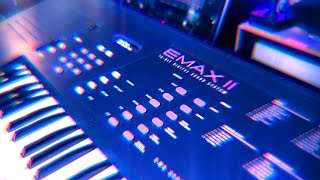
Emu Emax 2 | Sometimes the sequel is the best one
Espen Kraft
Reviews
Owner Insights
We analyzed real musician discussions from forums and Reddit to find what players love, question, and tweak about E-Mu Emax II Rack.
Setup and maintenance
-
An ATX power supply can be adapted to replace the original Emax II power supply if issues arise, simplifying maintenance.
Source
Mods and upgrades
-
Upgrading the Emax II can involve specific challenges, such as needing a special PAL and EEPROM modifications.
Source -
Memory expansion is possible; users seek 6MB expansion boards to increase capacity from 2MB to 8MB.
Source -
Owners recommend using SCSI2SD over floppy emulators for faster loading speeds and reduced reliance on floppy disks.
Source
Features and functionality
-
The Emax II is multi-timbral, capable of playing different presets on separate MIDI channels, though setup may require careful configuration.
Source -
The Emax II has a hidden "bird run" function, activated by specific key combinations or through a menu, displaying an emu running across the screen.
Source -
The primary advantage of the Emax II is its 16-bit architecture, offering enhanced audio quality compared to the 12-bit Emax I.
Source -
Emax II includes better ADCs compared to the Emax I, contributing to improved sound clarity and fidelity.
Source
Use cases and applications
Build quality
-
Inside the Emax II, there is an illustration of an emu playing the keyboard printed on the circuit board.
Source
Other
-
For community support and additional resources, E-mu groups on Facebook can be a valuable source for Emax II users seeking modifications and advice.
Source
Comparisons
Critic Reviews
4.5 out of 5
Based on 0 Reviews and 5 Ratings
Artist usage
Add artist

Trent Reznor, along with other members of Nine Inch Nails such as Danny and Robin, is confirmed to have used the E-Mu Emax II Rack during live performances. This information is corroborated by a 1995 interview in Keyboard Magazine with touring keyboardist James Woolley, who noted, "Everybody else is triggering Emax IIs, so we're all backed up on each other's drive." Additionally, Woolley's offstage rack setup included an E-mu Emax II among other equipment, indicating its significant role in NIN's live stage setup.


In an interview featured in Keyboard Magazine (February 1995), bandmate James Woolley confirmed that Danny Lohner uses the E-Mu Emax II Rack. Woolley stated, "Everybody else is triggering Emax IIs, so we're all backed up on each other's drive. The Emaxes are easy to use, and we already had a lot of the old songs stored in Emax format, so it wasn't a big hassle."


In a 1995 interview with Keyboard Magazine, it was confirmed that James Woolley used an E-Mu Emax II Rack during the "Self Destruct" tour. The article states: "Woolley uses a sole Yamaha DX7 onstage. His offstage rack houses an E-mu Emax II, Roland JV-880, Alesis D4, Kurzweil MicroPiano, Opcode Studio 3, MX-8 MIDI patch bay, and Juice Goose power module."


From "Musician" magazine, December 1992 found on Prince.org:
LEVI SEACER plays a Gibson Epiphone ("Because my stuff is clean stuff") straight into the board. He has a rack-mounted Zoom unit 9010, a Cry Baby chorus pedal, a Roland GPS and a Boss digital delay pedal. On "Thunder" and "Live for Love" Levi pulls out an Ibanez guitar with double humbucking pickups. Levi uses D'Addario strings.
When TONY U. reaches for a guitar, it's either a Charvel or a hollowbody Epiphone. Tony's strings are either GHS lights or Dean Markleys. He has a Zoom effects processor.
SONNY THOMPSON plays an Oswald bass (though be admits his favorite is an Alembic, "a great bass") with a GB8 effects processor, an Akai Octaver and a Boss Octaver. Sonny uses a Heavy Metal distortion pedal and plugs into a Trace Elliot amp. He prefers GHS heavy strings because "they seem brightest- they keep the boing longest."
ROSIE GAINES plays a Hammond organ onstage, and has a Korg and Roland D-50 MIDI'd to the Hammond. Rosie sings through Shure microphones. Rosie is also leaving the NPG to go out on her own.
TOMMY BARBRELLA plays a Roland A80 and an A50 controller, a Korg T3, an old Prophet which he uses on "Kiss" and a few others "for that old analog sound." Tommy also carries a new Roland JD800, a couple of E-mu E-max 2s, a Proteus 1 and Proteus 2, and a Roland D550.
MICHAEL BLAND's drums are a combination of Sonor, Yamaha and Gretach, with Zililian cymbals and Vater sticks. Trying to get mere details out of Michael is useless. "I abhor shop talk," he says. "I don't know when we change heads, I don't know when we get new cymbals. I don't have any emotional attachments to gear at all."
Genre Usage
Based on how artists on Equipboard use this gear, it is most commonly found in the following genres.
Used With
Based on how musicians on Equipboard use E-Mu Emax II Rack, it is most commonly used with the following gear.


More E-Mu Sound Modules

$75.00
in Sound Modules Rank


$49.99
in Sound Modules Rank


$505.70
in Sound Modules Rank


$41.05
in Sound Modules Rank


$350.00
in Sound Modules Rank
.jpg?v=1784685191)


$556.85
in Sound Modules Rank


$1,665.84
in Sound Modules Rank


-m.webp?v=1784876527)
$322.00
in Sound Modules Rank


$170.00
in Sound Modules Rank

.png?v=1784755332)


$1,158.97 - $1,999.99
in Sound Modules Rank


$1,388.00
in Sound Modules Rank


$700.00
in Sound Modules Rank


$237.98
in Sound Modules Rank


$2,299.00 - $2,330.00
in Sound Modules Rank


$625.00
in Sound Modules Rank


$119.00
in Sound Modules Rank


$259.00
in Sound Modules Rank

.jpg?v=1784733418)


$550.00
in Sound Modules Rank


$3,900.00
in Sound Modules Rank

$4,999.99
in Sound Modules Rank


$400.00
in Sound Modules Rank


$1,210.03
in Sound Modules Rank


$101.14
in Sound Modules Rank


Accessories & Related Items



Community setups


Similar


Gear Guides






.webp)

Most Popular Sound Modules
Most Popular Brands
-
Added to Equipboard on by
 jakkzter
GearIQ 79
-


