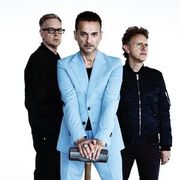
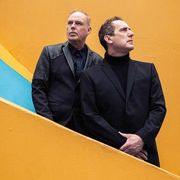
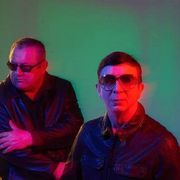
Vince Clarke
member of Erasure, Depeche Mode, Yazoo,…
Genre
Group
Genre
Group
Vince Clarke's Gear


In this interview/video of Vince Clarke he discusses how he uses the Arturia MiniBrute.
Find it on:


The OSCar can be seen pictured in his studio ... bottom row, 2nd from back/left.
Find it on:

The center of the setup is a Logic rig, where the signal path from each synth has been led. Via a routing and patching system set up in collaboration with his brother, Mick, Clarke can select any of his dozens of analog or digital synths for control and/or recording, as easily as if he were choosing any one or more Logic soft synths. Six Roland MPU 101 MIDI-to-CV converters allow him to run the old-school synths from a central MIDI controller, if desired.
Find it on:

Kenton Pro Solo Mk2 MIDI to CV converters are essential to triggering the older instruments.
Find it on:

The Roland VP-330 is featured in the "Studio Equipment List" from Vince Clarke's website.
Find it on:

The Korg M1 is featured in the "Studio Equipment List" on Vince Clarke's website.
Find it on:


"We use the same basic gear for live work and recording: an Oberheim Xpander, Juno 106, MKS80, Prophet VS, D550, S550, all run off UMI."
Find it on:

In an article from Muzines titled "Vince Clarke’s Wall Of Sound," Vince Clarke mentions using the Roland SH-09 Synthesizer as a general analog keyboard. While he appreciates its tight envelope, he notes that he doesn't use it for bass because it lacks the necessary weight compared to other options like the Minimoog.
Find it on:

Auction for Vince Clarke's Roland PG-300, which he used to program his Roland MKS-50.
Find it on:

On Tracy Hurley Martin's Instagram, a post features Vince Clarke with a Yamaha P 116 M PE Upright Piano, showcasing his use of this instrument.
Find it on:

The Moog Source can be seen in the lower right rack of synths in this photo of Vince Clarke's studio.
Find it on:

Keyboard Magazine shows a slide show of "all the enviable synths in Vince Clarke's Cabin Studio, followed by a complete gear list." One of the items in this list is the Roland System 700. Source.
Find it on:

The Roland - System 100M is listed as one of the many Synths used by vince according to Keyboard Magazine.
Find it on:

In the Synthtopia article "Vince Clarke And The Temple of Synth," Vince Clarke is mentioned using the Roland 100-M modular synthesizer.
Find it on:

In the Synthtopia article "Vince Clarke And The Temple of Synth," Vince Clarke is mentioned using the Waldorf Pulse Synthesizer.
Find it on:

In an article on Synthtopia titled "Vince Clarke And The Temple of Synth," Vince Clarke discusses his use of the Sequential Circuits Prophet-5 synthesizer.
Find it on:


In the Synthtopia article "Vince Clarke and the Temple of Synth," Vince Clarke is mentioned using the Oberheim Xpander synthesizer.
Find it on:

In the Synthtopia article "Vince Clarke And The Temple of Synth," Vince Clarke is noted for using the Roland JX-10 Super JX synthesizer.
Find it on:

Vince's Mopho Keyboard can be seen in the first picture
Find it on:
-m.webp?v=1783177092)
Vince Clarke is listed as an artist associated with the Roland TR-505 Drum Machine on Vintage Synth Explorer.
Find it on:
-m.webp?v=1783236080)
A Roland Juno 106 can be seen in Vince's studio (bottom right of photo).
Find it on:

The ARP 2500 is featured in the "Studio Equipment List" on Vince Clarke's website.
Find it on:

The Moog Modular is featured in the "Studio Equipment List" from Vince Clarke's website.
Find it on:

At 2:52, Arturia Minimoog can be seen on Vince's computer screen.
Find it on:



How did you come across Native Instruments?
"That was by recommendation from Martin Ware of Heaven 17. We worked together and he recommended Absynth and FM7 to me. I loved Absynth right away because it was so different from anything else. Then I got into Reaktor through Gareth Jones, who was another producer I worked with. He explained to me how it worked. At first I was a bit put off by the idea of creating your own synthesizers. Initially, I couldn't be bothered to do that because it sounded like a lot of hard work. But I soon found out that it was also a lot of fun!"
Find it on:

"With Depeche, we were using the ARP 16-step sequencer. Then it was a Roland MC-4, and then a 16-step sequencer make by a company called Umi, which was made to be used with the BBC Micro. They all did what we needed them to do."
Find it on:

(Used in the Erasure music video for the single "Drama!" from the 1989 album "Wild!")
Find it on:

In the Muzines article "Vince Clarke’s Wall Of Sound," Vince Clarke discusses his E-mu Modular Synthesizer, noting its distinctive sound and quality craftsmanship. He appreciates the digital sequencer operated via a numeric keypad and comments on the synth's exceptional build quality, including its tactile knobs.
Find it on:

An Akai MPK 25 can be seen in Vince Clarke's studio (second photo).
Find it on:
This is a community-built gear list for Vince Clarke.
- Find relevant music gear like Pianos, Keyboards and Synthesizers, Microphones, Software Plugins and VSTs, Instruments, Studio Equipment, Headphones, and other instruments and add it to Vince Clarke.
- The best places to look for gear usage are typically on the artist's social media, YouTube, live performance images, and interviews.
- To receive email updates when Vince Clarke is seen with new gear, follow the artist.
Discography
Album Credits
-

Saint Etienne · 2025
Engineer Programmer -
Robert Marlow · 2012
Mixing Engineer Producer -
Martyn Ware · 2001
Programmer Recording Engineer