

Pricing and availability




* Product prices and availability are updated by Equipboard every 24hrs and are subject to change. Equipboard may receive compensation for purchases made at participating retailers linked on this site. This compensation does not affect what products or prices are displayed, or the order of prices listed. For more information, please refer to our affiliate disclosure.
Description
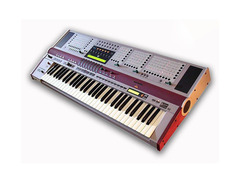
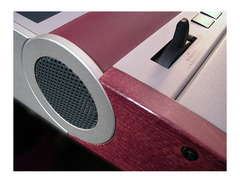
The Hohner ADAM keyboard from 1994 ADAM stands for Advanced Digital/Analog Musical Instrument. The keyboard design was created by Axel Hartmann, who has become a living legend on the synthesizer market thanks to his countless creations. The software, in turn, comes from Waldorf. The entire concept of the ADAM can be described as a multi-keyboard workstation. Anyone who thinks there are speakers behind the black, grid-like covers of the ADAM is mistaken. They are "empty" and are more likely to provide good ventilation for the considerably large instrument. The ADAM keyboard offers velocity and aftertouch, is easy to play and comes from the Fatar company. The Hohner ADAM was introduced in 1994 and was Hohner's attempt to bring a professional keyboard onto the market. This was only partially successful, which meant that the ADAM's broad acceptance was very limited. Hohner then let it go and, after the complex and expensive ADAM project, threw all further keyboard ambitions overboard. That's a shame, because Hohner has not only given the music world excellent accordions, good recorders, guitars, drums, etc., but also good keyboards. As early as the 1970s, there was the legendary Hohner Clavinet (and all its relatives), the Hohner String Melody and various other keyboards from the analogue era. In the 1980s, in collaboration with Casio, various professional synthesizers and samplers were even produced. The Hohner company is still an extremely successful and very interesting chapter in German instrument making. Hohner has been making instruments since 1857. More information is available at www.hohner.eu. But keyboards were over after the ADAM... Concept of the Hohner ADAM
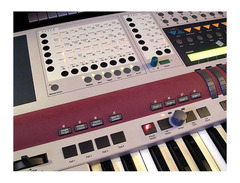
The ADAM is not as bad as it is sometimes portrayed. The individual sound groups are clearly arranged from left to right. Style, Bass, Organ, Poly III, Poly II and Poly I are essentially the main blocks that are important.
The rhythms sound pretty good for the most part. What's more, the automatic accompaniment arrangements are usually very tastefully designed. You just have to get to grips with the principle of an arranger keyboard, that's for sure. Fortunately, the ADAM IS more than just drums and accompaniment.
The poly sections I, II and III contain 256 PCM-based sounds, some of which are very good. As Synrise tells us, the samples were only recorded at 12 bits. This explains why some sounds have a lot of noise. But that doesn't necessarily have to be a bad thing, because in certain situations - with a choir or atmospheric sound - a little noise can create the necessary mood. Acoustically sterile isn't always the be-all and end-all, it just depends on the purpose and the music.
As you can hear from the sound samples, the ADAM offers some useful potential. It's better to turn off the somewhat weak internal effects and use external peripherals instead.
Hohner really tried to build an excellent instrument. As you can see from the many details, no effort was spared in developing the keyboard. Direct access to all sound areas is of course very user-friendly. Well, this is a top priority, especially for an arranger keyboard. Nevertheless, the design of the ADAM was very well chosen. There are also small buttons at every corner that do another bonus service. Poly I offers portamento, each sound section has its own sustain control, vibrato can be added globally, etc.
The 256 basic sounds can still be changed to a limited extent. So there is a small synthesizer hidden in the ADAM after all. A digital filter with resonance, two envelopes (filter and amplifier and, if desired, assigned to the pitch) and an LFO with four waveforms are great luck for sound tinkerers. The LFO at least offers a delay and attack (!) function, i.e. a timed oscillation after the delay. There is even random, and modulations can always be positive or negative. That's not so bad for sound design.
Organ - Leslie and drawbars This section deserves its own paragraph. The Leslie effect and digital drawbars of the ADAM are absolutely unique. The Leslie effect can automatically switch from slow to fast via aftertouch (!), so the speed of the (virtual) Leslie changes depending on the pressure you press your finger on. I'm not an organ expert, but I think the sound results are really nice (see sound example "Organ"). You can even add your own overdrive effect... The organ's drawbars can be changed using the eight (!) large wheels directly below the display. This is also very convincing in terms of sound, and fading in and out individual sound areas allows for very lively variations.
The connections of the ADAM keyboard
Hohner hasn't skimped on the back either. In addition to the MIDI trio, there is a stereo output pair, 2 pedal inputs, audio in (for mixing and forwarding to the output signal), EFX Send 1 & 2, a single output just for the organ sound, headphone connection, and speaker output. The latter pair of "speakers" already has an amplifier in front of it (!) and can therefore be connected directly to (passive) speaker.
Product specs
| Analog/Digital | digital |
Videos

Wheelmaker
Improvisation Hohner Adam und GEM WK3 Keyboards
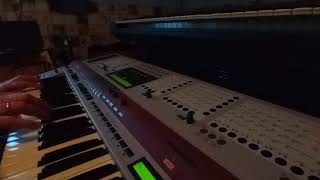
Improvisation Hohner Adam und GEM WK3 Keyboards
Wheelmaker
Reviews
Based on 0 Reviews and 0 Ratings
Genre Usage
Based on how artists on Equipboard use this gear, it is most commonly found in the following genres.
More Hohner Synthesizers


$3,266.16 - $3,499.99
in Synthesizers Rank


$469.00 - $699.99
in Synthesizers Rank


$20,218.87
in Synthesizers Rank


$439.00 - $545.00
in Synthesizers Rank
.jpeg?v=1784985816)
.jpg?v=1784893209)

$3,333.00 - $3,499.99
in Synthesizers Rank


$999.00 - $1,084.00
in Synthesizers Rank


-m.webp?v=1784905194)
$1,100.00
in Synthesizers Rank

-m.webp?v=1784991580)
$379.00 - $499.99
in Synthesizers Rank


$700.00 - $2,398.00
in Synthesizers Rank


$2,000.00
in Synthesizers Rank


$411.00 - $699.99
in Synthesizers Rank


$277.00 - $349.00
in Synthesizers Rank


$2,199.00 - $2,941.08
in Synthesizers Rank


$1,480.57 - $1,899.00
in Synthesizers Rank


$297.67 - $652.00
in Synthesizers Rank


$1,353.97 - $1,839.99
in Synthesizers Rank


$379.00 - $549.99
in Synthesizers Rank


$490.81 - $899.99
in Synthesizers Rank


$279.00 - $449.99
in Synthesizers Rank


$229.19 - $749.99
in Synthesizers Rank


$278.16 - $1,763.18
in Synthesizers Rank


$79.99 - $495.44
in Synthesizers Rank


$325.00 - $1,332.49
in Synthesizers Rank

.jpeg?v=1784891088)
-m.webp?v=1784992204)
$1,790.00 - $1,899.00
in Synthesizers Rank


$480.92 - $699.00
in Synthesizers Rank


$499.99 - $719.99
in Synthesizers Rank


$303.89 - $915.00
in Synthesizers Rank


$3,999.00 - $4,999.00
in Synthesizers Rank


$1,469.00 - $2,159.99
in Synthesizers Rank

$290.00
in Synthesizers Rank


$479.99 - $1,099.00
in Synthesizers Rank

Artist usage


Community setups


Similar


Gear Guides






.webp)

Most Popular Synthesizers
Most Popular Brands
-
Added to Equipboard on by
 hashimoto
GearIQ 14926
-


