

Pricing and availability
We compare 600+ stores and found this item at 5 stores. Prices updated .
Store
Reviews
Price





Average Price: $70
Budget/Beginner
$119
$300+
Price Tier
Budget
Standard
High-end
Price History
Based on price data from 3 merchants for "Passive Di direct box 1/4" instrument to balanced & unbalanced XLR". Prices shown reflect NEW condition. Tracking began Apr 2, 2026.
* Product prices and availability are updated by Equipboard every 24hrs and are subject to change. Equipboard may receive compensation for purchases made at participating retailers linked on this site. This compensation does not affect what products or prices are displayed, or the order of prices listed. For more information, please refer to our affiliate disclosure.
Description
In the world of music production, achieving pristine sound without breaking the bank is a musician's dream. Enter the Passive DI Direct Box, a robust solution for seamlessly converting your unbalanced 1/4" instrument signals into balanced and unbalanced XLR outputs. Whether you're a guitarist looking to maintain the integrity of your tone or a synth enthusiast aiming to deliver deep, resonant bass to your mix, this direct box is designed to meet your needs with finesse.
Crafted with a custom transformer, this DI box ensures every nuance of your sound is captured with clarity, from the subharmonic depths to the shimmering highs. Its rugged steel chassis is built for the rigors of the road, offering durability that withstands nightly performances and the most challenging environments. The passive design requires no power, making it a hassle-free addition to any setup.
With features like a Thru output and a ground lift switch, this direct box provides flexibility and noise reduction, ensuring clean and uninterrupted sound transmission. It's an indispensable tool for anyone seeking professional-grade audio performance in both live and studio settings.
Key Features:
- Converts unbalanced 1/4" instrument-level signals to balanced XLR mic-level signals
- Custom transformer captures full frequency range (18Hz-40kHz)
- Rugged steel chassis for durability and noise rejection
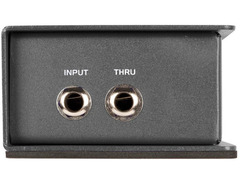
- Thru output for stage amp integration
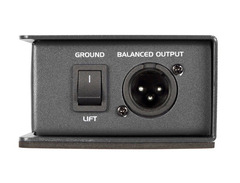
- Ground lift switch reduces hum in various environments
- Completely passive design—no power required
Product specs
| Type | Passive Direct Box |
| Channels | 1 |
| Ground Lift | Yes |
| Inputs | 1 x 1/4" (instrument/line) |
| Outputs | 1 x XLR (balanced out), 1 x 1/4" (thru) |
| Height | 1.95" |
| Width | 3.38" |
| Depth | 5" |
| Weight | 1.49 lbs. |
FAQs
-
What is the purpose of a passive DI box like this one?
-
A passive DI box converts an unbalanced instrument signal to a balanced XLR output, reducing noise and signal degradation over long cable runs. It is ideal for connecting instruments like electric guitars or keyboards to a mixing console or audio interface.
-
Does this passive DI box require a power source?
-
No, passive DI boxes do not require an external power source. They operate without batteries or phantom power, making them convenient for live performances and studio recording.
-
Can this DI box handle both instrument and line-level signals?
-
Yes, this DI box can handle both instrument and line-level signals, making it versatile for use with various audio equipment, including electric guitars, basses, and keyboards.
-
What is the function of the ground lift switch on this DI box?
-
The ground lift switch helps eliminate hum and ground loop noise by disconnecting the ground connection between the input and output. This is useful in reducing unwanted noise in live and studio environments.
-
How does the 1/4" thru output work on this DI box?
-
The 1/4" thru output allows you to connect your instrument to an amplifier while simultaneously sending a balanced signal to a mixer or audio interface. This setup is ideal for live performances where monitoring is needed on stage.


Reviews
Owner Insights
We analyzed real musician discussions from forums and Reddit to find what players love, question, and tweak about Passive Di direct box 1/4" instrument to balanced & unbalanced XLR.
Features and functionality
-
A ground lift switch on the DI box can help with electrical noise issues, particularly in environments with old wiring installations.
Source -
The 30dB switch on the DI box is typically a pad to attenuate hot signals, useful when interfacing with high-output instruments.
Source -
A TRS to XLR cable can avoid phantom power issues when connecting a balanced output to a mixing desk.
Source -
Passive DI boxes prevent DC offset transmission, protecting connected devices from potential electrical issues.
Source
Use cases and applications
-
The "link out" connection is intended for stage use, allowing the signal to feed an amplifier while the XLR output sends the balanced signal to a mixer or interface.
Source -
For optimal use, the DI box should be connected to an interface with an XLR cable, converting the unbalanced instrument signal to a balanced mic signal for better sound quality.
Source -
Passive DI boxes can reduce signal levels, especially when used after active preamps, which may not be desirable.
Source -
Using a DI box after a bass preamp pedal can provide ground isolation when the mixer is on a different power circuit.
Source -
Passive DIs are ideal for active signals like synthesizers and stage pianos, whereas active DIs suit high impedance instrument signals and piezo pickups.
Source -
In scenarios with multiple outputs, Klark Teknik's 10-14 channel rack mount DI is praised for large synth/keyboard setups, offering excellent sound and practicality.
Source
User experience
Comparisons
-
The Neve RNDI is favored by some users for bass applications over other DI options.
Source
5.0 out of 5
Based on 1 Review and 2 Ratings

Artist usage
Add artist

Genre Usage
Based on how artists on Equipboard use this gear, it is most commonly found in the following genres.
More Direct Boxes

$222.19 - $268.00
in Direct Boxes Rank


$925.00 - $936.00
in Direct Boxes Rank


$111.09 - $144.00
in Direct Boxes Rank


$217.55 - $258.00
in Direct Boxes Rank


$222.19 - $268.00
in Direct Boxes Rank


$200.00 - $259.99
in Direct Boxes Rank


$185.16 - $220.00
in Direct Boxes Rank
.png?v=1785038939)


$137.01 - $177.00
in Direct Boxes Rank


$225.00 - $259.99
in Direct Boxes Rank

$199.00 - $399.00
in Direct Boxes Rank


$125.00 - $349.99
in Direct Boxes Rank


$114.79 - $134.99
in Direct Boxes Rank


$115.00 - $232.00
in Direct Boxes Rank


$150.00 - $395.00
in Direct Boxes Rank


$111.00 - $232.00
in Direct Boxes Rank


$1,055.00 - $1,223.00
in Direct Boxes Rank


$222.19 - $275.50
in Direct Boxes Rank


$854.19 - $950.00
in Direct Boxes Rank


$349.00 - $479.00
in Direct Boxes Rank


$111.09 - $134.99
in Direct Boxes Rank


$219.00 - $275.50
in Direct Boxes Rank


$459.99 - $515.00
in Direct Boxes Rank


$81.46 - $95.00
in Direct Boxes Rank


$209.00 - $269.00
in Direct Boxes Rank


$77.99 - $98.00
in Direct Boxes Rank


$81.46 - $94.99
in Direct Boxes Rank


$92.57 - $114.00
in Direct Boxes Rank

$222.00 - $249.99
in Direct Boxes Rank


$40.10 - $79.99
in Direct Boxes Rank

.jpg?v=1783959930)


$229.60 - $267.00
in Direct Boxes Rank


$1,249.00 - $1,499.00
in Direct Boxes Rank


$429.00 - $449.00
in Direct Boxes Rank


.jpg?v=1784353661)

$333.00 - $379.00
in Direct Boxes Rank


$249.99
in Direct Boxes Rank

$47.00 - $149.00
in Direct Boxes Rank


$348.10 - $399.99
in Direct Boxes Rank


$89.60 - $199.89
in Direct Boxes Rank


$16.20 - $84.74
in Direct Boxes Rank


$119.99 - $149.99
in Direct Boxes Rank

-m.webp?v=1785065038)
$23.90 - $46.90
in Direct Boxes Rank

Accessories & Related Items


-s.webp?v=1785078137)




-s.webp?v=1785077988)
-s.webp?v=1785065038)


Community setups


Similar


Gear Guides









Most Popular Brands
-
Added to Equipboard on by
 chris_gomez
GearIQ 287
-


