Things You May Not Know About Playing Country Guitar


By Gear Experts

By Gear Experts
Table of Contents

Equipboard
Equipboard is the world's largest community of artists and their gear. Read our review process.
We are reader-supported. When you buy through links on our site, we may earn an affiliate commission. Learn more.
While country music may seem pretty simple at first glance, any of you who’ve really tried to play country guitar know how complex it can be. The lead playing is lightning fast, the instrumentation complex, and though country shares a lot of common ground with both rock and blues the songs are generally constructed in a very different way. Reference Brad Paisley, Waylon Jennings, and Merle.
So if you’ve always wanted to get into the genre, you’ve come to the right place. The sections below will give you a great primer of some of the techniques of country music, as well as a basic rundown on how many country songs are constructed.
Know Your Roots
Where did country music come from? The first genre most people would point to would most likely be Bluegrass. While that’s not wrong, it’s not the whole truth. What about the blues? The real answer is that during the inception of the genre as we understand it today, country drew from almost everything. The quick licks you hear today are an obvious hold-over from the days when Bluegrass and other types of Appalachian music held sway, but the genre still retains a lot of tonalities and musical ideas from the blues and early rock and roll. There’s also a pretty heavy jazz influence, evident in both western swing (an off-shoot of country and jazz) and the heavy emphasis the genre places on improvisation.
What The Cluck? Chicken Pickin’ and You
Chicken Pickin’ as we know it today is a bit complex. It’s a rhythmic hybrid picking technique, and there are several key factors in getting it to work. This section is a mini-tutorial, so it might help to try out what we're about to tell you on your guitar while reading this.
Alright, when we chicken pick we think of the three bass strings as a reinforcement to what we're playing on the higher strings. So to prevent the lead line from getting muddied, we generally palm mute the lower strings.
Next, part of chicken pickin' is plucking the 1st through 3rd strings with your finger. Do this hard enough to get a nice “pop” out of the note. That’s generally referred to as a cluck.
Next is what’s sometimes referred to as the scratch. This part is actually pretty simple, just leave your finger resting on the string and pick. You shouldn’t get any note out of this part, just the sound of the string being struck.
If you you're not a chicken pickin' maniac after watching a few YouTube videos, don't worry. While the technique itself isn’t super advanced, it's tricky and takes some practice. All of the online guitar lessons we recommend offer chicken pickin' courses (as well as loads of other courses specific to playing country music), so if you're feeling stuck definitely give that a look.
Keys, Chords, and Scales
Generally, the structure of most country songs is pretty simple. The main chords used are the: I’s, IV’s, V(7ths), and the VI’s. So for instance a, I, IV, VI, V chord progression in the key of C would be: C, F, Am, and G. The general gist of this system is that it’s based off the tones of the scale and a pretty basic formula for chords. The notes in the key of C are: C, D, E, F, G, A, B, C. The chord types you’d use are in this order: major (C Major), minor (D Minor), minor (E Minor), major (F Major), major (G Major), minor (A Minor), diminished seventh (B Diminished 7th), major (C Major).
For those of you who want to learn more about the Roman Numeral system, or as it’s sometimes referred to the “Nashville Number System”, you can read more about it on JamPlay.
As far as scales go, country uses the major and major pentatonic scale almost exclusively. The Major Scale was outlined above, and the major pentatonic is simply a major scale without any half-steps (one fret to another is a half step). The minor and minor pentatonic scales (as well as some modes) are used on occasion, but not too often.
The tricky part about playing country lead guitar is trying to wrap your head around chromatic movements. A chromatic movement is when you use a note outside of a key as a way to build musical tension. Generally, the way you approach this is that you play one fret above or below your target note, and quickly slide into it. This technique takes some practice, but if you can pull it off it’s a great tool.
Again, we're barely scratching the surface here. If you're wanting to get into playing country music and are just starting out on the guitar, jump on Guitar Tricks' Core Learning System and choose the Country path. If you're more experienced, look for some country music specific courses on TrueFire. You can find the best option for you here.
The Best Electric Guitar for Country Music: The Telecaster
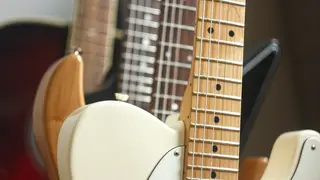
Why is the Fender Telecaster so ubiquitous in country music? Well the answer is actually pretty simple. It’s partly because it was such a popular guitar among the early country lead players. The other part is that it’s easy to pull great country tones out of.

You see, the Telecaster’s default state is a “twangy” guitar tone that’s very well suited to country. If you put a Tele into a clean amp and play a major lick, you’ve probably already got a sound that would work perfectly for any country song.
But the thing is, you don’t need a Telecaster to play country, it’s just the easiest way to go about it. If you have a single coil guitar and an amp with a great clean sound you can pull out a very workable country tone with a bit of work and careful adjustments to your picking technique.
You don’t have to buy a special guitar for country, and anyone who tells you that you do is misinformed. However, without a Tele-style guitar you may need to put in a bit of effort to get a good country tone.
Country Pedals, Amps, and Picks
When it comes to gear for country music, there’s no one right answer. However, there are a lot of good answers. We're not going to give specific recommendations (you can find a few of those those in the next section), but we will walk you through some of the things you should be looking for.
Pedals:
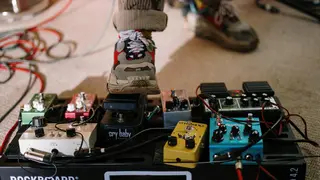
The guitar pedals for a country sound include a compressor pedal, an overdrive pedal, and a delay pedal.
The compressor will help smooth out your tone, as well as making sure you can get a consistent output while chicken pickin’. You don’t need to break the bank, just find something you like.
For your overdrive pedal, pick something that’s really easy to tweak. There are several different flavors to country overdrive and distortion, so you’ll need a versatile pedal.
As for delay, get the best one you can afford. You don't need to get the most advanced delay pedal in the world - after all, delay is an effect that needs to sound good at very subtle levels in country music - so the important thing is not to skimp on quality.
Amps:
When looking for the best guitar amp for country twang, you want something that handles cleans well. A lot of country music features either very clean or tastefully overdriven amps. Generally, you want something based on a Fender amplifier, though Vox would be pretty suitable as well.
But amps, like guitars, are a bit more subjective. One of the most important things of finding the right gear is keeping an open mind. Will the average guitarist use a cranked Marshall to play country? No, but with the right gear and the right technique, someone could easily be the exception to that rule.
Picks:
Your choice in guitar pick is probably one of the most important factors in getting the tone you want. Guitar picks have a drastic effect on the sound of your guitar, and the wrong pick can really hold you back.
Regardless of what genres you play - country, punk, blues, soul - it's not uncommon to have a unique set of guitar picks for each. You can carefully gauge which response, thickness, and tone is needed for each situation and choose a pick accordingly. It’s all about picking the right tool for the right job (pun fully intended).
When selecting a pick for country, you need to think about what complements your technique and gear the best. If you have a darker voiced guitar, you may need a brighter pick to compensate. Also, if you have trouble picking quickly, you may need to switch pick thickness. Country guitar is generally voiced brightly with a very snappy response, so getting that kind of tone should be your goal.
Thankfully, picks are cheap. We would strongly recommend grabbing a few different sets once you’ve finished reading this. The effect it has on your playing and tone will surprise you.
Gear Recommendations
We're not going to recommend really big things here. We’ve got specialty articles dedicated to that, and there’s no point in repeating ourselves. So instead this is going to focus on easy and (relatively) cheap ways to “country-fy” the rig you already have.
D’Addario EXL110 Nickel Wound Guitar Strings
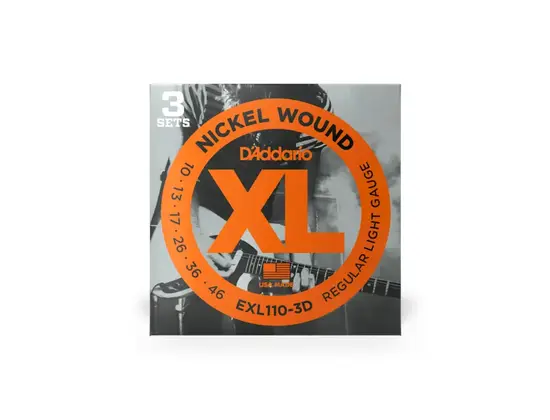
The choice of gigging guitarists the world over, D’Addario’s EXL110 Nickel Would Guitar Strings pose a great value to any musician. Manufactured in the U.S.A., every D’Addario string set ships in a corrosion resistant package, ensuring that the strings you buy will always arrive fresh. D’Addario strings are also made with a unique hex core, allowing the wire wrapping to grip tighter and last longer.
Why We Recommend This: D’Addario has a well deserved reputation for making great strings, and selling them at a very fair price. Aside from that, nickel strings have a very bright voicing and a lot of “snap” making them a cheap and easy way to get a bit closer to good country tone.
Squier Affinity Telecaster
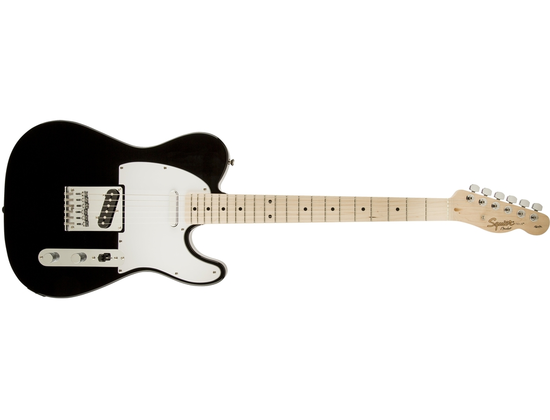
If you or a budding guitarist is on the hunt for a great instrument that won’t break the bank, look no further than the Squier Affinity Telecaster. Sporting an alder body with a gloss polyurethane finish, two Fender designed single coil pickups, and a six saddle top loading bridge, this Squier is more than capable of meeting whatever challenges you have to throw at it.
Why We Recommend This: Picking up a Squier Telecaster is a great way to see whether or not a Tele is a good fit for you. This one isn’t too expensive, and if you decide you want to move on to a better model it should retain a pretty good portion of its value. Most Squiers are also made out of decent wood, so it would also provide a pretty solid platform for modding should you decide to go that route.
Dunlop 12 Pick Variety Pack
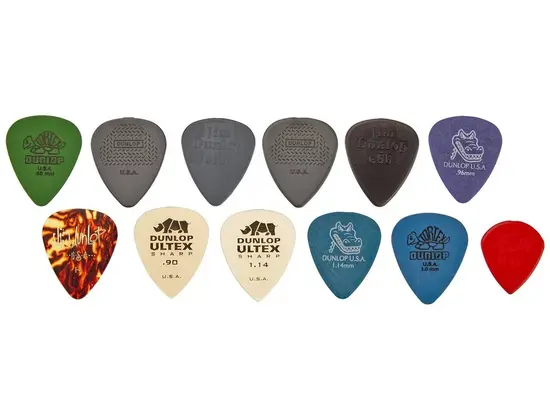
If you’ve always been curious as to which pick is the right choice for you, the Dunlop Variety pack is a great way to test out a variety of picks in several different materials and thicknesses. Made in the U.S.A., every Dunlop pick is made from high quality materials.
Why We Recommend This: One of the easiest and cheapest ways to tweak your tone and playing is to invest in a few different kinds of picks. This package fills that role admirably.
Like every genre, there’s a lot that goes into country guitar. We hope this article gives you enough information to start down the road of becoming a great country guitar player.
About the authors
Michael R. Pierce is the co-founder of Equipboard and a lifelong musician with over 25 years of experience as a guitarist and gear enthusiast. He blends solid music theory chops (thanks to formal training in guitar, piano, and trumpet) with real-world experience, always exploring and experimenting across genres like rock, blues, and hip-hop. Michael launched Equipboard in 2013 after graduating from The University of Texas at Austin, leveraging his unique blend of musical passion, technological acumen, and community building. His current go-to rig features a Fender American Original ‘50s Telecaster, Analogman King of Tone, Strymon Flint, and a Fender ‘57 Custom Champ. Read more
Giulio Chiarenza is the co-founder of Equipboard and a lifelong multi-instrumentalist with a deep passion for music gear. Born in Italy and raised in the U.S., he holds a Computer Science degree from The University of Texas at Austin and blends technical acumen with decades of hands-on experience across guitar, piano, drums, and electronic production. Early in his career, Giulio was signed to a San Francisco-based EDM label, releasing both remixes and original tracks. These days, he helps steer Equipboard’s vision while personally testing and reviewing gear. He's never too far from his go-to guitar: a vintage 1978 Fender Telecaster Custom. Read more