By Gear Experts
Table of Contents

Equipboard
Equipboard is the world's largest community of artists and their gear. Read our review process.
We are reader-supported. When you buy through links on our site, we may earn an affiliate commission. Learn more.
Our Picks

This compact pedal gets high marks for how simple it is to use, and its fantastic & very natural compression. This is one versatile pedal you won't regret adding to your setup.
Read more


It's a splurge, but this is one of the the best compressor pedals we've ever heard. The tilt EQ is fantastic for smoothing out your tone & the build quality is second to none.
Read more


As functional as it is good looking. It's impressively quiet even at high compression settings. Not the most budget priced, but if premium build quality and tone are important to you, don't overlook the Keeley.
Read more
MXR Dyna Comp clone does a remarkable job considering its budget friendly price. Best under $50.
Read more
Electro-Harmonix Nano Soul Preacher
Sub-$100 compressor pedal that sounds great and has an adjustable attack setting. Slightly noisy.
Read more
Extremely musical and transparent boutique compressor whose killer feature is the BLEND knob.
Read more
Transparent digital multiband compressor with a handy gain reduction meter.
Read more
TC Electronic HyperGravity Compressor
Insanely versatile digital compressor and perfect if you like to get your hands dirty with the TonePrint Editor and edit/create presets.
Read more-l.webp?v=1783609345)
Origin Effects Cali76 Compact Deluxe
About as close as you can get to vintage rackmount compressor goodness in a compact guitar pedal.
Read more


Going strong since 1976, the sub-$100 MXR Dyna Comp continues to be one of the best and easiest to use compressor pedals around. With its rugged enclosure it'll serve you well for decades. Best under $100.
Read moreWhat Does A Compressor Pedal Do?
Without getting too technical, compression normalizes the dynamic range of an instrument. So basically, it makes the output of your guitar more consistent. If you’re playing too quietly the pedal will boost the volume of your instrument, and if you’re playing too loudly it will dampen it. For instance, in live situations it can be a bit more difficult to control your dynamic range. It’s really easy to get a bit too pumped up and play your guitar louder than you should, drowning out the other members of your band. But with a compressor, you can set a control (generally called threshold) which will limit your output to a more reasonable level.
For guitarists, a compressor pedal is sort of a "secret weapon" type of effect. When talking about the most basic effects pedals a guitarist should own, it's easy to justify a tuner, and even easier to get excited about a much more tangible effect like overdrive, reverb, or delay. Compressor pedals are less understood, but those guitar players that know insist it should be one of the top 3 most necessary pedals on the pedalboard.
So the question is... why? It's because that aside from just evening out your playing dynamics (i.e. taming the notes you hit too loudly or too quietly), a compressor pedal can help you achieve more sustain on your clean signal; no overdrive pedal needed! Of course you can also use a compressor on an overdriven tone to still get a lot of sustain but use less overdrive. It’s one of the few ways that you can almost cheat as a guitar player! While the pedal shouldn’t be used as a crutch, it definitely can be.
Compressor pedals are used in all sorts of genres and styles of music, but they are particularly prevalent in country. This is likely because the sustained clean "twangy" tones almost make your electric guitar sound like a slide guitar. For you visual (and auditory) learners, this 4-minute video EFFECTS 101: Compressor by Roland is a great introduction.
What Should I Look For In A Compressor?
One of our Equipboard writers shared this story with us:
"Back when I was playing in an old-school country band, one of my mentors recommended I pick up a compressor. I was just getting into hybrid-picking (playing with both pick and fingers) and I didn’t quite have the hang of it yet. So, I drove down to my local Guitar Center to go and demo every compressor that I could get my hands on.
And in all honesty, I was actually kind of surprised by what I found. You see, pretty much every compressor pedal I tried actually worked out just fine. They all did a good job of taming the output of my hybrid picking, and I didn’t really notice any dramatic changes in the frequency response of the gear I was using.
However as I worked my way through more and more models, I started to notice a trend among the budget pedals. While the more expensive pedals had a pretty wide array of useable tones almost every one of the cheaper pedals I tried didn’t. The budget models might have done a pretty good job of adjusting the basic output, but they just didn’t handle the more intensive settings very well.
So what kind of compressor should you look for? I suppose that depends on what your needs are. If you’re looking for a pedal that will be able to tame the upper limits of your dynamic range almost any compressor should work for you. But if you’re looking for a compressor that’s a bit more flexible (for instance, if you use tapping) you’re going to have to invest a bit more."
Where Do You Put a Compressor Pedal in the Signal Chain?
There are two main contrasting opinions about where to place compression in a signal chain of effects pedals:
» Before Any Overdrive and Distortion Pedals
The most popular placement of compression is before dirt pedals. This makes sense because it ensures that a guitarist may switch between different guitars with different pickup outputs and retain consistent operation from everything after the compression in the signal chain. For this purpose, we recommend setting the level control higher with a lower compression ratio, a slower attack, and a longer release. This way, the individual tonal characteristics of different guitars remain audible, due to the lower compression ratio and slower attack. The higher level control and longer release control settings will ensure a more even amplitude through the rest of the signal chain.
» After Overdrive and Distortion Pedals
The other place in the signal chain where compressors are commonly found is directly following any dirt pedals. For this setup, we recommend setting the level control to cut the volume coming out of the drive pedals, setting the attack control at a medium setting, the release to be medium to slow, and the compression ratio higher. Fans of this setup use it for several reasons. First, it allows them to control the amount of drive from the pedals by using the volume knob on their guitar, but still retain the same overall volume due to the compressor. Second, by cutting the overall level of the signal, they can set the master volume of their amplifier slightly higher, which allows more current to flow through the power tubes providing a better bass response. Finally, the most important reason for doing this is to allow the player to use a compressed, easily mixable tone for rhythm playing, and a dynamic, cutting tone for lead playing. By switching off the compressor which has been set to cut the signal, players will get both a boost in volume and dynamic contrast, both ideal qualities for lead playing. Also, because many compressors clamp down on high frequencies, players may experience a brighter tone during solos, which makes their playing sit better in the mix with a full band.
Players may even want to combine these two uses of compression by using two compressors on their pedalboard. As always, when adding more pedals to a board, especially pedals that have an effect on the amplitude of the signal, background noise can become an issue. There are several ways to help this problem - using an isolated power supply, higher quality cables, and possibly a noise gate.
How We Tested Compressor Pedals
The results of a compressor pedal can vary depending on where it's placed in the signal chain, and what guitar and amp you're using. For these reasons, we tested our best compressor pedal shootout with most of the guitars and amps available to us - from headphones to tubes, from single coils to humbuckers.
When we talk about how each of these compressor pedals affects the tone, we mostly refer to the pedal as it sounds running into a clean amp. For the purpose of keeping things on a level playing field and not introducing too many variables and permutations, we think guitar > compressor > clean channel of amp is the best way to go about testing. We did not use a noise gate, so we were able to determine how noisy the compressor pedals get on their own.
You can read more about our review guidelines and testing rig here.
Xotic Effects SP Compressor
4.5 (181)
High marks for its simplicity, and its fantastic and very natural compression.





Average Price: $167
Standard/Professional
$50
$201+
Budget
Standard
High-end
- Compact size, suitable for pedalboards with limited space
- Blend knob allows control over the mix of dry and compressed signal
- Versatile, with internal dip switches for further tone shaping
- Solid build quality
- See 6 more
- High compression settings can introduce noise
- Some controls are internal, making on-the-fly adjustments difficult
- May emit a loud pop when engaging the compressor
- Not ideal for users who prefer external control over all parameters
- See 1 more
| Bypass | true bypass |
| Analog/Digital | analog |
| Power | 9V |
Like countless guitarists before us, we were pretty blown away by the Xotic Effects SP Compressor. This pedal delivers a lot in a very small package.
This is a small form-factor compressor pedal with a footswitch, two large knobs, and a tiny toggle switch. The Xotic SP is pretty beautiful to behold, and built very solid. It has the feel and heft of a boutique pedal. The green LED lights up bright and looks great against the colors of the pedal. But beauty is only skin deep, and luckily the SP has the personality to match.
Operation of the pedal is simple and straightforward. Save for maybe the MXR Dyna Comp, the Xotic SP has the simplest interface of all the other compressor pedals on this list. The toggle switch is responsible for amount of compression - low, mid, or high. After you’ve set that, the BLEND knob lets you dial in how much compressed signal you want blended with the dry input. And finally, set your VOLUME knob to maintain unity volume when you kick the compressor on, or you can use it boost your signal for solos... and ta-da, that’s it, you’re now in a world of compressed goodness.
Aside from its no-nonsense usability, where the Xotic Effects SP Compressor truly shines is how it sounds. The sound quality is absolutely sublime, particularly for a pedal at this price point. It’s very transparent, and the amount of noise is extremely low.
No piece of gear is flat out perfect, so here are some of the potential downsides of the SP. For starters, while its small size may allow you to fit more pedals on your pedalboard, it’s not the sturdiest pedal. The weight of your cables is enough to tip it over, so we recommend you secure it to your pedalboard.
Also, hidden inside are four dip switches to further customize your sound - fast/slow attack and release, and low and high cut for frequencies which you can utilize to brighten or darken the tone. It’s fantastic that this much control exists inside of this small pedal, but some people might not love the fact that they have to crack it open to adjust these parameters. Still, we feel like it’s better to have these controls hidden than not have them at all. Finally, while the price is great per what you get, it still might be stretching the budget of some guitarists. It’s not the best bang for the buck, but it is certainly close.
Bottom Line: Xotic Effects really outdid themselves with the SP Compressor pedal. Considering its simplicity of use, fantastic sound, and versatility, you simply won’t find much else out there in this price range. If you’re looking for a compressor that colors your sound you might want to look at something else, but for a transparent compressor pedal this is an amazing little package.
See how artists use this




Diamond CPR1 Compressor
4.5 (27)
The EQ is fantastic for smoothing out your tone, and the build quality is second to none.

- Enhances tone without overwhelming original sound
- Serves as an always-on effect, subtly improving tone
- Offers clean boost with tube or aural exciter vibes
- Features a versatile EQ for tone shaping
- See 4 more
- Switch pops loudly when toggling on/off
- May not provide enough compression for those seeking a "squashed" sound
| Bypass | true bypass |
| Analog/Digital | analog |
| Power | 9V |
Diamond is known for making very solid, great sounding pedals with spartan aesthetics and solid colors, and the Diamond Compressor is no exception. This is a true bypass pedal do it won’t affect the signal of your guitar when it’s switched off... but we liked this compressor so much we never wanted to turn it off! For the tone nerd in you, the Diamond Compressor uses an optical isolator for its compression, which is the same type of circuit found in high-end studio rackmount compressors. That higher price tag is beginning to make a little more sense...
The fit and finish is fantastic, it just feels like it’s great quality and durable, and it has a very no-nonsense layout. You've got three knobs - COMP which is the amount of compression, EQ, and VOLUME. The LED light lights up green when the pedal is on, and flashes when gain reduction is being applied to your signal - a very neat indicator that this pedal is doing work.
So, getting right down to it, the Diamond Compressor sounds extremely nice. It simply has this musical quality to it, does not overly “squash” your sound even at more extreme settings, and there’s just a clarity to it that has to be heard to be believed. We tested it out with a variety of guitars, and everything from the pick attack, to the wonderful sustain, to the decay of notes sounded wonderful. Subtle and transparent is how we'd describe it, though don’t let that fool you; if you crank the COMP knob up the effect can be much more in-your-face (but still very smooth). The Diamond Compressor truly does nothing but improve your tone.
Even on minimum compression settings (COMP knob rolled all the way back) it adds nice clarity and a smooth compression to your tone, which makes a great case for keeping this pedal on all the time.
The EQ knob is particularly nice. It’s a “tilt” EQ, meaning that it’s flat at 12 o’clock, rolling it to the left decreases the highs and boosts the lows, and rolling it right does the opposite. It’s really quite fantastic for smoothing out your tone and fixing any imbalances in your signal chain. The VOLUME knob works great too and has plenty of volume on tap.
As far as the cons go, the attack and release of the compression are not adjustable. Also, there are a couple switches which you have to access inside of the pedal - one removes the EQ completely from the compressor, and one adds a 4.8 kHz cutoff which can help clean things up if you use the Diamond Compressor alongside a distortion pedal. And of course there’s that matter of the hefty price tag.
Bottom Line: Sonically, this is one of the best compressor pedals we’ve had the pleasure of testing out, even edging out the Xotic SP in terms of clarity. Its price tag is really the Achilles heel here. Guitarist Johnny Marr says this about it:
There’s also the Diamond Compressor that’s important to my sound. It really works with my Jag. It’s the best.
That’s pretty high praise from Mr. Marr. If you can afford to splurge on your compressor, we definitely recommend looking very closely at the Diamond.
See how artists use this

.jpg)







Keeley C4 Compressor
4.5 (56)
Impressively quiet even at high compression settings.

- Preserves original instrument's frequency spectrum while taming dynamics
- Transparent sound, does not color tone
- Four knobs allow detailed tone shaping
- Solid build quality
- See 6 more
- Controls may not be intuitive for all users
- Possible reliability issues with older units (e.g., loose input/output jack screws, scratchy pots)
- Clipping knob may darken tone for some setups
| Bypass | true bypass |
| Analog/Digital | analog |
| Power | 9V |
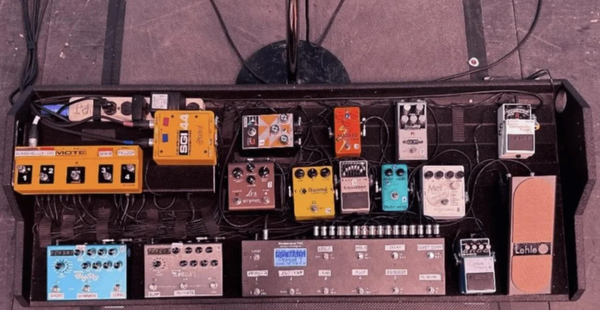
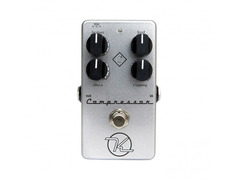
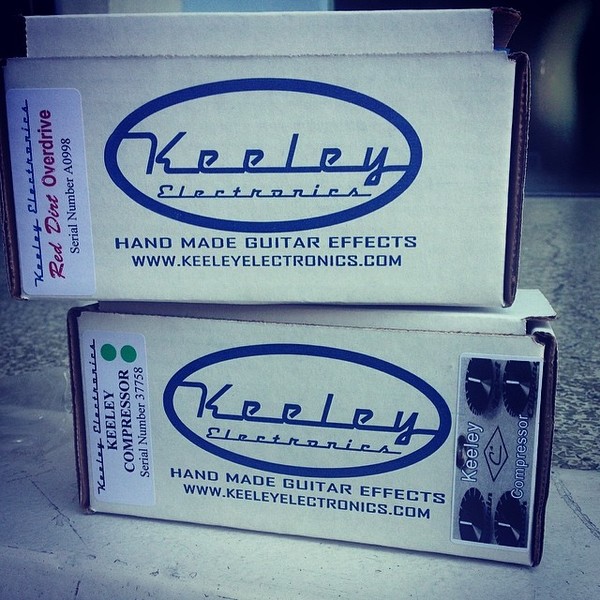
The Keeley 4 Knob Compressor is the big brother to the Keeley 2-knob; they are sonically identical, except the 4 Knob version adds more control with the attack speed and clipping knobs. Keeley has made a name for itself making some fantastic pedals and pedal modifications, and their compressor offering lives up to the brand’s reputation.
The thing feels like it could withstand some serious abuse, and we dig its attractive design. For the control freaks, you’ve got - yep, you guessed it - four knobs to play with: Sustain, Level, Attack, and Clipping. The latter two are knobs that not all guitar compressor pedals have, and oftentimes exist as switches on the inside of the pedal. The fact that they are readily accessible knobs on the front of this unit is definitely one of the selling points.
The Sustain knob sets the amount of compression, the Level knob is the volume, the Attack knob controls how quickly the compression happens, and the Clipping knob clips the input so you can adjust the signal before it gets to the compressor, which is handy if you plug in various guitars or other instruments into this pedal.
The most stand-out aspect of the Keeley 4 Knob Compressor is how quiet it is, especially at higher compression settings. The sustain you get sings for days, and yet it still has a very clean and musical sound, not too much unlike the Diamond Compressor. Sustain aside, with the four knobs we could really spend some time fine tuning it, to achieve a very subtle compression. We can see the Attack knob coming in handy to adjust for various styles of picking. If for any reason you don’t want to always keep this pedal on, rest easy knowing it’s true bypass and will leave your tone unaltered. We really like the Level knob as well, since with a pedal of this caliber with such low noise, it makes for a great clean boost, regardless of how much compression you have dialed in.
Bottom Line: There’s really not much to dislike here, aside from the steep price tag. It’s justifiable, though; this is definitely not your beginner budget compressor. Between this or the Diamond, we say go for the Keeley if the Attack and Clipping knobs are important for you to have handy on the front of the pedal. And in case it helps you with making a decision, Neon Trees guitarist Chris Allen favors the Keeley 4 Knob. Whichever you choose, if you’ve got the cash for it, the Keeley 4 Knob will cover all your compression and clean boost needs with astounding results.
See how artists use this







Joyo JF-10 Dyna Compressor
4.0 (79)
The Dyna Compressor does a remarkable job considering its budget friendly price.



- Quiet operation, great for bass single note lines
- Adds sweet, sustained compression without squashing the tone
- Distinctive, visually appealing scorpion graphic on a green metal box
- Enhances signal strength without altering the general sound
- See 5 more
- Some users report minimal noticeable compression effect
- May boost signal instead of compressing for some setups
- Low ratio, speed, and output unless sustain is maximized
- On/off switch operation can be hard and loud
- See 3 more
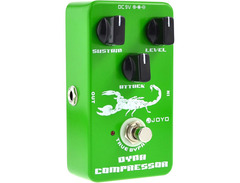
It's hard to have a discussion about the ”best cheap compressor pedal” without talking about the Joyo JF-10 Dyna Compressor. Not everyone can (or should) spend $100+ on a pedal, so it's nice to have an option like this one.
At its heart this pedal is a clone of the well-known MXR Dyna Comp, but you probably could have guessed that due to its name (though some people claim it’s a clone of the MXR M-132 Super Comp). Handling the pedal, we noted it's not quite as solid in the fit and finish department as other higher-end offerings (unsurprising given the price). Aesthetics are subjective, but for us this one elicits a bit of a “meh” - it’s not ugly, but we don’t love the green color and the scorpion design feels arbitrary.
The Joyo JF-10 offers three familiar knobs - SUSTAIN, LEVEL, and ATTACK. SUSTAIN is amount of compression, LEVEL is the output volume, and ATTACK is how quickly after you hit a note the compression kicks in. The inclusion of the ATTACK knob is nice. Tweak the knobs and the Joyo JF-10 respond well - surprisingly well, actually. This thing definitely over-delivers in the tone department. While not quite as pristine and quiet as the Xotic SP, Diamond, or Keeley, it still is nowhere near cheap sounding.
The Joyo doesn’t have as much character as the MXR Dyna Comp, and it’s more subtle - this is perhaps favorable if you’re looking for an always-on compressor pedal.
Bottom Line: The price/performance ratio of the Joyo JF-10 Dyna-Compressor is outstanding; for the price, it just can’t be beat. Our suggestion is to go for the Joyo if you’re new to guitar pedals, aren’t convinced if a compressor is something you need, or you simply need some subtle compression without adversely affecting your tone and don’t want to drop $100+ on one.
See how artists use this


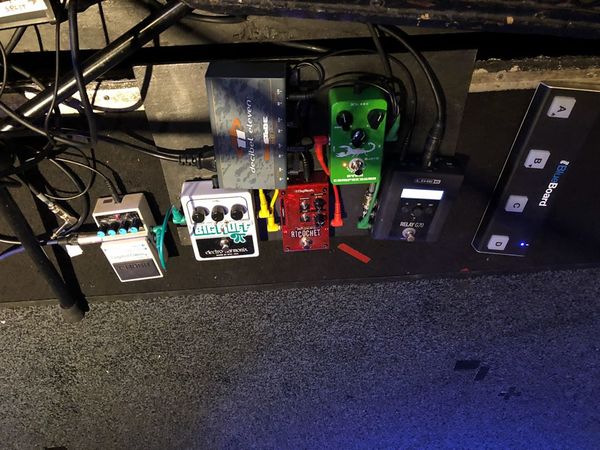

.jpg)




Electro-Harmonix Nano Soul Preacher
4.5 (19)
Nice sounding sub-$100 compressor pedal with a convenient attack toggle.





Average Price: $89
Standard/Professional
$50
$201+
Budget
Standard
High-end
- Excellent sustain enhancement for guitar tones
- Compressor feature adds versatility beyond sustain
- Compatible with a variety of instruments, including keyboards
- Can make inexpensive guitars sound appreciably better
- See 4 more
- Can be noisy at high volume levels
- Might feel invasive or too strong at lower settings
- Factory settings may require adjustment for optimal sound
- Not perceived as ideal for recording sessions by some users
| Bypass | true bypass |
| Analog/Digital | analog |
| Power | 9V |
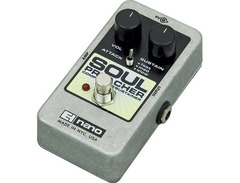
The EHX Soul Preacher is one of the nicest compressor pedals around without crossing over into the boutique pedal world.
It's an Electro-Harmonix pedal, so you know you're getting legendary quality and reliability. The enclosure is "nano" sized so it's pedalboard friendly. The design and build quality is on par with any other EHX pedal.
The controls are dead simple - you've got VOLUME, SUSTAIN which is the amount of compression, and a 3-way ATTACK toggle switch (fast/med/slow) which determines how quickly the compression kicks in to squash your signal.
Depending on what guitar we used, we found unity gain to be somewhere between 8 and 11 o'clock, which means you have some volume on tap. This can crunch things up a bit as you crank the volume up, as the manual says:
The preamp does add some distortion and the amount is level dependent... humbuckers and high output single coil pickups will distort much more than normal single coil guitar pickups. This distortion can be controlled somewhat from the guitar’s volume level ahead of the compressor.
Like many compressor pedals, the Soul Preacher can be noisy/hissy as you turn it up. Luckily, the compression does its job beautifully. It evens and thickens up your tone very nicely. We like it with the ATTACK in the medium setting, which preserves the initial bite of whatever you're playing.
Bottom Line: Electro-Harmonix comes through with a very nice sounding compressor in a convenient form factor and a very reasonable price point. Both the Soul Preacher and MXR Dyna Comp are great for their price point, but the Soul Preacher's main advantage is being able to set the attack.
See how artists use this




Wampler Ego Compressor
4.5 (52)
A boutique compressor pedal with a lot of flexibility.

Average Price: $166
Standard/Professional
$50
$201+
Budget
Standard
High-end
- Adds color and fullness to the sound
- Versatile control over compression effects
- Blend knob allows retention of attack and dynamics
- Tone knob restores lost highs, enhancing clarity
- See 6 more
- Requires battery removal if using a power supply to avoid mess
- Some may find the tone knob adjustments subtle
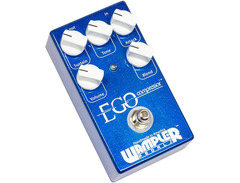
The Wampler Ego Compressor is an extremely musical transparent compressor that allows you to dial in the perfect amount of compression with its BLEND knob. Once you hear the effect it has on your tone, you won't ever want to turn the pedal off.
Brian Wampler and his team make boutique pedals, and the Ego Compressor looks and feels the part. It has a standard stompbox-size enclosure, it's true bypass, can run anywhere between 9-18V (more voltage gives it more headroom), and has a beautiful blue sparkle finish. It's certainly the prettiest compressor pedal we've played with.
Three of the five knobs are familiar - you've got VOLUME, SUSTAIN for the amount of compression, and ATTACK to determine how quickly the compressor kicks in to squash your signal.
The TONE knob lets you re-introduce any top end sparkle that may have gotten lost as you dial up the compression amount. All the way to the left it doesn't affect your signal, and all the way to the right it's quite bright and jangly. We found it sounds best kept at or under 12 o'clock.
The BLEND knob is what makes the Wampler Ego stand out. Think of it like a wet/dry mixer. The manual explains that "the signals are in parallel inside the pedal before mixing down to mono at the output." The BLEND knob is brilliant because it lets you keep the Ego always on, with just a subtle hint of compression to smooth our your playing at all times.
Bottom Line: Once you understand what all the knobs do and how they interact, like us you'll realize how indispensable the Ego Compressor is. Whether you just want a subtle always-on smoothness or you're a chicken-pickin' maniac, the Wampler Ego will impress you... provided you can stomach its high price tag.
See how artists use this

.jpg)



.jpg)



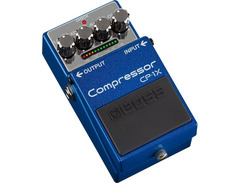
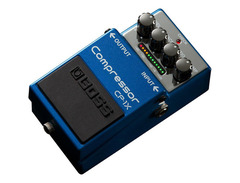
Boss CP-1X Compressor
5.0 (15)
Transparent digital multiband compressor with a handy gain reduction meter.

Average Price: $154
Standard/Professional
$50
$201+
Budget
Standard
High-end
- Exceptional clarity and noise-free operation
- Functions like a studio compressor, versatile compression range
- Maintains tonal output and string balance
- Effective with both subtle compression and squashed tones
- See 6 more
- Lacks the harmonic overtone sweetness of some analog compressors
- Slight omission of a dry mix function for natural feel
- Chrome knobs may require modifications for visibility
| Bypass | buffered bypass |
| Analog/Digital | digital |
| Power | 9V |
The Boss CP-1X Compressor is interesting in that it is a digital multiband compressor in a Boss stompbox format convenient for guitarists.
The key to this pedal is that it utilizes MDP (Multi-Dimensional Processing) to analyze all the nuances of whatever you're playing and deliver the appropriate compression to each EQ band, hence multi-band compression. It's not something you have detailed control over as it happens behind the scenes, but luckily it works very well.
What you do have control over are 4 very familiar compressor parameters: LEVEL, ATTACK, RATIO, and COMP. The Boss CP-1X is very transparent and doesn't color your tone, and also doesn't introduce much noise.
The CP-1X requires 9V of power, and internally it doubles it to 18V for more headroom, so that it has no problem handling signals from hot pickups.
One of the best parts of the Boss CP-1X Compressor is the gain reduction indicator, which shows you how much compression is being applied.
Bottom Line: The CP-1X is a solid workhorse, and thanks to its digital processing provides an advanced level of compression as compared to the vast majority of compressor stompboxes. If you want studio quality compression in a guitar pedal, the Boss CP-1X Compressor should make your list.
See how artists use this






.jpg)


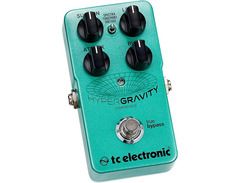
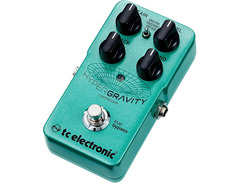
TC Electronic HyperGravity Compressor
4.5 (48)
Insanely versatile digital compressor and perfect if you like to get your hands dirty with the TonePrint Editor and edit/create presets.

Average Price: $107
Standard/Professional
$50
$201+
Budget
Standard
High-end
- Extensive control over parameters with TonePrint software
- Multiband compression reduces noise and offers natural sound
- Blend control allows mixing uncompressed signal for transparency
- Vintage and Spectra settings provide tonal versatility
- See 6 more
- Some units may have a defective "Beam" function
- Spectra setting can introduce a hiss not alleviated by noise gates
- TonePrint editor complex and not intuitive for all users
- Default modes may not satisfy all, requiring deep editing for perfection
- See 6 more
| Bypass | true bypass, buffered bypass |
| Power | 9V |
There are guitarists who want to set their compression settings once and be done with it, and guitarists who want to tweak infinitely. The TC Electronic HyperGravity compressor pedal is for the latter group.
This is a multiband digital compressor, and it's insanely versatile. It's built very well and an internal switch lets you choose between buffered or true bypass.
It has two built-in modes selectable via a toggle switch - VINTAGE mode adds a classic squashed character to your tone, and SPECTRA mode is very transparent.
The controls on the pedal are familiar. SUSTAIN, ATTACK, and LEVEL perform the same function as on most compressor pedals, and BLEND is like on the Xotic SP and Wampler Ego, where you can dial in a blend of the original uncompressed and compressed signals to keep some of your dynamics intact.
The third mode, TONEPRINT, is what makes this pedal truly special. Using a USB connection to your Mac or PC, or wirelessly through your iPhone, you can load in one of dozens of TonePrint presets which model a variety of classic and modern compressor types.
Using the TonePrint app on your computer or iPad, you can modify presets or create your own, and there are dozens if not hundreds of parameters to tweak! You can also play your guitar as you're tweaking to hear the results in real time. If you know your way around compressor parameters you will LOVE this.
Bottom Line: TC Electronic yet again took a classic effect and made it super versatile. For all it can do the price is more than fair. If you're a "set it and forget it" compressor user, we would skip the HyperGravity in favor of something simpler. However if the idea of infinitely tweaking a library of different compressor presets excites you, this is the pedal for you.
See how artists use this


.jpg)

.jpg)





Origin Effects Cali76 Compact Deluxe
5.0 (43)
About as close as you can get to vintage rackmount compressor goodness in a compact guitar pedal.
-s.webp?v=1783609345)


- Drastically improves overall sound, tone, punch, and articulation
- Offers warm, rich sound adding "meat" to tone
- Exceptional customer service from Origin Effects
- Versatile; effective for a range of playing styles and techniques
- See 6 more
- Requires 18v for optimal performance, potentially needing additional power supply
- Can raise noise level as it boosts signal
- Slightly larger than a normal stompbox, may be tight on some pedalboards
| Bypass | buffered bypass |
| Analog/Digital | analog |
| Power | 9V, 12V, 18V |
| Current Draw | 77ma @ 9v, 104ma @ 18v |
A premium guitar compressor pedal if there ever was one, the Origin Effects Cali76 Compact Deluxe has a circuitry that mimics that of the classic UREI 1176 FET compressor. Its high price tag is tough to stomach, but if you can get your hands on one you'll see why it's so beloved.
The chassis is heavy, solid, metallic, and beautiful. The brushed aluminum knobs are a pleasure to turn, and the jewel light looks straight from a Fender amp. The light is red by default, and turns orange and yellow when more and more compression is achieved (minor complaint but we wish it was the reverse of that).
The pedal can run at 9-18V, and 18V is recommended to get the most headroom out of it. If you're spending this much money, make sure you run it at 18V.
The Cali76's six knobs are definitely on the high end of what you would find on a guitar compressor pedal. They're all normal compressor parameters. It's interesting to have an IN knob to set how hard you want to drive the front of the compressor, and the DRY knob enables parallel compression with the wet & dry signal simultaneously.
The compressed sound itself sounds beautiful. It adds plenty of warmth and sustain, and sounds as good if not better than other premium options we've heard from Empress, Diamond, Keeley, and Wampler. It also has extremely low noise on its own, even when cranked pretty high.
Bottom Line: The Cali76 incorporates the best features of other guitar compressor pedals, adds warmth, thickness, and clarity to your tone in spades, and is very tweakable thanks to its six knobs. The worst thing about it is its price tag, but unfortunately that's the cost of this type of quality.
See how artists use this








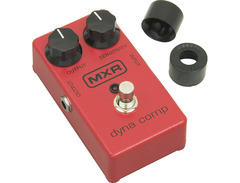
MXR M102 Dyna Comp
4.5 (338)
A legendary compressor pedal that adds character to your tone.



Average Price: $90
Standard/Professional
$50
$201+
Budget
Standard
High-end
- Adds significant sustain, useful for solos
- Boosts volume for leads effectively
- Simple to use with minimal controls
- Enhances clean tones remarkably well
- See 6 more
- Lacks an attack control for more nuanced dynamics
- May not be compatible with all fuzz pedals
- Might be too simple for those seeking more control
- Introduces noise, especially through dirty amps
- See 6 more
| Analog/Digital | analog |
| Power | 9V |
| Current Draw | 3.3ma |
The MXR M102 Dyna Comp is a ubiquitous compressor pedal; it originally came out in 1976 and continues to go strong today. When it comes to value for the money, the Dyna Comp hits quite the sweet spot, but it definitely has its quirks! Let’s dig in.
This little red box looks and feels fantastic. It’s an MXR pedal after all, so there’s a certain standard of quality and durability you know you’re going to get from it. With only two large knobs to worry about, the Dyna Comp couldn't be much easier to use. You’ve got OUTPUT on the left which is just the output volume, and SENSITIVITY on the right, which is yet another way of saying amount of compression. Like other MXR pedals, we love the fact that it comes with fat rubber caps that go over the knobs, to ease adjusting them with your feet as you’re playing live, if you’re so inclined. Also, it’s true bypass, so expect zero coloration of your signal when you have it switched off.
The MXR Dyna Comp compresses beautifully, but it has more tonal character than the other pedals on this list. As you crank the SENSITIVITY knob past 3 o’clock the Dyna Comp gives you a very “squished” sound, which is a term a lot of people use to describe a sound that has been so compressed it loses most of its dynamic range. All compressor pedals do this, but the MXR has its own little nuances. It’s also worth mentioning that with the OUTPUT knob cranked all the way to the right and the SENSITIVITY all the way down this box gives you a nice clean boost, albeit one that colors your tone ever so slightly.
At high compression settings you can expect it to be a bit noisy, though increased noise is something to be expected from any compressor. Depending on your needs, another downside of the MXR Dyna Comp is the omission of an Attack knob.
Bottom Line: This classic pedal from MXR has found a home on countless pedalboards, for good reason. Looking at our Equipboard data we can see it’s the compressor pedal of choice of Caleb Followill of Kings of Leon, Green Day’s Billie Joe Armstrong, Two Door Cinema Club’s Sam Halliday, and Noel Gallagher, all of whom have very different playing styles which speaks to the versatility of the Dyna Comp. It’s not the most transparent guitar compressor pedal out there in that there is a slight coloration of tone, but its sub-$100 price tag and pleasant compressed tone give it plenty of staying power.
See how artists use this




.png?v=1783563118)

Top Ranked Compressor Effects Pedals on Equipboard
-m.webp?v=1783609345)


About the authors
Michael R. Pierce is the co-founder of Equipboard and a lifelong musician with over 25 years of experience as a guitarist and gear enthusiast. He blends solid music theory chops (thanks to formal training in guitar, piano, and trumpet) with real-world experience, always exploring and experimenting across genres like rock, blues, and hip-hop. Michael launched Equipboard in 2013 after graduating from The University of Texas at Austin, leveraging his unique blend of musical passion, technological acumen, and community building. His current go-to rig features a Fender American Original ‘50s Telecaster, Analogman King of Tone, Strymon Flint, and a Fender ‘57 Custom Champ. Read more
Giulio Chiarenza is the co-founder of Equipboard and a lifelong multi-instrumentalist with a deep passion for music gear. Born in Italy and raised in the U.S., he holds a Computer Science degree from The University of Texas at Austin and blends technical acumen with decades of hands-on experience across guitar, piano, drums, and electronic production. Early in his career, Giulio was signed to a San Francisco-based EDM label, releasing both remixes and original tracks. These days, he helps steer Equipboard’s vision while personally testing and reviewing gear. He's never too far from his go-to guitar: a vintage 1978 Fender Telecaster Custom. Read more
Comments
Sign Up or Log In to add comments

838
Love the Xotic SP Compressor. I recommend it to everyone.

62
Thanks for a great run down here on these compressors. I'm currently looking for the very best compressor and am surprised that the Carl Martin, Barber Tone Press and Wampler Ego didn't make this list based on the fact that So many players rate these three amongst the very best!?. I'm not looking for country "squish", I want transparency, warmth, smoothness, etc. Any thoughts anyone?. PS Fantastic website here! Thank you.
New in Compressor Effects Pedals


$171.00 - $179.00

$99.95 - $149.97
in Compressor Effects Pedals Rank


.jpg)


.jpg)