Analog vs Digital Delay | Oscillation & Hold Explained


By Gear Experts
By Gear Experts
Table of Contents

Equipboard
Equipboard is the world's largest community of artists and their gear. Read our review process.
We are reader-supported. When you buy through links on our site, we may earn an affiliate commission. Learn more.
The battle between analog delays and digital delays has been raging for decades now. I have summarized the argument as briefly and inaccurately as possible in the following flow chart. My contribution to the argument is in purple.
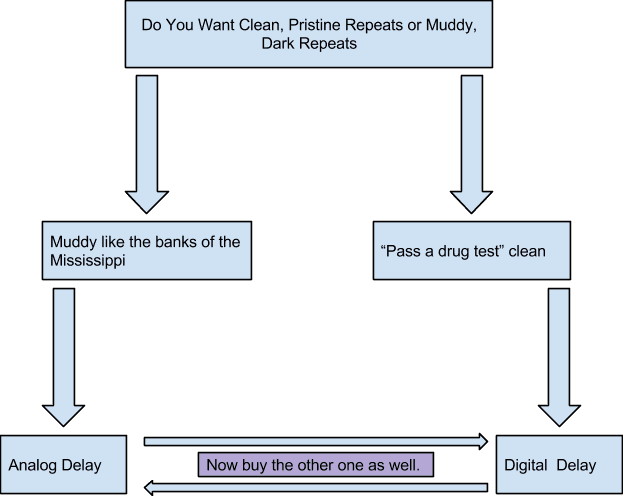
This ground has been tread a number of times. The grass is dead, and it is starting to get really dusty. To prevent any respiratory issues I’m going to travel to a green pasture of weirdness.
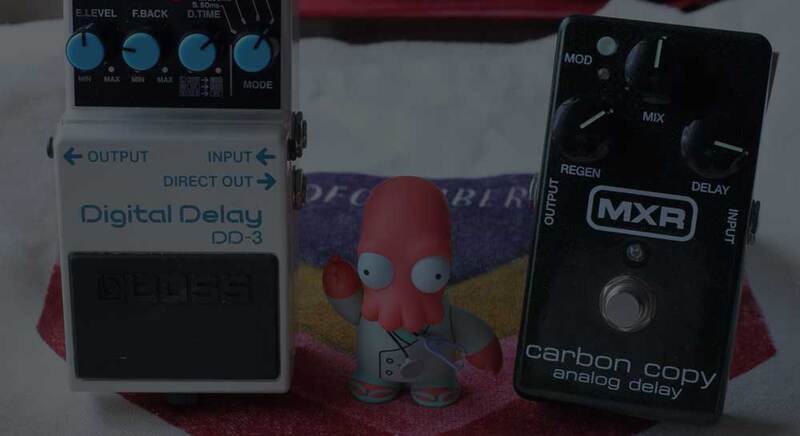
There are A LOT of delay pedals out there, from simple three knob analog delays up to an 8 knob, 12 mode, 3 footswitch digital foot-computers. I am going to experiment with two entry-level delay pedals. Say hello to the Boss DD-3 (digital) and MXR Carbon Copy (analog), each can be found on the used market for $100 or less.
Analog delays that use BBD (bucket-brigade device) can often self-oscillate at higher repeat settings. The result is loud and chaotic repetition and degradation of the guitar signal. Digital delay pedals make a digital copy of your signal, which also allow them to loop your playing. The DD-3 has a hold feature that can capture a moment and then repeat it. We’ll see what nonsense these pedals can create on their own, or gasp even together? A T.C. Electronic Ditto is used to loop the oscillation and hold sounds, this increases the utility of these often weird, and commonly unpleasant sounds.
We will start with the Carbon Copy on the edge of self-oscillation and then dive in.
I hope you have found this video both informative and distressing. Both delays can produce some incredible textures. My favorite usage for both these pedals is to create a melodic passage that can repeat and function as backing rhythm. I then use that as a base for additional looping, re-sampling and melody. When you dig deep into these pedals there's so much more to offer than just the tone of the repeats. There’s glitchy, alien, destructive, abrasive and beautiful sounds under the hood. The green pastures of weird await your arrival.
Top Ranked Delay Effects Pedals on Equipboard
-m.webp?v=1784905089)


About the authors
Michael R. Pierce is the co-founder of Equipboard and a lifelong musician with over 25 years of experience as a guitarist and gear enthusiast. He blends solid music theory chops (thanks to formal training in guitar, piano, and trumpet) with real-world experience, always exploring and experimenting across genres like rock, blues, and hip-hop. Michael launched Equipboard in 2013 after graduating from The University of Texas at Austin, leveraging his unique blend of musical passion, technological acumen, and community building. His current go-to rig features a Fender American Original ‘50s Telecaster, Analogman King of Tone, Strymon Flint, and a Fender ‘57 Custom Champ. Read more
Giulio Chiarenza is the co-founder of Equipboard and a lifelong multi-instrumentalist with a deep passion for music gear. Born in Italy and raised in the U.S., he holds a Computer Science degree from The University of Texas at Austin and blends technical acumen with decades of hands-on experience across guitar, piano, drums, and electronic production. Early in his career, Giulio was signed to a San Francisco-based EDM label, releasing both remixes and original tracks. These days, he helps steer Equipboard’s vision while personally testing and reviewing gear. He's never too far from his go-to guitar: a vintage 1978 Fender Telecaster Custom. Read more
New in Delay Pedals


$259.00 - $288.00


$203.00 - $249.00


$133.00 - $241.99


.jpg)



.jpg)

.jpg)