By Gear Experts
Table of Contents

Equipboard
Equipboard is the world's largest community of artists and their gear. Read our review process.
We are reader-supported. When you buy through links on our site, we may earn an affiliate commission. Learn more.
Our Picks

The Mini Deja-Vibe is the most recommended modern vibe pedal available today, and is very true to the 1960s original. It's well-built and easy to use, and can be as subtle or as present as you desire thanks to the VINTAGE/MODERN toggle. Best of the Best
Read more


EarthQuaker Devices The Depths V2
A boutique vibe pedal unlike any other. While it can conjure up Hendrix, Trower and Gilmour, its beauty lies in its ability to get much more intense and crazy. If you want something more like the original Uni-Vibe, the Fulltone Mini Deja-Vibe is the better choice. For a more flexible and unique vibe, this is it.
Read more


The Viscous Vibe is digital, so tone purists dock some points for not sounding as warm as its analog peers. On the plus side, it sounds pretty convincing, and you get the flexibility of TonePrint technology. If you're into tweaking & editing, Viscous Vibe can't be beat (the budget-friendly price tag helps).
Read more

It's not often a budget-priced pedal nails build quality, usability & sound like the Shaky Jimi does. It sounds like a proper vibe pedal should, and has a great range. The only thing we can really knock it for is that it doesn't have a "boutique feel," but then again that's why the price is so good! Best Bang for Your Buck
Read more
Voodoo Lab Micro Vibe has managed to recreate the circuit of the vintage original with the Micro Vibe. There's beauty in its simplicity with only two knobs to adjust. It has some slight tone coloration and we wish the SPEED knob could go faster, but it's still a great alternative to the Fulltone Mini Deja-Vibe.
Read moreIf you’ve listened to Jimi Hendrix or Pink Floyd, chances are you’ve already been graced by the sweet sound of a Uni-Vibe pedal. It’s a lesser known effect, and many guitarists and bassists are confused as to what exactly a vibe/rotary speaker pedal is and does. Is it a chorus? Is it a vibrato? Both? Neither? In this guide, we’ll cover what a Uni-Vibe pedal is, what types of guitar players use it, and we’ll list some of the most highly recommended modern vibe pedals available today.
What the Heck is Uni-Vibe, Anyway?
Uni-Vibe is the name of an effect you don’t even realize you need in your life until you hear it! Jokes aside, it truly is a fantastic effect that’s an interesting blend of a few effects you might be more familiar with.
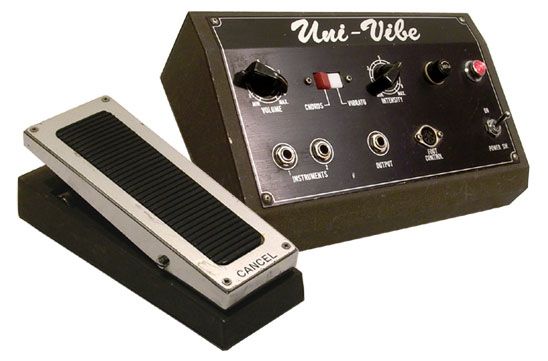
The inception of the Uni-Vibe is a bit of a happy accident. In 1968, a Japanese company by the name of Shin-Ei was attempting to capture the sound of a rotating Leslie speaker cabinet (i.e. the “doppler” sound), in pedal form. The experiment failed, but the result was such a unique effect that it caught on with guitarists. If you’re interested in the internal circuitry of a Uni-Vibe, we recommend this article.
In terms of how it sounds, it’s a beautiful combination of chorus, flanger, phaser, and vibrato. However, those four effects separately or together cannot quite replicate what a Uni-Vibe can do. Jimi Hendrix became particularly fond of the effect and is probably its most notable user. His song Machine Gun is a fantastic showcase of the original effect in action:
David Gilmour of Pink Floyd also used a Uni-Vibe heavily, though he employed it as a more subtle effect (listen to Gilmour’s swirling guitar tone on the Pink Floyd song Breathe). English guitarist Robin Trower is another notable user. Today, getting your hands on the original long-discontinued Shin-Ei Uni-Vibe would set you back several $1000s. Luckily, many pedal manufacturers have realized the importance of this pedal and guitarists’ affinity for it, and have managed to recreate it with a much more affordable price tag.
Uni-Vibe and gain effects go hand-in-hand nicely. Perhaps popularized by Hendrix, pairing a vibe pedal with fuzz is a particularly choice combination. It’s typically recommended to place your Uni-Vibe before your dirt pedals, though obviously we encourage that you experiment with your specific rig.
What To Look For in a Uni-Vibe Pedal
There are definitely less Uni-Vibes out there than more mainstream effects like delay or distortion. Still, there are enough Uni-Vibes out there where selecting the right one for you can be confusing. There are two main schools of thought for pedal manufacturers making Uni-Vibes - the first being attempting to recreate the original Shin-Ei Uni-Vibe circuit as accurately as possible, and the second being creating a more modern and versatile interpretation, while still keeping the “soul” of the original intact. The direction you go is completely up to you and your style of playing.
Analog vs. digital is something else to consider. Analog pedals tend to be praised for their warm vintage vibes, while digital pedals can be a little bit harsher, but generally offer more versatility. You’ll find both types of Uni-Vibe interpretations out there.
And finally, as with any other pedal you would consider purchasing, the build quality, manufacturer’s reputation, pedal size, and of course price should always be kept in mind.
How Did We Select the Best Uni-Vibe Pedals?
The search for great vibe pedals leads to some heated forum debates, and it almost feels audacious for us to come in and recommend the 5 best ones that are currently available. Our approach is a little bit different; “Best” is obviously subjective, so we focused on what vibe pedals are being recommended the most by guitarists and bassists across the Web. We scour “What’s the best Uni-Vibe” forum threads across multiple communities, and count up recommendations by owners of the pedals, or recommendations from guitarists and bassists with experience actually using the pedals. By looking at what’s being recommended most often, we tend to get a nice cross-section of pedals with differing functionality and price ranges. Perhaps “best” to you means a $300 Drybell Vibe Machine, but that price range might preclude it from being recommended as often as a more affordable and mainstream pedals.
After tallying up the results, we take the top handful and go try them out ourselves at our local music shops to make sure we’re familiar with their ins and out and how they sound, and to either support or refute claims other musicians are making about these pedals. We then write our impressions in the reviews below.
We hope our research helps you figure out what to look for in a vibe pedal, and narrow down your choice to the one that’s best for you, your setup, and budget. Without further ado, let’s talk about the 5 best vibe pedals under $200.
Fulltone Mini DejaVibe MDV-1
4.5 (26)





- Authentic 60's Uni-Vibe circuit perfect for Hendrix tone enthusiasts
- Nails the Trower tone, offering a range from subtle to sweeping vibes
- Built like a tank for durability
- Provides a unique, round, fat tone distinct from distortion or overdrive
- See 3 more
- Requires 18 volts instead of the standard 9, which could be inconvenient
- Knob can be hard to adjust on crowded pedalboards
By and large one of the most recommended vibe pedals available today is the Fulltone MDV-1 Mini Deja-Vibe pedal. It’s the winner for a good reason; It’s a near exact replica of the circuit found in the original 1960s Shin-Ei Uni-Vibe, using custom made “correct glass-covered, hermetically sealed photo cells.” This combination of vintage circuitry, modern controls, and reasonable price-point and Fulltone reliability make this a very desirable Uni-Vibe.
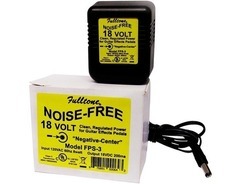
In typical Fulltone fashion, the Mini Deja-Vibe sports a spartan aesthetic and a very rugged feel. This pedal is built well, and like anything else by Fulltone we wouldn’t hesitate putting it through the rigors of touring. The layout is very intuitive, and even on the outside this pedal is reminiscent of the original Uni-Vibe. Amongst the really nice things about the Mini Deja-Vibe is that it’s usability is very straightforward. On the lower left you have your true bypass footswitch to turn the effect on and off. In the upper left is a Volume knob which as you might imagine just sets the volume level of the effect. The upper-right knob is labeled Intensity, and it simply sets how drastic you want the effect to be. The knob in the lower-right corner is Speed, which is basically the vibe rate, and the nearby LED light flashes in time with the set speed so you can quickly glance at it and tell where you are. The Speed knob is large and easily adjustable with your foot, which is handy for live use. There are two toggle switches which let you really change the tonal character of the Fulltone Mini Deja-Vibe. The MODERN/VINTAGE toggle is particularly cool. VINTAGE mode recalls the feel of the original effect, while MODERN mode adds more low end and volume; the effect just sounds more present and cuts through more. The VIBRATO/CHORUS toggle does exactly as it’s labeled, and engages engages vibrato or chorus (chorus being the more classic choice with vibe enthusiasts). Pedal power quirks can trip up even the savviest guitarists, so we’re happy to report the Fulltone Mini Deja-Vibe not only includes a 9V DC FPS-1 power supply, but the voltage doubling circuit internally ramps up the power to 18+ volts DC (which is the same as the original Uni-Vibe).
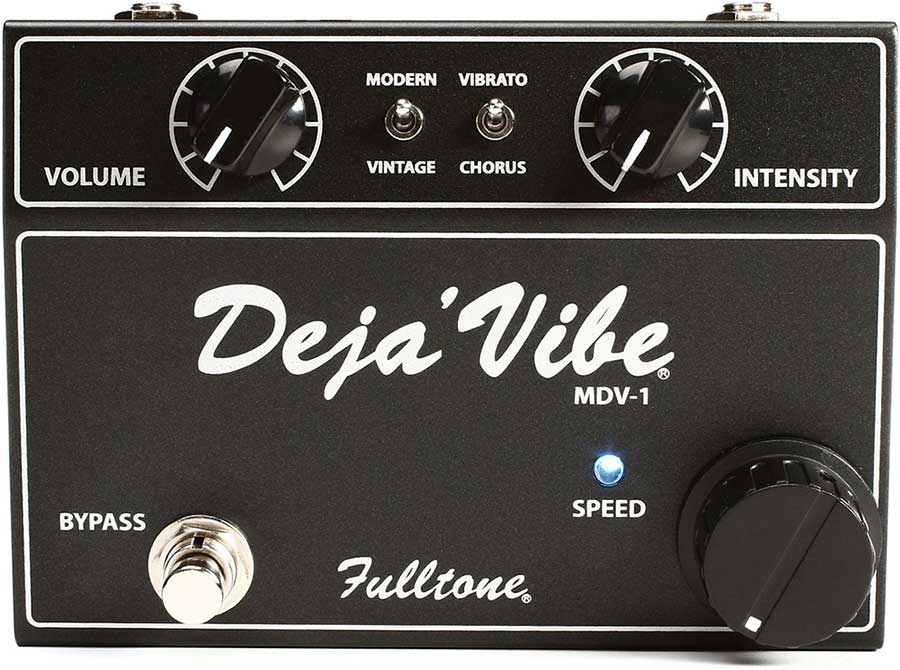
So we’ve established the Mini Deja-Vibe is built like a Uni-Vibe, and sort of looks like one. But does it sound like one? In short, yes! Dunlop nails it here, and from the moment you turn this pedal on it’s basically Jimi Hendrix’s Machine Gun in a box. The dripping chorus/phase tone of the Mini Deja-Vibe will not disappoint, and there’s plenty of versatility on tap as you adjust the knobs. It can get crazy if you crank the Speed and Intensity, and switch the toggle to the MODERN voicing. Dial everything back and switch to the VINTAGE mode for a more subtle vibe, like what you would hear on Pink Floyd’s Us and Them. In terms of unwanted tone coloration, there’s very little to be had. Some users report the mids are slightly boosted and the bass is slightly cut when the effect is engaged, but this very well could be dependent on specific setups.
Bottom Line: Considering what Fulltone aimed to achieve with the Mini Deja-Vibe, it’s little wonder this is a very strong contestant for those looking for the best Uni-Vibe available today. Adding this pedal to the mix will give a guitarist more tone options than he or she likely anticipates, especially with the chorus/vibrato and vintage/modern toggle controls. While it’s not exactly a cheap pedal, considering the painstaking detail that went into making its circuit, combined with the Fulltone name and build quality, the price tag is definitely fair. All in all, when it comes to vibe pedals available today the MDV-1 Mini Deja-Vibe pedal is the Best of the Best.
See how artists use this


EarthQuaker Devices The Depths V2
4.5 (30)




Average Price: $188
Standard/Professional
$100
$251+
Budget
Standard
High-end
- Highly tweakable, offers unique sounds beyond typical Uni Vibe
- Works well with gain stages and other pedals like distortion and pitch shifters
- Throb and voice controls allow for in-depth sound shaping
- Can be used as a boost thanks to the level knob
- See 4 more
- Some users find it alters the EQ balance too much, impacting the base sound
- Missing the classic chorus/vibrato switch found in other vibe pedals
- May not be transparent enough for those seeking to preserve their clean tone
- Lacks the "mojo" of some traditional Uni Vibe pedals
| Bypass | true bypass |
| Power | 9V, 12V, 18V |
| Current Draw | 21ma |
Next up is the EarthQuaker Devices The Depths, a handmade boutique vibe pedal with a very unique character. The Depths gets less recommendations overall than the Fulltone Deja-Vibe, but it’s not an entirely apples-to-apples comparison. The Deja-Vibe aims to replicate the circuit of the original 1960s Shin-Ei unit, while EarthQuaker Devices went for something a little more modern, original, and versatile with The Depths.
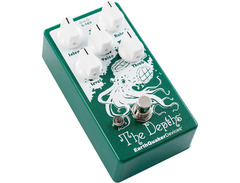
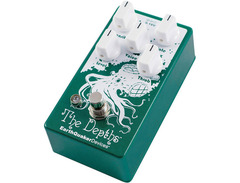
EarthQuaker Devices pedals are boutique in every sense of the word. They are handmade in Akron, Ohio USA, and as such the quality level is premium. The Depths is as well-built as they come, and feels like it could take some abuse on the floor. While aesthetics don’t matter to everyone, we’d be remiss not to mention how good this pedal looks. It has a beautiful dark teal paint contrasted by the graphic of a tentacled sea creature reminiscent of 20,000 Leagues Under the Sea. The Depths is also quite compact and has a relatively small footprint. Note that your ¼” instrument input and output are at the top of this pedal as opposed to the sides. It can be powered with a standard 9V DC power supply (not included) which EarthQuaker says leads to warmer tones, or up to 18V “for a stiffer tone with more headroom and sparkle” (we were only able to to test it ourselves with a 9V power supply). As opposed to Fulltone’s Mini Deja-Vibe, the layout of The Depths looks nothing like the original Uni-Vibe. A single footswitch turns the pedal on and off (true bypass), and you get 5 knobs to shape your tone. The Intensity and Level knobs are self-explanatory, and Rate controls the speed of the effect. The Throb knob is interesting in that its effect is subtle at best, and seems to affect the overall sound differently depending on where the other knobs are set (EarthQuaker says it “controls the low end pulse”). The Voice knob is the most unique feature of this pedal, and has the most drastic effect. Turned all the way to the left, the tone is more “mid-range heavy” like a more traditional, Hendrix-esque, vintage Uni-Vibe. Turned all the way right it sounds like the mids are scooped and the bass and treble are boosted; in a way it sounds more hollow and very much unlike a Uni-Vibe.
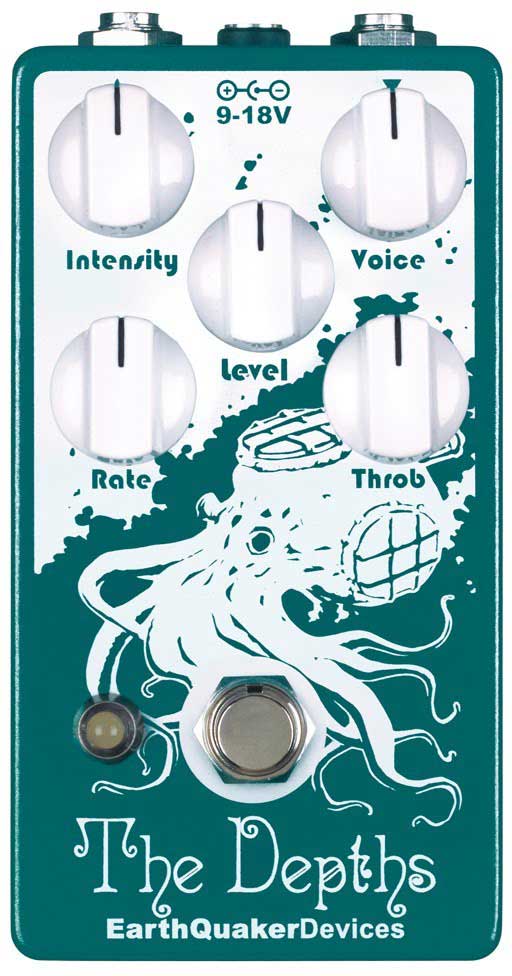
What the EarthQuaker Devices The Depths lacks in traditional circuitry, it makes up for with flexibility. You can certainly come close enough and dial in Jimi Hendrix, Robin Trower, and David Gilmour tones, but you can also take it a completely different direction. And really, that’s the true beauty of this pedal; it’s a vibe unlike any other. It just feels like it has more intensity and output than something like the Fulltone Deja-Vibe. In our test we preferred to keep the Voice knob more towards the left, to achieve a bit more of that vintage vibe. One thing users point out which we noticed as well is that the range of the Rate knob is peculiar. There is a lot more range in the slower settings as opposed to the faster settings, and yet when set to minimum we wish it would let us go even slower. Like most Uni-Vibe pedals, The Depths pairs extremely well with fuzz.
Bottom Line: EarthQuaker Devices The Depths’ boutique look, feel, and tone comes with a steep price tag attached. If you’re a Uni-Vibe purist and are looking for the closest recreation of the original, we would recommend looking at the Fulltone over this one. If you’re intrigued by Uni-Vibe but want something more flexible and unique, you’d be hard pressed to find a better pedal than The Depths.
See how artists use this







TC Electronic Viscous Vibe
4.5 (42)

Average Price: $112
Standard/Professional
$100
$251+
Budget
Standard
High-end
- Produces deep, authentic sounding univibe effect
- Flexible with thousands of variations via TonePrint
- Features include boost and drive settings, phase reversal
- Metal housing, durable construction
- See 5 more
- Some users report a tone suck effect
- Artificial ramp down delay when disengaging the pedal
- Can make the sound dark and bassy, coloring the tone
- Not all TonePrint settings meet expectations
- See 1 more
| Bypass | true bypass, buffered bypass |
| Power | 9V |
| Current Draw | 100ma |
The next most recommended Uni-Vibe pedal is the TC Electronic Viscous Vibe. With this pedal, TC Electronic has digitally replicated the circuitry of the original Uni-Vibe. On top of that, you get the awesome TonePrint feature, which lets you download presets dialed in by pro guitarists, or use the TonePrint editor to create your own custom tones. All of this vibe-y goodness comes in a very compact and relatively affordable package. Let’s dig in.
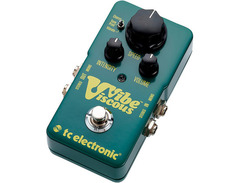
TC Electronic’s TonePrint series has been well-received by guitar players for the way these pedals combine great tone, a reasonable price tag, and the utmost versatility. The Viscous Vibe upholds the standard with a great build quality and compact footprint. Most guitarists out there have a mono setup, but in case you run a stereo rig you’ll appreciate the Viscous Vibe’s stereo inputs and outputs. The pedal can be powered with a standard 9V DC power supply (not included, but they recommend this one). The footswitch to turn this effect on and off is “soft click” style, which eliminates the harsh feel and jarring click found in other footswitches. If you’ve looked at any Uni-Vibe pedals, the controls on the Viscous Vibe will seem very familiar. The two smaller knobs control Intensity (the height of the modulation wave) and Volume (how much of the effect you want to send through), while the large Speed knob controls the speed of modulation. A 3-way toggle switch allows you to select between Chorus, Vibrato, and TonePrint modes. Chorus is the quintessential Uni-Vibe tone, while Vibrato is... well... much more of a swirly vibrato-style effect! In TonePrint mode, you can use whichever TonePrint you’ve beamed to your pedal from the TonePrint app on your Android or iPhone, or by connecting the Viscous Vibe to your computer via USB.
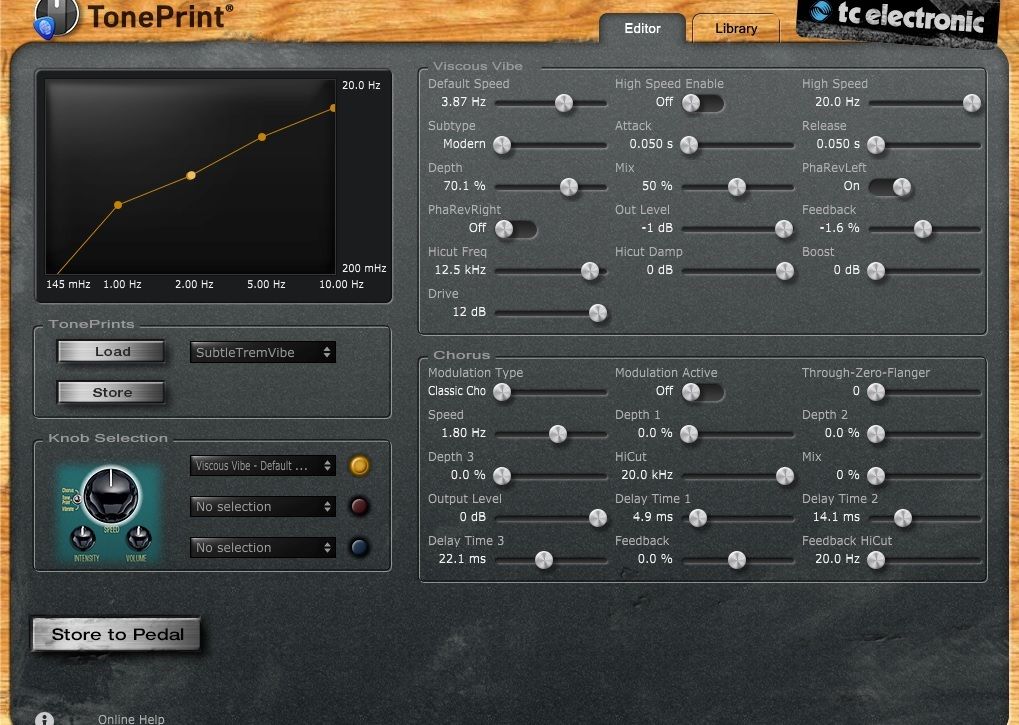
For most guitarists, the TC Electronic Viscous Vibe will provide a fairly convincing recreation of the original Shin-Ei Uni-Vibe. Unlike the Fulltone Deja-Vibe or EarthQuaker’s The Depths, this is a digital pedal, and as such some tone purists point out that it doesn’t quite have the same character, sparkle, warmth, and presence as its all-analog peers. The Speed and Intensity knobs work exactly as you would expect, and with them you can dial in a subtle vibe, all the way to pretty wild modulation. If you’re chasing the vintage Uni-Vibe tone, you’ll prefer to keep the toggle on Chorus mode as opposed to Vibrato, but the latter can be fun when applied to a clean tone and for picking some arpeggios. The true differentiator of the Viscous Vibe are the dozens of TonePrints available for you to use. From pro guitarists like Steve Stevens and Devin Townsend, to TC Electronic themselves creating TonePrints, it’s difficult to imagine that you won’t find something you love. If you love to tinker and design sounds, you’ll love the TonePrint Editor software available for Windows and Mac, which lets you get really in-depth designing your custom Uni-Vibe tones.
Viscous Vibe has a few “hidden” features up its sleeve. When you turn it off, you’ll notice a bit of lag. This is because the speed ramps down just like an old Leslie would do. Also, when the pedal is active, if you keep the footswitch pressed down you’ll activate a Speed-ramp feature, which will increase the vibe speed. Also note that this pedal features True Bypass and analog dry-through, meaning that your dry unprocessed sound passes through without ever being converted to digital. If you unscrew the back plate of the pedal, you’ll find dip-switches that let you switch the pedal to buffered bypass if you need it, as well as set Kill-dry mode on or off.
Bottom Line: If you’re chasing after that original 1960s Uni-Vibe tone, there’s good news and bad news. The good news is that the TC Electronic Viscous Vibe has been painstakingly digitally modeled after the vintage original. The bad news is that it’s not an all-analog pedal like the Fulltone Deja-Vibe or EarthQuaker The Depths. Still, the Viscous Vibe will give you Pink Floyd and Hendrix tones, but the serious horsepower comes with the TonePrint feature. Depending on how “down and dirty” you want to get with editing, there are virtually limitless tone options. The Viscous Vibe is also significantly more budget-friendly than other Uni-Vibe pedals out there, which adds to its appeal. TC Electronic has another winner on its hands with this one.
See how artists use this


Moen MO-VB2 Shaky Jimi Vibe
4.5 (9)

- Excellent Jimi Hendrix-style vibe, comparable to more expensive pedals
- Affordable price for those on a budget
- Sturdy metal case with battery provision
- Subtle and lush sound, great for home use
- See 5 more
- Occasional volume drop when engaged
- Audible pop when toggling between Vibe and Chorus modes
- Larger size may be cumbersome for some pedalboards
- Some units have inconsistent performance out of the box
- See 1 more
| Bypass | true bypass |
| Power | 9V |
The Uni-Vibe is very closely associated with Jimi Hendrix, and pedal manufacturer Moen actually created a vibe pedal specifically using his name and image. The Moen Vibe Shaky Jimi is the next recommended vibe pedal on our list, and this one wins big-time when it comes for value for the money. Moen Guitar Effects is a bit of a lesser-known pedal manufacturer, and their official website doesn’t really say much about this pedal aside from a couple photos and handful of basic specs. After hearing the positive feedback on forums and seeing its extremely affordable price tag, we ordered one to demo right away, and are very glad we did!
With “value” pedals that sound good, we always have some reservation when it comes to the durability and build quality, as typically this is where they skimp. That’s definitely not the case with the Shaky Jimi. The construction quality is first-rate, with a solid metal case and knobs and switches that feel nice and sturdy. One small gripe is that the enclosure is a little larger than your average Boss-sized pedal, and once you have guitar cables going in and out of it it takes up the same space as two pedals. For power, the Shaky Jimi requires 9V DC. It’s also a pretty nice looking pedal. The color scheme will liven up your pedalboard, and the Jimi Hendrix graphic is a nice homage to the legend that made Uni-Vibe famous. The pedal’s controls include an on/off footswitch (true bypass), 3 knobs, and a small toggle. The RATE knob controls the speed of the modulation, while the DEPTH is similar to the “intensity” knob found on other vibe pedals (basically how full-on you want the effect). The HUE knob can be best described as tone or coloration, and can produce a pretty drastically different sound at its two extremes. The toggle switch is the same one that appears on other vibe pedals, and lets you switch from the more traditional CHORUS setting to VIBE. The knobs are large and have good visibility, however we like how on the Fulltone Deja-Vibe the Speed knob is easily adjusted with your foot, which is a little bit difficult to pull off with the Shaky Jimi.
Honestly in terms of sound it’s hard to find fault in this pedal. The Moen Vibe Shaky Jimi sounds like a Uni-Vibe should, with a fantastic range able to go from a subtle wash to a very deep and fast warbly shimmer. If it’s the Hendrix/Trower/Gilmour sound you’re after, the Shaky Jimi will get you there with ease. Despite being a more inexpensive pedal, it does not have any undesired addition or subtraction of frequencies, nor is it noisy. It simply applies the Uni-Vibe effect and does a great job at retaining the character of your tone. You can use the HUE knob to change the sound pretty drastically; all the way to the right it really opens up and gets brighter and more pronounced. The RATE knob has a fairly wide range, and we only wish the LED on this pedal flashed to indicate the currently selected speed. Check out this video demo to hear it in action, both by itself and paired up with a Blackout Effectors Seriously Special Twosome fuzz pedal:
Bottom Line: It’s hard to find fault with the Moen Vibe Shaky Jimi, other than it’s just not by a boutique maker like Fulltone or EarthQuaker Devices. Then again, if it was, you’d surely be paying between 2 and 3 times the price. If you can’t wait to get a sweet sounding vibe pedal on your board and need one that gets the job done on a tight budget, we cannot recommend the Shaky Jimi enough. Best Bang for your Buck.
Voodoo Lab Micro Vibe
4.5 (13)
Average Price: $128
Standard/Professional
$100
$251+
Budget
Standard
High-end
- Unique sweep adds variety to pedal collections
- Ideal for achieving classic 60s and 70s psychedelic rock tones
- Simple two-knob design for ease of use
- Adds warmth and color to the guitar signal
- See 3 more
- Initial impression might seem underwhelming
- Lacks the versatility and features of more complex pedals
- Volume might decrease when activated, affecting clarity in a band mix
- Highly sensitive to cable quality and signal interference
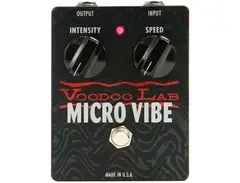
The Voodoo Lab Micro Vibe is a great vibe pedal for those that want true analog circuitry and a no-frills pedal from a reputable manufacturer. Voodoo Lab is perhaps best known for their Pedal Power 2 Plus power supply, but their guitar effects pedals are no slouches. With the Micro Vibe, they deliver a very solid contender for guitarists seeking out a Uni-Vibe clone.
The Micro Vibe is hand-built in the U.S.A. and feels very rugged and well made. Despite the word “micro” in the name, it’s slightly larger than a Boss stompbox but won’t crowd your pedalboard too much. It can be powered by a 9V battery, or standard 9V DC power supply. The input and output jacks are at the top of the pedal, on either side of the power supply jack. Of all the Uni-Vibe clones we tested, it doesn’t get much simpler than the Micro Vibe in terms of controls. A true bypass footswitch turns the pedal on and off, and Voodoo Lab includes only the two most essential knobs - INTENSITY and SPEED, both of which you should be familiar with by now. It should be noted that of the two Uni-Vibe modes chorus and vibrato, this pedal makes the choice for you and defaults to chorus, which is the most commonly used Uni-Vibe mode. All in all, with a layout this simple there’s not much to say. The knobs are large and you should have little trouble seeing them and adjusting even in a venue with tough lighting conditions. One minor omission is an LED that pulsates to indicate the selected speed.
The sound of the Voodoo Lab Micro Vibe is a double-edged sword; On one hand, Voodoo Lab recreated the circuit of the original Uni-Vibe, including “the original sine-wave oscillator, incandescent lamp, and photocells.” On the other hand, users have reported some unwanted EQ adjustment, where the highs are cut and a little low end is added in. We were able to confirm this effect, and while the coloration is not drastic, we would prefer it not be there. But make no mistake, the Uni-Vibe effect you get sounds good and lush. While the SPEED knob has a decent range, we do wish it could go faster. As one reviewer puts it:
Setting the speed at max doesn't go fast enough to simulate a "Leslie" so I couldn't do tunes like "Badge" or "Any Colour You Like". Lame.
Bottom Line: Despite some tone coloration and the SPEED knob falling short, this is still a great little vibe pedal. If you just crave a good vintage Uni-Vibe tone in a tough enclosure and don’t care for any bells and whistles, the Voodoo Lab Micro Vibe is a solid choice. The price tag is a little bit on the high end, and if it was $20-30 cheaper we would consider it a much better deal. At this price, we would opt for the Fulltone Mini Deja Vibe instead.
See how artists use this



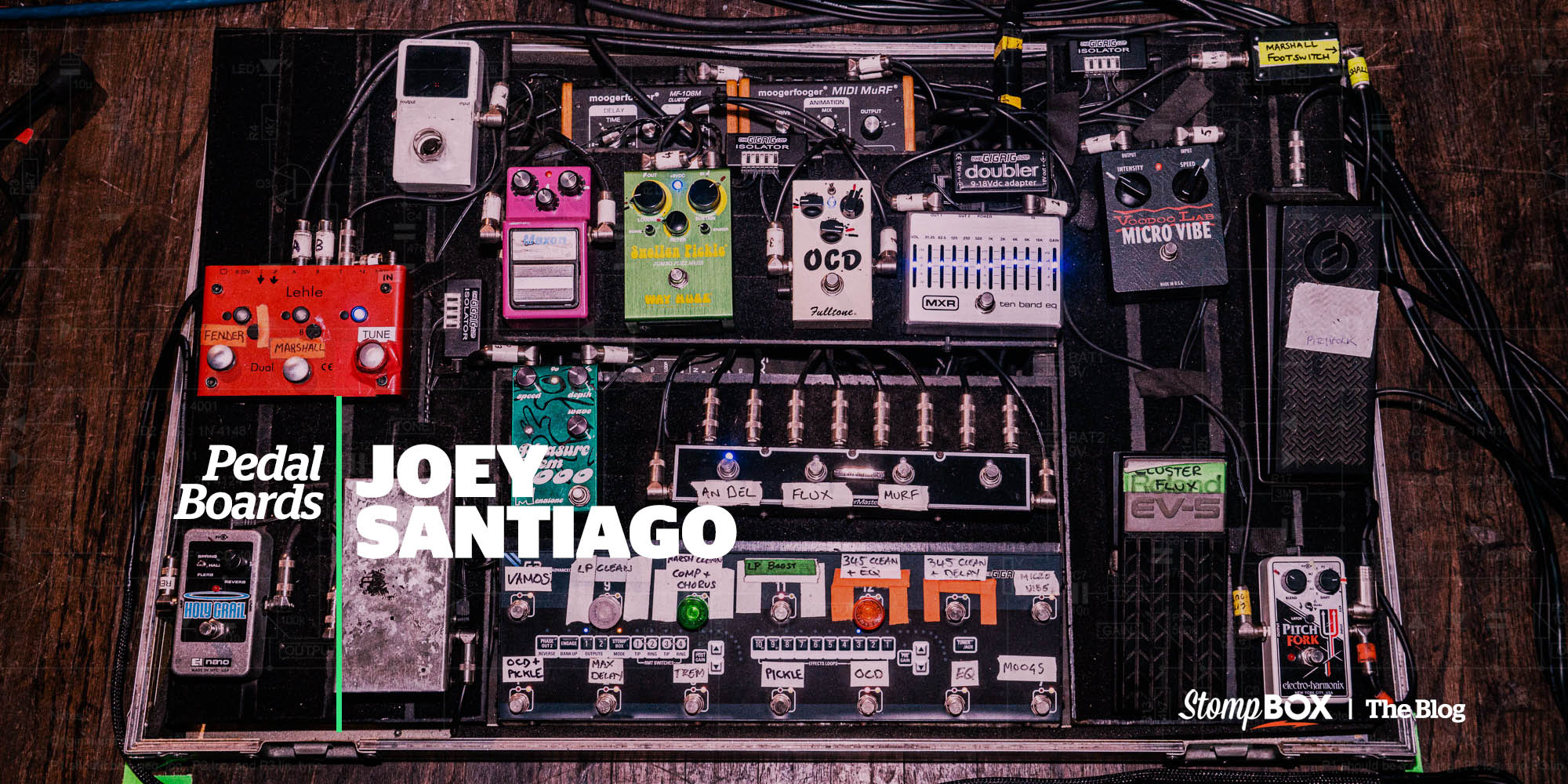


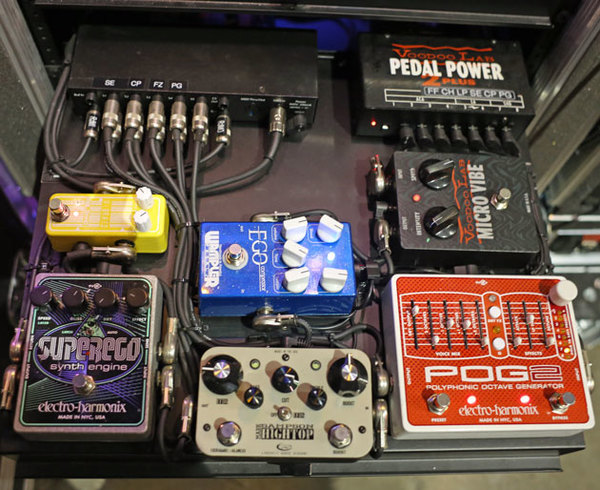


Top Ranked Univibe & Rotary Effects Pedals on Equipboard


About the authors
Michael R. Pierce is the co-founder of Equipboard and a lifelong musician with over 25 years of experience as a guitarist and gear enthusiast. He blends solid music theory chops (thanks to formal training in guitar, piano, and trumpet) with real-world experience, always exploring and experimenting across genres like rock, blues, and hip-hop. Michael launched Equipboard in 2013 after graduating from The University of Texas at Austin, leveraging his unique blend of musical passion, technological acumen, and community building. His current go-to rig features a Fender American Original ‘50s Telecaster, Analogman King of Tone, Strymon Flint, and a Fender ‘57 Custom Champ. Read more
Giulio Chiarenza is the co-founder of Equipboard and a lifelong multi-instrumentalist with a deep passion for music gear. Born in Italy and raised in the U.S., he holds a Computer Science degree from The University of Texas at Austin and blends technical acumen with decades of hands-on experience across guitar, piano, drums, and electronic production. Early in his career, Giulio was signed to a San Francisco-based EDM label, releasing both remixes and original tracks. These days, he helps steer Equipboard’s vision while personally testing and reviewing gear. He's never too far from his go-to guitar: a vintage 1978 Fender Telecaster Custom. Read more
Comments
Sign Up or Log In to add comments

838
Is the MXR Uni-Vibe supposed to be any good?

41
Found your site looking for vibe reviews to replace my shaky Jimi. Mine has just broke after not a lot of use. None of the knobs produce any variation at all. either on chorus or vibe. LED lights up but nothing else works... some component must have just burnt out. no idea. why. must have a lemon, yuck. I liked the pedal but looking for a replacement now.
New in Univibe & Rotary Effects Pedals

$199.99 - $239.99
in Univibe & Rotary Effects Pedals Rank
.png?v=1785156352)


$91.08 - $109.00
in Univibe & Rotary Effects Pedals Rank

$49.00 - $76.90
in Univibe & Rotary Effects Pedals Rank






.jpg)
.jpg)