By Gear Experts
Table of Contents

Equipboard
Equipboard is the world's largest community of artists and their gear. Read our review process.
We are reader-supported. When you buy through links on our site, we may earn an affiliate commission. Learn more.
One of the most important factors that sets a good guitar apart from a lousy one is its intonation.
No matter how many amps or effects you’re running your guitar through, it’ll never sound good if it is not properly tuned. And if we want our instrument to be perfectly in tune, it must have good intonation.
The intonation of a guitar ensures that every note on the fretboard sounds at its correct pitch, which makes the instrument "in tune with itself." Without it, the frets closest to the bridge can produce out-of-tune notes, affecting the overall sound.
What Is Intonation?
Intonation on an electric guitar refers to the instrument’s ability to produce accurate pitches across the entire fretboard. When a guitar is properly intonated, every note you play sounds in tune, whether you’re playing open strings, chords, or single notes at any fret position. If the intonation is off, notes will sound sharp (higher in pitch) or flat (lower in pitch) as you move up or down the neck, even if the open strings are correctly tuned.
Why Is Intonation Important?
Proper intonation ensures that:
• Chords Sound Harmonious: Chords played at different positions on the neck will resonate correctly, without dissonance caused by out-of-tune notes.
• Melodies Are Accurate: Single-note lines and solos will have the correct pitch, making your music sound professional and polished.
• Recording and Performing: In studio recordings or live performances, accurate intonation is crucial for blending with other instruments and vocals.
How Does Intonation Work?
When you press a string against a fret, you shorten the vibrating length of the string, which raises its pitch. The guitar’s frets are spaced to produce specific notes based on mathematical calculations of string length and pitch (the equal temperament system). However, various physical factors can cause deviations from these ideal pitches.
If you want to learn how to intonate a guitar on your own, here’s a quick overview!
What Affects Guitar Intonation?
In a perfect world, a guitar wouldn’t need intonation adjustments. However, there are several factors that can commonly affect a guitar’s intonation, making it necessary to periodically check and adjust it.
String Action
The height of the strings from the fretboard is known as the action. As the saddle height changes as you make adjustments, the length of the string changes, affecting intonation.
Neck Curvature
The tension of the strings can alter the curvature of the guitar’s neck, especially with changes in humidity and temperature. Whether the neck is perfectly straight or has a slight convex shape, any change in its curvature will affect intonation. To correct the neck’s curvature, you will need to calibrate your instrument.
String Gauge
The thickness of the strings impacts intonation. Thicker or thinner strings have different tensions and flexibility, which can subtly alter the distance between the fret and the saddle. Therefore, it’s essential to adjust intonation whenever you change string gauges, or whenever you change the strings, as the old strings may also respond differently to the new ones even if they are of the same gauge. Check out our guide to electric guitar strings to learn more about string gauges.
When to Check Guitar Intonation
It is a good idea to check the intonation of your guitar whenever you change strings, especially if you change gauge, brand or material. Guitars require periodic intonation adjustments also due to environmental factors, such as humidity and temperature changes, which can cause slight imbalances.
Adjusting the Intonation of an Electric Guitar
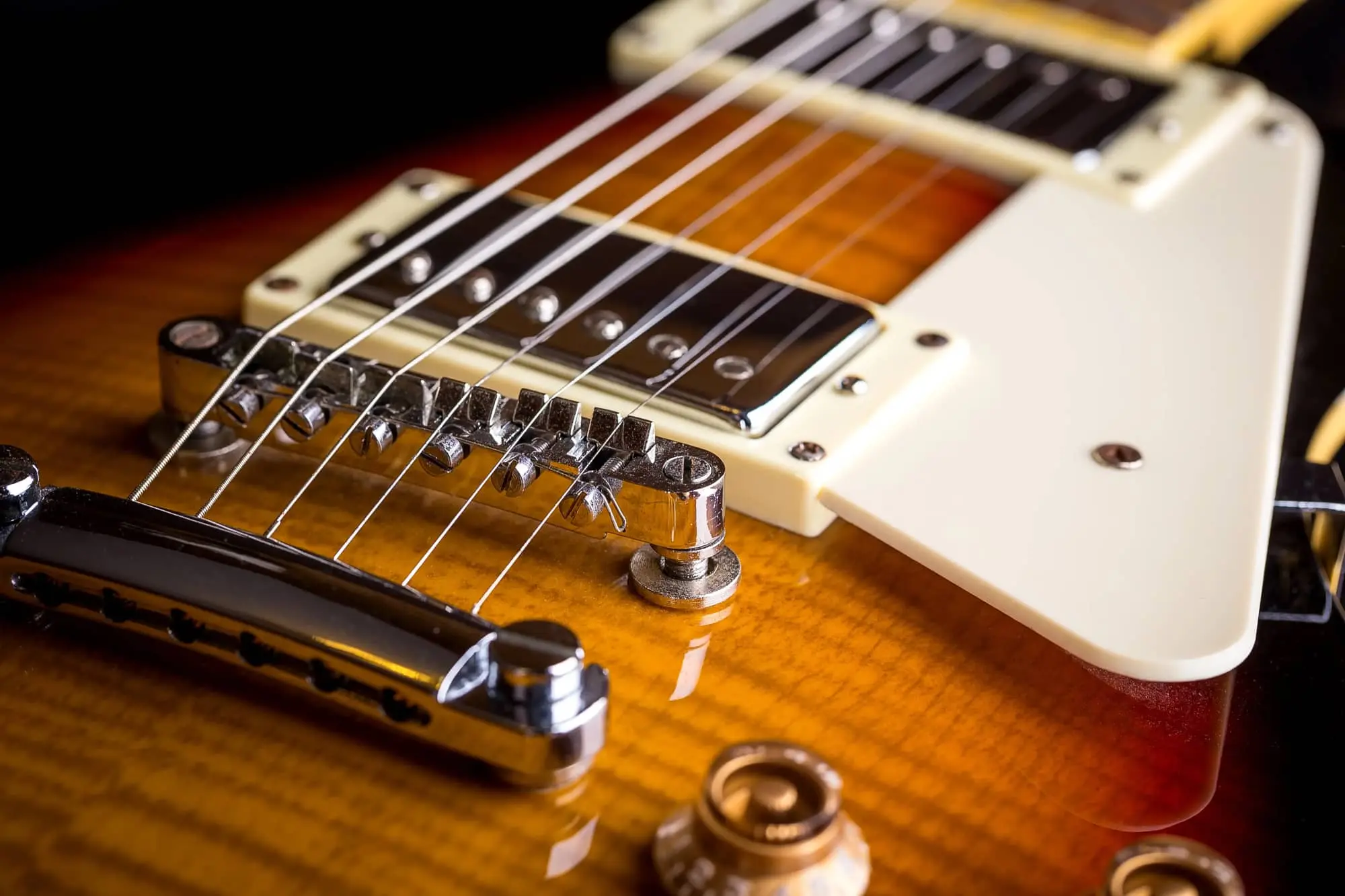
On electric guitars, the saddles on the bridge are adjustable. Moving them slightly closer or further from the nut changes the vibrating length of the string, allowing you to adjust the intonation.
Before you start adjusting intonation, ensure that the neck bend, action, and tuning are already set. No matter what tuning you use for your guitar, this method will work with any of them.
To adjust your intonation, you will need a few tools:
- Tuner: which can be a pedal tuner, clip-on tuner, or tuning app.
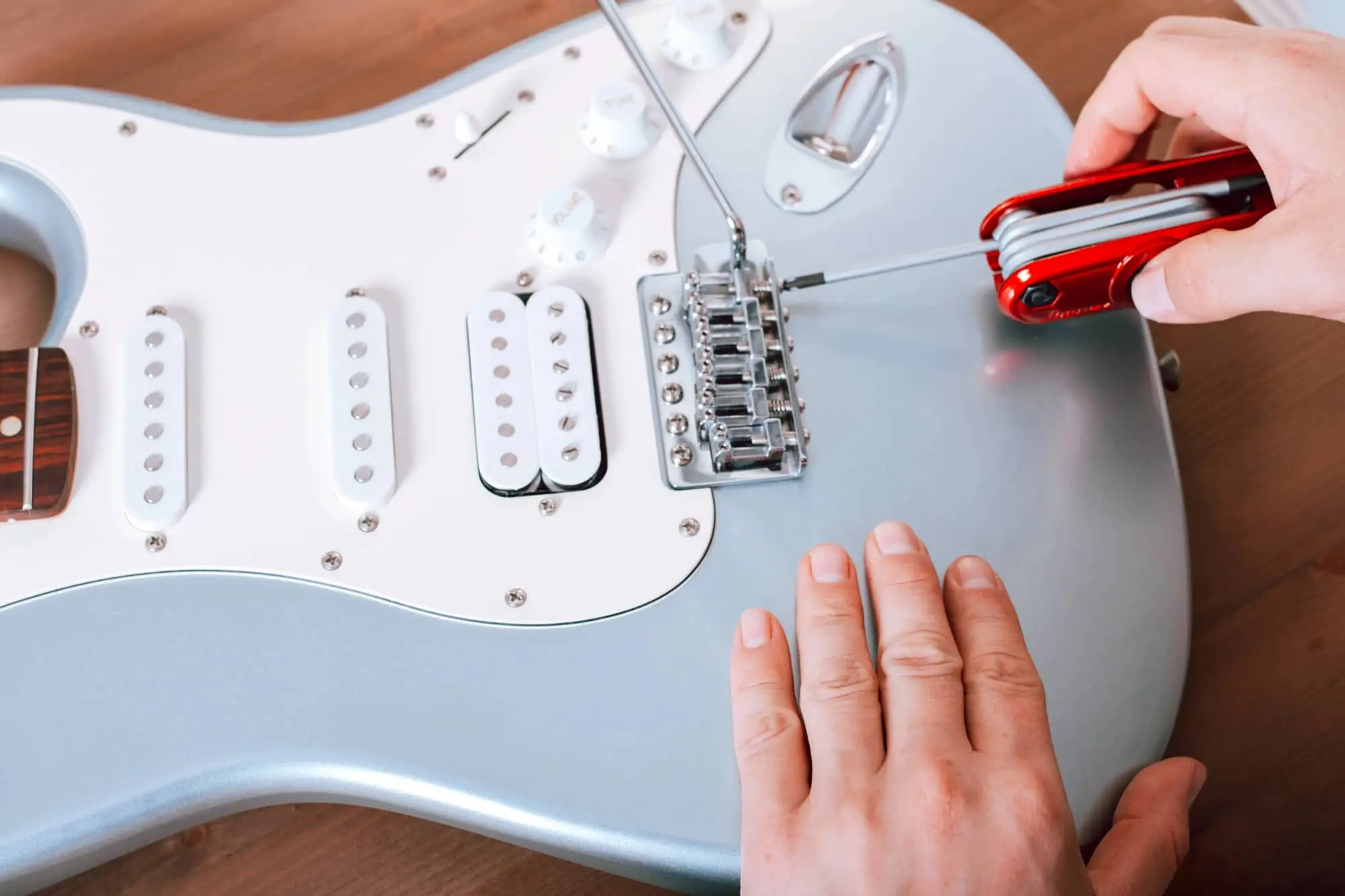
- Screwdriver: In case you are working on a Stratocaster, Telecaster, or Tune-o-Matic bridges
- Allen Key: For Floyd Rose tremolos.
There are different models of bridge for different models of guitars. The bridge is the piece that holds the strings in place and transfers the vibrations of the strings to the body of the guitar. Beyond the differences in bridge’s design, the intonation mechanism generally works in the same way.
Steps to Adjust Intonation
To set a starting position, measure the distance from the inside of the nut to the center of the 12th fret, then double it to find the scale length of your guitar. Adjust the bridge saddle of the first string to this scale length.
For each subsequent string, adjust the saddle back according to the string gauge (for example, if the second string measures 0.011", move the second saddle back 0.011". Thus, the length of the strings will be longer in heavier strings than in lighter ones.
Check the 12th fret by pressing it and playing the note.
It should be exactly one octave higher than the open string note. Of course, if it’s in tune, no adjustment is needed.
Adjusting the Saddle
If the note at the 12th fret is sharp, move the bridge saddle slightly away from the nut.
If the note is flat, however, move the saddle closer to the nut, which will shorten the string.
After each adjustment, retune the string and check the 12th fret note again. Continue making small adjustments until the intonation is perfect.
Final Thoughts
Adjusting your guitar’s intonation is a precise process that requires patience, but the results are worth it. With a properly intonated guitar, each note will ring true, ensuring your instrument sounds its best across the entire fretboard. Happy playing!
Top Ranked Cleaning & Care on Equipboard


About the authors
Juan Spinelli is a multi-instrumentalist musician, but more of a guitarist than anything else. Based in Buenos Aires, Argentina, he started playing at a very early age and learned various instruments such as flute, clarinet, percussion, didjeridoo, cavaquinho, bass and more. Today, he also works as a music producer and sound engineer, collaborating in several projects in his city and with artists from all over the world. Read more
New in Cleaning & Care

$54.99
in Cleaning & Care Rank

$49.99 - $87.97
in Cleaning & Care Rank

$465.97 - $499.00
in Cleaning & Care Rank