This page about Akai X-150D is a stub. You can help improve it:


Pricing and availability




* Product prices and availability are updated by Equipboard every 24hrs and are subject to change. Equipboard may receive compensation for purchases made at participating retailers linked on this site. This compensation does not affect what products or prices are displayed, or the order of prices listed. For more information, please refer to our affiliate disclosure.
Description
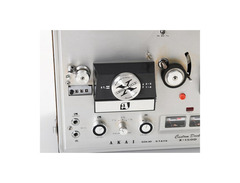
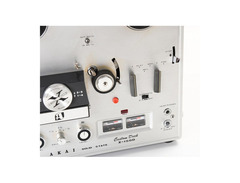
The Akai x-150D Soild State Custom Deck Tape Maschine The cross-field head created a sensation in the tape recorder market by making possible a wide range recording never before heard on any conventional tape recorder. Using this cross-field head, Akai model X-150D provides a surprising recording performance of 30-23,000 cps at a tape speed of 7-1/2 ips, 30-18,000 cps at 3-3/4 ips and 30 to 9,000 cps at 1-7/8 ips. What is superior about cross-field recording? How does it differ from typical recording methods as far as construction is concerned? In the typical recording system, the signal current and the bias current are combined together and applied to the recording head. It is well known that the purpose of bias current is to record, at high sensitivity, a signal applied on the tape, with little distortion and minimizing noise generation. However, the bias current providing such an advantage also has an undesirable character. That is, the wide magnetic field of the bias current affects the recorded signal, resulting in weakening or even erasing the signal. This phenomenon is particularly noticeable at high frequencies. In the cross-field system, the signal current is applied to the recording head while the bias current is applied to the bias head. These two heads are located in different positions, as determined inter-relatively, so that the magnetic field of the bias will not affect the signal recorded on the tape, even when sufficient bias is applied. This allows the recorded signal to remain on the tape with high fidelity. Specifications Track system: 4-track, 2-channel, stereo/monaural system Heads: 1 x record/playback, 1 x erase, 1 x bias Motor: 2 speed hysteresis synchronous Equalization: NAB Tape speeds: 1 7⁄8 3 3⁄4 7 1⁄2 ips Wow and flutter: 0.12% (7 1⁄2 ips) Frequency response: 30Hz to 23kHz (7 1⁄2 ips) Signal to Noise Ratio: 50dB Input: 60mV (line), 0.5mV (DIN) Output: 1.23V (line) Semiconductors: 11 x silicon transistors, 2 x diodes, 2 x rectifiers Dimensions: 340 x 340 x 230mm Weight: 14kg Note: optional 15ips
Owner's manual
Akai X-150D User ManualVideos

Ryan
Akai X-150D Reel to Reel - Pulldown Clean

Akai X-150D Reel to Reel - Pulldown Clean
Ryan

Akai X-150D Reel to Reel Tape Deck

marcusdolby1

Akai X-150D Reel to Reel Tape Deck.
marcusdolby1
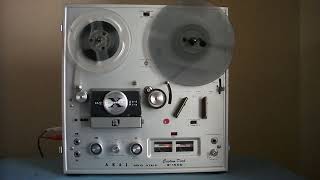
Akai X-150D Reel To Reel Cross Field Tape Recorder____________sn: 34509

Jaime Estevez

Akai x-150d reel to reel demo

Reel Stereo Vintage Outlet
Reviews
Owner Insights
We analyzed real musician discussions from forums and Reddit to find what players love, question, and tweak about Akai X-150D.
Build quality
-
The Akai X-150D is noted for having a robust build, typical of late 1960s Akai models, indicating good durability for a consumer-oriented deck.
Source -
The X-150D's cross field head feature was an innovative addition that enhances performance, reflecting Akai's durable and reliable design choices.
Source
Features and functionality
Comparisons
-
Comparatively, the Revox PR99 and B77 offer higher studio-grade specifications, such as half-track stereo and higher tape speeds, though at a significantly higher price point.
Source
Use cases and applications
-
Suitable for hobbyists seeking tape coloration; the X-150D can add tone and color for occasional use, but isn’t ideal for high-quality studio mastering.
Source -
The X-150D is appreciated for producing elegant sound quality, suitable for casual office systems or personal enjoyment.
Source -
The unit's speed settings offer versatility; 7.5, 3.75, and 1.875 IPS speeds are achievable with or without the capstan sleeve.
Source
Value and pricing
-
At around $165 USD, the X-150D offers an affordable entry into reel-to-reel tape decks, though it’s more for experimentation than professional results.
Source
Setup and maintenance
-
Owners recommend cleaning the outer case with soap and water for improved aesthetics and using Deox-it D5 on recording level pots to resolve channel imbalance issues.
Source -
Regular motor lubrication is advised for optimal performance; one owner plans to maintain this for continued reliability.
Source -
The X-150D requires a new pinch wheel tire for optimal function; replacements are available on eBay or through Terry's Rubber Rollers.
Source -
J.I.S. Japanese screws are used in the X-150D; using the correct screwdriver bits is crucial to avoid damaging screw heads.
Source
Mods and upgrades
-
A 15 IPS kit exists but isn't recommended for this model due to lack of 15 IPS EQ and limitations with 7” reels.
Source
Based on 0 Reviews and 0 Ratings
Artist usage
Add artist

Album Usage
The Akai X-150D has been featured on the following albums:

Genre Usage
Based on how artists on Equipboard use this gear, it is most commonly found in the following genres.
Used With
Based on how musicians on Equipboard use Akai X-150D, it is most commonly used with the following gear.


More Akai Effects Processors


$1,550.00
in Effects Processors Rank


-m.webp?v=1784041063)
$624.00
in Effects Processors Rank


$204.28
in Effects Processors Rank


$1,799.00
in Effects Processors Rank


$1,549.00
in Effects Processors Rank


$1,999.00
in Effects Processors Rank


$749.99 - $835.39
in Effects Processors Rank


$149.00
in Effects Processors Rank


$1,450.00
in Effects Processors Rank


$3,799.00 - $4,725.00
in Effects Processors Rank


-m.webp?v=1784213838)
$40.00 - $2,999.00
in Effects Processors Rank

$5,699.00 - $6,999.00
in Effects Processors Rank

.jpg?v=1784138439)

$1,153.00 - $2,635.00
in Effects Processors Rank


$897.18 - $1,799.95
in Effects Processors Rank


$4,545.70 - $4,777.00
in Effects Processors Rank


$229.00
in Effects Processors Rank


$620.00
in Effects Processors Rank


$69.95
in Effects Processors Rank


$199.99 - $250.00
in Effects Processors Rank


-m.webp?v=1784213885)
$436.63
in Effects Processors Rank


$749.99 - $4,999.00
in Effects Processors Rank


$419.99 - $1,179.99
in Effects Processors Rank


$1,710.00
in Effects Processors Rank

$2,999.00 - $3,290.00
in Effects Processors Rank


$629.99 - $849.00
in Effects Processors Rank


$35.89 - $199.00
in Effects Processors Rank


$2,555.00 - $2,850.00
in Effects Processors Rank
-m.webp?v=1784213971)
$311.02 - $936.00
in Effects Processors Rank


-m.webp?v=1784213924)
$450.00 - $699.00
in Effects Processors Rank


$4,999.00 - $8,047.13
in Effects Processors Rank


$1,100.00
in Effects Processors Rank

.jpg?v=1784214497)


$135.00
in Effects Processors Rank


$1,345.77
in Effects Processors Rank


$202.50 - $599.99
in Effects Processors Rank


$300.00
in Effects Processors Rank


$66.00
in Effects Processors Rank


$225.00
in Effects Processors Rank


$489.00
in Effects Processors Rank


Community setups


Similar


Most Popular Effects Processors
Most Popular Brands
-
Added to Equipboard on by
 hashimoto
GearIQ 14850
-


