Table of Contents

Equipboard
Equipboard is the world's largest community of artists and their gear. Read our review process.
We are reader-supported. When you buy through links on our site, we may earn an affiliate commission. Learn more.
Our Picks

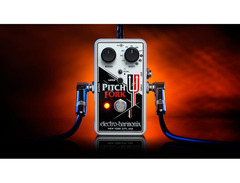
Octave and pitch shift pedals don't get much better than this. The EHX Pitch Fork lets you select between 11 pitch shift intervals, and you can shift up & down independently or at the same time. Whether you need it for multi-part harmonies, turning your guitar into a bass, and much more, it's got you covered.
Read more


-l.webp?v=1784818691)
Electro-Harmonix Micro POG Polyphonic Octave Generator
An instant classic, the EHX Micro POG is simple and powerful. You control the volume of one octave up and one octave down, which lets your guitar sound like a 12-string, an organ, a bass, etc. Hard to believe you can do so much with just 3 knobs. It's a bit pricey, but it's a POG so you know it'll sound fantastic.
Read more
DigiTech Whammy Pitch-Shifting Pedal
It seems like the DigiTech Whammy is on every pro guitarist's pedalboard, and for good reason. It's a versatile pedal that tracks extremely well and has its own interesting tonal character. It has a large footprint and costs a pretty penny, but if you want the timeless, premium choice this is it.
Read more
A near perfect clone of the EHX Micro POG for a fraction of the price. It's built well and sounds excellent, so if you just need an inexpensive octave pedal or can forgo the "name brand" aspect of owning a POG, this is the one to get.
Read more


There are better sounding and more versatile octave pedals out there, but if your focus is getting deep, fat bass tones at 1 and 2 octaves below your original note, nobody does it better than the Boss OC-3. Provided you don't care about going up any octaves, take a serious look at this one.
Read more

Electro-Harmonix POG2 Polyphonic Octave Generator
The POG2 allows you to use two octaves down in addition to the original POG’s one octave up, two octaves up, and one octave down from your guitar signal.
Read more
Eventide PitchFactor Harmonizer
The PitchFactor utilizes many of the tones from the H3000, but upgraded, digitally run, and in a compact stompbox. If you want the most tweakable and versatile octave/harmonizer pedal, then this is it.
Read moreSince our abilities to create complex digital designs for pedals have grown, we have seen a huge advancement in the usability of Octave pedals. Whether you’re simply looking for a new octave pedal, or are a beginner just getting into the world of octave and pitch shifters, we hope this guide will walk you through what you need to know and help you make a decision, as well as recommend some of the best octave pedals available today.
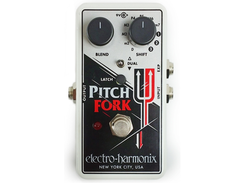
Electro-Harmonix Pitch Fork
4.5 (187)
Octave and pitch shift pedals don't get much better than this.









Average Price: $182
Standard/Professional
$100
$301+
Budget
Standard
High-end
- Compact size saves pedalboard space
- Superior sound quality compared to competitors
- Versatile; suitable for various musical styles and tunings
- Effective for both guitar and bass, including 5-string basses
- See 6 more
- High register can sound "cheesy"
- Requires included power supply to avoid noise issues
- Minor latency noticeable in pitch tracking
- Cannot independently mix pitch in dual mode
- See 6 more
| Bypass | true bypass |
| Analog/Digital | digital |
| Power | 9V |
| Current Draw | 30ma |
When gathering recommendations and reviews for the best octave pedal, we were sure the top honor would go to some version of the venerable Electro-Harmonix POG, or the DigiTech Whammy. As it turns out, the Electro-Harmonix Pitch Fork stole the show, being recommended more times than any other octave pedal. Pitch shifting pedals come in all sorts of shapes, sizes, and prices, and it would seem EHX spotted a gap in the market when they created this pedal. EHX’s line of POG pedals sound great, but they’re pricey. Other options are either inexpensive budget pedals, or very limited in their functionality. The Pitch Fork is extremely versatile, sounds great, and is offered at a very attractive price considering how good it is.
The Pitch Fork’s good looks and great build quality should come as no surprise, as Electro-Harmonix has proven they know what they’re doing when it comes to building pedals that last. This pedal comes with an EHX 9.6DC-200 mA AC Adapter which is nice, but it can also run off a 9V battery which fits snugly underneath (we strongly recommend a power adapter, as it tends to drain batteries very quickly). On either side of the pedal you have a ¼” input and output as well as an input for an expression pedal, which we’ll soon discuss.
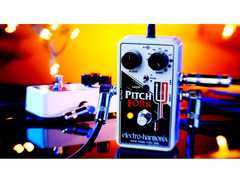
This pedal is laid out very intuitively, and is actually a breeze to use despite seeming slightly complicated on first glance. The big knob on the upper right is the most crucial one. It’s labeled SHIFT , and it’s what you use to select your pitch shift interval. You can select between 11 positions: D (for Detune, a shift of 17 cents that sounds kind of like a chorus effect), Minor 2nd, Major 2nd, Major 3rd, Perfect 4th, Perfect 5th, Major 6th, Minor 7th, and then 1, 2, and 3 Octaves (essentially making this a +/- three-octave range pedal). The small 3-way toggle switch in the middle lets you select if you want to pitch shift UP to your selected interval, DOWN, or DUAL in the middle position, meaning both up and down together. The BLEND knob in the upper left is simply a wet/dry adjustment, meaning all the way left is the original signal, all the way right is 100% pitch shift effect. Finally, the LATCH switch engages “Latch Mode,” which just means the effect will only be present when you hold down the pedal’s footswitch. As soon as you let go, it turns off. This is a fantastic and useful feature unique to the Pitch Fork. Last but not least you can connect an expression pedal, which lets you glide smoothly to your interval. So say you have the “1” selected for 1 octave, you can slide up or slide down to it gradually as you press down or up on the expression pedal. Quick tip - without an expression pedal, default ramp time is 60ms. Stick any ¼” headphones adapter into the expression pedal jack and you’ll get super fast 4ms ramp time, so you can do quick pitch stutters in LATCH mode. All in all it took us about less than five minutes to get comfortable with the pedal, and it’s impressive how easy and intuitive the controls are given how much the Pitch Fork can do.
Whether your intention is to do multi-part harmonies, turn your guitar into a bass, or use this pedal as a capo (which you can do since you can detune in half step intervals), the Pitch Fork handles the task with no issues. Provided your expectation isn’t that it’s a perfect sounding replacement for a bass guitar, you won’t be disappointed. Setting the SHIFT knob to Detune mode is very interesting, as it produces an ethereal, deep chorus-like effect, which you can further customize with a flick of the DUAL toggle. And speaking of the DUAL setting, while some octave pedals can only go up or only go down, having both simultaneously sounds a bit like if another guitar and bass is accompanying your playing. Set your BLEND knob to 50%, and solos will sound tremendous and huge with this setting. If you simply want to transpose your playing up or down, set the BLEND to 100% right, and you’ll get a fantastic-sounding 100% effected sound.
Many guitarists use an octave pedal with a dirt pedal, so we made sure to test this pedal before and after an overdrive in the signal chain. Both yield interesting results, and it’s impossible to recommend one placement over the other.
We’ll leave you with this quick demo video that runs through a bit of what the Pitch Fork can do, and demonstrates the fun and inspirational LATCH setting:
Bottom Line: The Electro-Harmonix Pitch Fork is as versatile as an octave pedal gets, it has an intuitive layout and it sounds and tracks great. It’s not “glitchy” in the least like some pitch shifters tend to be. Perhaps the one downside is the Pitch Fork is a lot more fun and useful with an expression pedal, so you’ll need to buy one separately which increases the price. The EHX Pitch Fork is not exactly super budget-friendly, but realize you’re getting a superb quality pedal, and the most recommended octave pedal currently available.
See how artists use this






Electro-Harmonix Micro POG Polyphonic Octave Generator
4.5 (230)
An instant classic, the EHX Micro POG is simple and powerful.
-s.webp?v=1784818691)


Average Price: $224
Standard/Professional
$100
$301+
Budget
Standard
High-end
- True polyphonic tracking, handles complex chords well
- Enhances sound range, works on various instruments (guitar, bass, synth)
- Simple operation with intuitive blending controls
- Offers unique organ-like tones and textures
- See 6 more
- Some users note a slight delay in tracking, affecting performance
- May impart a distinct "color" or tone, not ideal for pure octave shifts
- No battery capability, limiting portability
- Some quality control issues reported, with occasional need for factory returns
- See 3 more
| Bypass | true bypass |
| Analog/Digital | digital |
| Power | 9V |
It wouldn’t be a proper best of list without a POG, and coming in second place is the Electro-Harmonix Micro POG pedal. POG stands for P olyphonic O ctave G enerator, polyphonic meaning that it will track multiple notes at once. The Micro POG is the middle child, fitting in between its big brother POG2, and its little brother the Nano POG. Some guitarists might be taken aback that the POG2 didn’t make it onto our list. It’s not a snub by any means; the POG2 is a classic, but its high price makes it inaccessible to many guitarists, and the Micro POG has the same great original sound in a more compact and affordable package, which explains why in our research more people recommend it.
There’s no issue with build quality here. The die-cast chassis is rock solid, and EHX pedals are found on pedalboards of touring pros the world over, which is a testament to their quality, reliability, and staying power. Unlike the EHX Pitch Fork you cannot power the Micro POG with a 9V battery. In fact, one small drawback of this pedal is its finicky power requirements. It includes a 96DC-200BI power supply , and users have not reported any issues when using wither that, or a stalwart pedal power supply like the Voodoo Lab Pedal Power 2 Plus. Ordinary 9V power supplies or daisy chain power supplies have caused users some issues... just a small thing to be aware of.
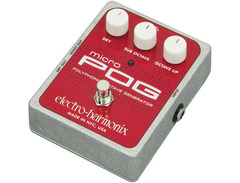
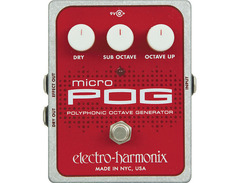
In terms of layout, the Electro-Harmonix Micro POG is very simple to operate, even more so than the Pitch Fork we covered above. You get a single ¼” input for your instrument, and two outputs - an Effect Out which is the “default” one, and a Dry Out, which you can use to send your completely unaffected signal to a separate amp, if you like. The effect can be switched on and off using the footswitch, and operation is limited to 3 simple knobs, which sort of function like wet/dry controls:
- The DRY knob controls the blends of the effect. As you turn it clockwise, the volume of the DRY signal will increase. Think of it as the volume of the original pitch.
- The SUB OCTAVE knob controls the volume of an octave down.
- The OCTAVE UP knob controls the volume of an octave up.
This works a little bit differently than the EHX Pitch Fork, where you select your interval. Here, the interval is fixed at +1/-1 octave, and you simply dial in how much of each of those you want. So while you don’t have the granular interval control, you can still achieve a multitude of pitch effects with the knobs at your disposal. The Electro-Harmonix POG line has become ubiquitous for a reason; these pedals are some of the best sounding octave pedals money can buy. At the end of the day, no amount of features or tweakability can compensate for a glitchy, laggy octave pedal. We’re happy to report the Micro POG tracks perfectly, and seldom does a user of it complain about the way it sounds. You can achieve fantastic results making your guitar sound like a bass, or a 12-string, or both at once. There is very complete detail and articulation no matter your settings. The simple but helpful user manual itself suggests settings for 12-string Guitar , 8-string/16-string Bass , Phat Bass , and Organ. Some users have complained that going beyond about 50% on the OCTAVE UP knob results in a slightly tinny or metallic sound. We can attest to this in our testing of the pedal, but considering how great it sounds at most settings this is a minor setback, and one you can avoid completely.
Bottom Line: The Electro-Harmonix Micro POG is simple, and sounds great. If you don’t need to get fancy with your octave needs, this is the one to get. If you value an expression pedal, or Latch mode is important to you, we suggest going with the EHX Pitch Fork, since it sounds great and is also less expensive than the POG. If you just cannot resist the allure of a POG pedal, then between the available models the Micro POG is a great middle-ground and bang for the buck. Don’t confuse that with budget-friendly, however. You’ll still need to shell out some cash to get your hands on one. There is a lot of star power behind this one - Mike Einziger , Jonny Buckland , Josh Homme , Mike McCready , Noel Gallagher , Mark Tremonti , and many, many more use it.
See how artists use this






DigiTech Whammy Pitch-Shifting Pedal
4.5 (266)
A versatile pedal that tracks extremely well and has its own interesting tonal character.


Average Price: $248
Standard/Professional
$100
$301+
Budget
Standard
High-end
- Unique, versatile sound that's hard to replicate
- Adds expressive pitch-shifting capabilities to guitar play
- True bypass and polyphonic tracking for cleaner sound
- Chords function adds beautiful harmonizing effects
- See 6 more
- May alter the guitar's natural tone
- High power consumption, may require dedicated supply
- Requires hands to change program, limiting live versatility
- Some tracking issues with modulation
- See 1 more
| Power | 9V |
Electro-Harmonix POG pedals are iconic when it comes to octave and pitch shift pedals, but right up there with them is the DigiTech Whammy. This big red box is probably on more pro guitarist pedalboards than any other harmonizer or octave pedal. The one we’re focusing on is the newest 5th generation one. The previous version (the DigiTech Whammy IV) is well regarded, but its flaws include not being true bypass, and needing AC power instead of 9V DC. DigiTech listened to the critics, and fixed these issues (and more) in the DigiTech Whammy V. In terms of features, functionality, and price, this can be closely compared to the Electro-Harmonix Pitch Fork with an expression pedal plugged into it.
With this pedal’s legendary status, it’s no secret that it’s built like a small tank. Not much to say about build quality, fit, and finish other than the Whammy is 100% build to last. A trademark of this pedal is its rather large size at about 6.5 inches wide. This might be an issue if you’ve got limited space on your floor or pedalboard (perhaps enough of an issue to sway you towards the EHX Pitch Fork). This pedal is true bypass, and a 9V power supply is included. The DigiTech Whammy’s layout is easy and intuitive, with the majority of the controls in the upper right hand corner. Another trademark of this pedal is its built-in pedal, which occupies the left half of it. A black selector knob in the middle can be set to various settings, which are divided into three main sections: WHAMMY (column on the right with 10 settings), HARMONY (column on the left with 9 settings), and two DETUNE settings at the bottom. The WHAMMY settings are for pitch shifting and are clearly labeled; you can go from DIVE BOMB (which is 3 octaves down) to 2 octaves up, and everything in between. With these settings, you use the pedal to glide to and from your interval. The HARMONY settings basically add a harmony, and it allows you to blend between two different tones. Helpful markings on the pedal provide a nice visual of how you can affect these with the pedal in the up and down position. The DETUNE settings make for a chorus-like effect that’s very interesting and fun to use. One final note is the inclusion of a small toggle switch to go from CLASSIC mode to CHORDS mode, the former being a more “old school” whammy sound, and the latter being better for when you’re playing chords.
Sound-wise, the DigiTech Whammy sounds very good, and tracks extremely well. If there’s any latency we’re not able to perceive it, as it keeps up even with the quickest passages you can play. Some say it’s not as “clean” sounding as the Micro POG by Electro-Harmonix, but its warbly sort of character is desirable and adds to the Whammy’s appeal (especially when playing chords). The sounds you can conjure up from this pedal are inspirational to say the least.
Bottom Line: In terms of the DigiTech Whammy vs Electro-Harmonix Pitch Fork debate, it’s very difficult to recommend an outright winner. If pedalboard space is at a premium, you might opt for the Pitch Fork. Then again, in our research users have reported the DigiTech Whammy tracks slightly better than the PF. If you have a need to control how much your clean signal is blended with your pitch shifted note, that would be another reason to go with the Pitch Fork. DigiTech Whammys are on countless pedalboards of the pros for a reason: Tom Morello , Matthew Bellamy , Jack White , The Edge , Matthew Followill , Steve Vai , Joe Satriani , Joe Perry , Noel Gallagher , Ed O’Brien , Buckethead , and tons more.
See how artists use this


Mooer Tender Octaver MKII
4.0 (9)
A near perfect clone of the Micro POG for one third the price.
Average Price: $112
Standard/Professional
$100
$301+
Budget
Standard
High-end
- Polyphonic, handles chords without weirdness
- Adjustable octave levels with dry signal removal option
- Features "swell" mode for dynamic effects
- Compact size, fits easily on pedalboards
- See 5 more
- Ineffective on lower notes for bass guitar
- Upper octave can sound less smooth compared to competitors
- Latency issues noted, typical of digital octave pedals
- Some digital noise and requires isolated power source
- See 2 more
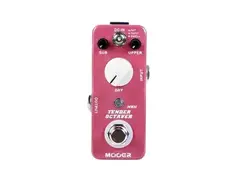
The folks at Mooer have done it again. The Mooer Tender Octaver is a polyphonic octave generator pedal with Sub, Upper, and Dry signal control, and is pretty much a clone of the Electro-Harmonix Micro POG in the way that it works and sounds. We’ll keep this review short and sweet, and focus on any areas where the Tender Octaver differs from the Micro POG, though there honestly aren’t many!
The Mooer Tender Octaver is a very compact pedal, measuring even smaller than the EHX Nano POG. The Mooer is certainly no POG in the build quality and looks department, but it’s also no slouch. It feels relatively well-built, and it’s a perfect size for small pedalboards. The knobs at your disposal mirror those of the Micro POG. The SUB knob adjusts the amount of lower octave in your guitar signal, the UPPER knob adjusts the amount of higher octave, and the DRY control adjusts the amount of your original guitar signal. This pedal requires a standard 9V power supply, and is true bypass when it’s switched off for no tone coloration.
Tone-wise, there is VERY little difference between the Mooer Tender Octaver and a Micro POG. Some comparisons out there report the Mooer is slightly more bass heavy, but it’s frankly hard to tell. Tracking is also excellent with the Tender Octaver.
Bottom Line: If you want an octave pedal and want to save space and money, you really can’t go wrong with the Mooer Tender Octaver. Great sound, great tracking, and one third the price of the EHX Micro POG. Sure, it doesn’t have the same allure as a USA-made Electro-Harmonix pedal, and it might not look as good or be as recognizable on your pedalboard, but it’s up to you to decide how important that is to you!

.jpg)


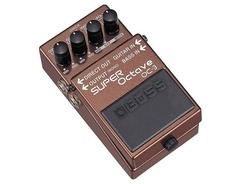
Boss OC-3 Super Octave
4.0 (201)
If your focus is getting deep, fat bass tones at 1 and 2 octaves below your original note, nobody does it better than the Boss OC-3.
Average Price: $116
Standard/Professional
$100
$301+
Budget
Standard
High-end
- Superior octave adjustment compared to OC-5
- Analog vibe despite being digital
- Effective with humbuckers and compressed signals
- Unique retro and synth bass sounds
- See 6 more
- Tracks poorly, especially on high/low notes
- Can sound synthetic and unauthentic
- Poly mode sound decreases with higher notes
- Short delay when effect is engaged
- See 4 more
| Bypass | buffered bypass |
| Analog/Digital | digital |
| Power | 9V |
| Current Draw | 55ma |
The Boss OC-3 is a very popular octave pedal, and the successor to the OC-2. A notable difference between the Boss OC-3 and the other octave pedals on this list is that the OC-3 can only go down octaves, not up. Also unless you specifically enable POLY mode, this is a monophonic octave pedal, meaning that it is only capable of tracking one note at a time. Its primary use is to thicken up your sound and really fill in the low end, which it does remarkably well.
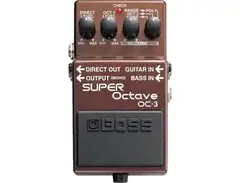
Like everything made by Boss, it is built like a tank. If you’ve ever owned a Boss pedal, then you know that you could probably throw it out of a car on the highway and it would still work (please don’t actually do that). This is a huge reason why a lot of people, especially touring musicians, like to use Boss pedals. It comes with a 9V battery so you can start playing with it immediately, but as usual we recommend a 9V power adapter. Boss has a tried-and-true form factor, and manages to fit a lot of functionality over a relatively few amount of knobs. In terms of inputs and outputs, the Boss OC-3 has a GUITAR IN and BASS IN , and the pedal will optimize itself to suit the frequency range of whatever guitar you are using. This is great, as bass players can be confident Boss made an octave pedal with them in mind. In terms of outputs you have a normal mono output, and a DIRECT OUT (which is just the effected sound, in case you want to route that elsewhere).
Let’s go through the knobs from left to right. First you have DIRECT LEVEL , which just sets the volume of the direct sound (basically a wet/dry adjustment). Next you have OCT 1 LEVEL , which as you turn it clockwise increases the level of the sound one octave below the original. The third knob is a multi-functional CONTROL knob, and its function depends on what mode the pedal is in. To adjust the mode you use the fourth MODE knob, which has three settings - POLY, OCT2, and DRIVE.
- POLY is polyphonic mode, and lets you play multiple notes at once (e.g. chords) and the octave effect will track correctly. One of the coolest things about the OC-3 is that while in POLY mode, the Control knob lets you set a cutoff point or a range, so that for example you could only apply the octave down to the lower 3 strings on your guitar, and leave the higher 3 strings normal.
- OCT2 mode recalls a feature from the Boss OC-2 pedal, and allows you to have a sound one octave below the original input, and a sound two octaves below, for some real deep rumbling bass (in this mode the Control knob controls the level of the sound two octaves below).
- DRIVE is an interesting inclusion, which basically adds distortion to the direct sound and octave sound. In Drive mode the Control knob adjusts the amount of distortion. It likely won’t replace your dedicated distortion pedal, but it’s usable and it can be fun to have some quick and dirty distortion on tap for some aggressive bass sounds.
The Boss OC-3 shines when it comes to maximizing what you can do in the lower octave ranges. This is the pedal to get if you want to play Rage Against The Machine’s “Bombtrack” all by yourself (save for the drums of course). Check out the start of this demo of the OC-3 to see just that, with the pedal in DRIVE mode. POLY mode is great, and there’s not really a better octave pedal when it comes to being able to set your lower strings to play big boomy bass, and leave your higher strings unaffected. As we mentioned, the drive can be cool, but it takes you out of POLY mode which makes the pedal monophonic. This can be a little limiting, as in monophonic mode you’ll confuse the pedal if you play more than one note at once (the lower octave note will jump around, not knowing which one to “latch” onto).
Bottom Line: It’s hard to argue with the Boss OC-3’s budget-friendly price tag. If you want maximum flexibility in your octave intervals, and like the idea of making your 6-string guitar sound like a 12-string or even an organ, you’ll want to look at an octave pedal that lets you go up one or more octaves. The Boss OC-3 keeps things simple, and its specialty is giving you deep, fat bass tones at one and two octaves below your original note. All in all, if you are looking for a budget-friendly, simple one or two octave down pedal that will probably outlast you by at least three generations, then even though the OC-3 is not the best sounding or most feature laden pedal on this list, this is definitely the pedal for you and will get you many usable tones.
See how artists use this





Electro-Harmonix POG2 Polyphonic Octave Generator
5.0 (183)
The POG2 allows you to use an addition octave to the original POG, adding even more to a classic.


Average Price: $358
High-end/Boutique
$100
$301+
Budget
Standard
High-end
- Authentic organ, horn, and other instrument simulations
- Versatile: fits many musical situations from ambient to rock
- Precise tracking, even with complex chords and bends
- Preset functionality for easy sound switching
- See 6 more
- Reliability concerns in high-pressure situations
- Preset button only cycles in one direction, impractical live
- Sliders may accumulate dirt and dust, requiring maintenance
- Some users might not fully utilize its extensive functionality
- See 2 more
| Power | 9V |
It doesn’t take a “best of” list to know the POG2 is one of the most popular Octave pedals out there. And for good reason. The POG2 allows you to use two octaves down in addition to the original POG’s one octave up, two octaves up, and one octave down from your guitar signal. Then you can blend the different octaves as needed.
If you use all of these octaves, you can come really close to an organ sound, and by using some of the lower octaves, you can get a Jack White style tone, or create some great noise band style tones. The best part of this pedal is that it is very responsive, so if your signal is a bit dirty, or you bend a note a bit, it doesn’t mess up the octave sound, as a lot of older octave pedals would do. The biggest down side is this pedal’s hefty price tag, which puts it out of reach for many guitarists and bassists.
See how artists use this
.jpg)




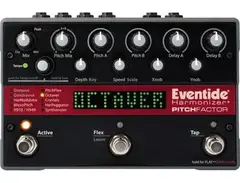
Eventide PitchFactor Harmonizer
4.5 (32)
If you want the most tweakable and versatile octave/harmonizer pedal, then this is it.


Average Price: $421
High-end/Boutique
$100
$301+
Budget
Standard
High-end
- Excellent for diatonic/interval harmonizing and chorus/flange effects
- Versatile across instruments: guitar, voice, synth, loops
- High sound quality, unique sounds not found elsewhere
- True bypass, no residual noise
- See 6 more
- Steep learning curve, not beginner-friendly
- UI could be improved, not as user-friendly as competitors
- Slight low-end roll-off on mono synths
- Screen hard to read, saving presets can be fiddly
- See 1 more
| Bypass | true bypass |
| Power | 9V |
Eventide kind of wrote the book on Octave and Harmonizing pedals. The Famous Eventide H3000 is still, to this day, the industry standard in recording studios for harmonizing and octave effects. The PitchFactor utilizes many of the tones from the H3000, but upgraded, digitally run, and in a compact stompbox.
If you want the most tweakable and versatile octave/harmonizer pedal, then this is it. The only downside is that, although the Eventide UI is straight forward and well designed, if you aren’t used to digitally run pedals, it can be a tad intimidating and there definitely is a bit of a learning curve.
However, once you understand how it works, the PitchFactor is easy to use and can get just about any octave related sound that you could want. Just don’t lose or throw away the instructional manual.
See how artists use this



What Is An Octave Pedal?
An octave pedal is a fairly straight forward concept, which can get very complicated if you dive deep into the technical aspects of the effect. Essentially, an octave pedal creates a note that is in a different octave then the one that you’re playing, either higher or lower depending on what you decide. Then, on many octave pedals, you can choose how much you want to blend the octave that the pedal is making with the octave that you are playing.
Different Ways You Can Use an Octave Pedal
On the surface, octave pedals seem to a bit of a one trick pony; the kind of effect that is fun to have, but perhaps only useful in a very specific setting. However, octave pedals actually have a huge amount of possible uses. One of the most common uses is to pitch shift the guitar down an octave, and use it with a fuzz pedal in order to make single note riffs sound really fat sounding. You can hear this kind of sound in the chorus of "Song Two" by Blur, as well as numerous modern rock and metal bands. Octave pedals can also be used to mimic a variety of other instruments. For example, octave pedals are often used to mimic a twelve string guitar, or if used with a bunch of delay and a volume pedal, can be similar to an organ.
One thing to look for when shopping for an octave pedal is how well it tracks. This is basically a test to see if there’s any perceptible latency as you play fast passages, and the pitch-shifted sound is able to keep up.
Top Ranked Harmonizer & Octave Effects Pedals on Equipboard

-m.webp?v=1784732274)
-m.webp?v=1784818716)
-m.webp?v=1784819021)

About the authors

Paul is a session guitar player who is also a two time BCCMA award winner and a final ballot 'Guitar Player of the Year' Nominee, and has played many large festivals, clubs, theatres, and arenas across the country, done many Radio/TV performances, and opened for artists such as, Thomas Rhett, Carrie Underwood, Randy Houser, Sam Hunt, High Valley, and many more. He is also endorsed by Prestige Guitars and Mission Engineering. Read more
New in Harmonizer & Octave Effects Pedals

$299.00 - $299.99

$177.00 - $179.00


$184.50 - $299.99


-m.webp?v=1784814286)

$135.00 - $349.99


-m.webp?v=1784819650)
$192.41 - $245.99
.jpg)





.jpg)

.jpg)