James Honeyman-Scott
James Honeyman-Scott's Gear



His guitar signal runs to three Boss pedals - a chorus, an overdrive, and a compressor. From there it goes to one of three 100-watt Marshalls (the other two are spares): "I always play with the guitar flat out, and I set the level as it would be for a live rhythm sound. Then if it comes to showing off and doing a solo, I flip on the overdrive. I like a really loud rhythm sound."
Find it on:


His guitar signal runs to three Boss pedals - a chorus, an overdrive, and a compressor. From there it goes to one of three 100-watt Marshalls (the other two are spares): "I always play with the guitar flat out, and I set the level as it would be for a live rhythm sound. Then if it comes to showing off and doing a solo, I flip on the overdrive. I like a really loud rhythm sound."
Find it on:
-m.webp?v=1784876468)
According to an interview by Jas Obrecht for Guitar Player magazine, conducted January 29, 1981, Honeyman-Scott used bandmate, Chrissie Hynde's white telecaster often:
"She's got two Telecasters - a little white one and a metallic green one. And the white one is just one of the most fantastic guitars ever made. I love using that. I use it as much in the studio as possible."
The full in-depth interview is quite fantastic and can be found here:
http://jasobrecht.com/james-honeyman-scott-the-pretenders-qa/
Find it on:


Mentioned in this 1981 Jas Obrecht interview and this April 1981 Guitar Player interview.
Jas Obrecht, 1981
What were you doing prior to co-founding the Pretenders?
I was selling guitars for a living, for a shop in the Hereford. I did gardening too – that was great! And it was during that time – I was out in the garden, you see, digging away, and the radio was on. Nick Lowe came on with [sings] “and so it goes, so it goes,” that number – Elvis Costello’s “Red Shoes.” And they had this big, jangly guitar sound, which is what I’d been wanting to get into for a long while. All of a sudden the radio’s on and there’s this huge guitar sound coming out, like sending out a big Rickenbacker 12-string or something. And I thought, “Ah, my time is here.” So that’s what happened. And then I hooked up with the Pretenders.
What did you use to get that sound?
At that time I was using an Ibanez Explorer that was fantastic – it was stolen. It was incredible. That went through a Marshall. And to get that sound, I was using the Clone Theory pedal made by Electro Harmonix. That’s how I go the sound. And I’m now using the old Boss pedals.
(...) What is the effect on “Precious”?
That would be the Clone Theory through a Harmonizer. I didn’t use a MuTron then.
Guitar Player, April 1981
Cheeks toured extensively for three years without ever recording. After they disbanded. Jimmy started making his living selling guitars in a Hereford shop. During the summer of 1978, after hearing the guitar sounds on new cuts by Nick Lowe and Elvis Costello, he decided that it was time to reenter the music scene: "I was out in the garden, digging away, and Nick Lowe came on with 'So It Goes,' and then came Elvis Costello's 'Red Shoes.' And they had this big, jangly guitar sound, which was what I'd been wanting to get into for a long while. It was a huge guitar sound, like a big Rickenbacker 12-string or something. I thought, 'Ah, my time is here!' To get that sound at first I used a fantastic Ibanez Explorer-style guitar through an Electro-Harmonix Clone Theory pedal and a Marshall."
Find it on:



Honeyman-Scott can be seen playing his pink three-pickup Gibson Firebird at the 1:35 mark in this Top Of The Pops video for the Pretenders song, "Kid." In his 1981 Guitar Player magazine interview with Jas Obrecht, Honeyman-Scott stated that he also owned a '63 single-pickup Firebird.
Find it on:

"I'm using the old Boss pedals now."
(Trace your signal from the guitar to the amp.)
"It goes through three Boss pedals, the little ones that have got noiseless switches. They come in pretty colors. I’ve got a blue one, a green one [laughs]. I’ve got a chorus, an overdrive, and a compressor. I don’t have a harmonizer, but I think I’ll get one."
Find it on:

"And I’m now using the old Boss pedals."
(Trace your signal from the guitar to the amp.)
It goes through three Boss pedals, the little ones that have got noiseless switches. They come in pretty colors. I’ve got a blue one, a green one... [laughs]. I’ve got a chorus, an overdrive, and a compressor. I don’t have a harmonizer, but I think I’ll get one.
Find it on:

Honeyman-Scott can be seen playing a Zemaitis at the 0:39 second mark of this video of the Pretenders performing "Talk Of The Town" live in 1980. At the time of his interview with Jas Obrecht of Guitar Player magazine, conducted January 29, 1981, Honeyman-Scott owned three Zemaitis guitars and a fourth was "on the way." These guitars were custom builds by Tony Zemaitis. Honeymoon-Scott was quite excited about the guitars. Obrecht's interview is quite fantastic. Here is the link:
http://jasobrecht.com/james-honeyman-scott-the-pretenders-qa/
Find it on:

I'm not sure if the year is correct, but the model appears to be. Honeyman-Scott can be seen playing his Gibson ES-335 at the 1:45 mark of this Pretenders live performance for "Brass In Pocket." In his 1981 Guitar Player magazine interview with Jas Obrecht, Honeyman-Scott stated he acquired a 335 when he was 16. According to statements in the interview, during recording sessions for The Pretenders' debut album, Honeyman-Scott multi-tracked the solo bridge on "Mystery Achievement" with his 335 and Chrissie Hynde also "borrowed" his 335 to track her guitar part for the song, "Kid".
Find it on:

Honeyman-Scott can be seen playing a Rickenbacker throughout this video for The Pretenders song, "Message Of Love." In his 1981 Guitar Player magazine interview with Jas Obrecht, Honeyman-Scott lists "a Rickenbacker 12-string" among his guitar collection.
Find it on:


The staccato sound heard at the end of the solo on the Pretenders’ “Tattooed Love Boys” is a direct descendent of Townshend’s trick, and it was performed with aplomb by the late James Honeyman-Scott on his Les Paul. Meanwhile, his Hamer Sunburst had the switch behind the bridge, but Honeyman-Scott carried on regardless. (This effect, accomplished by quickly moving the selector, requires that one pickup is turned off.)
Find it on:

Trace your signal from the guitar to the amp.
It goes through three Boss pedals – the little ones that have got noiseless switches. They come in pretty colors. I’ve got a blue one, a green one [laughs]. I’ve got a chorus, an overdrive, and a compressor. I don’t have a harmonizer, but I think I’ll get one. I think I’ll try one onstage. Pete, the bass player, uses one. And then I go right to the amps. I’ve got three 100-watt Marshalls and three 4×12 cabs, but two of those are spare, I think. I just go through the one. They mike that, and what happens is, I always play with the guitar flat-out, and I set the level as it would be for a loud rhythm sound. And then if it comes to showing off and doing a solo, I just flip on an overdrive. That’s how I like to work it. I like a really loud rhythm sound.
Find it on:

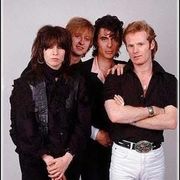
James Honeyman-Scott of The Pretenders is pictured with a Fender Stratocaster Electric Guitar, as seen in a photo shared by Ken Thorn on Pinterest.
Find it on:


JHS can be seen playing this guitar throughout this rare video. One of the only times he appeared to use it live.
Find it on:

The guitar can be seen from 0:34. Another model rarely seen in live performances.
Find it on:

Used for the outro of "Up the Neck", as mentioned in this 1981 Jas Obrecht interview.
On “Up the Neck,” who’s strumming and who’s picking?
Chrissie is doing the strumming, and I’m doing the single-note stuff.
Did she use a Telecaster on most of the tracks?
Yeah. The only cut she didn’t was on “Kid.” She borrowed my 335.
Did you use her Tele for the solo?
Yeah, I used her Tele for the solo. Very observant! Christ, you got that well. She’s got two Telecasters – a little white one and a metallic green one. And the white one is just one of the most fantastic guitars ever made. I love using that. I use it as much in the studio as possible.
The end of that tune almost sounds like a harpsichord.
Oh, yeah. That was done with a Gibson Dove guitar, and the bottom three strings were replaced with top three strings again – a real high tuning, you know? It was high strung. We laid all the picking down like that. Then we did it at half speed and doubled that to get the top notes again. That’s why it sounds like a harpsichord. It’s really difficult to do that, when you’re playing half-speed on a number. It’s done very slow and you have to get each note right on. It’s very difficult, but it turned out great.
Find it on:

In the video titled "THE PRETENDERS - Live Chorus, French TV 11th June 1979," James Honeyman-Scott is seen playing a 1976 Gibson Les Paul Standard Wine Red throughout the performance. This video was uploaded by MrHbsauce on YouTube.
Find it on:


In the video titled "Pretenders Brass In Pocket Live Rehearsal 1979 HD 720 X 720" on YouTube, James Honeyman-Scott is seen playing a Gibson Flying V throughout the performance.
Find it on:
This is a community-built gear list for James Honeyman-Scott.
- Find relevant music gear like Guitars, Amplifiers, Effects Pedals, and other instruments and add it to James Honeyman-Scott.
- The best places to look for gear usage are typically on the artist's social media, YouTube, live performance images, and interviews.
- To receive email updates when James Honeyman-Scott is seen with new gear, follow the artist.