
Pricing and availability




* Product prices and availability are updated by Equipboard every 24hrs and are subject to change. Equipboard may receive compensation for purchases made at participating retailers linked on this site. This compensation does not affect what products or prices are displayed, or the order of prices listed. For more information, please refer to our affiliate disclosure.
Description
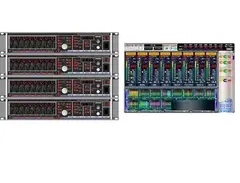
Discover the Aphex 1788A, an 8-channel microphone preamp that merges cutting-edge technology with sleek design, perfect for both stage and studio settings. This versatile 2U rackspace unit is designed to shorten cable runs, ensuring your audio signal remains pristine from the source. The Aphex 1788A shines with its advanced MicLim technology, a proprietary limiter that manages microphone output levels, providing an impressive 20dB of headroom without compromising sound quality. Whether you're capturing the subtle nuances of a live performance or the intricate details of a studio session, this preamp delivers unparalleled clarity.
Engineers will appreciate the 1788A's digitally-controlled Low Noise Amplifier, which allows for precise input gain adjustments in 0.125dB steps, ensuring optimal sound with minimal noise. Its dual, separately trimmable analog outputs offer flexibility, allowing you to feed multiple inputs at ideal levels. For those seeking digital integration, optional modules provide AES/EBU, TDIF, and ADAT outputs, supporting sample rates up to 96kHz.
Easily controlled via Ethernet or MIDI, this preamp integrates seamlessly with modern setups, and its remote capabilities make it a favorite among front-of-house and studio engineers alike. With Aphex's 1788A, you're not just investing in a preamp; you're elevating your entire audio production process.
Key Features:
- 8-channel preamp in 2U rackspace
- Proprietary MicLim technology for 20dB output limiting
- Digitally controlled Low Noise Amplifier with precise gain adjustment
- Two separately trimmable, buffered analog outputs
- Optional digital outputs: AES/EBU, TDIF, and ADAT
- Supports sample rates up to 96kHz
- Remote control via Ethernet or MIDI
- Ideal for live and studio applications
Videos

Aphex Audio
Aphex 1788A Mic Pre Training Video
Aphex 1788A Mic Pre Training Video
Aphex Audio
Reviews
5.0 out of 5
Based on 1 Review and 1 Rating

Exellent remote pre-amps,continuously variable gain control without "zippering" noise and a peak limiter that offers additional dynamic range without clipping the preamp's input.
Occasionally, a manufacturer offers a product that is not only innovative, but has multi-use applications, ease-of-use, loads of functions and great sonic characteristics. Aphex's new Model 1788, a quality eight-channel remote-controlled microphone preamplifier, is just such a product.
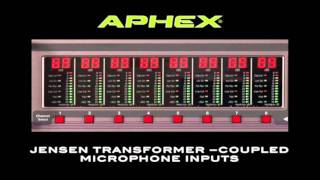
The Aphex 1788 is 3.5" high, 19" wide and 13.25" deep. It weighs in at 14 lb and occupies two rack-spaces. The front panel of the Model 1788 is arranged in five separate blocks (local, control, digital, monitor and test). The local block includes the individual channel status readouts. At the top of each channel is a two-digit gain readout LED that shows the input or output gain setting, depending on the status of the gain select button. Below that, on the right side, is a vertical 12-segment LED meter that indicates the available peak headroom, in 4 dB increments from 0 to 44.
On the left of the LED meter are several key functions: polarity reverse, 75 Hz low cut, 26 dB pad, 48 V phantom power and microphone output limiter. An associated LED lights when any of these functions are being used for each channel.
Buttons and a rotary knob on the right of the eight-channel display engage or adjust these indicators. Under each of the eight channels is a channel select button.
Located to the right of the local block is the control block, which selects communication ports and data rates. The Aphex 1788 using MIDI protocol via the RS-232, RS-422 or MIDI control ports controls up to 16 units at once. The RS-232 port is a three-wire, full duplex connection that can connect to a PC with runs between 50 and 100 ft. A Windows 95/98 remote program provides easy and maximum control of the Model 1788. The RS-422 is a full duplex differential transmission capable of runs up to 4,000 ft. A total of 128 channels of mic preamplification can be used with one control link.
The adjust button in this section selects options for the functions (MIDI, set port, local control). A six-digit global status readout display is located next to an adjust button.
The digital block is an optional module that includes an AES/EBU dB-15 digital output. It is possible to send all eight channels directly to a digital recorder or console. An ADAT digital connector is also included. A TASCAM TDIF DB-25 connector is available as an option ($1,000) for direct connection to digital recorders. This option also sets the synchronization source and sample rate.
A clock button determines either the internal or an external clock as a synchronization reference. Internal clock rates can be set to 32 kohm, 44.1 kohm and 48 kohm. The monitor block makes it possible to monitor each channel separately through headphones. The test block is used to adjust system levels with a 700 Hz test tone.
The Aphex 1788 rear panel consists of a power receptacle that works with a voltage range of 80 to 280 VAC. The eight XLR male input connectors are transformer-balanced with Jensen transformers. The output section provides two separate analog outputs per channel, eight servo-balanced XLR-type transformer-less connectors and a DB-25 multipin connector, transformerless and balanced.
The analog DB-25 connector is marked "aux output" on the rear panel. This allows the inputs to be split and used in live sound for monitors and front of house (FOH) from an optimized microphone preamp, a very nice feature. All XLR-type connectors are wired 2-pin positive (signal). The output levels of the Aphex 1788 (main and aux) are adjustable from +27 dBu to 0 dBu, with sensitive 1 dB increments.
The Aphex 1788 is a full-featured, 8-channel, remotely-controllable microphone preamplifier offering excellent sound quality plus two inventions: continuously variable gain control without "zippering" noise and a peak limiter that offers additional dynamic range without clipping the preamp's input.
In addition to 26 to 65 dB of variable gain, a 26dB pad, polarity reverse, a 75Hz low-cut filter and 12-segment LED headroom meter, each channel includes a unique microphone limiter (MicLim[superscript]TM) before the preamp, preventing clipping altogether and allowing higher gain settings. The main and auxiliary outputs are individually adjustable to match the limiter's operation to the input headroom of connected analog devices. The limiter also assures that the optional digital outputs never hit 'Over.'
All controls can be accessed from the front panel. Channels can be grouped to adjust the parameters or gain of several at once. A headphone amp allows local monitoring. A 700Hz test tone at either -20 or 0 dBfs can be assigned to any channel.
Remote control of up to 16 units (128 channels) can be handled with a single MIDI, RS-232 or RS-422 control line via MIDI protocol. The controller can be anything that talks MIDI or a personal computer. An optional dedicated remote controller, the 1788-R, duplicates the front panel controls and adds clip/limit indication and device selection for 16 units, as well as preset loading and editing. Multiple 1788-Rs can be used in serial with or without a PC, allowing control from various remote locations.
1788 Program Software for Windows 95 is included, providing screens for control and status, or saving and recalling scenes. Its main window duplicates the front panel's control and metering for each device, including grouping functions. In addition to real-time metering, the software displays either peak-hold or absolute maximum levels, updated every half second. It allows up to 20 scene changes, each linked to presets that are named in software, and each snapshot is a MIDI dump containing all device parameters. As the preamps offer glitchless gain changes, scenes are smoothly ramped without muting. The System Setup window is an alternative to the master window that simplifies comparing the settings or programming multiple units. All settings of four 1788s, including channel and device names, can be seen at once, and for larger systems this window scrolls.
Each channel has two independently adjustable balanced outputs. A digital option-24-bit sampled at 32, 44.1 or 48kHz-has three outputs simultaneously: AES/EBU, ADAT optical and TDIF. Connections are eight XLR inputs, eight XLR outputs and DB-25 (Tascam) for the auxiliary outputs. The digital option has AES/EBU on a DB-15, ADAT optical, TDIF on DB-25 and Word Clock in/out on BNCs.
The 1788 is a cost-effective solution for touring acts that want to record their shows as it offers direct digital connection to recorders while the main out is connected to the FOH and the Aux out routed to the monitors. It can substitute for conventional passive splits and offers enhancement over active splits. Placing the preamp closer to the microphone reduces mode noise because gain does not have to be taken at the end of the run. Frequency response effects of capacitance in long mic lines are reduced. Also, loading a mic into a single preamp allows higher quality than loading that mic into several preamps through a splitter. Remote control allows use of fiber systems without an engineer babysitting the preamps.
An internal jumper allows users to "unload" this transformer for a more colorful character, though I prefer the honest transparency offered by the factory-default setting. I used it for several vocal applications, from choir mics to handhelds, where the 75Hz highpass was convenient and the mic limiters were a luxury. It was also used on a Pavarotti show for the two Schoeps MK-4 vocal mics, substituting for the usual active splitter, where it offered an open, clear sound, earning compliments from both the artist and the audience. The auxiliary output allowed separate connection to two more channels in the console, used strictly for foldback. It was also used at field level on shotgun mics used at the SuperBowl for crowd ambience.
8-channel preamp with 60 dB gain, 8 input transformers JENSEN
48V,-20dB pad, Phase Reverse, low cut, limit, mute
- 8 XLR outputs with separate gain,
- 8 analog outputs on DB-25 with separate gain also
- 8 AES outputs on DB15 ABB
- 8 ADAT
- 8 TDIF outputs on sub-D 25
sync I / O rs 232, 422, noon and MLAN
More Aphex Preamps


-m.webp?v=1784698904)
$2,250.00 - $3,866.00
in Preamps Rank


$99.00 - $159.99
in Preamps Rank
.jpg?v=1784574736)


-m.webp?v=1784698464)
$509.00 - $699.99
in Preamps Rank


$1,750.00 - $1,999.00
in Preamps Rank
.jpg?v=1784640202)


$919.00 - $1,285.00
in Preamps Rank


$1,964.84 - $2,830.00
in Preamps Rank


$333.00 - $464.00
in Preamps Rank


$745.00 - $849.00
in Preamps Rank


-m.webp?v=1784698680)
$1,633.00 - $2,095.00
in Preamps Rank


$729.00 - $899.99
in Preamps Rank


-m.webp?v=1784645964)
$273.87
in Preamps Rank


$795.00 - $999.99
in Preamps Rank


$492.00 - $559.99
in Preamps Rank


$849.00 - $999.00
in Preamps Rank


$45.00 - $129.99
in Preamps Rank


$772.45 - $1,799.99
in Preamps Rank


$50.00
in Preamps Rank


$273.87 - $899.99
in Preamps Rank


$143.00 - $168.00
in Preamps Rank


$899.85 - $1,435.00
in Preamps Rank


$1,240.00 - $1,322.00
in Preamps Rank


$492.00 - $579.00
in Preamps Rank


$222.45 - $449.00
in Preamps Rank


$1,375.00 - $1,600.00
in Preamps Rank


$259.00 - $419.99
in Preamps Rank


$649.00 - $699.00
in Preamps Rank


$2,979.00 - $3,655.00
in Preamps Rank


$1,370.00
in Preamps Rank


.png?v=1784580320)


$68.40 - $109.00
in Preamps Rank


$55.99 - $79.95
in Preamps Rank

Accessories & Related Items

Artist usage


Community setups


Similar


Gear Guides







Most Popular Preamps
Most Popular Brands
-
Added to Equipboard on by
efraimidis_vassilisGearIQ 244
-


