



Pricing and availability
We compare 600+ stores and found this item at 4 stores. Prices updated .
Store
Reviews
Price




Average Price: $287
Standard/Professional
$149
$350+
Price Tier
Budget
Standard
High-end
Price History
Based on price data from 4 merchants for "Make Noise Maths". Prices shown reflect NEW condition. Tracking began Apr 2, 2026.
* Product prices and availability are updated by Equipboard every 24hrs and are subject to change. Equipboard may receive compensation for purchases made at participating retailers linked on this site. This compensation does not affect what products or prices are displayed, or the order of prices listed. For more information, please refer to our affiliate disclosure.
Description
Unlock a universe of sonic possibilities with the Make Noise Maths module, a cornerstone of any modular synthesizer setup. This versatile Eurorack component functions as an analog computer for musicians, deftly transforming signals and crafting complex modulations. Whether you're sculpting evolving soundscapes or designing intricate rhythms, Maths is your creative catalyst.
With its intuitive four-channel layout, Maths allows you to perform an array of tasks such as scaling, inverting, integrating, and amplifying incoming signals. Channels one and four act like mirror images, providing versatile options for signal manipulation. The module shines even when idle, generating a spectrum of linear, logarithmic, and exponential functions. Enhanced LED indicators offer a clear visual representation of both positive and negative voltages, ensuring you never miss a beat in your sonic experiments.
The Maths module is not just about traditional modulation; it offers a playground for creative exploration. From generating voltage-controlled envelopes and LFOs to applying portamento for slurred effects, the possibilities are endless. Combine up to four control signals to unlock even more complex modulations, making every performance unique and captivating.
Key Features:
- Versatile 20HP Eurorack module
- Generates linear, logarithmic, and exponential functions
- Functions as an envelope, LFO, oscillator, and slew limiter
- Can amplify, attenuate, integrate, or invert signals
- Combines up to 4 control signals for complex modulations
- Upgraded LED indicators for visual feedback
- Power consumption: 60 mA @ +12V, 50 mA @ -12V
- Requires a Eurorack case and power supply (sold separately)
Owner's manual
Make Noise Maths User ManualProduct specs
| Type | Multi Function Generator Module, Black |
| Analog/Digital | Analog |
| Depth | 0.94" (24mm) |
| HP Size | 20HP |
| Power Usage | +12V/60mA, -12V/50mA |
| Power Supply | Requires Eurorack Case and Power Supply |
FAQs
-
What functions does the Make Noise Maths module provide in a modular synthesizer setup?
-
The Make Noise Maths module acts as a complex function generator, offering envelope generation, LFOs, and signal processing capabilities, making it highly versatile for modulation tasks.
-
Is the Make Noise Maths module compatible with standard Eurorack systems?
-
Yes, the Make Noise Maths module is designed for Eurorack systems, requiring a +12V/60mA and -12V/50mA power supply.
-
Can the Make Noise Maths module be used to generate both audio and control voltages?
-
Yes, the Make Noise Maths module can generate both audio rate signals and control voltages, providing flexibility in sound design and modulation.
-
How much space does the Make Noise Maths module occupy in a Eurorack system?
-
The Make Noise Maths module occupies 20HP in a Eurorack system, making it a compact yet powerful addition to your setup.
-
Does the Make Noise Maths include any built-in mixing capabilities?
-
Yes, the Make Noise Maths includes a mixer section that allows for combining and processing signals within the module.
Videos

loopop
22 reasons the #1 eurorack module is Maths by Make Noise
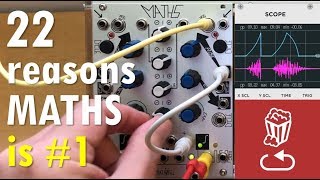
22 reasons the #1 eurorack module is Maths by Make Noise
loopop
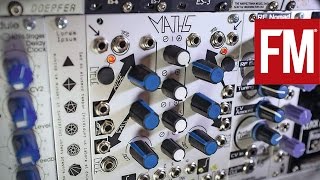
Modular Monthly: A Make Noise MATHS Lesson

MusicRadar Tech
MATHS Lesson, Pt. 1

MAKEN0ISE
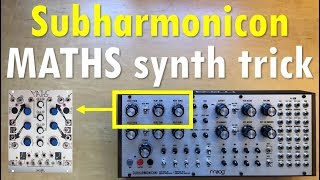
Synth trick: How mimic a Subharmonicon with Maths by Make Noise
loopop
MAKE NOISE MATHS TUTORIAL ~ Eurorack analog computer module

once upon a synth
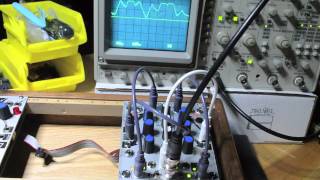
MATHS Advanced Envelope Techniques
MAKEN0ISE

Patch from Scratch: MATHS Drums
MAKEN0ISE

Patch Programming: Ratcheting with MATHS | Make Noise
MAKEN0ISE

MATHS Swirly Bird Grooves
MAKEN0ISE
Reviews
PROS
-
Versatile: called "CV Swiss Army Knife" for modulation, shaping, etc.
-
Essential for Eurorack: nearly ubiquitous in systems for its utility
-
Great for complex modulations with handy features for space-saving
-
Functions as multiple modules in one: EG, LFO, VCO, and more
-
Highly responsive and natural-sounding controls
-
Offers unique outputs like end of cycle for creative patching
-
Helpful in translating digital to analog signals and vice versa
-
Attenuverters and polarizers add depth to sound shaping
-
Encourages exploration and learning in modular synthesis
-
Excellent build quality and thoughtful design choices
CONS
-
Steep learning curve, not immediately intuitive
-
No manual included, requiring online research for full use
Owner Insights
We analyzed real musician discussions from forums and Reddit to find what players love, question, and tweak about Make Noise Maths.
Features and functionality
-
Maths' attenuverters and logic section are crucial for advanced patching, allowing for creative and complex interactions beyond basic function generation.
Source -
The EOC and EOR triggers on Maths can be crucial in shaping dynamic modulations, with some users emphasizing their utility in envelope and LFO applications.
Source -
Maths has full EOR/EOC gates that last for as long as the respective dial that triggers them, unlike Rampage which only offers triggers.
Source -
Maths allows for voltage control over auto-cycling, functioning as an LFO instead of just an AD envelope.
Source -
Maths shines in its patch-programmability, excelling when users patch it back into itself to create complex and involved functions.
Source -
The dual slope generator design allows Maths to function as both an oscillator and a low-frequency oscillator, depending on user adjustments.
Source
Comparisons
-
Users often compare Maths to combinations like Rampage with additional modules for enhanced flexibility, citing the inability of Maths to simultaneously tweak both envelope slopes.
Source -
Falistri is preferred by some for its superior build quality and ability to serve as a complete voice with three patch points, but lacks Maths' mixing/offset capabilities.
Source -
Contour 1 and QARV are seen as compact alternatives, but don't match Maths' logic and attenuverting capabilities, requiring additional modules to achieve similar functionality.
Source -
Joranalogue Contour 1 is praised for its high precision and unique features, although it's noted that it's not equivalent to Maths' comprehensive functionality.
Source -
Befaco Rampage is noted for better documentation and uses regular op amps, unlike the complex LM3900 Norton amps in the Serge DUSG.
Source
Use cases and applications
-
Maths allows for self-patching to exploit its potential as an instrument interface, which some users feel enhances engagement with small modular systems.
Source -
Maths’ four-channel attenuverting mixer is highlighted for its role in pulling and attenuating signals from the middle of patches.
Source -
Maths can be used as a low pass filter by subtly limiting rise and fall times of an AC signal, potentially making it resonant through feedback.
Source
User experience
-
Owners note that Maths can provide DC-offset, range adjustment, and CV mixing which are useful for testing and designing DIY modules.
Source -
Some users find that Maths often ends up as just two large envelope generators, but this limitation is due to not exploring its full potential.
Source -
Many users discover new functionalities of Maths even after years of use, highlighting its capacity for continuous exploration and creativity.
Source -
The module is described as performing functions not initially considered when assembling a first modular setup, highlighting its versatility and utility.
Source
Critic Reviews
5.0 out of 5
Based on 9 Reviews and 43 Ratings

3889
Absolutely essential.
Make Noise Maths is one of the most essential module about the Eurorack modular area. It is a Control Voltage generator and processor based to the Buchla Model 257 and Model 281 function generators. Maths can be used for VC Envelope Generators, VC LFOs, VC Slew Generators, VCF/VCA as well as polarizer/attenuator, clock divider and oscillator. It can translate digital information (clocks and triggers) into analog information (sloped waveforms and continous shifting voltages), and vice versa. The wave shapes can be changed from Logarithmic to Linear to Exponential with a control knob, which also affects their frequency range and timbre. Two cycle buttons convert the functions from triggered or gated envelopes to looping LFOs. Two utility polarizers process CV and/or Audio. When nothing is patched into the Polarizer input, it outputs a static voltage based on the level of the knob. When something is patched in, the polarizers work as attenuverters. The Maths is an essential Eurorack synthesizer module for any style of synthesis.
.jpg?v=1767833554)
565
the most useful eurorack module
Absolutely necessary in every eurorack modular system, at least the most of all. It was defined as the "analog computer" of the modular synthesis. LFO, Envelope Generator, Envelope Follower, Oscillator, all about modulations and many more. For me it's absolutely needful and it's present in every patch I do. It's the Photoshop of the modular synthesis.

126
a super Comp
Gives you instantaneous controls through Exponential and Logarithmic slews as well as 4 attenuverters that create offsets and acts as a mixer, You can also control the rise and fall of shapes! Everything on the bottom of the module is an output, everything on the top is an input. At the moment i trigger gates with the moog 32 and find new ways to control parameters through basic trial and error of patching.

5454
Function.
A function generator- be it LFO, envelopes, modulation of those envelopes, hell- it can be an oscillator too, etc.
This is the kinda beast that is incredibly useful when explored with restraint & intention- hell, it’ll bring surprises too.
A incredibly HUGE value for money. Huge.
Best enjoyed with an oscilloscope for a better understanding of all that’s possible.


265
Fantastic!
I love this module! It is by far my favorite one, it has so many features that I'm still discovering and adding into my book of tricks

278
Summed&Dot
MATHS is an analog computer designed for musical purposes. Amongst other things, it will allow you to:
Generate a variety of linear, logarithmic, or exponential triggered or continuous functions Integrate an incoming signal With no sign..

167
Should be required with any modular!
This thing is perfection. I cannot imagine I would be nearly as pleased with my modular if I didn't have this.

Artist usage
Add artist

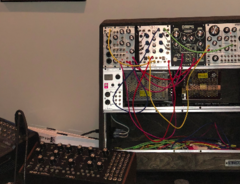
In this photo of one of Deadmau5's modular synthesizers, the Make Noise Maths module is hiding two modules to the right of the grid of green lights on the left.


In this photo, you can see the Make Noise Maths module in the picture posted by Nigel Godrich on Twitter.


The blue and white Maths module can be seen on the lower-right of Thijs' modular synthesizer, as seen from the first photo of his Tumblr post.


In this podcast called Tape Notes, TN:122 James Blake, James mentions learning about how to use the "Make Noise Maths" at 00:20:06

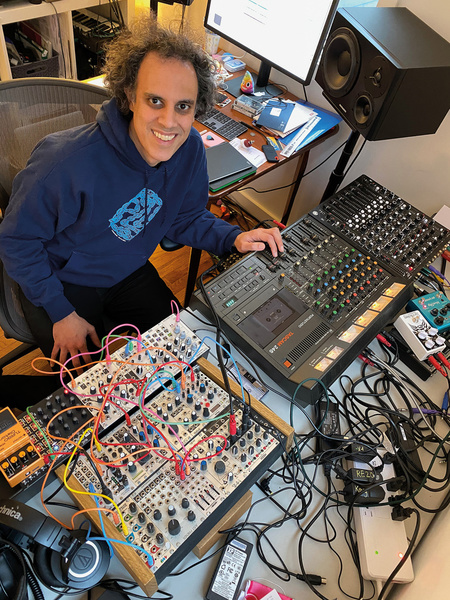
Visible in this photo from this August 2021 Sound on Sound interview.


Visible throughout this September 23, 2020 video.


Seen in Mick Gordon's Eurorack setup at 0:22 in the video for "BFG Division".


In this photo of Joey's modular from the gizzverse listing for the b3k ocular, you can see the black MATHS model in his system.


Picture from their Facebook of them playing with their modular gear. Maths is in the middle row.


0:00-0:02 top left of Richard's video, you can see the CV modulation / CV processing module.

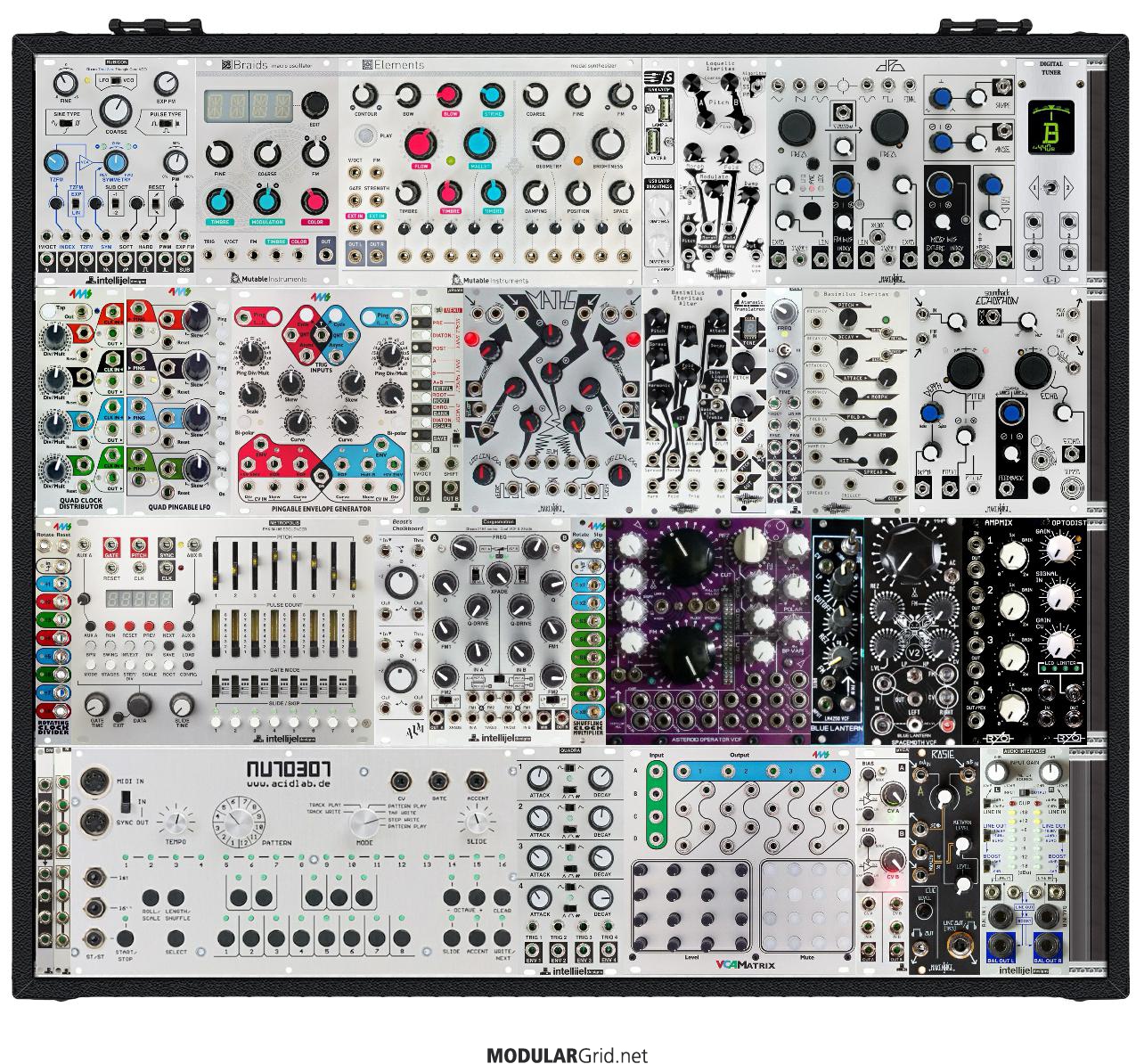
In this digital guide to JFK's modular synth, linked on MSTRKRFT's official website, the Maths is present


Album Usage
The Make Noise Maths has been featured on the following albums:

Genre Usage
Based on how artists on Equipboard use this gear, it is most commonly found in the following genres.
Used With
Based on how musicians on Equipboard use Make Noise Maths, it is most commonly used with the following gear.


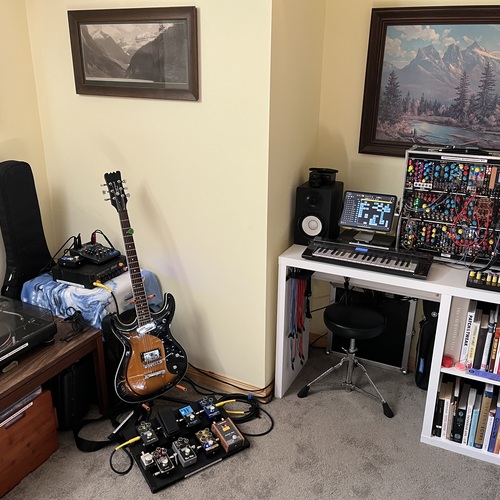
Community setups
Show yours


.jpeg?v=1778511529)


Similar
Add recommendation1 alternative for Make Noise Maths, curated by the Equipboard community.

$290.00
More Make Noise Modular Synthesizers

$1.29 - $3,421.95
in Modular Synthesizers Rank


$599.00
in Modular Synthesizers Rank


$489.00 - $499.00
in Modular Synthesizers Rank


$525.00
in Modular Synthesizers Rank


$389.00 - $399.00
in Modular Synthesizers Rank


$96.92 - $239.00
in Modular Synthesizers Rank


$290.00
in Modular Synthesizers Rank


$199.00 - $219.00
in Modular Synthesizers Rank


$379.00 - $409.00
in Modular Synthesizers Rank


$399.00 - $438.00
in Modular Synthesizers Rank


$388.16
in Modular Synthesizers Rank


$269.00 - $282.00
in Modular Synthesizers Rank


$238.33
in Modular Synthesizers Rank


$199.00 - $215.00
in Modular Synthesizers Rank


$179.00 - $185.00
in Modular Synthesizers Rank

$297.91
in Modular Synthesizers Rank


$309.07
in Modular Synthesizers Rank


$259.00 - $3,421.95
in Modular Synthesizers Rank

$9.00 - $4,495.00
in Modular Synthesizers Rank


$249.00
in Modular Synthesizers Rank

.jpg?v=1780236581)

$430.62
in Modular Synthesizers Rank


$249.00 - $279.00
in Modular Synthesizers Rank


$101.15
in Modular Synthesizers Rank


$108.19 - $165.00


$140.00 - $190.00


-m.webp?v=1780758471)


$2,220.00 - $3,421.95


Accessories & Related Items


Most Popular Modular Synthesizers
Most Popular Brands
-
Added to Equipboard on by
 torchandnail
Gear IQ 261
-


