This page about Casio GZ-5 is a stub. You can help improve it:


Pricing and availability




* Product prices and availability are updated by Equipboard every 24hrs and are subject to change. Equipboard may receive compensation for purchases made at participating retailers linked on this site. This compensation does not affect what products or prices are displayed, or the order of prices listed. For more information, please refer to our affiliate disclosure.
Description
The Casio GZ-5 (mini keyboard with MIDI-out) This was likely the world smallest MIDI keyboard with integrated sound and speaker. But it has only 10 preset sounds, no rhythm, and despite Casio gladly called it "midi master keyboard", also the MIDI playability is very restricted since it not only lacks velocity but even the pitch and modulation wheels are fake and only behave like buttons instead of sending intermediate analogue values. In MIDI mode the internal sound is disabled and the preset sound buttons control MIDI parameters. 2 slide switches set the velocity and keyboard octave range with each 6 steps, but really annoying is that the pitch & velocity wheels have only 1 step (like a button switch). The internal sound mode is not interesting at all; there are only 10 preset sounds (taken from Casio SA-1) and no rhythm; unfortunately even the octave and velocity slide switches don't work here; only pitchbend works and the modulation wheel adds a vibrato. (Note: This keyboard is not worth to buy for its internal sound unless you want the pitchbend, vibrato and 4 note polyphonic mini keys; other SA-series keyboards sound is more versatile. The GZ-5 is mainly interesting for laptop musicians or mini keys freaks those want to use MIDI, but even for this it is nothing great, thus do not pay too much for it.) main features:
32 mini keys built-in small speaker main voice polyphony 4 notes 10 OBS preset sounds {piano, e. piano, vibraphone, organ, e. guitar, e. bass, strings, brass, flute, synth-lead} pitchbend wheel (up/ down, each 1 step) modulation wheel (only up, 1 step) volume +/- buttons (6 steps) in MIDI mode: velocity slide switch with 6 steps {pp, p, mp, mf, f, ff} octave shift slide switch with 6 steps {C1..C6} OBS preset sound buttons select MIDI functions {program change, velocity, volume, pan, expression, hold 1, soft, effect depth, fine tune, coarse tune} and act as cipher buttons {0..9} buttons "control", "MIDI ch.", "bend sense" volume buttons control "bend curve", "mod. depth" sound hardware like Casio SA-series (with less static noise than SA-1) CPU "OKI M6387-A23, 5102304, Japan" (30 narrow pin DIL) jacks for AC- adapter & MIDI- out The pitchbend and modulation wheel of this instrument are a similarly bad hoax like the scratch disc of Casio Rapman RAP-1, because they contain no analogue potentiometers but only mechanically simulate button presses on silicone contacts (on and off). At least their value range can be apparently adjusted somehow by entering numbers in MIDI mode. Casio really should have added real analogue controls here, since these fake wheels disqualify this self- claimed "MIDI master keyboard" far more for serious use than the lack of velocity sensing keys. The PCB looks like classic SA-series single chip hardware. (I haven't examined the hardware closer yet.)
In "internal" (sound) mode only the pitchbend range can be adjusted among 4 depths; press "bend sense", type a cipher between 0 and 3 for the number of semitones per direction and press "enter" (i.e. 0=off). The pitchbend always glides quite fast when the wheel is moved. The modulation wheel adds a 6Hz vibrato so long it is pressed. The 10 OBS preset sounds are simply a subset of Casio SA-1; "e. piano" corresponds to its "elec piano", "organ" to "jazz organ", "e. guitar" to "elec guitar", "e. bass" to "elec bass", "brass" to the famous tooting "brass ens.", "flute" to "quena", "synth-lead" to "synth-reed". (If you like the vibrato sound style of this thing, also watch out for the fullsize MIDI keyboard Kawai PH50, which has plenty more of such sounds with genuine continuous pitchbend and modulation control through a joystick.)
Like with midsize SA-series keyboards (see Casio PA-31) the main voice is 4 note polyphonic and hisses less than those 2 note polyphonic mini keyboards, and like there the volume control and preset sound selection does not change held notes, which can be used for live play tricks; here even the buttons don't play disturbing click noises. But the very limited count of preset sounds and the total lack of rhythm makes the internal sound source quite useless. Possibly there was too little ROM memory in the single chip CPU to implement the MIDI functions together with complete SA-series 100 ToneBank. But even when it were more expensive; a fully functional SA-1 with MIDI- out, MIDI- in, working octave switch and real analogue pitch and mod wheels would have been much more fun than this crippled thing. For a highly compact laptop MIDI keyboard the large speaker section and bulky case of the GZ-5 only wastes space, thus the GZ-5 is not really good for anything. (The SA-1 case was smaller and much lower.)
Videos

Edward Jones
Casio GZ-5 Demonstration by Edward Jones aka Loscha
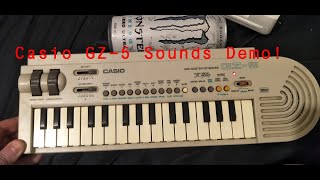
Casio GZ-5 Demonstration by Edward Jones aka Loscha
Edward Jones
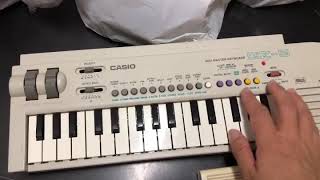
CASIO GZ-5 試し弾き

評論放送 Hyoron-broadcast
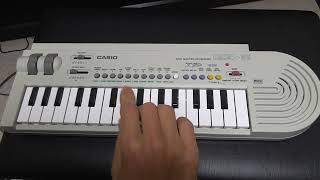
【発車メロディ】せせらぎ play on CASIO GZ-5

harukichi_a
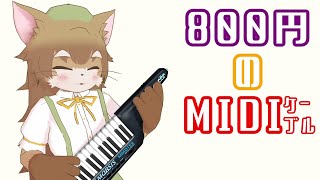
MIDI-USBケーブル🎹CASIOのGZ-5というキーボードをパソコンに接続したくて安いのを買ったけど微妙な結果になっちゃったにゃ【Cakewalk by BandLab, 3tene】

カチュアさんの動画
Reviews
Owner Insights
We analyzed real musician discussions from forums and Reddit to find what players love, question, and tweak about Casio GZ-5.
Features and functionality
-
The GZ-5's digital wheels are a common point of criticism; users favor analog wheels for more nuanced control.
Source
Use cases and applications
Based on 0 Reviews and 0 Ratings
Artist usage
Add artist
Genre Usage
Based on how artists on Equipboard use this gear, it is most commonly found in the following genres.
More Casio Synthesizers


.png?v=1784159848)


.jpg?v=1784215364)


.jpg?v=1783709979)


.png?v=1783958482)


.png?v=1783943851)

Community setups


Similar


Gear Guides









Most Popular Synthesizers
Most Popular Brands
-
Added to Equipboard on by
 shiba_inu_jedi
GearIQ 20110
-


