



Pricing and availability
We compare 600+ stores and found this item at 1 store. Prices updated .
Store
Reviews
Price




Average Price: $75
Budget/Beginner
$200
$801+
Price Tier
Budget
Standard
High-end
* Product prices and availability are updated by Equipboard every 24hrs and are subject to change. Equipboard may receive compensation for purchases made at participating retailers linked on this site. This compensation does not affect what products or prices are displayed, or the order of prices listed. For more information, please refer to our affiliate disclosure.
Description
The E-Mu Proteus 1 is a landmark in the world of digital sound modules, offering musicians a remarkable palette of tones to enhance their creative expression. Released in the late 1980s, this module cemented its place in music history with its legendary 16-bit ROM samples, which were cutting-edge at the time. It includes a diverse array of sounds, from lush orchestral strings to punchy brass and dynamic basses, making it a versatile tool for both live performances and studio sessions.
The Proteus 1 stands out with its intuitive interface, allowing musicians to effortlessly select and modify sounds with precision. Its robust sound architecture provides access to over 192 preset sounds that can be further customized to meet individual artistic needs. This module is perfect for those looking to add authentic vintage tones to their setup without the hassle of complex programming.
Key Features:
- 16-bit digital sound engine
- Over 192 high-quality preset sounds
- Intuitive user interface for easy navigation
- Extensive library of orchestral, brass, and bass sounds
- MIDI compatibility for seamless integration with existing setups
- Compact design ideal for studio and live use
Product specs
| Brand | E-MU Systems |
| Model | Proteus/1 Rackmount 32-Voice Sampler Module |
| Finish | Black |
| Year | 1989 |
| Made In | United States |
| Categories | Digital Synthesizers, Rackmount Synths |
| Analog / Digital | Digital |
| MIDI I/O | MIDI Input, MIDI Output, MIDI Through |
| Polyphony | 32 Voices |
FAQs
-
What type of sounds does the E-Mu Proteus 1 offer?
-
The E-Mu Proteus 1 provides a collection of general sounds from the Emulator library, suitable for a wide range of music production applications, including pop, rock, and electronic genres.
-
How many voices can the E-Mu Proteus 1 play simultaneously?
-
The E-Mu Proteus 1 features 32-voice polyphony, allowing for complex sound layering and rich musical arrangements.
-
What are the MIDI connectivity options for the E-Mu Proteus 1?
-
The E-Mu Proteus 1 includes MIDI Input, MIDI Output, and MIDI Through ports, facilitating seamless integration with other MIDI-compatible equipment in your setup.
-
Is the E-Mu Proteus 1 suitable for live performances?
-
Yes, the E-Mu Proteus 1 is rackmountable and offers reliable sound quality, making it a practical choice for live performances and studio use.
-
How can I reset the E-Mu Proteus 1 to factory settings?
-
To reset the E-Mu Proteus 1, hold down "master" and "edit" while powering it on, then navigate to the diagnostics mode and select "initialize" to restore factory settings.
Videos

Doctor Mix
The Emu Proteus 1 In Action
The Emu Proteus 1 In Action
Doctor Mix
E-mu Proteus/1 demo

SynthMania
E-mu Proteus/1 Initial Thoughts by The Daydream Sound

The Daydream Sound
E-mu Systems Proteus 1 - Factory Presets (Sounds Only)

wolfgang S vukan
Emu Proteus 1 Demo Number 1 - DARK ALLEY

Mystic Frequencies
E-MU PROTEUS/1 XR - (1989) - FACTORY SOUNDS - REVIEW by TIAGO MALLEN #vintage

Tiago Mallen
E-MU Proteus 1 different patterns 1990s 80s Demo

Microesfera
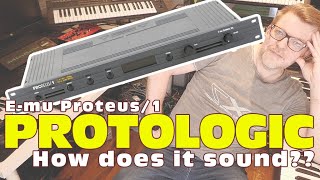
Emu Proteus/1 Protologic | How does the expansion card sound?

SynthFellow
Reviews
PROS
-
Vast library of professionally sampled instruments
-
Pristine sound quality integrates well in modern mixes
-
High multi-timbrality suitable for complex arrangements
-
Versatile internal effects enhance output subtly
-
Easy repairability with generic, easily replaceable parts
-
Excellent MIDI integration with minimal lag
-
Unique nostalgic sounds, ideal for specific genres like vaporwave
-
Clean output with perfect isolation for recording
-
Notable for punchy and hard bass sounds
-
Cost-effective for retro and experimental music production
CONS
-
Some sounds may feel dated or too niche
-
Occasionally misinterprets MIDI note length and pitch
-
Lacks onboard effects, relying on external processing for enhancement
-
Limited appeal outside specific musical styles or production needs
Owner Insights
We analyzed real musician discussions from forums and Reddit to find what players love, question, and tweak about E-Mu Proteus 1.
Features and functionality
Comparisons
-
Proteus 2000 offers a completely different sound profile compared to the Proteus 1, thanks to its Composer ROM with 8 banks and over 1000 samples.
Source
User experience
Mods and upgrades
-
Proteus 2000 allows for up to 4 ROM slots, offering significant expansion potential despite the high cost of individual ROMs.
Source
Setup and maintenance
-
The Proteus/1 XR may lose presets if the internal battery dies, requiring replacement to restore functionality.
Source -
Owners report that the SysEx transfer speed settings might need adjustments for successful data transfers.
Source -
A missing +12v connection can cause audio issues; resoldering the ribbon cable to the PCB can resolve this.
Source -
Surface mount reflow requires steady handwork, flux, and patience; improper technique risks bending legs and damaging PCB pads.
Source -
Voltage regulators convert -12 and +12 to -5 and +5 for the audio amp stage and DACs, critical for proper sound output.
Source
Software and compatibility
Critic Reviews
4.0 out of 5
Based on 2 Reviews and 12 Ratings

219
50% gold, 50% fools!
I'm going to start by saying that if you've ever used digital recreations of the Proteus series, you're missing out. The soundfont files for the Proteus lines that are floating around are really inaccurate and sound really bad, and various digital recreations are inaccurate in one way or the other. You won't get anything good, unless you get the real deal.
That being said, this is a fun little synth with a cute set of sounds, I picked mine up earlier this year, and while I've not used it much for actual production, the playing around I've done with it has been quite a treat as I find it to be very fun to fiddle with and see what patches I can mix together to get really cool sounds, plus this thing sounds cool on its own despite having no onboard EFX, no clue how they pulled it off but the 'fakery' they do for simulating things like reverb trails on strings is smart and well done.

26907
Great write-up :) So sample sets made from the original equipment won't do this thing justice?

530
Nothing to rave about, but it changed an industry when it came out
Quoted from Vintagesynth.com
http://www.vintagesynth.com/emu/proteus.php
Throughout the 1990’s, E-mu came to be known for its rack-mounted synth and sampler modules. In 1989, the Proteus was the first rack-mount module E-mu produced, and it was a huge success for the company. The Proteus 1 is an economical one-space module consisting of your basic rock and pop sounds. It has 4 MB of sounds from the EIII library such as samples of pianos, organs, strings, horns, guitars, basses, drums, Latin percussion, and more all at your fingertips. The Proteus offers professional features such as full 16-part MIDI multitimbrality, 32-voice polyphony, 16-bit ROM samples, six individual polyphonic outputs and extensive editing and modulation capabilities. There is also E-mu's RMidiPatchS that allows direct real-time control of over 40 parameters for keyboard, midi controllers, internal LFOs and envelopes. It has been used by Astral Projection, Pet Shop Boys, Vangelis, Genesis, and Information Society.
Artist usage
Add artist
In his YouTube video titled "E-mu Proteus | The Module EVERYONE wanted!", Espen Kraft discusses his E-Mu Proteus 1, exploring the history and programmability of this popular sound module series.

:format(jpeg):mode_rgb():quality(90)/discogs-images/R-3089190-1374902675-4218.jpeg.jpg)
E-mu Proteus is included in list of instruments played by Suzanne Ciani, and the Proteus 1 is the only version of the E-mu Proteus that existed when this album was recorded in 1989.


The Synclavier system may be at the heart of the studio, patched through a Soundcraft Sapphyre LC mixer, but that's not it for "MIDI boxes", as Mark refers to them: the studio also accommodates a Roland S760 sampler, Kurzweil MicroPiano module, an Emu Proteus 1, 2 (source of the famous X‑Files whistle, in combination, apparently, with a sample of Snow's wife whistling!) and 3, Emu Morpheus, Korg M1R and Wavestation SR. But these are adjuncts to the core sound produced by the Synclavier and its large library: "I have all these great samples on the Synclavier's magneto drives." Mark doesn't do much sampling of his own: "There are so many sample disks available that I have people transfer them onto Synclavier format." And is there anything else he'd like to add to the studio? "Well, the only thing that means anything to me is new sounds or new combinations of sounds. All I care about is if somebody has a great new sound library. That's what I'm looking for. Since my background is music, rather than electronics and technology, I just know as much as I have to. There are so many other composers who know about sampling rates and all that technical stuff, but none of that really interests me. So apart from new sounds, I could maybe upgrade the RAM and the number of voices on the Synclavier..."


Marty O'Donnell began to show a video of his studio that he and Mike own in the 1992, this showcase synths and gear he own at the time. This is during a interview he had with Michael Salvatori, highlight from 1:14:37 to 1:16:58.
Following Synths shown are: Emu Proteus 1, 2, 3, Yamaha DX7.


"Adams does his composing at his home studio in Berkeley, which consists of several Yamaha keyboards, including an SY77, SY99 and Electone, Korg Wavestation, Emu Proteus 1 module and Emax II, Kurzweil K2000, Lexicon LXP15 reverb, Macintosh computer with software such as Performer and Blank Software's Alchemy, and a small 16-channel desk ("I can't remember the name. I only use this studio for writing, and I write as much with the sequencer as with pen, paper and piano")."

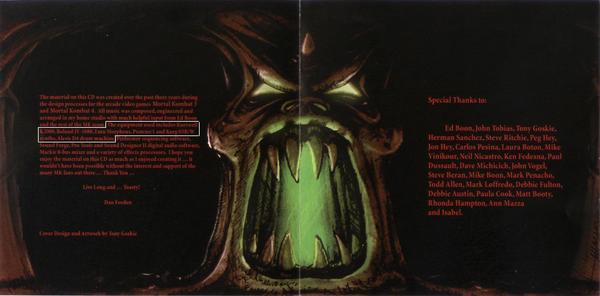
Included in the list of equipment used by Dan Forden in the liner notes of one of the Mortal Kombat soundtracks.


The BBC Radiophonic Workshop's use of the E-Mu Proteus 1 sound module is documented in the workshop's diary, as noted in the source provided by Whitefiles.

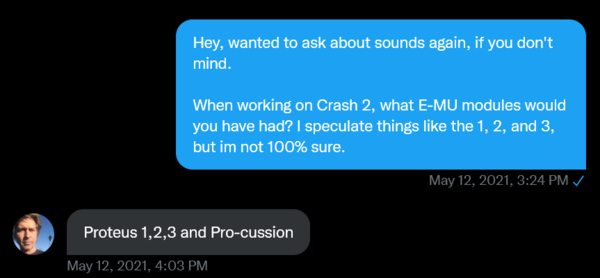
When asked in regards to the modules Josh used on Crash Bandicoot, he said he used a Proteus/1, 2, and 3, Pro-cussion, Vintage Keys, Morpheus, and the Carnaval. Recalls all of them being the standard version. Later replaced either a Proteus/1 or 2 with a Proteus 2000.


From "Musician" magazine, December 1992 found on Prince.org:
LEVI SEACER plays a Gibson Epiphone ("Because my stuff is clean stuff") straight into the board. He has a rack-mounted Zoom unit 9010, a Cry Baby chorus pedal, a Roland GPS and a Boss digital delay pedal. On "Thunder" and "Live for Love" Levi pulls out an Ibanez guitar with double humbucking pickups. Levi uses D'Addario strings.
When TONY U. reaches for a guitar, it's either a Charvel or a hollowbody Epiphone. Tony's strings are either GHS lights or Dean Markleys. He has a Zoom effects processor.
SONNY THOMPSON plays an Oswald bass (though be admits his favorite is an Alembic, "a great bass") with a GB8 effects processor, an Akai Octaver and a Boss Octaver. Sonny uses a Heavy Metal distortion pedal and plugs into a Trace Elliot amp. He prefers GHS heavy strings because "they seem brightest- they keep the boing longest."
ROSIE GAINES plays a Hammond organ onstage, and has a Korg and Roland D-50 MIDI'd to the Hammond. Rosie sings through Shure microphones. Rosie is also leaving the NPG to go out on her own.
TOMMY BARBRELLA plays a Roland A80 and an A50 controller, a Korg T3, an old Prophet which he uses on "Kiss" and a few others "for that old analog sound." Tommy also carries a new Roland JD800, a couple of E-mu E-max 2s, a Proteus 1 and Proteus 2, and a Roland D550.
MICHAEL BLAND's drums are a combination of Sonor, Yamaha and Gretach, with Zililian cymbals and Vater sticks. Trying to get mere details out of Michael is useless. "I abhor shop talk," he says. "I don't know when we change heads, I don't know when we get new cymbals. I don't have any emotional attachments to gear at all."


The instrument appears on the list of instruments on official artist's website (http://olszak.pl/).


Rémi Gazel utilized the E-Mu Proteus 1 sound module at Studios de la Seine to record music for the Rayman 1 PSX soundtrack. This information is detailed in a discussion on Rayman Pirate-Community regarding the sound modules and sample CDs used in Rayman games.


List of equipment at his studio:
KEYBOARDS F Kaim & Son grand piano Korg SG1D master keyboard
SAMPLERS Akai S1000HD Akai CD3000
SOUND MODULES Emu Proteus 1 Emu Proteus 2 Orchestral Emu Proteus 3XR World Emu Morpheus Sequential Circuits Prophet 2002
DRUM MACHINE Roland R8
COMPUTING & SOFTWARE Atari 1040ST Emagic Notator Time + Space sample CD‑ROMs
RECORDING Alesis ADAT (x5) Alesis BRC remote control Soundtracs Jade mixer Drawmer dual gate TC Electronic M5000 digital effects Lexicon PCM70 digital effects
Album Usage
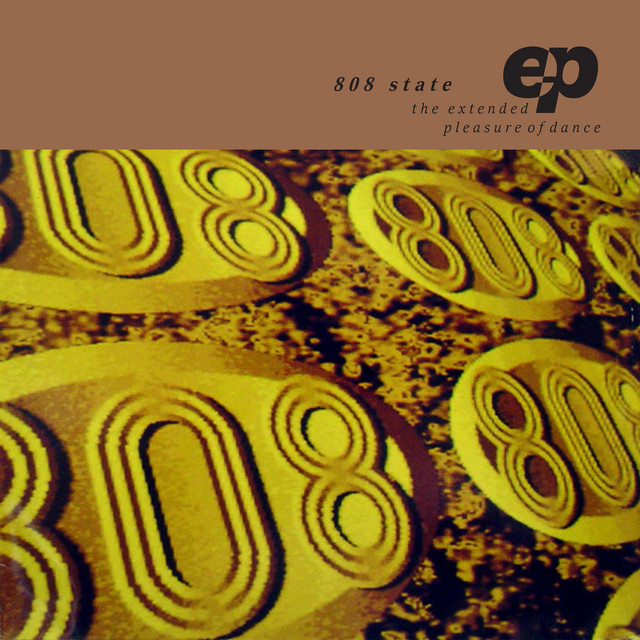
The E-Mu Proteus 1 has been featured on the following albums:
Genre Usage
Based on how artists on Equipboard use this gear, it is most commonly found in the following genres.
Used With
Based on how musicians on Equipboard use E-Mu Proteus 1, it is most commonly used with the following gear.


Community setups
Show yours.jpeg?v=1725818427)

More E-Mu Sound Modules
$49.99
in Sound Modules Rank


$626.93
in Sound Modules Rank


$41.20
in Sound Modules Rank


$399.00
in Sound Modules Rank
.jpg?v=1783256941)


$556.31
in Sound Modules Rank


$1,671.81
in Sound Modules Rank


-m.webp?v=1783238222)
$350.00
in Sound Modules Rank


$194.73
in Sound Modules Rank


$1,250.00 - $1,999.99
in Sound Modules Rank


$1,350.00
in Sound Modules Rank


$906.26
in Sound Modules Rank


$298.54
in Sound Modules Rank

$2,299.00 - $2,333.00
in Sound Modules Rank


$550.00
in Sound Modules Rank


$119.00
in Sound Modules Rank


$261.00
in Sound Modules Rank


.jpg?v=1783200117)

$500.00
in Sound Modules Rank


$3,900.00
in Sound Modules Rank

$4,999.99
in Sound Modules Rank


$495.00
in Sound Modules Rank


$1,250.00
in Sound Modules Rank


$65.55
in Sound Modules Rank

Accessories & Related Items


Similar


Most Popular Sound Modules
Most Popular Brands
-
Added to Equipboard on by
enorthbyGear IQ 530
-


