

Pricing and availability
We compare 600+ stores and found this item at 1 store. Prices updated .
Store
Reviews
Price




* Product prices and availability are updated by Equipboard every 24hrs and are subject to change. Equipboard may receive compensation for purchases made at participating retailers linked on this site. This compensation does not affect what products or prices are displayed, or the order of prices listed. For more information, please refer to our affiliate disclosure.
Description
The MIDI Looper works with MIDI data (notes, CCs, clock signals), NOT AUDIO, to allow for MIDI instruments to explore the creative/performative workflow of audio loopers (pedals, rack gear, etc) with the performance data of MIDI, rather than the resultant audio signal. This allows musicians to create loop based music with performance options not previously available with audio, such as true quantization, extensive overdub/undo history, and changing instrumentation/voicing of an already-captured performance. The MIDI Looper allowed 4 tracks of MIDI looping with separate lengths, quantization, editing, and history. It's simple 2-button, 2-knob interface allowed for deep, intuitive usage for jamming or other loop-based exploration.
From the Future Artist Website: "The MIDI Looper serves as the automated helping hand for the electric piano, synthesizer or accordion player. It helps to perform live sessions as well as to produce complex melodies." "To play accurately to the beat and to record a perfectly played note sequence is a challenge, not only for beginners but also for professionals. By using the MIDI Looper the musician can record a MIDI not sequence and quantize note patterns dynamically. The high polyphony allows complex melodic and tonal variations by parallel processing of MIDI note and controller data. By using an additional foot switch, the musician can entirely concentrate on playing the instrument with both hands. "
Designed, created, and demo'ed at conferences by Matthias B. of Future Artist between 2015-2022.
This product is separate from a "MIDILOOPER" released by Bastl in 2021.
Product specs
| Brand | BASTL Instruments |
| Model | Midi Looper |
| Finish | Black |
| Year | 2013 - 2020 |
| Categories | Modular Synth Splitters / Hubs |
| Modular Synth Format | Desktop Modular |
FAQs
-
What is the primary function of the BASTL Instruments MIDI Looper?
-
The BASTL Instruments MIDI Looper is designed to record, loop, and manipulate MIDI data, allowing musicians to create complex sequences and patterns in real-time.
-
Is the BASTL Instruments MIDI Looper compatible with all MIDI devices?
-
Yes, the MIDI Looper is compatible with any device that supports MIDI, making it versatile for use with keyboards, synthesizers, and other MIDI-enabled equipment.
-
Can the BASTL Instruments MIDI Looper be used in a live performance setting?
-
Absolutely, the MIDI Looper is well-suited for live performances, offering intuitive controls and real-time looping capabilities to enhance musical creativity on stage.
-
Does the BASTL Instruments MIDI Looper require external power?
-
The MIDI Looper typically requires a standard power supply compatible with its specifications to function, ensuring reliable performance during use.
-
What are the standout features of the BASTL Instruments MIDI Looper?
-
Key features include real-time MIDI recording, looping, and manipulation, along with user-friendly controls that make it ideal for both studio and live environments.
Videos

Bastl Instruments
Introducing the Bastl Midilooper
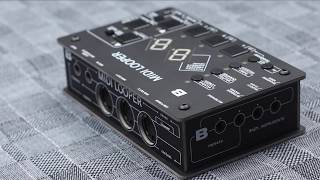
Introducing the Bastl Midilooper
Bastl Instruments
BASTL MIDI LOOPER sneak peek + Bass Station 2 Jam

True Cuckoo
Superbooth 2018: Simple but Fiendishly Clever MIDI Looper from Future Artists

sonicstate
Midilooper - Connectivity and Setup - Video Manual Part 1
Bastl Instruments
Reviews
Owner Insights
We analyzed real musician discussions from forums and Reddit to find what players love, question, and tweak about MIDI Looper.
Software and compatibility
-
USB MIDI connections for loopers, like on the RC-500, can struggle with jitter, causing synchronization issues and affecting the loop's audio quality.
Source -
The Sand app for iOS offers deep MIDI hardware control and ongoing updates, making it a strong contender for users seeking flexible MIDI looping solutions.
Source -
Boss RC-600 offers up to 16 programmable MIDI assigns per memory slot, allowing extensive customization and control through MIDI commands.
Source
Use cases and applications
-
The EMU Command Station is suitable for preset track lengths but lacks the ability for quick edits, making it better for structured performances.
Source -
Using a dedicated clock signal device like CLOCKstep:MULTI can ensure tight sync between DAW and external MIDI devices, crucial for achieving reliable loop synchronization in live setups.
Source -
Boomerang III allows for a master loop synced to MIDI clock, with three slave loops that can be set to multiples of the master loop's length for diverse looping options.
Source -
The RC-500, when used with Digitakt, allows for seamless control over loop operations via MIDI, such as start/stop and record, enhancing live performance setups.
Source
User experience
-
The Retrokits RK-008 is noted for capturing MIDI CC messages effectively, allowing detailed control over synth parameters like frequency and resonance.
Source -
The RC-500 is sensitive to MIDI jitter when using USB, which can lead to undesirable granular audio artifacts if the clock isn't stable.
Source -
Despite some MIDI sync issues, the RC-505 can work effectively when slaved to certain sequencers, though it may produce artifacts if the tempo changes even slightly.
Source
Features and functionality
-
The Pioneer Toraiz Squid allows real-time editing with auto-recording of the last 10 changes, although it is limited to 4-bar patterns which can be chained.
Source -
The OXI One supports up to 64 bars, undo/redo up to ten commands deep, and allows pattern editing on the fly, making it versatile for complex live setups.
Source -
The Bastl MIDI Looper offers 3 channels of MIDI looping and is praised for its intuitive operation, making it highly effective for live performance.
Source -
The Pigtronix Infinity 3 supports MIDI commands for starting, stopping, and recording loops which can be synced with sequencers like the Digitakt.
Source -
Boomerang III's simplicity stands out, as it only requires MIDI clock for sync and has no need for additional MIDI CC or PC messages unless paired with a custom controller.
Source -
The Boomerang III can sync and quantize loops to MIDI clock with a 5-pin cable, allowing for seamless live performance integration without extensive setup or programming.
Source
Comparisons
-
The Looperlative LP-1 is noted for its stable MIDI clock sync, suggesting the LP-2, being a software fork, would also perform reliably in this capacity.
Source
Critic Reviews
Based on 0 Reviews and 0 Ratings
More MIDI Controllers
-m.webp?v=1783868404)
$101.49 - $799.00
in MIDI Pad Controllers Rank


.jpg?v=1783828865)

$405.89
in MIDI Pad Controllers Rank


-m.webp?v=1783868471)
$85.00 - $149.50
in MIDI Keyboard Controllers Rank


$237.30 - $349.99
in MIDI Pad Controllers Rank


$299.00 - $350.00
in MIDI Pad Controllers Rank


$23.88 - $217.39
in MIDI Pad Controllers Rank


$153.02 - $229.99
in MIDI Pad Controllers Rank

.jpeg?v=1783828863)


$175.19 - $712.00
in MIDI Keyboard Controllers Rank


$428.63 - $484.00
in MIDI Foot Controllers Rank


$135.00 - $678.00
in MIDI Keyboard Controllers Rank


$40.00 - $299.00
in MIDI Pad Controllers Rank


$32.83 - $59.00
in MIDI Keyboard Controllers Rank


$46.56
in MIDI Keyboard Controllers Rank


-m.webp?v=1783868283)
$405.15 - $469.00
in MIDI Keyboard Controllers Rank


$76.07 - $89.00
in MIDI Keyboard Controllers Rank


$159.00 - $199.00
in MIDI Keyboard Controllers Rank


$277.00 - $440.00
in MIDI Keyboard Controllers Rank


$39.99 - $99.99
in MIDI Keyboard Controllers Rank


$676.87 - $1,301.40
in MIDI Keyboard Controllers Rank
-m.webp?v=1783870175)
$69.50 - $119.00
in MIDI Pad Controllers Rank


$26.10 - $129.99
in MIDI Pad Controllers Rank


$477.57
in MIDI Pad Controllers Rank


$39.00 - $177.00
in MIDI Pad Controllers Rank


$435.00 - $1,637.00
in MIDI Keyboard Controllers Rank


$80.00 - $119.99
in MIDI Keyboard Controllers Rank


$19.95 - $139.00
in MIDI Foot Controllers Rank


$214.99
in MIDI Keyboard Controllers Rank


$119.00 - $199.99
in MIDI Keyboard Controllers Rank


$20.00 - $599.99
in MIDI Keyboard Controllers Rank


$180.00 - $777.00
in MIDI Pad Controllers Rank


$91.80 - $275.77
in MIDI Pad Controllers Rank


$260.76 - $780.99
in MIDI Keyboard Controllers Rank
.jpeg?v=1783828863)


$99.00 - $99.99
in MIDI Keyboard Controllers Rank


-m.webp?v=1783843829)
$43.00 - $79.00
in MIDI Keyboard Controllers Rank


$359.00 - $699.00
in MIDI Keyboard Controllers Rank

$99.99 - $149.99
in MIDI Keyboard Controllers Rank


$185.06 - $469.00
in MIDI Keyboard Controllers Rank


$134.99 - $269.00
in MIDI Keyboard Controllers Rank


$299.99
in MIDI Keyboard Controllers Rank

Artist usage


Community setups


Similar


Most Popular Brands
-
Added to Equipboard on by
 patrick_richardson
GearIQ 832
-


