

Pricing and availability
We compare 600+ stores and found this item at 1 store. Prices updated .
Store
Reviews
Price




Average Price: $288
Standard/Professional
$249
$500+
Price Tier
Budget
Standard
High-end
Price History
Based on price data from 1 merchant for "JHS 424 Gain Stage". Prices shown reflect NEW condition. Tracking began Apr 7, 2026.
* Product prices and availability are updated by Equipboard every 24hrs and are subject to change. Equipboard may receive compensation for purchases made at participating retailers linked on this site. This compensation does not affect what products or prices are displayed, or the order of prices listed. For more information, please refer to our affiliate disclosure.
Description
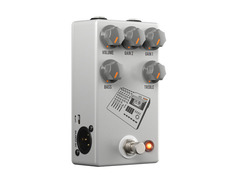
The 424 Gain Stage gives all the elastic, lo-fi tone you get from plugging a guitar rig straight into a TASCAM® Portastudio® 424. Now in pedal form, you can easily integrate the rubbery clean tones, high head room, and smashed out fuzz that’s being repopularized by today’s emerging guitarists.
And yes, it does the Mk.Gee “thing!” It also ventures well beyond, covering all types of bedroom pop and direct-in tones from emerging artists like D4vd, Steve Lacey, Malcolm Todd, and Omar Apollo, as well as mainstays like Mac Demarco, Spoon, and Radiohead.
The original Portastudios® were made famous in the ‘80s and ‘90s, and gave us the ability to bring our songs to life from the comfort of our cluttered bedrooms. These multi-track recorders meant for home studios found their way onto hit records like Springsteen’s Nebraska, the Wu-Tang Clan’s Enter the Wu-Tang, and Spoon’s Gimme Fiction. Many of the vocal parts and fuzzy guitar tracks on Gimme Fiction – a huge inspiration for the creation of the Colour Box – were actually recorded on a Portastudio®. Since hearing those recordings, the 424 Gain Stage has been brewing in the background, and now we’re proud to bring it to you.
In this historically accurate recreation, we perfectly replicated the original 424 MKI® circuit using the original UPC4570 and NJM4565 op-amps and all the original controls, which is crucial for recreating the unique character that makes the old units sound so good. The Portastudio’s® gain controls–trim, channel volume, & master volume–all work in tandem for dialing up your desired tone and can be further refined with the Low and High EQ settings. In addition, our unit offers a ¼” output alongside a balanced XLR output (DI out) for ultimate flexibility in any situation, live or studio.
The 424 Gain Stage as a DI
Going DI will give you the exact same unparalleled gooey texture and lo-fi fuzz you get when plugging directly into a 424® without the hassle of dragging around your beloved Portastudio®. Leave it on your recording desk for easy access. If you want to get fancy, you can toss an Active A/B/Y switcher at the end of your rig and send the A output to your amp and the B output to the JHS 424 Gain Stage input, then XLR output of the pedal directly into your mixer or interface. This way, you can flip between your amp and the 424 Gain Stage easily or play through both at the same time. Give it a try!
The 424 Gain Stage with an Amp
Plugging a Portastudio® into your amp is quite a feat. In this pedal format, you can easily integrate the tone of the 424 with the saturation of your favorite amp. This adds a whole new quality to the tone and gives the ability to stack it with your other pedals. Use it as a gain stage to boost your signal, a unique and colorful new overdrive sound, or push the gain knobs into full-on overloaded and broken fuzz.
CONTROLS:
VOLUME (Corresponds to Portastudio® Master) - Controls the output volume. Left is less, right is more. On the Portastudio 424, this is the MASTER fader.
GAIN 1 (TRIM) - Sets how much preamplification will be added to the input signal. On the Portastudio 424, this is the TRIM control.
GAIN 2 (CHANNEL) - Sets the volume level of the second gain stage. On the Portastudio 424, this is the CHANNEL fader.
BASS - Cuts or boosts bass frequencies. Left is less, right is more.
TREBLE - Cuts or boosts the treble frequencies. Left is less, right is more.
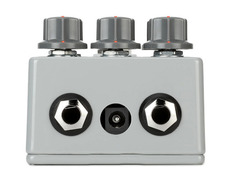
INPUT - Top ¼” right jack.
OUTPUT - Top ¼” left jack.
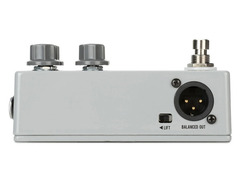
XLR OUTPUT - XLR jack on the left side of the pedal. This is a balanced output which can be used as a direct-out straight into a mixer or interface. The 1/4” output and XLR output can be used simultaneously.
GROUND LIFT - Dip switch on the left side of the pedal. If you experience a hum/buzz while using the XLR output, use this switch to lift the ground.
POWER - Requires 9VDC center negative power and consumes 50mA.
The 424 Gain Stage is silent, soft touch switching with a buffered bypass.
THIS PEDAL MEASURES 2.6” X 4.8” X 1.6” AND CONSUMES 50MA. DO NOT USE MORE THAN 9VDC. DAMAGE MAY OCCUR AND YOUR WARRANTY WILL BE VOIDED.
THE JHS PEDALS 424 GAIN STAGE IS IN NO WAY AFFILIATED WITH OR ENDORSED BY TASCAM®
TASCAM AND PORTASTUDIO ARE REGISTERED TRADEMARKS.
Videos

JHS Pedals
JHS 424 Gain Stage: The Iconic Portastudio® Sound in a Pedal!

JHS 424 Gain Stage: The Iconic Portastudio® Sound in a Pedal!
JHS Pedals
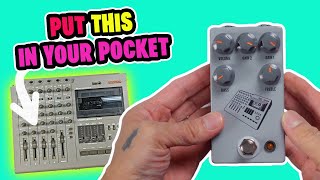
JHS 424 Gain Stage | Tascam Portastudio Preamp

R.J. Ronquillo
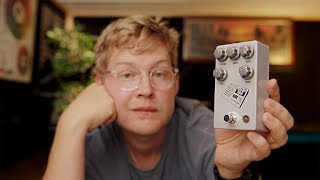
The sound we’ve been avoiding for years (JHS 424 Gain Stage)

Eirik Stordrange
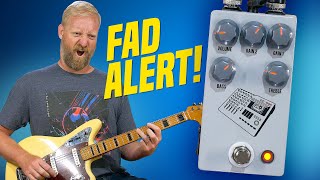
FAD ALERT! - Is the "Tascam Sound" the hot new thing? - JHS 424 GAIN STAGE

60 Cycle Hum
Reviews
Owner Insights
We analyzed real musician discussions from forums and Reddit to find what players love, question, and tweak about JHS 424 Gain Stage.
Comparisons
-
AionFX offers a PCB clone of the 424 preamp for DIY enthusiasts, providing a cheaper alternative to the JHS 424 Gain Stage.
Source -
While it suits indie or bedroom pop sounds, it’s less ideal for general rock or alt-rock, where its distinct sound might not fit all styles.
Source -
The Templo Reel Dealuxe offers modulation features like phase and vibrato, differentiating it from the JHS 424 Gain Stage which focuses on the preamp effect.
Source -
The JHS 424 Gain Stage is compared to the MXNHLT Porta424, which lacks an XLR output but is noted as an alternative.
Source
User experience
-
It's been noted that using the pedal through a Focusrite 18i20 and KRK V6 Series 1 monitors produces excellent results, enhancing its appeal for studio use.
Source -
Owners report it as one of the quietest drives, even when used direct via XLR out, with no noticeable extra hum compared to other overdrive pedals.
Source -
Some users highlight its utility for creating a dirty DI for blending or further processing when placed early in the signal chain.
Source
Use cases and applications
-
The pedal effectively captures Mk.Gee's tones, even when based on a MK1 unit, which Mk.Gee originally used.
Source -
It excels in shoegaze and dream pop, providing a great lo-fi distortion when paired with pedals like the DOD or Hizumitas and chorus.
Source -
Owners have mentioned it as a bass DI option, offering a different preamp flavor compared to the JHS Colour Box.
Source -
It's noted that using the JHS 424 Gain Stage at the end of a chain can replicate Tascam 424 saturation before hitting a recording interface.
Source -
Users interested in lo-fi, indie rock tones, akin to artists like Mk.Gee, find the pedal particularly appealing for capturing that specific sound.
Source -
Some users consider the JHS 424 Gain Stage for acoustic DI purposes, leveraging its XLR out for live performances.
Source
Value and pricing
Features and functionality
-
The XLR out can serve as a second output to a mixer or audio interface, offering a direct-in tone.
Source -
The JHS 424 Gain Stage includes an XLR output, which is particularly useful for live performances or direct recording applications.
Source -
The JHS 424 Gain Stage includes top-mounted input jacks, facilitating easy placement on pedalboards.
Source
Critic Reviews
Based on 0 Reviews and 0 Ratings
Artist usage
Add artist

In this Instagram post from JHS Pedals, John Mayer demos the new JHS 424 Gain Stage.
.jpeg?v=1784831401)

Genre Usage
Based on how artists on Equipboard use this gear, it is most commonly found in the following genres.
Used With
Based on how musicians on Equipboard use JHS 424 Gain Stage, it is most commonly used with the following gear.


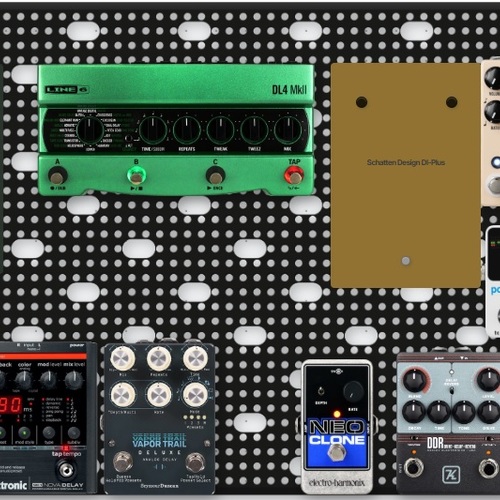
Community setups
Show yours
Similar
Add recommendation1 alternative for JHS 424 Gain Stage, curated by the Equipboard community.

$650.00
More JHS Guitar Preamp Pedals

$399.00 - $449.00
in Guitar Preamp Pedals Rank


$392.36 - $449.00
in Guitar Preamp Pedals Rank


$444.00 - $449.00
in Guitar Preamp Pedals Rank


$27.99 - $39.99
in Guitar Preamp Pedals Rank


$249.00 - $283.00
in Guitar Preamp Pedals Rank


$315.00 - $329.00
in Guitar Preamp Pedals Rank

.png?v=1784782055)


$255.00 - $359.95
in Guitar Preamp Pedals Rank


$229.99 - $315.99
in Guitar Preamp Pedals Rank


$799.00
in Guitar Preamp Pedals Rank


$749.00 - $849.00
in Guitar Preamp Pedals Rank

.jpg?v=1784793231)


$293.00 - $360.00
in Guitar Preamp Pedals Rank


$259.00 - $298.00
in Guitar Preamp Pedals Rank

$569.00 - $575.00
in Guitar Preamp Pedals Rank

$359.00 - $519.99
in Guitar Preamp Pedals Rank


$161.00 - $399.99
in Guitar Preamp Pedals Rank


$379.99
in Guitar Preamp Pedals Rank


$125.81 - $329.99
in Guitar Preamp Pedals Rank


$699.95 - $1,049.00
in Guitar Preamp Pedals Rank


$243.49 - $350.90
in Guitar Preamp Pedals Rank


$110.00
in Guitar Preamp Pedals Rank


$200.97
in Guitar Preamp Pedals Rank


$349.00
in Guitar Preamp Pedals Rank


$430.00
in Guitar Preamp Pedals Rank


$139.32 - $199.00
in Guitar Preamp Pedals Rank


$599.00 - $638.00
in Guitar Preamp Pedals Rank

$39.95 - $49.00
in Guitar Preamp Pedals Rank

$149.99 - $259.99
in Guitar Preamp Pedals Rank


$425.00
in Guitar Preamp Pedals Rank


$399.00 - $439.00
in Guitar Preamp Pedals Rank


$146.20 - $155.08
in Guitar Preamp Pedals Rank

in Guitar Preamp Pedals Rank


$535.93 - $666.00
in Guitar Preamp Pedals Rank

$370.03 - $464.00
in Guitar Preamp Pedals Rank


in Guitar Preamp Pedals Rank

$333.00
in Guitar Preamp Pedals Rank

$597.00
in Guitar Preamp Pedals Rank


$287.00 - $329.00
in Guitar Preamp Pedals Rank


$89.00 - $169.00
in Guitar Preamp Pedals Rank
Gear Guides
.jpg)





Most Popular Guitar Preamp Pedals
Most Popular Brands
-
Added to Equipboard on by
 sprucebringsteen
GearIQ 28756
-

