This page about Lorre Mill Double Knot is a stub. You can help improve it:


Pricing and availability




* Product prices and availability are updated by Equipboard every 24hrs and are subject to change. Equipboard may receive compensation for purchases made at participating retailers linked on this site. This compensation does not affect what products or prices are displayed, or the order of prices listed. For more information, please refer to our affiliate disclosure.
Description
Double Knot is an all analog synthesizer which is both sequencer and voice. It can be thought of as something of an indeterministic "groovebox". A stereo instrument with two identical voices that can give different rhythms, melodies or cross timbral slaps. The idea of this instrument is to invite reconciliation of linear and nonlinear systems, and to encourage the building of multiple-feedback synthesis architectures. User interface is with rotary potentiometers, switches, and banana cables. Patching puts are banana ports of round brass tube. Clock in and out are 3.5mm jacks bearing 5V square waves. Audio output is stereo 3.5mm line out.
Oscillators
The oscillators are triangle/square wave oscillators with very wide range that runs from around 0.8hz to around 20khz. Each oscillator has inputs for sync and exponential frequency modulation w/ attenuverter. There are square and triangle outputs.
FM
The FM section allows triangle outputs of each oscillator to modulate the opposite oscillator in a linear way.
Three modes set by a toggle switch are 1>2, 2>1, and circularly 1>2>1>2>1...
Also part of the FM section is a depth knob that doubles as a depth attenuator when a signal is plugged in to the FM cv tube
With the depth knob at around 2 o-clock there will be the clear triangle of one oscillator presented to the opposite oscillator. Clockwise past that, the triangle begins clipping and ends up more square at the full clockwise position.
Sequencers
The two identical sequencers are 8 stage shift registers with the first four outputs R2R dac'd (of Rob Hordijk rungler concept) and subsequent outputs available as logics for recirculation or sending as cv. (Please note! If you use one of these last four outs to loop the register, stacking other puts on top of this connection can alter the data in the register!)
Inputs to this section are clock input, which is normaled to the reg out of the clock, and data input which feeds bits of data along the shift register.
Red and grey buttons allow for data entry or erasure, if the sequencer is looping these entries will circulate... If the sequencer is fed by a square from either oscillator the buttons will null incoming data or hold the input high...
Keep in mind the clock input is a very sensitive put and if a cable with a loose opposite end is plugged into the port this will open up the clock put to the clock of the air around you and your skin, noise and 60hz hum
Envelopers
These are zero-attack, voltage controlled decay linear envelopers that allow percussively shaped sounds triggered by the shifting of bits in the shift registers.
The trigger input of each enveloper is internally tied to the first output of the shift register. At first glance, this may seem limiting, but you'll find that you can trigger the envelope whenever you want, by just filling up the shift register full of high bits, and using the clock input...
With these envelopers, the more CV the shorter the decay, this allows for output to be patched back into cv input for log curves. Also if envelope decay is modulated by the same signal as pitch of oscillator, higher pitches will have shorter decay.
There is a "fill" input which is attached through a resistor to the slewing capacitor of the enveloper, essentially allowing a superimposed style of amplitude control. To read an article on the enveloper design, follow this link to my blog post.
Clock
The clock uses the VCO section of the 4046PLL chip. This is a voltage controlled clock with a clearly square, nearly exactly 50% dutycycle output.
The controls and puts for this section include pitch knob, sync input, CV input and attenuverter, "reg" and "inv" clock outputs.
Product specs
| Analog/Digital | analog |
Videos

Allieway Audio
Lorre-Mill Double Knot (in-depth overview / demo)
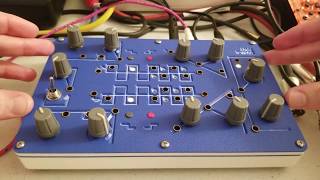
Lorre-Mill Double Knot (in-depth overview / demo)
Allieway Audio
double knot teaser

Will Schorre
Cybernetics VII.5 - Interference and Rungling

La Synthèse Humaine
double knot surveys
Will Schorre
Reviews
Based on 0 Reviews and 0 Ratings
Artist usage
Add artist
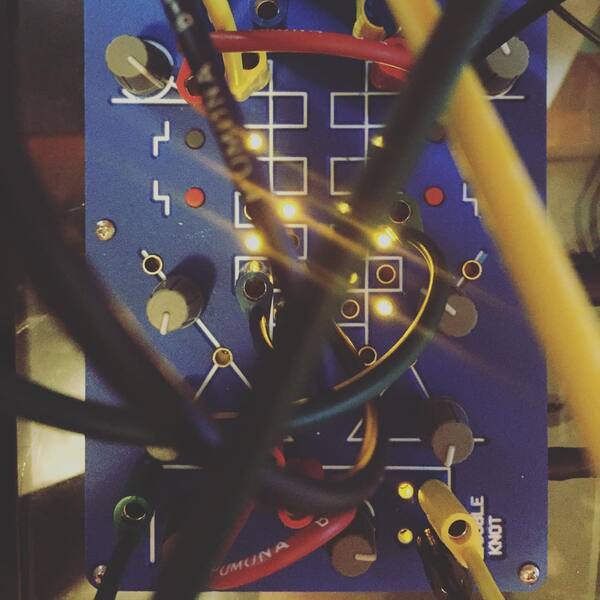
Appears in Instagram posts dated:
May 19, 2017
got me a new toy 🎛🎨🎛 #doubleknot
Genre Usage
Based on how artists on Equipboard use this gear, it is most commonly found in the following genres.
More Lorre Mill Synthesizers


$3,283.92 - $3,499.99
in Synthesizers Rank


$469.00 - $699.99
in Synthesizers Rank


$19,535.25
in Synthesizers Rank


$999.00 - $1,084.00
in Synthesizers Rank


$3,216.54 - $3,499.99
in Synthesizers Rank


-m.webp?v=1783177119)
$1,200.00
in Synthesizers Rank


$439.00 - $543.00
in Synthesizers Rank
.jpg?v=1783265555)

-m.webp?v=1783422560)
$379.00 - $499.99
in Synthesizers Rank


$752.32 - $2,398.00
in Synthesizers Rank


$277.00 - $349.00
in Synthesizers Rank


$2,000.00
in Synthesizers Rank


$411.00 - $699.99
in Synthesizers Rank


$2,432.00 - $2,870.95
in Synthesizers Rank


$1,470.85 - $1,899.00
in Synthesizers Rank


$299.29 - $652.00
in Synthesizers Rank


$379.00 - $530.00
in Synthesizers Rank


$1,361.33 - $1,839.99
in Synthesizers Rank


$220.00 - $749.99
in Synthesizers Rank


$493.48 - $899.99
in Synthesizers Rank

$279.00 - $449.99
in Synthesizers Rank


$289.66 - $1,763.18
in Synthesizers Rank


$57.95 - $495.44
in Synthesizers Rank


$325.00 - $1,332.49
in Synthesizers Rank

-m.webp?v=1783427910)
$1,709.10 - $1,899.00
in Synthesizers Rank


$397.06 - $699.00
in Synthesizers Rank


$499.99 - $719.99
in Synthesizers Rank


$309.99 - $915.00
in Synthesizers Rank


$3,999.00 - $4,999.00
in Synthesizers Rank


$1,469.00 - $2,159.99
in Synthesizers Rank
.jpeg?v=1783389560)

$290.00
in Synthesizers Rank


$479.99 - $1,099.00
in Synthesizers Rank


$166.00 - $299.00
in Synthesizers Rank


$627.41
in Synthesizers Rank


$383.00 - $449.99
in Synthesizers Rank


-m.webp?v=1783349880)
$956.53
in Synthesizers Rank

$29.95 - $69.99
in Synthesizers Rank


$6,600.00 - $10,444.00
in Synthesizers Rank


$735.79
in Synthesizers Rank


Community setups


Similar


Gear Guides









Most Popular Synthesizers
Most Popular Brands
-
Added to Equipboard on by
 eyeseeofficial
Gear IQ 161563
-


