

Pricing and availability
We compare 600+ stores and found this item at 1 store. Prices updated .
Store
Reviews
Price




Average Price: $127
Standard/Professional
$80
$181+
Price Tier
Budget
Standard
High-end
* Product prices and availability are updated by Equipboard every 24hrs and are subject to change. Equipboard may receive compensation for purchases made at participating retailers linked on this site. This compensation does not affect what products or prices are displayed, or the order of prices listed. For more information, please refer to our affiliate disclosure.
Description
An all-analog boost, overdrive, and fuzz in one convenient box.
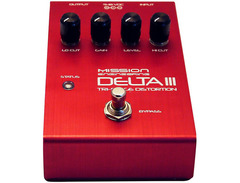
The Mission Delta III is a flexible distortion pedal capable of a wide range of tones from boost, through TS style overdrive to fuzz. Delta III features a three-transistor, all-analog audio circuit, and quiet, digital switching. A high-quality output buffer ensures compatibility with other pedals making Delta III a fuzz pedal that’s usable in just about any rig.
The basis of the pedal is a three-transistor distortion circuit. The third transistor forms an output buffer that improves compatibility with other pedals, allowing the Delta III to be used with a wide variety of instruments and signal chains. Unlike many distortion boxes, the Delta III is not overly sensitive to where it is placed on your pedal board and can be used with active pickups, basses, and with buffered pedals. The voltage bias of the transistors has been adjusted for optimal response as the signal decays, allowing smooth distortion sounds even from very high or low signal inputs.
The Delta III has two separate EQ controls creating a huge tone-shaping capability. The Lo Range EQ control allows you to fatten up the fuzz tone without getting too flubby. The Hi Range control will let you roll off some of the high end to prevent harshness. Proper adjustment of these two controls allows a very wide choice of sounds from full frequency response to a mid-range lead boost.
The Delta III is very touch sensitive, cleaning up with reduced volume or pick attack, and more aggressively clipping as you play harder. It has also been designed to work with the fuzz compatible Mission VM-PRO and V-BOOST pedals in front, allowing you to create pedal controlled variable distortion.
The gain knob controls the character of the distortion:
Off position – The pedal behaves as a boost. Use volume and EQ controls to set boost parameters.
Mid range – TS style overdrive and crunch tones.
High positions – Fuzz tones.
The microcontroller managed relay bypass system provides soft-touch on/off with fast and quiet switching operation. Engaging and bypassing the effect happens in a few milliseconds. The soft touch switch is much quieter than a typical latching switch, so no nasty clicks and pops when you turn the effect on and off. Digital switching is also much more reliable ensuring your pedal will continue to consistently switch for many years to come.
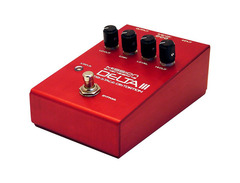
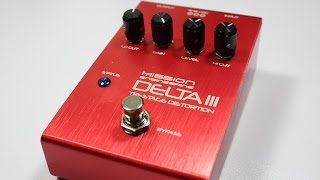
Delta III features a red anodized aluminum chassis weighing just 12 oz., top mounted jacks for easy pedal board setup, four aluminum knobs for volume, gain, Lo EQ and Hi EQ, and a blue status LED.
Product specs
| Brand | Mission Engineering |
| Model | Delta III Tri-stage Distortion |
| Year | 2010s |
| Made In | United States |
| Categories | Distortion Pedals |
FAQs
-
What makes the Mission Engineering Delta III Tri-Stage Distortion unique compared to other distortion pedals?
-
The Delta III features a tri-stage distortion circuit, offering a wide range of distortion tones from subtle overdrive to aggressive fuzz, making it versatile for various musical styles.
-
Is the Mission Engineering Delta III suitable for both rhythm and lead guitar playing?
-
Yes, the Delta III's tri-stage design allows it to handle both rhythm and lead guitar tones effectively, providing clarity and sustain for solos while maintaining punch and definition for rhythm parts.
-
Does the Mission Engineering Delta III work well with both single-coil and humbucker pickups?
-
The Delta III is designed to perform well with both single-coil and humbucker pickups, delivering consistent tone and response regardless of pickup type.
-
What power supply is required for the Mission Engineering Delta III Tri-Stage Distortion?
-
The Delta III requires a standard 9V DC power supply with a center-negative plug, which is common for most guitar pedals.
-
Can the Mission Engineering Delta III be used in a live performance setting?
-
Yes, the Delta III is built for durability and reliability, making it suitable for live performances where consistent tone and robust construction are essential.
Videos

Sweetwater
Mission Engineering Delta III Tri-stage Distortion Pedal Review by Don Carr
Mission Engineering Delta III Tri-stage Distortion Pedal Review by Don Carr
Sweetwater
NAMM '15 - Mission Engineering Delta III Tri-Stage Distortion Demo

Premier Guitar
Mission Engineering DELTA III Tri-Stage Distortion demo by Lance Seymour

Lance Seymour
Mission Engineering Delta III Demo and Review

Mobius Guitars
Mission Engineering DELTA III Distortion demo with PureSalem JIMMY guitar

gearmanndude
Reviews
Critic Reviews
Based on 0 Reviews and 0 Ratings
More Mission Engineering Distortion Effects Pedals
-m.webp?v=1783263522)
$79.00 - $89.00
in Distortion Effects Pedals Rank


$77.00 - $109.99
in Distortion Effects Pedals Rank


-m.webp?v=1783263637)
$139.00 - $159.99
in Distortion Effects Pedals Rank


-m.webp?v=1783249357)
$219.00 - $261.00
in Distortion Effects Pedals Rank


-m.webp?v=1783263733)
$109.00
in Distortion Effects Pedals Rank


$129.00 - $154.00
in Distortion Effects Pedals Rank


.jpg?v=1783256553)

$206.39 - $259.00
in Distortion Effects Pedals Rank


$41.00 - $62.90
in Distortion Effects Pedals Rank


$73.58
in Distortion Effects Pedals Rank


$212.64 - $249.00
in Distortion Effects Pedals Rank


-m.webp?v=1783249283)
$77.97 - $99.99
in Distortion Effects Pedals Rank


$280.00
in Distortion Effects Pedals Rank


$96.91 - $122.00
in Distortion Effects Pedals Rank


$99.00 - $139.99
in Distortion Effects Pedals Rank


$54.99 - $74.00
in Distortion Effects Pedals Rank


$93.60 - $120.99
in Distortion Effects Pedals Rank


$99.48 - $125.99
in Distortion Effects Pedals Rank


$122.00 - $199.99
in Distortion Effects Pedals Rank

$88.00 - $604.00
in Distortion Effects Pedals Rank


$92.00 - $108.90
in Distortion Effects Pedals Rank


$200.00 - $227.00
in Distortion Effects Pedals Rank


$92.82 - $199.99
in Distortion Effects Pedals Rank


$89.10 - $125.99
in Distortion Effects Pedals Rank


$183.20 - $229.00
in Distortion Effects Pedals Rank


-m.webp?v=1783263930)
$90.00 - $99.99
in Distortion Effects Pedals Rank


$88.00 - $105.99
in Distortion Effects Pedals Rank


$38.79 - $48.00
in Distortion Effects Pedals Rank


$195.00 - $199.00
in Distortion Effects Pedals Rank


$85.00 - $120.99
in Distortion Effects Pedals Rank


$249.00
in Distortion Effects Pedals Rank


-m.webp?v=1783177073)
$179.12
in Distortion Effects Pedals Rank


$227.36
in Distortion Effects Pedals Rank


$140.00 - $179.99
in Distortion Effects Pedals Rank


$45.00
in Distortion Effects Pedals Rank


$93.00 - $175.00
in Distortion Effects Pedals Rank


$78.00 - $124.00
in Distortion Effects Pedals Rank


$43.99
in Distortion Effects Pedals Rank


$75.39 - $159.95
in Distortion Effects Pedals Rank


$147.15 - $164.99
in Distortion Effects Pedals Rank
.jpg?v=1783214872)


$155.24
in Distortion Effects Pedals Rank


Accessories & Related Items


Artist usage


Community setups


Similar


Gear Guides
.jpg)





Most Popular Distortion Effects Pedals
Most Popular Brands
-
Added to Equipboard on by
 michael
Gear IQ 42641
-


