

Pricing and availability
We compare 600+ stores and found this item at 1 store. Prices updated .




Average Price: $865
High-end/Boutique
$150
$601+
Price Tier
Budget
Standard
High-end
* Product prices and availability are updated by Equipboard every 24hrs and are subject to change. Equipboard may receive compensation for purchases made at participating retailers linked on this site. This compensation does not affect what products or prices are displayed, or the order of prices listed. For more information, please refer to our affiliate disclosure.
Description
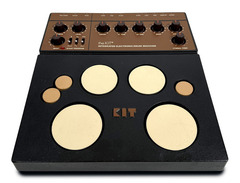
MPC Electronics have produced a stylish, compact and probably highly popular update of the much older original Kit design, which has attracted a lot of attention over the last couple of months. Whether it will be capable of replacing a full-scale electronic or acoustic drum kit, or whether conventional rhythm machines will remain more popular, has yet to be seen. To MPC's credit they are not resting on their laurels, and have now brought out a range of additions to the basic Kit design.
The machine is a response to complaints that conventional rhythm boxes, whether preset or programmable, lack variation and the 'human touch'. The kit, then, is played by hand, or more specifically with the fingertips of one or both hands. The playing surfaces are small fablon-covered circles, of 7½cm diameter (bass drum and snare) or 6cm diameter (high and low toms), or polished golden metal buttons of 2cm diameter (crash/ride cymbal, open and closed high-hat).
Piezo pickups & circuitry.
The larger pads are mounted over piezo pickups which produce a voltage when struck, the edge of which triggers the sound generating oscillators with a degree of force-to-volume sensitivity. The cymbals are on micro-switches which aren't force sensitive, and have quite a different feel requiring a different playing technique. Like any other instrument this is a matter of practice, the predictable penalty for the extra expressiveness of which the Kit is capable.
The high-hat can be set to play automatically. Three very small toggle switches control stop/start, 4:4/3:4 and 8 beat/4 beat/disco beat. There's a 6-position rotary switch giving a total of 36 high-hat patterns, most of which use only the closed setting with a rare open high-hat thrown in. How easy it is to follow these patterns is open to question — in a live situation the sound may be quite lost, although there's always the possibility of taking a headphone monitor from the high-hat only socket on the back panel. A programmed bass drum might have been more useful.
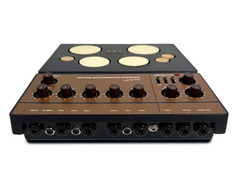
The sounds are individually mixable using front panel controls, and there's a tone control for the crash/ride cymbal. Each instrument has a ¼inch individual output on the back panel, and the mix output acts as the power on/off switch. The back panel also carries a mini-jack for external 9V power supply, an alternative to an internal PP3 cell which can give 50 hours of operation.
Rear panel.
Also on the rear panel are two mini-jack Trigger Out sockets, operating on the high and low toms to activate additional units, and a footswitch socket. The optional footswitch acts as an on/off control for the automatic high-hat and a bass drum pedal which works in addition to the panel mounted pad.
Underneath there are eleven preset resistors which alter pad sensitivity and drum ring/decay for the bass, toms and snare, cymbal pitch and decay, and snare noise. These allow the user to perfect his imitation of a conventional kit, or to tailor the sound to his own requirements. The toms can be adjusted to a point just short of oscillation, and the cymbal pitch can be adjusted from crash to ride or well beyond either.
The sound can be very authentic given a wide-range amplification system, but certainly isn't consistent. The bass drum is fine, with a good choice from a tight thump to quite a loose sound, although it's just a basic low-pitched oscillator thump. The cymbal is excellent, with six detuned oscillators providing a metallic ring-modulator noise, but the toms are fairly ordinary. The high-hat does its job but hasn't had as much effort put into it as the cymbal — it's basically just a chiff or a sustained burst of pink noise.
Internal circuitry.
In use, the Kit can be quite versatile or slightly frustrating. Despite the beat indicator LED it takes some time to learn to follow the auto high-hat, and although anybody can produce a few authentic drumbeats it takes a degree of co-ordination to turn out a professional rhythm track.
In some ways it's more comfortable to use the machine with a pair of ball-point pens or chopsticks (drumsticks being much too heavy) although in this case it's very difficult to use the cymbal pads as they're too small to hit. The instruction book has some useful hints for playing style, and without doubt it is possible to become quite skilled with the machine, but it's all a matter of time and practice.
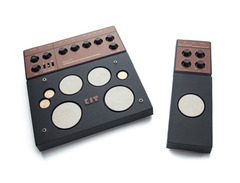
In addition to the footpedal there are three matching units also available, 'The Synkit' (with volume, decay, pitch and sweep controls for syndrum sounds) 'The Clap' (for white noise effects from gunshots to handclaps) and 'The Tymp' (for tuned timpani sounds). Each of these units has a single 6cm pad and can be used independently or triggered from The Kit.
As 'a new concept in drumming' The Kit may have some way to go, but it's a brave concept and one which, to its credit, is infinitely expandable and adaptable.
Owner's manual
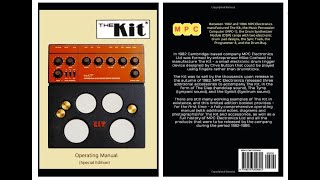
MPC Electronics The Kit User ManualVideos

Watchdog Video
MPC The Kit Part 1 - Trashbay!
MPC The Kit Part 1 - Trashbay!
Watchdog Video
MPC Electronics The Kit The Clap The Synkit - vintage electronic drums

Momtnz
MPC The Kit Part 2 - Trashbay!
Watchdog Video
Reviews
Critic Reviews
Based on 0 Reviews and 0 Ratings
Genre Usage
Based on how artists on Equipboard use this gear, it is most commonly found in the following genres.
More MPC Electronics Drum Machines

-m.webp?v=1784559385)
$4,599.00
in Drum Machines Rank


$659.00 - $899.99
in Drum Machines Rank


-m.webp?v=1784645974)
$77.53
in Drum Machines Rank


$274.34
in Drum Machines Rank


-m.webp?v=1784645890)
$4,699.00
in Drum Machines Rank


-m.webp?v=1784645894)
$119.99 - $159.99
in Drum Machines Rank


$215.00 - $1,073.79
in Drum Machines Rank


$1,600.00
in Drum Machines Rank


$347.00 - $494.99
in Drum Machines Rank


$89.46 - $2,199.00
in Drum Machines Rank


$399.00
in Drum Machines Rank


$47.00 - $59.00
in Drum Machines Rank


$118.75 - $159.00
in Drum Machines Rank

.png?v=1784615088)

$1,649.00
in Drum Machines Rank


$499.00
in Drum Machines Rank


$269.99
in Drum Machines Rank
.png?v=1784579347)

-m.webp?v=1784646463)
$399.00
in Drum Machines Rank


-m.webp?v=1784646462)
$244.00 - $299.00
in Drum Machines Rank


$289.85
in Drum Machines Rank


$330.00
in Drum Machines Rank


$109.99 - $159.99
in Drum Machines Rank


$561.78
in Drum Machines Rank

-m.webp?v=1784559441)
$100.00
in Drum Machines Rank


$109.64
in Drum Machines Rank


$152.10
in Drum Machines Rank


$237.00 - $339.00
in Drum Machines Rank


$82.86
in Drum Machines Rank


$3,600.00
in Drum Machines Rank

$69.99 - $129.53
in Drum Machines Rank


$119.99 - $159.99
in Drum Machines Rank


$833.00 - $1,149.00
in Drum Machines Rank


$218.55 - $328.00
in Drum Machines Rank


$19.99 - $1,969.00
in Drum Machines Rank


$125.50 - $149.00
in Drum Machines Rank


$17.89
in Drum Machines Rank


$349.99 - $1,099.00
in Drum Machines Rank


$347.50 - $453.99
in Drum Machines Rank


$1,000.00
in Drum Machines Rank


$170.00
in Drum Machines Rank


Artist usage


Community setups


Similar


Gear Guides





Most Popular Drum Machines
Most Popular Brands
-
Added to Equipboard on by
 hashimoto
GearIQ 14876
-


